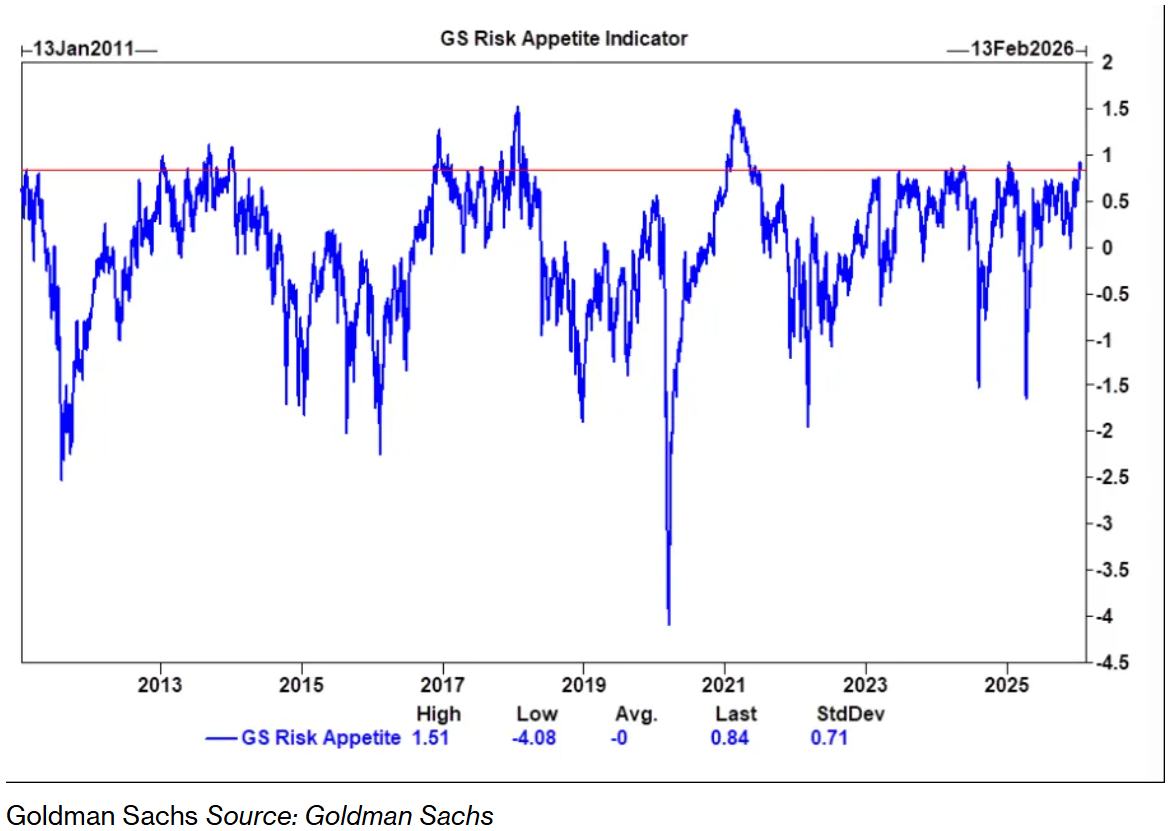
风险偏好指标

Search documents
高盛风险指标飙升至历史高位!华尔街陷入“极度亢奋”,是增长繁荣还是见顶前奏?
智通财经网· 2026-01-15 03:33
Group 1 - Goldman Sachs clients' optimism has surged to its highest level in about a year, driven by confidence in global growth outweighing geopolitical and macroeconomic concerns [1] - The firm's "risk appetite indicator" has risen to its highest point since early 2025, positioned at the 96th percentile historically [1] - Goldman Sachs' managing director, Lee Koppesmith, noted that while increased risk appetite is often seen as a sign of investor exuberance, the current growth momentum in the U.S. and other regions may support a bullish outlook [1] Group 2 - The S&P 500 index has risen approximately 0.7% in 2026, maintaining a position near historical highs, aligning with Wall Street strategists' optimistic views for strong performance this year [3] - Geopolitical concerns have recently impacted the market, with the benchmark index dropping about 1% due to worries over potential U.S. actions against Iran [3] Group 3 - Goldman Sachs reported a significant jump in indicators measuring global growth optimism, with investors showing a preference for stocks over bonds and cyclical stocks over defensive ones, alongside narrowing credit spreads and rising inflation expectations [4] - This shift is particularly evident in U.S. cyclical sectors, indicating strong confidence in growth, with small-cap stocks outperforming the S&P 500 for nine consecutive trading days, matching the longest winning streak since the financial crisis [4] Group 4 - Other sentiment indicators also reflect similar bullishness, with Goldman Sachs' Marquee client survey showing bullish sentiment levels not seen in the past decade, occurring only three other times [4] - In two of those instances, the market experienced a pullback within three months [4] Group 5 - A key distinction this time is the broadness of positions, with about 22% of respondents still identifying as bearish, indicating that while positive sentiment is high, it has not reached a dangerously one-sided state [6]


“从ICU到KTV”后,下半年挡在美股牛市前方的三大风险
Hua Er Jie Jian Wen· 2025-07-10 04:07
Core Viewpoint - Goldman Sachs warns investors to be cautious of three "bear market" risks in the second half of the year, despite a rapid reallocation to risk assets in Q2, which has led to a return to a "golden girl" scenario pricing [1] Group 1: Key Risks - **Risk 1: Growth Shock** Economic growth may face significant downward pressure in the second half, particularly due to anticipated tariff impacts. The probability of a substantial market pullback is currently higher than that of a significant rise, driven by high valuations, weak leading indicators, and a slight deterioration in the business cycle score [2] - **Risk 2: Interest Rate Shock** Unexpected fluctuations in interest rates pose a second risk. If tariffs do not lead to a slowdown, inflation may rise again, exerting upward pressure on bond yields. The report suggests that long-term bond yields may decline moderately due to a more dovish Fed, but concerns over fiscal policy and rising yields in Europe and Japan could limit this downward space [3] - **Risk 3: Weak Dollar** A continued decline in the dollar may negatively impact multi-asset portfolios denominated in dollars. The report predicts further depreciation of the dollar over the next 12 months, reflecting concerns over fiscal policy and the independence of the Fed [4][5] Group 2: Investment Strategies - **Diversification Strategies** Investors are advised to reassess stock allocations, particularly in multi-asset portfolios dominated by U.S. assets. Diversification through low-volatility stocks, defensive quality stocks, and gold is recommended to mitigate potential losses from growth shocks [2] - **Short-Duration Bonds** To reduce duration risk, investors are encouraged to favor short-duration bonds. Financial stocks, such as bank stocks, may serve as effective hedges against interest rate shocks due to their ability to benefit from a steepening yield curve [3] - **Emerging Markets and Currency Hedging** In a weakening dollar environment, emerging market equities and local currency bonds are expected to perform better. Investors should consider currency hedging and allocating to emerging markets and gold to lower dollar risk [5]