
食品安全法修正

Search documents
食品安全法修正草案通过 将加强 重点液态食品道路散装运输监管
Yang Shi Xin Wen Ke Hu Duan· 2025-09-13 01:55
Core Viewpoint - The National People's Congress Standing Committee has passed amendments to the Food Safety Law, effective December 1, 2025, to address new challenges in food safety and enhance regulatory frameworks [1][2]. Background and Significance - Food safety is a critical public health issue, impacting the health and safety of the population. The Food Safety Law was first enacted in 2009 and has undergone several revisions to adapt to evolving challenges in the food sector [2]. - The amendments were included in the legislative work plan for 2025, with the State Council submitting a proposal for review in June 2025. The amendments focus on key issues such as the regulation of liquid food transportation and infant formula liquid milk [2]. Principles of the Amendment - The amendments adopt a "small cut" approach, focusing on specific food safety issues to improve legal frameworks and address regulatory gaps [3]. - The amendments emphasize the importance of balancing development and safety while clearly defining the scope of applicable licenses [4]. - Increased penalties and strict legal responsibilities are established for violations related to food safety [5]. Main Content of the Amendment - The amendment includes three main articles affecting five existing provisions of the Food Safety Law, focusing on two key areas: - **Regulation of Liquid Food Transportation**: - Licensing is required for the transportation of key liquid foods, with specific requirements for containers, personnel, and management systems [6]. - Obligations for shippers, receivers, and transport operators are clearly defined, including the prohibition of transporting non-food items [6][7]. - Strict legal responsibilities are established for violations related to transportation records and container cleaning [8]. - **Registration Management for Infant Formula Liquid Milk**: - The amendment incorporates "infant formula liquid milk" into the registration management system, aligning it with existing regulations for powdered infant formula [9]. Implementation Measures - The amended Food Safety Law will take effect on December 1, 2025, necessitating the development of supporting regulations [10]. - Key actions include: - Rapid formulation of specific management regulations for liquid food transportation and registration measures for infant formula liquid milk [10]. - Enhanced collaboration among enforcement agencies to improve regulatory effectiveness [10]. - Comprehensive legal education and outreach to ensure understanding and compliance among stakeholders and the public [10].
食品安全法修正草案通过 将加强重点液态食品道路散装运输监管
Yang Shi Xin Wen· 2025-09-12 13:58
Core Points - The National People's Congress Standing Committee approved amendments to the Food Safety Law, effective December 1, 2025, focusing on the regulation of liquid food transportation and the registration of infant formula liquid milk [1] Group 1: Regulatory Changes - The amendments include stricter regulations on the road transportation of key liquid foods, requiring operators to have specialized containers, trained personnel, and management systems to ensure food safety [1] - A licensing system will be implemented for the transportation of key liquid foods, mandating that operators obtain a permit for such activities [1] Group 2: Registration Management - The amendments introduce registration management for infant formula liquid milk, aligning it with the existing regulations for infant formula powder [1] - Producers of infant formula liquid milk must adhere to the registered product formulations and production processes, facing legal consequences for non-compliance [1]
食品安全法修正草案三审 增加规定伪造运输记录的法律责任
Zhong Guo Xin Wen Wang· 2025-09-08 02:36
食品安全法修正草案三审 增加规定伪造运输记录的法律责任 中新网北京9月8日电(记者 谢雁冰 曾玥)食品安全法修正草案8日提请十四届全国人大常委会三次审议。 修正草案三审稿对伪造、变造或者使用伪造、变造的运输记录、运输容器清洗凭证等单据,以及未履行 重点液态食品道路散装运输相关查验、核验义务的,增加规定相应法律责任。 修正草案三审稿规定,违反本法规定,伪造、变造或者使用伪造、变造的重点液态食品道路散装运输记 录、运输容器清洗凭证等单据,或者未履行重点液态食品道路散装运输相关查验、核验义务的,由县级 以上人民政府食品安全监督管理等部门按照各自职责分工责令改正,给予警告;拒不改正的,处一万元 以上十万元以下罚款。 修正草案三审稿还明确对道路运输经营者未按要求进行重点液态食品散装运输,且情节严重的行为,并 处五万元以上五十万元以下罚款。(完) 来源:中国新闻网 编辑:徐世明 广告等商务合作,请点击这里 本文为转载内容,授权事宜请联系原著作权人 中新经纬版权所有,未经书面授权,任何单位及个人不得转载、摘编或以其它方式使用。 关注中新经纬微信公众号(微信搜索"中新经纬"或"jwview"),看更多精彩财经资讯。 ...
食品安全法修正草案拟二审,规范重点液态食品道路散装运输
Di Yi Cai Jing· 2025-09-05 10:12
Core Viewpoint - The revised draft of the Food Safety Law focuses on addressing the regulatory gaps in the transportation of liquid food products, particularly the issues surrounding the transportation of edible oils in tankers, which have raised significant public concern [1][2]. Group 1: Legislative Changes - The draft proposes a licensing system for the transportation of key liquid foods, requiring operators to meet specific conditions and obtain a transport permit [2]. - Obligations are defined for shippers, receivers, and transport operators, including the requirement for transport operators to display special markings on containers and to ensure proper cleaning of transport containers [2]. - Strict penalties are established for violations, including fines ranging from 50,000 to 500,000 yuan for unauthorized transportation of key liquid foods [2]. Group 2: Regulatory Enhancements - The draft introduces a dynamic adjustment mechanism for the list of key liquid foods, allowing for responsive regulatory updates [3]. - It specifies penalties for severe violations of transportation requirements, enhancing accountability for transport operators [3]. - Additional legal responsibilities are outlined for actions such as falsifying transport records or failing to perform necessary checks [3].
食品安全法修正草案将二审 拟规范重点液态食品散装运输
Zhong Guo Xin Wen Wang· 2025-09-05 08:02
Core Viewpoint - The Food Safety Law amendment draft is set for a second review by the 17th meeting of the 14th National People's Congress Standing Committee, focusing on regulating the bulk transportation of key liquid foods [1] Summary by Relevant Sections Key Amendments - The draft proposes a dynamic adjustment mechanism for the directory of key liquid foods [1] - It targets specific issues related to road transport operators who fail to comply with bulk transportation requirements for key liquid foods, imposing fines for serious violations [1] - Legal responsibilities are added for actions such as forging or altering transportation records and cleaning certificates, as well as failing to fulfill verification obligations [1]
食品安全法修正草案拟提请二审
Yang Shi Xin Wen· 2025-09-05 07:31
Core Points - The National People's Congress Standing Committee is set to review the draft amendment to the Food Safety Law, which was initially examined in June 2025 [1] Group 1: Legislative Changes - A dynamic adjustment mechanism for the directory of key liquid foods is proposed [1] - Penalties will be imposed on road transport operators who fail to conduct bulk transportation of key liquid foods as required, particularly in severe cases [1] - Legal responsibilities will be added for actions such as forging or altering transport records and failing to fulfill verification obligations [1]
食品安全法(修正草案)征求意见
仪器信息网· 2025-06-28 11:02
Core Viewpoint - The article discusses the review and publication of the revised draft of the Food Safety Law of the People's Republic of China, emphasizing the importance of public feedback during the 30-day consultation period [1][2]. Group 1: Key Regulations on Liquid Food Transport - The revised law mandates that the sender must verify the transport operator's permit and the safety compliance of the transport containers for bulk liquid food [4]. - The receiving party is also required to check the transport operator's permit and the integrity of the transport container seals [4]. - Transport operators must prominently display special markings on transport containers and are prohibited from carrying substances other than food [4][8]. Group 2: Penalties for Non-compliance - Violations of the law regarding the transport of key liquid foods without a permit can result in fines ranging from 50,000 to 500,000 yuan [4][6]. - Non-compliance in food storage, transport, and handling can lead to warnings, business suspension, and fines between 10,000 and 50,000 yuan, with severe cases resulting in license revocation [5][6]. Group 3: Amendments to Infant Formula Regulations - The revised law includes provisions for infant formula liquid milk alongside powdered milk, requiring strict quality control from raw material intake to finished product delivery [8][9]. - Manufacturers of infant formula must register their product formulas with the relevant government authorities, ensuring compliance with safety standards [9][10]. Group 4: Responsibilities of Food Safety Supervisory Departments - The State Council's food safety supervisory department is tasked with formulating specific management regulations for the transport of key liquid foods [8]. - Provincial food safety supervisory departments are responsible for publishing registered health food and special medical purpose formula food lists, maintaining confidentiality of commercial secrets [10][11].


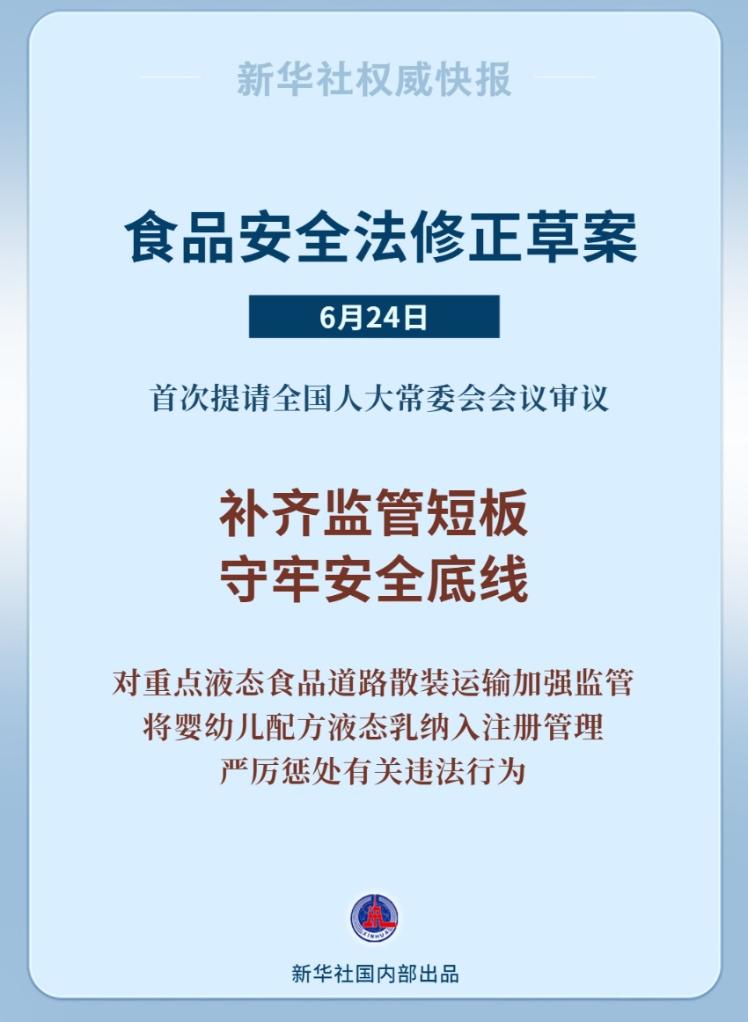
新华鲜报丨补监管短板!食品安全法“小切口”修改
Xin Hua She· 2025-06-24 11:17
Core Viewpoint - The proposed amendments to the Food Safety Law focus on enhancing regulatory measures for liquid food transportation and infant formula liquid milk, signaling a commitment to address regulatory gaps and ensure food safety [1][5][9]. Group 1: Regulatory Enhancements - A licensing system for the road transportation of key liquid foods will be implemented to address safety concerns, particularly in light of recent issues with the transportation of edible oils [6][7]. - The draft law aims to establish strict legal responsibilities for unauthorized transportation of key liquid foods and increase penalties for violations related to food storage, transportation, and handling [6][7]. Group 2: Infant Formula Liquid Milk Regulation - The amendment includes the registration management of "infant formula liquid milk," aligning it with existing regulations for "infant formula powder," in response to growing market demand and safety concerns [8]. - The draft law mandates that production companies adhere to registered product formulations and production processes, with legal consequences for non-compliance [8]. Group 3: Industry Context and Implications - The Food Safety Law, originally enacted in 2009 and revised multiple times, is being updated to address new challenges arising from the rapid development of the food industry [5][9]. - The amendments reflect a broader trend of increasing public concern for food safety and aim to bolster consumer confidence through enhanced legal frameworks [9].
《制造业绿色低碳三年行动方案》出炉
Huan Qiu Wang· 2025-05-24 02:20
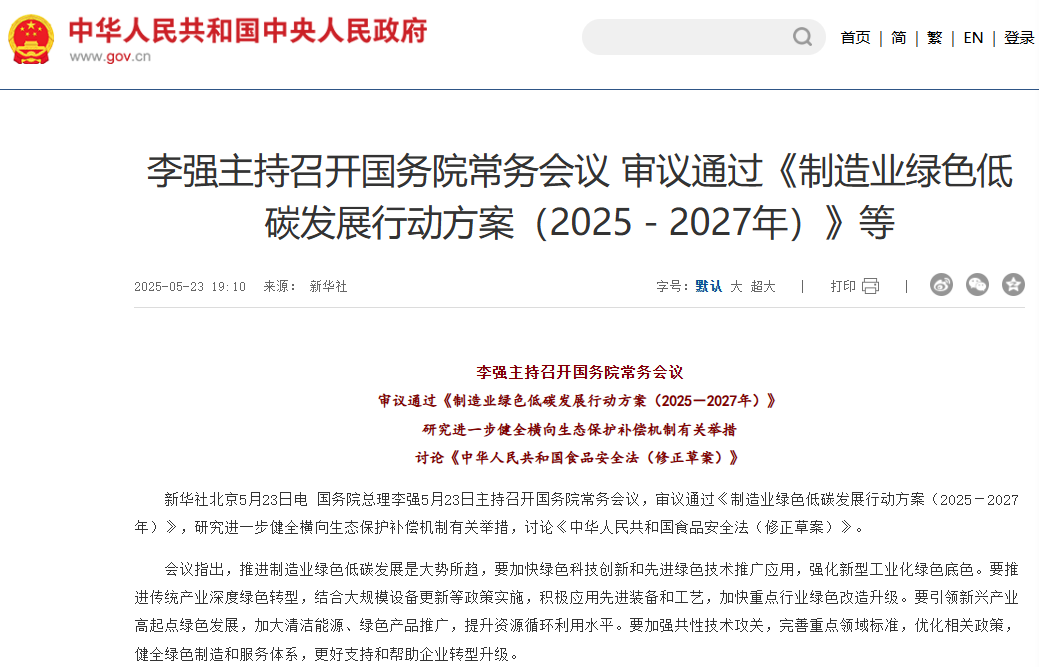
Group 1 - The core viewpoint of the article emphasizes that green development will become the core driving force for promoting high-quality economic development in China, as indicated by the approval of the "Manufacturing Green Low-Carbon Development Action Plan (2025-2027)" [1][3] - The meeting highlighted the necessity of advancing green low-carbon development in the manufacturing sector, accelerating green technology innovation, and promoting the application of advanced green technologies [3] - The government plans to focus on key products such as steel, electrolytic aluminum, lithium batteries, and new energy vehicles, and will develop carbon footprint accounting standards while preparing for the comprehensive utilization of retired products like used power batteries and photovoltaic components [3] Group 2 - Establishing a horizontal ecological protection compensation mechanism is crucial for enhancing ecological environment protection and promoting regional collaborative development [4] - The meeting called for a comprehensive, clear, and efficient horizontal ecological protection compensation mechanism, which will facilitate the interaction between ecological product supply areas and beneficiary areas [4] - The discussion on the revision of the Food Safety Law reflects the government's high emphasis on food safety issues, providing a stronger legal guarantee for ensuring the safety of food for the public [4]
金十图示:2025年05月23日(周五)新闻联播今日要点
news flash· 2025-05-23 13:30
Group 1 - The development of China-Germany relations is emphasized, focusing on mutual respect, cooperation, and win-win outcomes [3] - China aims to solidify political mutual trust with Germany and enhance resilience in their relationship by expanding cooperation in traditional sectors like automotive and machinery, as well as emerging fields such as artificial intelligence and quantum technology [3] - China expresses willingness to share development opportunities arising from high-level opening-up and seeks more policy support from Germany for bilateral investment cooperation [3] Group 2 - The State Council of China, led by Premier Li Qiang, has approved the "Green and Low-Carbon Development Action Plan for Manufacturing Industry (2025-2027)" to promote green technology innovation and the application of advanced green technologies [5] - The plan aims to facilitate the deep green transformation of traditional industries and promote high-starting-point green development in emerging industries, focusing on clean energy and resource recycling [5][6] - A horizontal ecological protection compensation mechanism is proposed to enhance ecological environment protection and promote regional collaborative development [6] Group 3 - The meeting also discussed the revision of the Food Safety Law, emphasizing the importance of food safety for health and the need for a more scientific and rigorous food safety standard system [6] - The focus is on shifting food safety governance towards prevention, enhancing supervision, and ensuring strict enforcement against violations [6] Group 4 - The meeting with the Turkmenistan Speaker highlighted the elevation of China-Turkmenistan relations to a comprehensive strategic partnership, focusing on cooperation in natural gas, digital economy, green development, and renewable energy [7] - The commitment to mutual respect and win-win principles is reiterated, aiming for stable and long-term bilateral relations [7] Group 5 - The UN Conference on Trade and Development criticized the US tariff policies for disregarding WTO rules, which negatively impact vulnerable economies [8]
