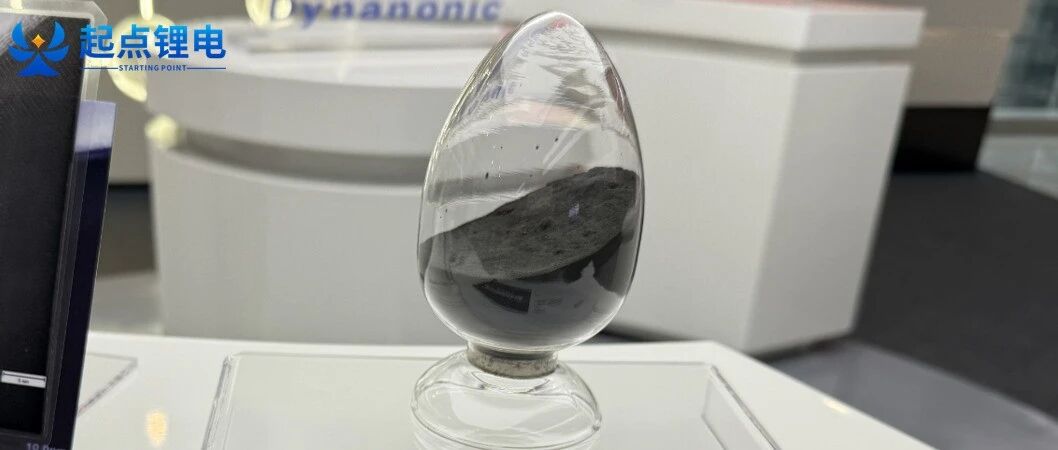
高压实磷酸铁锂技术

Search documents
七大磷酸铁锂项目开工/投产!
起点锂电· 2026-03-05 11:48
Core Viewpoint - The lithium battery industry is experiencing a recovery, particularly in the lithium iron phosphate (LFP) sector, driven by breakthroughs in high-voltage solid-state LFP technology and increased production activities across various projects [4][10][12]. Industry Developments - Gansu Jinlin Lithium's 100,000-ton cathode material project has commenced production with an investment of 3.135 billion yuan, aiming for a comprehensive layout in upstream materials for new energy [4]. - Wanhua Chemical has announced three LFP projects with a total investment exceeding 12 billion yuan and a combined capacity of 1.05 million tons, indicating significant expansion in LFP production [5]. - Inner Mongolia Times Fulin's 500,000-ton LFP project has begun foundation work, with a total investment of 6 billion yuan, reflecting strong ties with CATL [6][7]. - Geely's Jiangxi Yiyuan LFP project has officially started production, marking a new phase in Geely's upstream materials strategy, with an initial capacity of 40,000 tons [8]. - Tianli Lithium's subsidiary in Sichuan has resumed production after maintenance, with plans for a total capacity of 80,000 tons in the future [9]. Market Trends - The demand for LFP is expected to surge, with a projected shipment of 2.575 million tons in the first three quarters of 2025, representing a year-on-year increase of 60.8% [10]. - The global energy storage market is anticipated to grow significantly, with a forecasted shipment of 610 GWh in 2025, a 75% increase year-on-year, and lithium batteries will dominate this market [11]. Technological Advancements - The industry is shifting towards high-end LFP technology, with a focus on high-voltage solid-state LFP, which is expected to enhance performance in both energy storage and power batteries [11][12]. - The scarcity and strategic value of phosphate, a key component in LFP production, are becoming increasingly recognized, with potential benefits for phosphate chemical companies [13].




万华化学上位!入榜磷酸铁锂TOP10
起点锂电· 2026-02-02 10:09
Core Viewpoint - The article highlights the successful entry of Wanhua Chemical into the lithium iron phosphate (LFP) market, emphasizing its strategic positioning and technological advancements in the context of the booming global lithium battery industry [2][3]. Group 1: Market Dynamics - The global lithium battery cathode material market is projected to reach 4.798 million tons by 2025, marking a 48.5% year-on-year increase, with LFP shipments expected to hit 3.654 million tons, a staggering 67.2% increase, capturing 78% market share [2][3]. - The demand for LFP is driven by the rising penetration of electric vehicles and explosive growth in the renewable energy storage sector, positioning LFP as the preferred material for downstream enterprises [3]. Group 2: Competitive Landscape - The LFP market, previously dominated by a few leading companies, is undergoing significant restructuring as more players enter the field, intensifying competition [3]. - By 2025, the top 10 companies in China's lithium iron phosphate cathode material shipments include Hunan Youneng, De Fang Nano, Wanhua Chemical, and others, indicating Wanhua's successful positioning in the market [4][3]. Group 3: Company Background and Strategy - Wanhua Chemical, established in 1998, has transformed from a small leather factory into a global leader in high-end chemical materials, leveraging its extensive technical expertise and supply chain capabilities to enter the lithium battery sector [5]. - The company has strategically built a comprehensive lithium battery materials ecosystem, covering various core segments such as LFP, ternary materials, and electrolytes, breaking away from traditional single-point layouts [5]. Group 4: Production Capacity and Technological Innovation - Wanhua Chemical has established a production capacity matrix across Shandong and Sichuan, with planned capacities of 650,000 tons in Laizhou, 500,000 tons in Haiyang, and over 100,000 tons in Meishan, totaling over 1.25 million tons [5][6]. - The company has developed high-pressure compacted LFP technology, achieving a density of ≥2.5 g/cm³ and a capacity retention rate of ≥90% after 500 cycles, which is crucial for meeting the demands of modern electric vehicles and energy storage systems [6][7]. Group 5: Project Developments - Key projects, including the 650,000 tons LFP project in Laizhou and the 200,000 tons project in Haiyang, are progressing towards implementation, with environmental assessments underway [8][9]. - The Meishan project aims to upgrade existing production lines to enhance capacity, further solidifying Wanhua's position in the southwestern market [9][10]. Group 6: Market Expansion and Collaborations - Wanhua Chemical is expanding its market reach, having established strategic partnerships with companies in Europe and domestic markets to supply LFP materials and key raw materials [11]. - The company's cross-industry approach, combining chemical expertise with renewable energy initiatives, positions it to influence the existing LFP market structure and contribute to the industry's transition towards high-end, large-scale, and low-carbon solutions [11].

回暖趋势明显!近20家锂电材料上市公司业绩公布
Sou Hu Cai Jing· 2025-11-03 01:50
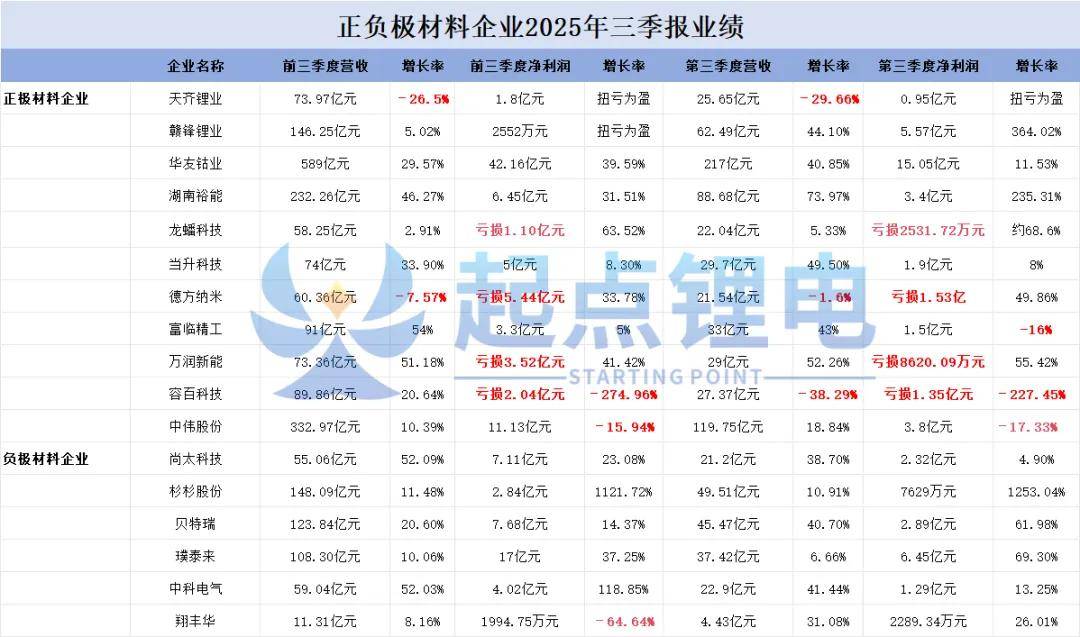
Core Insights - The lithium battery materials industry has shown significant improvement in the third quarter of 2025, with many companies turning losses into profits and a clear trend of recovery in the sector [1][3] Group 1: Performance of Positive Electrode Material Companies - Tianqi Lithium's revenue for the first three quarters was 7.397 billion yuan, down 26.5%, but it achieved a net profit of 180 million yuan, marking a turnaround [2] - Ganfeng Lithium reported a revenue of 14.625 billion yuan, a growth of 5.02%, with a net profit of 2.552 billion yuan, also a turnaround [2] - Huaneng Technology and other companies have seen significant profit increases, with Huaneng's revenue reaching 23.226 billion yuan, up 46.27%, and a net profit of 645 million yuan, up 31.51% [2][3] Group 2: Trends in Positive Electrode Materials - High-pressure compact lithium iron phosphate has become a focal point for companies, driven by strong demand in the energy storage sector and advancements in technology [3][4] - The price of battery-grade lithium carbonate has rebounded, maintaining a range of 80,300 to 81,700 yuan per ton, contributing to the positive performance of many positive electrode material companies [4] - Major companies like Longpan Technology have secured large orders from leading firms, enhancing their market position [4] Group 3: Performance of Negative Electrode Material Companies - The negative electrode materials sector has also seen a recovery, with a total shipment of 201.1 million tons in the first nine months of 2025, a year-on-year increase of 35.1% [7] - Shanshan Co. achieved a net profit of 33.14 million yuan in Q1, marking a successful turnaround, and its stock price has rebounded significantly [7][8] - Companies like BTR and Putailai are expanding their overseas business and solid-state battery technology, contributing to their recovery and growth [8]



磷酸铁锂电池头部企业产能利用率普遍维持高位
Zheng Quan Ri Bao· 2025-11-02 16:40
Core Insights - The energy storage battery materials market is experiencing a significant supply-demand gap, driven by explosive domestic demand and accelerated overseas market expansion, particularly for lithium iron phosphate (LFP) materials [1][2] Group 1: Market Demand and Growth - Domestic energy storage demand has surged since 2024, leading to saturated orders for leading companies and full-capacity utilization [1] - As of mid-2025, the new energy storage installation capacity in China reached 94.91 million kilowatts, a 29% increase compared to the end of 2024 [2] - The shipment volume of energy storage batteries in China for the first half of 2025 was 265 GWh, representing a 128% year-on-year growth, with LFP batteries becoming the mainstream route for electrochemical storage [2] Group 2: Technological Innovations - Companies are focusing on technological innovations to enhance LFP materials, with leading firms like Hunan Youneng and Jiangxi Shenghua pioneering new product lines and production techniques [3] - The breakthrough in high-pressure LFP technology has opened up vast market opportunities for chemical energy storage applications [3] Group 3: Production Capacity and Expansion - Major companies are experiencing high production capacity utilization rates, with some reporting over 80% for ternary lithium and 70% for LFP [4] - Companies are accelerating their expansion plans, with significant increases in shipments and ongoing construction of overseas production bases [5] - The current tight supply-demand balance in the energy storage market is expected to persist until the second half of 2026 [5]

七大磷酸铁锂项目落地!
起点锂电· 2025-09-06 10:56
Core Viewpoint - The lithium iron phosphate (LFP) market is undergoing a critical period characterized by the accelerated elimination of backward production capacity and the rapid release of advanced capacity, indicating a structural adjustment within the industry [2][3]. Group 1: Market Dynamics - The LFP sector is experiencing a structural adjustment due to the explosive growth of electric vehicles and commercial energy storage, leading to a crowded market and a reversal in supply-demand dynamics [2]. - The "Matthew Effect" is becoming more pronounced, where leading companies with quality production capacity continue to secure orders, while smaller firms struggle for survival [3]. Group 2: Project Developments - Guizhou Anda's 60,000 tons/year LFP project is set to invest 1 billion yuan to establish six production lines, with a total capacity of 150,000 tons of phosphate and 150,000 tons of lithium iron phosphate [6]. - Guizhou Phosphate Zhonghe's 300,000 tons/year LFP project is in the public participation phase, with an initial capacity of 150,000 tons [7]. - Shanxi Yangquan's 100,000 tons/year LFP project is nearing production, with an investment of 1.85 billion yuan and plans for further expansion [8][10]. - Ningxia Baofeng Energy Group's first phase of a 250,000 tons/year LFP project is expected to be operational by September 2025, with an investment of approximately 15 billion yuan [12]. - Sichuan Wanhua Chemical's 120,000 tons/year phosphate expansion project is also underway, with an investment of 110 million yuan [11]. - Hebei Beike New Energy's LFP project aims for an annual production of 2,000 tons, with the environmental impact assessment nearing approval [14]. Group 3: Technological Advancements - The energy storage market's growth is driving continuous optimization of LFP technology in energy density, cycle life, and rate performance, with high-pressure solid LFP technology emerging as a future focus [3][19]. - Recent breakthroughs in LFP technology include the fourth-generation high-pressure solid density LFP products gaining customer recognition, with a shipment ratio of approximately 20% to 30% [17][19].