高收入经济体

Search documents
如何看待步入“高收入经济体”门槛
Sou Hu Cai Jing· 2026-02-01 20:38
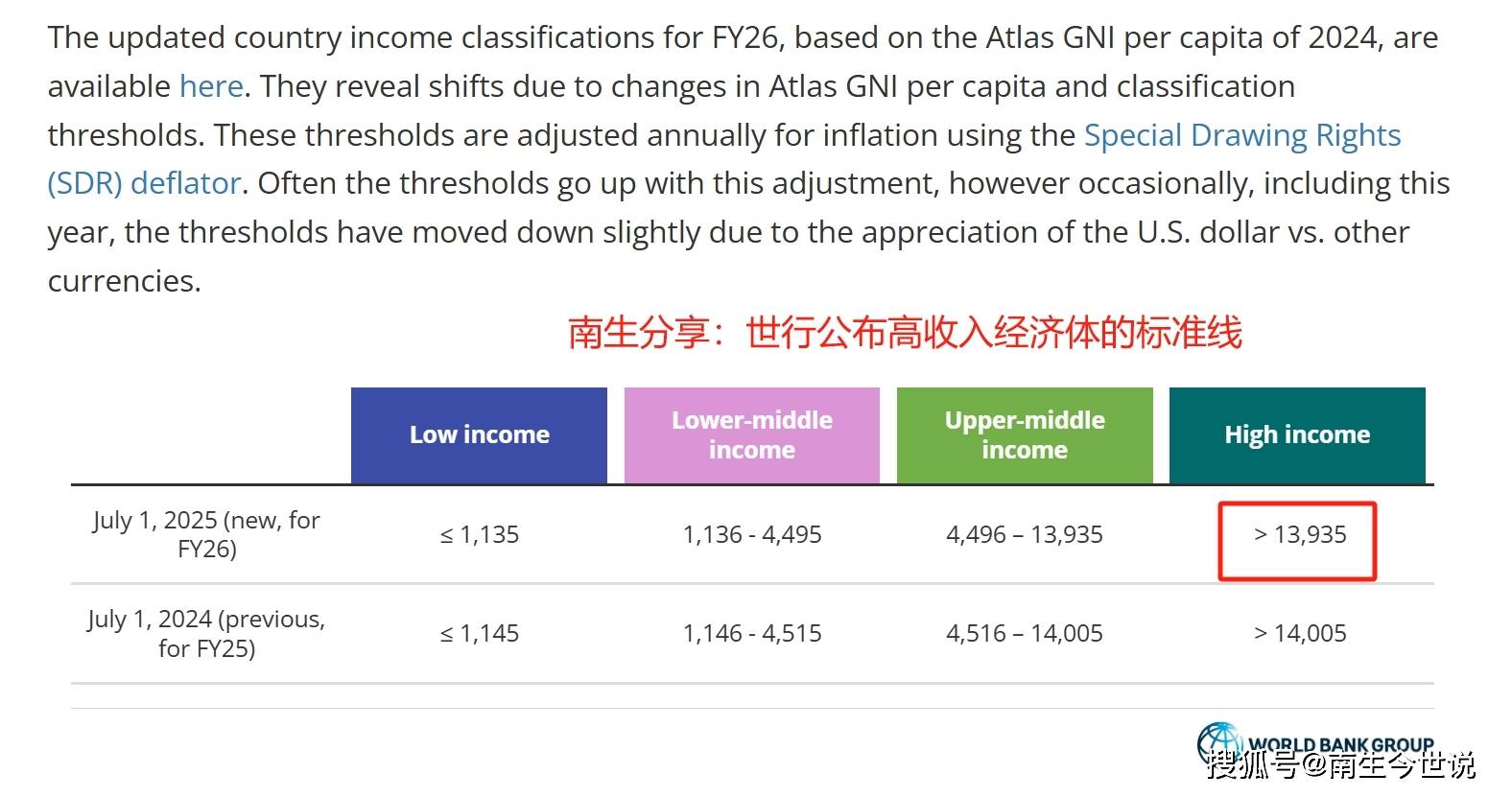
Core Viewpoint - China is on the verge of becoming a high-income economy, with a projected per capita GDP of $13,953 by 2025, surpassing the World Bank's high-income threshold of $13,935. This milestone represents a significant achievement in China's economic development, transitioning from a low-income economy with a per capita GDP of just over $200 to a high-income status, which will also nearly double the global population living in high-income economies from 1.418 billion to 2.827 billion [1]. Group 1: Economic Milestones - The potential classification of China as a high-income economy is a major event for both China and the global economy, marking a significant economic miracle after decades of growth [1]. - The transition to high-income status does not equate to fulfilling the goal of meeting the people's growing needs for a better life, as the current income level still falls short of the requirements for achieving Chinese-style modernization, which aims for a per capita GDP of over $20,000 by 2035 [2]. Group 2: Challenges Faced by High-Income Economies - Income distribution issues affect people's happiness, as the average GNI can mask significant income disparities. The Gini coefficient for disposable income in China is projected to be 0.465 in 2024, exceeding the international warning line of 0.4, indicating substantial income inequality [2]. - The phenomenon known as Baumol's cost disease, where costs in stagnant sectors like healthcare and education rise significantly as productivity improves in other sectors, poses challenges for high-income economies. This can lead to increased opportunity costs for essential services, making them harder to access [2][3]. - Employment pressure may increase as higher income levels raise the marginal productivity requirements in the labor market, making it more difficult for individuals to secure jobs [3]. - The declining birth rate and aging population present additional challenges, as higher income levels lead to increased opportunity costs associated with child-rearing, contributing to lower fertility rates [3]. Group 3: Strategies for Addressing Economic Challenges - To address these challenges, it is essential to continue raising income levels by developing new productive forces and improving total factor productivity, thereby promoting high-quality economic development [4]. - Efforts should be made to reduce income inequality, which can enhance overall happiness and support sustained economic growth. Increasing the final consumption rate, which has risen to 56% in 2023, is crucial for long-term trends, as it remains below the global average [4]. - Addressing Baumol's cost disease requires leveraging innovative technologies, including artificial intelligence, to improve the efficiency of essential services like healthcare and education, while also ensuring equitable access to these services [5]. - Creating job opportunities is vital, necessitating improvements in human capital and promoting the integration of technology and education to stimulate employment demand. The labor-intensive service sector should be emphasized, particularly in the context of flexible employment opportunities [5]. - To combat the challenges of an aging population, measures such as fertility incentives and improving conditions for young people, including better support for international students and immigration policies, should be implemented [6].
中国距高收入经济体仅一步之遥:人均GDP距新标准差500美元
Sou Hu Cai Jing· 2025-07-02 08:29
Group 1 - The World Bank has adjusted the definition of high-income economies, lowering the minimum threshold for Gross National Income (GNI) per capita from $14,005 to $13,935, allowing more countries to qualify as high-income economies [1] - China's nominal GDP for 2025 is projected to reach 31,875.8 billion RMB, approximately $4,442.05 billion, with a per capita GDP of $13,445, which is about $500 short of the new high-income threshold [1] - The small gap of approximately $500 translates to about 9.5 RMB per person per day for China's 1.4 billion population, indicating a minimal effort required to reach the high-income status [1] Group 2 - If China successfully enters the high-income economy category, it will become the largest high-income economy globally, significantly increasing the proportion of high-income individuals worldwide [2] - China's achievement will allow it to become a rule-maker in the industrial revolution, as seen with German car manufacturers adapting to Chinese standards in vehicle networking [4] - China's development model offers new insights for many developing countries, exemplified by Zambian farmers benefiting from smart agriculture initiatives in Chongqing, showcasing China's advancements in agricultural modernization [6] Group 3 - China's rise to high-income status will create new opportunities and challenges, necessitating continued reforms and openness to achieve a more prosperous and democratic developed economy [8]

结果来了,差500美元!按新标准,我国离高收入经济体仅一线之隔
Sou Hu Cai Jing· 2025-07-02 03:40
Core Viewpoint - China's nominal GDP for 2025 is projected to be approximately 31.88 trillion RMB, equivalent to about 4.44 trillion USD, with a per capita GDP of 13,445 USD, placing it just 500 USD away from the World Bank's high-income threshold of 13,935 USD [3][6]. Group 1: Economic Indicators - The World Bank has lowered the minimum GNI standard for high-income economies from 14,005 USD to 13,935 USD, making China's transition to high-income status more attainable [3][6]. - The current gap of 500 USD translates to a daily value creation of approximately 9.5 RMB per person across China's 1.4 billion population [4][6]. - A 3.7% appreciation of the RMB against the USD would allow China to naturally surpass the 13,935 USD threshold without any economic growth [6][9]. Group 2: Global Economic Impact - If China crosses the high-income threshold, it will become the largest high-income economy by population, significantly increasing the global high-income population from about 1.32 billion to over 2.7 billion, raising the percentage of high-income individuals globally from approximately 16% to 35% [6][9]. - This transition will reshape the global economic and industrial landscape, positioning China as a rule-maker in the industrial revolution rather than a follower [7][9]. - China's development model will provide a new path for many developing countries, demonstrating that high income does not equate to Westernization, and showcasing diverse modernization pathways [9][10]. Group 3: Future Aspirations - The next goal for China, after achieving high-income status, will be to become a prosperous, strong, and democratic developed economy, marking a significant milestone in its economic journey [10].