黄金产业链

Search documents
加纳签署本土黄金精炼协议
Shang Wu Bu Wang Zhan· 2026-01-23 04:16
Core Viewpoint - The collaboration between the Ghana Gold Board and Gold Coast Refinery aims to establish a systematic gold refining system domestically, reducing reliance on raw gold exports [1] Group 1: Agreement Details - The agreement signed on January 20 will ensure that gold produced from both artisanal and large-scale mining in Ghana will be refined domestically to meet the international purity standard of 99.9% before export [1] - This initiative is expected to help Ghana minimize the outflow of refining costs, allowing more funds to be allocated for domestic economic development [1] Group 2: Economic Impact - Currently, Ghana exports approximately 1 ton of gold daily, and with the new measures, this gold will enter the international market in refined form [1] - The Gold Coast Refinery will adjust its operations in line with relevant policies, which is anticipated to create more job opportunities [1] Group 3: Industry Positioning - Industry experts indicate that this move will enhance Ghana's position in the global gold supply chain, strengthening its influence as a significant gold producer in Africa [1]
黄金产业链叙事现分化:上游享受金价红利 下游深耕产品溢价
Zhong Guo Zheng Quan Bao· 2026-01-22 20:56
Group 1 - The traditional pricing model for gold jewelry, based on weight, is facing challenges as prices approach 1500 yuan per gram, while "fixed price" models that integrate traditional craftsmanship and cultural elements are gaining popularity among younger consumers [1][2] - The "fixed price" gold products are preferred by consumers due to their perceived value, as they include all costs such as base gold price and craftsmanship fees, making them less sensitive to daily fluctuations in international gold prices [2][3] - Major brands like Chow Tai Fook and Chow Sang Sang are following the trend initiated by Lao Pu Gold, launching their own fixed-price gold products, indicating a shift in consumer preferences towards this pricing model [2][3] Group 2 - Despite the rising gold prices impacting overall sales, certain categories of gold jewelry, particularly those with high added value, continue to attract consumers, as evidenced by strong sales performance in lightweight and high-value products [4] - Companies like Chow Tai Fook are projecting significant profit growth, with expected net profits for 2025 ranging from 436 million to 533 million yuan, reflecting a year-on-year increase of 125% to 175% [4] - Upstream companies in the gold mining sector are benefiting from rising gold prices, with firms like Chifeng Gold and Zijin Mining forecasting substantial profit increases for 2025, driven by higher sales prices and stable production levels [5][6] Group 3 - Analysts are optimistic about the long-term outlook for gold prices, with Goldman Sachs raising its target price for gold to $5,400 per ounce by the end of 2026, driven by ongoing demand from central banks and investors [6] - The World Gold Council anticipates that the gold market will enter a new phase characterized by dynamic balance, influenced by geopolitical uncertainties and potential economic recovery [6] - Experts predict that gold prices may experience a period of high volatility but overall remain strong, with a target range of $4,500 to $5,000 per ounce for 2026 [6]




周大生:公司持续关注黄金产业链发展
Zheng Quan Ri Bao· 2026-01-07 11:48
Group 1 - The company, Zhou Dashing, is actively monitoring the development of the gold industry chain [2] - The issues related to gold mining are currently in the preliminary research stage [2] - Investors are advised to refer to the company's disclosed announcements for accurate information [2]

金价大涨,但黄金首饰难卖了!
Sou Hu Cai Jing· 2025-11-12 06:36
Core Insights - The gold industry is experiencing a dichotomy, with upstream gold mining companies reporting significant revenue growth, while downstream gold jewelry companies are facing declining performance [1] Group 1: Upstream Gold Mining Companies - Companies like Zhaojin Gold and Western Gold have reported over 100% year-on-year growth in both operating revenue and net profit attributable to shareholders for the first three quarters of the year [2] Group 2: Downstream Gold Jewelry Companies - Many downstream gold jewelry enterprises are struggling, with several reporting a decline in performance despite the rising gold prices [1]

点石成金:黄金税务调整,产业结构重塑
Guo Tou Qi Huo· 2025-11-03 14:59
Report Summary 1. Core View - The new gold tax policy will increase the tax costs of the gold industry chain to varying degrees, making the gold market more concentrated, curbing the scale of gray chain business, and cooling down speculative behavior in the physical gold industry chain. It will also maintain the activity of futures, TD, ETF and other transactions, and promote the standardized development of the industry [7][8]. 2. Key Points of the New Tax Policy - **Exemption for Certain Transactions**: Members or customers selling standard gold through the Shanghai Gold Exchange or Shanghai Futures Exchange are exempt from VAT if no physical delivery occurs. For physical delivery, different VAT policies apply based on investment or non - investment use [3]. - **Investment Use by Member Units**: For member units' investment use, the exchange implements VAT immediate refund, exempts urban maintenance and construction tax and education surcharge, and issues VAT special invoices. However, when member units sell to downstream, they can only issue ordinary invoices, and the downstream's tax cost increases as the VAT deduction rate drops from 13% to 0% [3][4]. - **Non - investment Use by Member Units**: For non - investment use by member units, the exchange exempts VAT and issues ordinary invoices. General VAT - paying member units can calculate input tax with a 6% deduction rate. They can issue VAT special invoices when selling processed non - investment gold products [4]. - **Customer Transactions**: Customers are exempt from VAT when purchasing standard gold from the exchange, and the exchange issues ordinary invoices. General VAT - paying customers can calculate input tax with a 6% deduction rate and can issue VAT special invoices when selling [6]. - **Non - exchange Sales**: Selling standard gold without going through the exchange should pay VAT according to current regulations [6]. 3. Impact on the Gold Industry - **Industry Concentration**: The new policy encourages gold investment product trading around exchanges and member units, making the gold market more concentrated and the gold flow more transparent [7]. - **Price Impact**: The tax cost increase at the raw material end of gold jewelry will be transmitted to downstream, leading to a significant theoretical increase in the purchase price of end - consumers. The purchase price of gold bars is less affected, but the subsequent circulation is restricted, and the sales pressure of non - member units increases sharply [7]. - **Investment and Speculation**: The policy cools down speculative behavior in the physical gold industry chain, restrains physical liquidity, and maintains the activity of futures, TD, ETF and other transactions. Ordinary people's participation in gold ETF, gold accumulation and other investments through regular channels is not affected and becomes more cost - effective [8]. - **Recycling Market**: Recycling agencies may lower the recycling price due to increased operating costs [8].
四川黄金前三季度净利润同比增长超八成 加快找矿进程提升资源量
Zheng Quan Ri Bao Wang· 2025-10-28 11:45
Core Viewpoint - Sichuan Gold reported strong financial performance in Q3 2025, driven by rising gold prices and effective cost control measures, indicating a robust growth trajectory for the company [1][2]. Financial Performance - In the first three quarters of 2025, Sichuan Gold achieved operating revenue of 788 million yuan, a year-on-year increase of 49.43%, and a net profit attributable to shareholders of 369 million yuan, up 87.36% [1]. - In Q3 alone, the company saw operating revenue and net profit attributable to shareholders increase by 161.19% and 184.38% year-on-year, respectively [1]. Market Context - The rise in gold prices has positively impacted the performance of gold-related companies, with 6 out of 10 listed gold companies in A-shares reporting double growth in both operating revenue and net profit for the same period [2]. - The overall high profitability in the gold sector reflects a favorable market environment for gold mining companies [2]. Strategic Initiatives - Sichuan Gold has implemented measures such as adjusting mining production plans and optimizing processes to ensure stable operations, alongside completing key projects like the 2000t/d expansion at the Suoluo Gold Mine [1]. - The company is actively pursuing resource expansion through acquisitions and exploration, including a recent successful bid for exploration rights in Xinjiang for 510 million yuan, which is expected to enhance its resource base and competitive edge [3]. Industry Trends - The gold market is evolving, with gold transitioning from a "safe-haven asset" to a core component of global reserve systems, driven by rigid demand and limited supply growth [3]. - The industry is expected to see a concentration of resources among state-owned and leading private enterprises, while midstream refining profits may be compressed, leading to a focus on scale and by-product recovery for profitability [3].
黄金股票ETF(517400)盘中涨超2%,市场关注贵金属逻辑强化
Mei Ri Jing Ji Xin Wen· 2025-10-17 04:08
Group 1 - The core viewpoint is that despite a recent decline in the VIX index for gold and silver, the medium to long-term outlook remains bullish due to weak U.S. economic conditions, rising inflation risks, and increased overall demand for gold [1] - The gold stock ETF (517400) tracks the SSH Gold Stock Index (931238), which includes listed companies involved in gold mining, refining, and sales in both A-share and Hong Kong markets, focusing on the upstream, midstream, and downstream sectors of the gold industry [1] - The index sample consists of 50 companies characterized by medium to small market capitalization and leading effects, indicating a high industry concentration aimed at reflecting the overall performance of gold-related securities [1]

老凤祥股份有限公司关于控股子公司以盈余公积转增注册资本的公告
Shang Hai Zheng Quan Bao· 2025-09-15 18:37
Group 1 - The company plans to increase the registered capital of its subsidiary, Shanghai Laofengxiang Jewelry Research Institute, by 33.85 million yuan, raising it from 16.15 million yuan to 50 million yuan [2][11][20] - This capital increase is aimed at supporting the subsidiary's business development and enhancing its operational efficiency, aligning with the company's overall strategic planning [2][12][20] - The board of directors approved this capital increase without requiring a shareholders' meeting, and it does not constitute a related party transaction or a major asset restructuring [2][20][44] Group 2 - The subsidiary, Shanghai Laofengxiang Jewelry Research Institute, intends to apply for recognition as a gold refining enterprise by the Shanghai Gold Exchange, which requires a minimum registered capital and net assets of 50 million yuan [2][28] - The company aims to establish a modern refining plant and testing laboratory in Jinshan District, Shanghai, in collaboration with Shenzhen Cui Lv Jewelry Co., Ltd. and Shanghai Xinpai Platinum Group Co., Ltd. [19][25][28] - The total estimated investment for this project is up to 215 million yuan, with 50 million yuan contributed by the shareholders, while the remaining amount will be financed through debt [25][32] Group 3 - The company is also planning to establish Laofengxiang Luxury Goods Sales Co., Ltd. to enhance its brand image and expand its product offerings in the high-end market [50][52] - The registered capital for the luxury goods company will be 50 million yuan, with contributions from Laofengxiang Co., Ltd. and Laofengxiang Diamond Processing Center [51][52] - This initiative aims to integrate resources and improve the company's positioning in the luxury market, catering to high-end consumer demands [52][58]

黄金登顶全球央行储备榜首,为何被各国央行看好?
Sou Hu Cai Jing· 2025-09-15 02:55
Group 1: Core Insights - Gold has surpassed US Treasury bonds to become the most favored asset among global central banks, reflecting a growing recognition of its value as a reserve asset [1][3] - The share of gold in global central bank reserves has exceeded that of US Treasury bonds for the first time since 1996, indicating a significant shift in asset allocation strategies [1] - Over 90% of surveyed central banks expect to increase their gold reserves in the next 12 months, marking a 17 percentage point increase from the previous year, the highest since the survey began in 2019 [7] Group 2: Reasons for Central Bank Preference - The decline of the Bretton Woods system and geopolitical tensions, such as the Russia-Ukraine conflict, have led to a loss of trust in the US dollar, prompting central banks to increase gold purchases [1][5] - The high level of US national debt, which has surpassed $37 trillion, has further eroded confidence in the dollar, with the debt-to-GDP ratio reaching approximately 126.8% [3] - Political polarization in the US has increased uncertainty in policies, leading to a preference for gold as a hedge against potential risks associated with the dollar system [5][7] Group 3: Investment Strategies - For investors who have not yet invested in gold but are optimistic about its future, a gradual accumulation strategy is recommended to mitigate risks associated with high volatility [8] - Investors already holding gold may consider adjusting their positions based on market conditions, particularly around key events such as the Federal Reserve's meetings [8] - Different investment products are available for various risk appetites, including gold stocks, ETFs, and balanced funds, catering to aggressive, moderate, and conservative investors [10][11]
挖金炼金用金,中俄黄金实力全景透视
Sou Hu Cai Jing· 2025-06-15 02:28
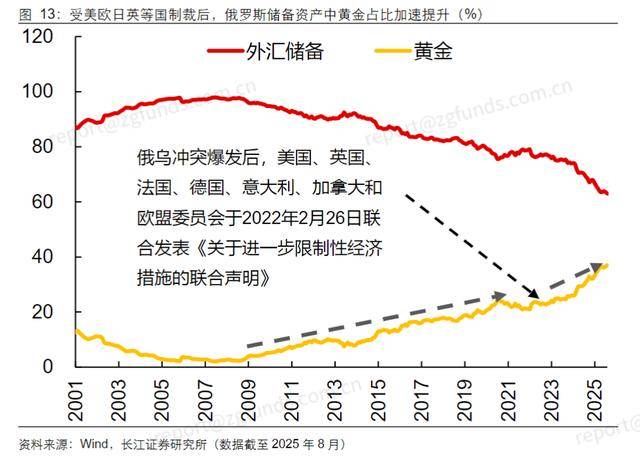
Core Insights - Russia's gold production for 2024 is projected at 330 tons, a 5.3% increase from the previous year, maintaining its position as the world's second-largest gold producer. In contrast, China's gold production is expected to reach 377.242 tons, surpassing Russia by 47 tons, marking over a decade of being the top producer globally [3] - China's total gold supply, including imported raw materials processed into 156.864 tons, amounts to 534 tons, indicating that for every 5 tons of gold produced globally, 1 ton has been processed by China [3] - Russia has significant gold reserves, with 40,000 tons located in the Siberian permafrost, but harsh mining conditions limit its production capacity. In comparison, China has discovered a world-class gold mine in Shandong with an additional reserve of 209 tons, sufficient for 40 years of mining [3] - Technological advancements in gold processing differ significantly between the two countries. Russia primarily uses outdated cyanide methods, while China has developed a biological oxidation technique that utilizes microorganisms, resulting in higher purity gold [5] - Consumer behavior towards gold varies, with Russians showing low interest in gold consumption, averaging only 0.3 grams per person in 2023, compared to China's 373 tons of gold bars and coins sold last year, reflecting a strong cultural affinity for gold [5] - Strategic approaches to gold differ, with Russia attempting to establish a "gold-ruble" payment system due to Western sanctions, while China is enhancing its financial influence through the Shanghai Gold Exchange, which saw a transaction volume of 34.65 trillion yuan last year [7] - The competition between China and Russia in gold production is not merely about mining output but reflects broader differences in resource management and national strategies, with China integrating the entire gold supply chain from exploration to trading and reserves [7]