黄金定价权转移

Search documents
一觉醒来黄金血崩!华尔街深夜收割,为何全球黄金偏偏扎堆上海金库?
Sou Hu Cai Jing· 2026-01-31 17:19
Core Viewpoint - The recent sharp decline in gold prices, driven by Wall Street's strategic selling during low liquidity hours, highlights the growing shift of physical gold towards Shanghai, indicating a loss of influence for Wall Street in the gold market [1][2][11]. Group 1: Market Dynamics - Wall Street executed a significant sell-off of paper gold contracts during Asian market hours, resulting in a rapid drop of $500 in gold prices, equivalent to 3500 RMB, causing panic among investors [1] - The Federal Reserve's hawkish comments and the Chicago Mercantile Exchange's increase in gold trading margins forced many leveraged investors to liquidate their positions, further driving down prices [2] - The current gold market is characterized by a shift away from reliance on paper gold contracts, with increasing demand for physical gold, particularly in Shanghai [4][11]. Group 2: Global Gold Trends - Central banks, including China's, are accumulating physical gold, with China's reserves surpassing 2305 tons and over 70% of global central banks planning to increase their gold holdings in the next five years [4][10] - The Shanghai Gold Exchange is becoming a preferred destination for global capital seeking to avoid dollar risks, offering secure transactions and bypassing Western financial systems [6][10] - The average gold price during Asian trading hours is 0.7% higher than during Western hours, indicating strong demand for physical gold in Asia and a shift in pricing power from the West to the East [11]. Group 3: Implications for Investors - The recent volatility in gold prices serves as a reminder for investors to avoid speculative trading in paper gold and instead focus on tangible assets like physical gold for value preservation [12] - The ongoing accumulation of gold in Shanghai reflects a broader trend of diminishing dollar dominance and the rising financial influence of Eastern markets [12][13].

美债突破38万亿, 中美博弈又一轮升级,在香港人民币直接挂钩黄金
Sou Hu Cai Jing· 2026-01-26 11:06
Core Viewpoint - The article discusses the transformation of Hong Kong into a financial hub that allows the direct exchange of the Chinese yuan for physical gold, thereby reducing reliance on the US dollar and challenging the existing financial order [1][3][5]. Group 1: RMB Internationalization Challenges - Prior to establishing the gold vault, the internationalization of the RMB faced significant hurdles, as overseas investors had limited options for utilizing RMB outside of China [3]. - As of the end of 2024, offshore RMB deposits in Hong Kong exceeded 1 trillion yuan, with net inflows from southbound funds surpassing 785 billion HKD, indicating a substantial but stagnant capital pool [3]. - The current system forces RMB holders to constantly monitor exchange rates to convert back to USD, highlighting the currency's status as a "shadow currency" [3]. Group 2: New Financial Mechanisms - The newly upgraded "multi-functional gold financial service center" in Hong Kong allows RMB holders to directly exchange their currency for physical gold without needing to convert to USD [5]. - This mechanism fundamentally alters the perception of RMB, transforming it from a currency that can only be exchanged for USD to one that can be directly converted into gold [5]. - Hong Kong is also advancing the issuance of "digital gold tokens" for settling transactions in commodities like oil and chips, bypassing traditional systems like SWIFT [5][7]. Group 3: Strategic Positioning of Hong Kong - The financial dynamics in Hong Kong are influenced by its currency peg to the USD and its common law system, which provide a familiar interface for international capital [9][11]. - The dual system of pegging HKD to USD while linking RMB to gold positions Hong Kong as a buffer in the US-China financial rivalry [13]. - This strategy aims to transition Hong Kong from a financing center to a pricing center, attracting global investors to trade gold directly in RMB [13]. Group 4: Ambitious Gold Reserve Goals - Hong Kong plans to increase its gold reserves to 2,000 tons within three years, which would nearly match the gold reserves of the People's Bank of China [17]. - This significant accumulation of gold is not merely for storage but aims to establish Hong Kong as an independent "gold pricing hub" in the international market [17][18]. - The ultimate goal is to shift global gold pricing power from New York and London to Shanghai and Hong Kong, facilitating transactions in RMB and physical gold [20].
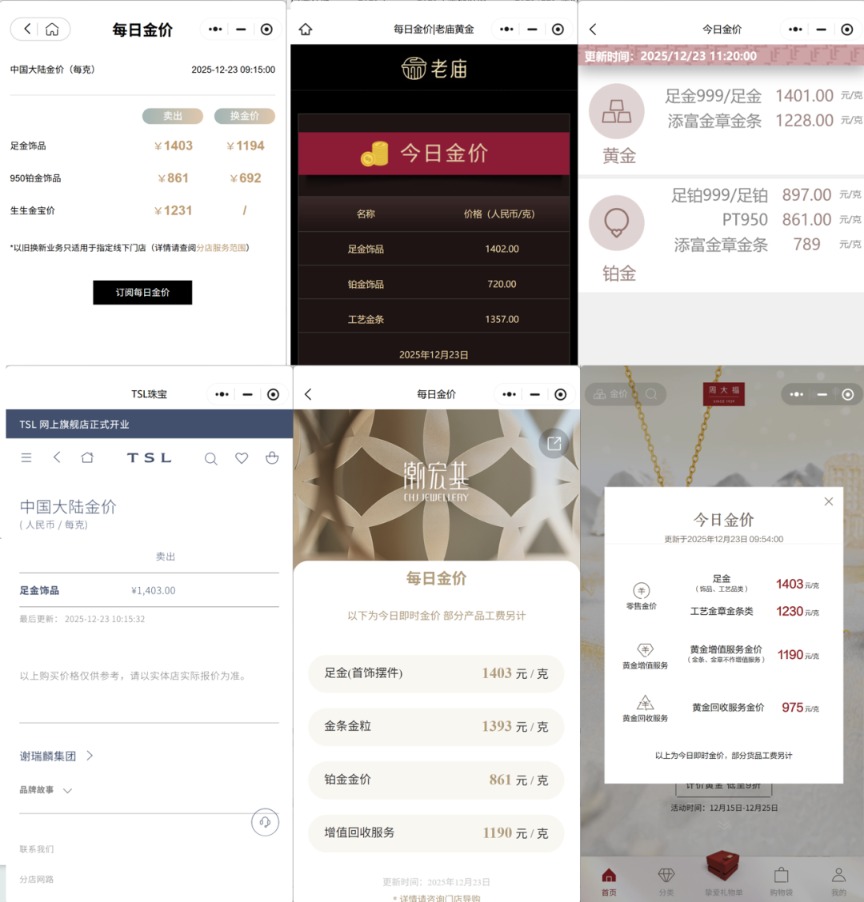
金饰价格,首次突破1400元/克
Shang Hai Zheng Quan Bao· 2025-12-23 08:14
Group 1 - The core point of the news is that the price of gold jewelry in China has surpassed 1400 RMB per gram for the first time, indicating a significant increase in gold prices over the past year [1][3]. - On December 23, 2025, the domestic prices for various gold jewelry brands were reported as follows: Chow Tai Fook at 1403 RMB per gram, Xie Ruilin at 1403 RMB, and Liufuk at 1401 RMB [1][3]. - The price of gold jewelry has nearly doubled within a year, with international and domestic gold prices reaching historical highs of 4500 USD per ounce and 1000 RMB per gram, respectively [3][7]. Group 2 - The international gold price has increased by over 70% and domestic gold prices by over 60% since the beginning of the year, making 2025 the year with the largest annual increase in gold prices in history [7]. - According to forecasts, global gold demand is expected to reach 4850 tons in 2025, driven by ETF investments and central bank purchases, despite a decline in jewelry demand due to high prices [8]. - The report indicates that the contribution of the Chinese market to gold pricing has significantly increased, with its influence on global gold prices becoming more prominent over the past few years [8][9].
听说中国要替他们保黄金,美西方急眼了,但没想到中国还有大计划
Sou Hu Cai Jing· 2025-10-01 03:44
Core Viewpoint - The article discusses China's strategic moves to position itself as a key player in the global gold market, potentially undermining Western dominance and promoting the internationalization of the Renminbi. Group 1: China's Gold Strategy - China is lobbying friendly countries' central banks to store their gold reserves at the Shanghai Gold Exchange, a move that has been ongoing for several months [3] - The global gold custody, liquidity, and pricing power are gradually shifting from the West to the East, indicating a potential decline in U.S. hegemony [5] - The Shanghai Gold Exchange is establishing a new gold trading ecosystem, which could disrupt the traditional dominance of London and New York in the gold market [6] Group 2: Operational Developments - The "Golden Road" project launched by Shanghai Customs in late 2024 allows domestically forged gold bars to be processed and exported directly to international warehouses, improving efficiency significantly [8] - By June 2025, the Shanghai Gold International version will have established its first overseas collection warehouse in Hong Kong, further enhancing its operational capabilities [10] - The introduction of the "Shanghai Gold" centralized pricing mechanism in March 2025 marks the first time a gold benchmark price is calculated in Renminbi, involving 12 domestic and foreign banks [11] Group 3: Market Impact - The daily trading volume of the Shanghai Gold International version reached 3.67 trillion yuan by October 2024, with bonded gold imports accounting for two-thirds of the national total [13] - Malaysia is emerging as a key player in this gold storage initiative, potentially leading other Southeast Asian countries to follow suit, which could create a gold reserve network centered around China [15][20] - The U.S. government's reaction to these developments has been one of concern, as evidenced by a sudden proposal to impose a 39% tariff on Swiss gold imports, which caused a spike in gold prices [22] Group 4: Broader Economic Implications - The shift towards gold storage in Shanghai is seen as a natural outcome of deepening economic ties between China and Malaysia, particularly as Malaysia seeks to mitigate risks associated with U.S. dollar fluctuations [18] - The increasing preference for "Shanghai Gold" among Asian clients is evident, with a 45% rise in trading volume for the Shanghai Gold International version compared to the previous year, while London gold trading volumes have decreased by 12% [24] - The credibility of the U.S. dollar is being undermined as more countries consider replacing dollar reserves with gold, especially following the freezing of Russian foreign reserves by the U.S. [26]