3D激光雷达

Search documents
宇树机器人“以武会春”:刷新多个全球第一,空翻最大高度超3米
Xin Lang Ke Ji· 2026-02-16 15:49
Core Viewpoint - The performance of Yush Robot at the 2026 CCTV Spring Festival Gala showcased significant advancements in robotics, highlighting the company's ability to push the limits of robotic movement and coordination [1] Group 1: Performance Highlights - Yush Robot participated in the martial arts segment "Dance BOT," demonstrating various stunts such as flips, staff dance, jumping flips, and sword dance [1] - The humanoid robots achieved several global records, including the highest flip over 3 meters, the first single-leg consecutive flips, and the first Airflare with seven and a half rotations [1] - The robots exhibited rapid positioning capabilities, with the fastest arbitrary positioning speed reaching 4 meters per second [1] Group 2: Technological Innovations - Yush Technology developed a new dexterous hand that allows for quick changes and stable handling of martial arts props [1] - The company successfully coordinated dozens of robots in real-time with ultra-low synchronization delay, ensuring precise movements even after intense activity [1] - AI algorithms combined with 3D laser radar were utilized to maintain accurate positioning, overcoming challenges related to cumulative motion errors during long sequences [1]



2025年机器人激光雷达销量:速腾聚创第一,禾赛、览沃、万集紧随其后
Zheng Quan Ri Bao· 2026-01-15 23:18
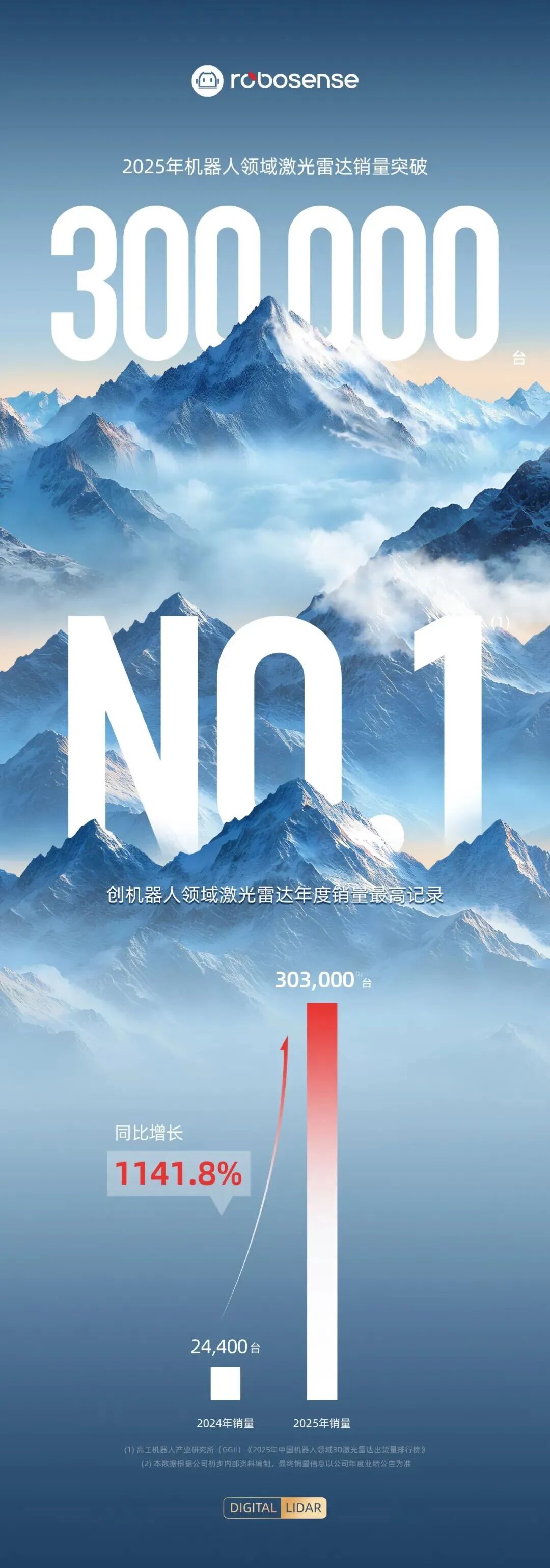
Core Insights - RoboSense announced that its LiDAR product sales in the robotics sector will reach 303,000 units by 2025, making it the industry leader [1][6] - This represents a remarkable year-on-year growth of 1141.8% compared to 2024, where sales were only 24,400 units [4][5] Industry Overview - According to the GGII report, RoboSense's rapid growth in the robotics business positions it at the top of the 3D LiDAR shipment rankings for 2025, with competitors Hesai Technology, Lanwo Technology, and Wanji Technology following in second to fourth place [6] - The 3D LiDAR market is expected to experience significant growth, projected to reach nearly 4.5 billion by 2030, with a compound annual growth rate (CAGR) of approximately 35.52% from 2025 to 2030 [6] Company Strategy - RoboSense is leveraging its fully self-developed chips to enhance the performance of its digital products, targeting applications in smart lawn mowers, unmanned delivery, and humanoid robots [6] - The company is expected to ignite new performance growth engines in 2026 as various market segments expand further [6]
品类革新系列之精耕细作——割草机器人
2025-11-10 03:34
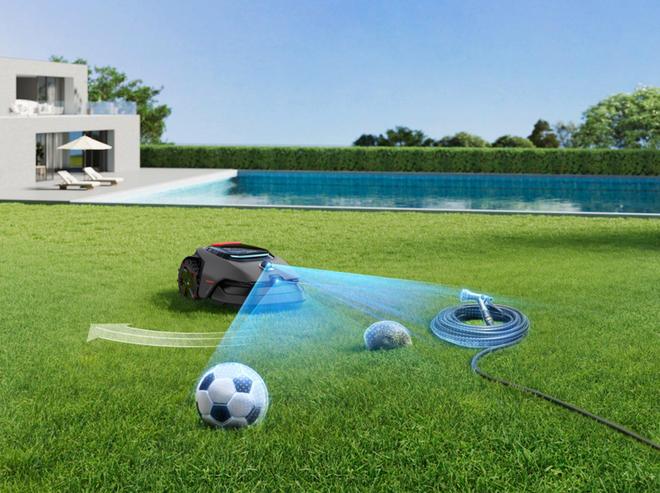
Summary of the Lawn Mower Robot Industry Conference Call Industry Overview - The global Outdoor Power Equipment (OPE) market is projected to reach $32.4 billion by 2025, with lawn mowers accounting for 34%, approximately $11 billion [1][2] - Currently, lawn mower robots have a penetration rate of about 10% in the lawn mower market, indicating significant growth potential [1][2] Key Drivers and Trends - Technological iteration is a key driver, with boundary-less technology (RTK positioning + visual fusion) rapidly replacing traditional wired technology, becoming the market mainstream [1][2] - 2024 is expected to be the year of mass production for boundary-less lawn mower robots, with an estimated shipment of 300,000 to 400,000 units [1][3] - Cost-effectiveness analysis shows that the average annual cost of lawn mower robots is comparable to or even lower than manual maintenance or riding equipment, with U.S. households spending an average of $190 annually on self-maintenance, while the average amortized cost of lawn mower robots is about $220 [1][3] Market Dynamics - The global lawn mower robot market is concentrated in Europe and North America, with projected sales in 2024 accounting for 40% and 25% of global sales, respectively [1][4] - The demand in these regions is driven by temperate climates, single-family home models, and policy restrictions [1][5] - The navigation technology landscape includes various solutions, with RTK + visual being the mainstream option, balancing experience and cost [1][5] Regional Insights - As of 2024, the global sales of lawn mower robots account for less than 10% of total lawn mower sales, with Europe having a higher penetration rate of about 30% due to EU policies tightening emissions from fuel-powered mowers [1][6] - The U.S. market has a lower penetration rate of less than 2%, primarily due to larger lawn sizes and complex environments that challenge robot capabilities [1][7] Future Growth Potential - It is estimated that by 2028, global lawn mower robot sales could approach 3 million units, with a CAGR exceeding 20% from 2024 to 2028, leading to a projected sales revenue of $3 billion [2][8] - In a steady-state scenario, annual sales could reach 6.77 million units, with a potential sales revenue of $6.8 billion, indicating a fourfold growth opportunity [2][8] Competitive Landscape - The lawn mower robot industry consists of three main player categories: traditional garden tool leaders, Chinese tech crossover companies, and startups [2][9] - Traditional leaders like Fujitsu and Bosch dominate the wired mower market but lag in boundary-less product development [2][9] - Chinese tech companies, such as 9号, have captured 90% of the global boundary-less shipment market, leveraging strong algorithms and AI capabilities [2][12] Key Competitive Factors - The main competitive factors include product performance, pricing, and channel distribution [2][13] - Product performance focuses on user experience, operational efficiency, and stability, with ongoing improvements in navigation and obstacle avoidance technology [2][13] - Pricing advantages for Chinese companies stem from a mature manufacturing supply chain, allowing for cost optimization and competitive pricing [2][13] Channel Dynamics - The lawn mower robot market has a high channel barrier, with offline channels accounting for over 80% of sales, particularly in Europe [2][13] - Traditional brands leverage established distribution networks and after-sales service to create competitive advantages [2][13] Conclusion - The lawn mower robot industry is poised for significant growth, driven by technological advancements, favorable market conditions, and strong competitive dynamics, particularly from innovative Chinese companies [2][19]
独家对话MOVA割草机CTO秦岭:何为智能割草机的真正未来?
Tai Mei Ti A P P· 2025-09-16 06:18
Core Insights - Chinese lawn mowers are rapidly gaining market share in Europe and North America, with exports reaching $1.01 billion in Q1 2025, a year-on-year increase of 58.92% [2] - The compound annual growth rate (CAGR) for robotic lawn mowers is projected to be between 12% and 20% over the next 5-10 years, with market penetration expected to rise from 0.1% in 2022 to 17% [2] - MOVA, a new entrant in the market, has achieved significant sales by adopting a 3D LiDAR technology approach, differentiating itself from competitors [2][4] Market Performance - In 2024, Ninebot's robotic lawn mowers are expected to exceed 140,000 units in sales, while Ecovacs will surpass 80,000 units in the North American and European markets [2] - MOVA's sales have also been impressive, with over 100,000 units sold in the first half of the year [2] Technology Comparison - The industry has seen a shift from RTK positioning technology to 3D LiDAR due to the latter's superior performance in complex environments [3][4] - RTK technology requires a base station for accurate positioning, which can be affected by environmental factors, leading to significant errors and product returns [4] Product Features - MOVA's 3D LiDAR technology allows for "out-of-the-box" usability, enabling users to operate the mower without extensive technical knowledge [5] - The 3D LiDAR system can map a 1,000 square meter area in just 3.5 minutes with centimeter-level accuracy [4] New Product Launches - MOVA has introduced new models, MOVA 600 and MOVA 1000, targeting small to medium lawns, with sales in Germany exceeding 3,000 units in a single month [6] - The latest models, MOVA LiDAX Ultra AWD and MOVA LiDAX Ultra, feature UltraView environmental perception technology, allowing for 360° sensing and high-precision navigation [6] Future Trends - The integration of AI vision technology enhances the mower's ability to detect and avoid obstacles, while also allowing it to function as a security device [7] - MOVA is also exploring embodied intelligence in its products, such as the Master X, which can perform various garden maintenance tasks [9] - The market is expected to grow at a CAGR of 15%-20% over the next 3-5 years, driven by increasing demand in Europe, North America, and Australia [9]