6P法则

Search documents
智能早报丨今日起开展6000亿买断式逆回购;京东广汽宁德联合造车……
Guan Cha Zhe Wang· 2025-10-15 05:11
Group 1: Trade and Regulatory Actions - The U.S. has implemented port fee restrictions on China's maritime, logistics, and shipbuilding sectors based on the 301 investigation results [1] - China's Ministry of Commerce has expressed a firm stance against U.S. actions, emphasizing readiness for both confrontation and dialogue [1] - China has added five U.S. subsidiaries of Hanwha Ocean Co. to its countermeasure list in response to the U.S. sanctions [1] Group 2: Monetary Policy - The People's Bank of China will conduct a 600 billion yuan reverse repurchase operation to maintain liquidity in the banking system [2] - This operation marks the fifth consecutive month of increased reverse repurchase operations, with a total of 1 trillion yuan added this month [2] - The reverse repurchase tool was introduced in October 2024 to provide medium to long-term funding to the market [2] Group 3: Automotive Industry Developments - JD.com, GAC Group, and CATL are collaborating to launch a new vehicle on November 9, targeting the mass market with prices ranging from 50,000 to 300,000 yuan [3] - The vehicle aims to meet over 90% of daily commuting needs and will be exclusively sold on JD.com during the "11.11" shopping festival [3] - The collaboration focuses on user insights and sales, while manufacturing will be handled by GAC and CATL [3] Group 4: Technology and Industry Growth - Shanghai aims to grow its smart terminal industry to over 300 billion yuan by 2027, with plans to develop globally influential consumer brands [4] - The action plan includes enhancing AI computing capabilities and fostering the production of AI smartphones and robotics [4] - The initiative also targets the development of smart glasses and low-orbit satellite applications [4] Group 5: Battery Production and Sales - In September, China's production of power and other batteries reached 151.2 GWh, a year-on-year increase of 35.4% [5] - Cumulative production for the first nine months of 2025 was 1,121.9 GWh, reflecting a 51.4% year-on-year growth [5] - Battery sales in September totaled 146.5 GWh, with power batteries accounting for 75.5% of total sales [5] Group 6: Electric Vehicle Battery Installations - In September, the installation of power batteries reached 76.0 GWh, marking a year-on-year increase of 39.5% [6] - Lithium iron phosphate batteries constituted 81.8% of the total installation volume, showing a significant growth rate [6] Group 7: Data Center Energy Demand - Goldman Sachs has revised its forecast for global data center electricity demand in 2030 to a 175% increase compared to 2023 [7] - The report indicates that AI applications are driving unprecedented energy consumption in data centers [7] - The International Energy Agency predicts that global data center electricity demand will more than double by 2030, reaching approximately 945 TWh [7] Group 8: Investment Opportunities in Energy - Goldman Sachs suggests investors focus on reliability, availability, and efficiency in energy investments related to data centers [8] - The investment strategy includes sectors such as power generation, electrical equipment, and demand-side management [8]





AI带来史无前例“电力牛市”! 高盛“6P法则”揭示AI时代的电力财富密码
智通财经网· 2025-10-14 11:28
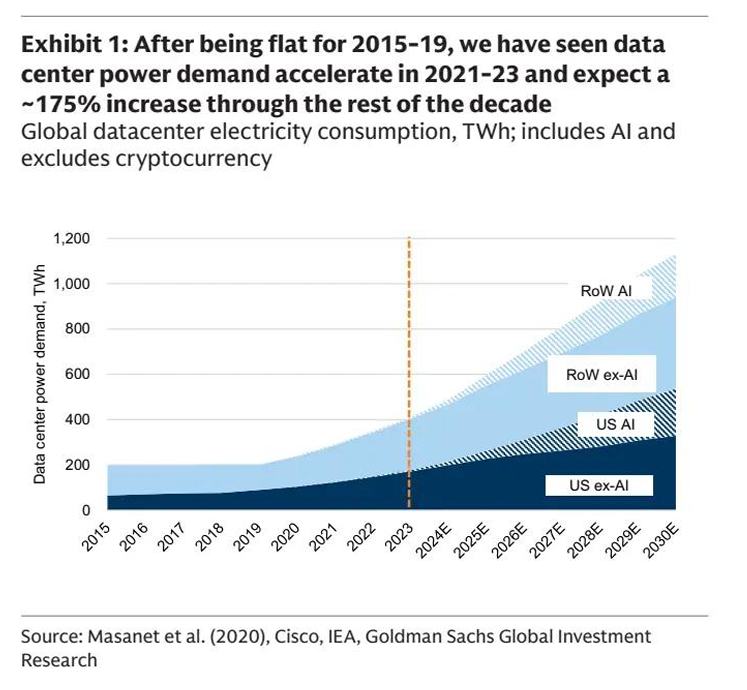
Core Insights - Goldman Sachs has significantly revised its forecast for global data center electricity demand, projecting a 175% increase by 2030 compared to 2023, driven primarily by AI applications [1][2] - The firm emphasizes that AI models are fundamentally reliant on electricity, leading to a "super bull market" for electricity stocks [1] - The competition in AI is fundamentally a race for computational infrastructure, which is heavily dependent on a stable and substantial electricity supply [1][2] Electricity Demand Projections - By 2030, global data center electricity demand is expected to exceed 945 terawatt-hours (TWh), more than Japan's current total electricity consumption, with AI applications being the main driver of this growth [2] - AI-focused data centers are projected to see their electricity demand increase by over four times by 2030 [2] Investment Strategies - Goldman Sachs recommends investors focus on three main pillars: reliability, availability, and efficiency, while investing in the electricity supply chain [3] - Suggested investment areas include power generation and fuel, electrical equipment and system integration, engineering EPC/transmission and distribution construction, and cooling and efficiency management [3][12] Key Drivers and Constraints - The report identifies six key drivers and constraints in the global electricity market: Pervasiveness, Productivity, Prices, Policy, Parts, and People [4] - The "Jevons Paradox" indicates that total electricity demand will continue to rise due to AI penetration, despite improvements in efficiency [4] Pricing and Policy Insights - The average low-carbon cost in the U.S. is approximately $40 per megawatt-hour (MWh), with expectations of rising costs as policies like the Inflation Reduction Act (IRA) phase out [7] - The U.S. electricity sector is experiencing a trend of rapid installation and grid connection to secure incentives, with permitting and site selection being critical non-price constraints [10] Labor Market and Capacity Needs - A significant labor shortage is anticipated in the global electricity market, with the U.S. needing approximately 300,000 new power-related jobs by 2030 [10] - To meet the electricity demand from data centers by 2030, an estimated 82 gigawatts (GW) of new generation capacity will be required [11] Recommended Stocks and Sectors - Goldman Sachs suggests investing in companies that can quickly connect to the grid and have strong load-following capabilities, such as NextEra Energy and Kinder Morgan [12] - In the electrical equipment and system integration sector, companies like Schneider Electric and Siemens are highlighted as beneficiaries of high capital expenditure from tech giants [12][13]