AH价差

Search documents
南下资金1200亿涌入 AH价差七年最低|中环观察
2 1 Shi Ji Jing Ji Bao Dao· 2026-02-09 08:52
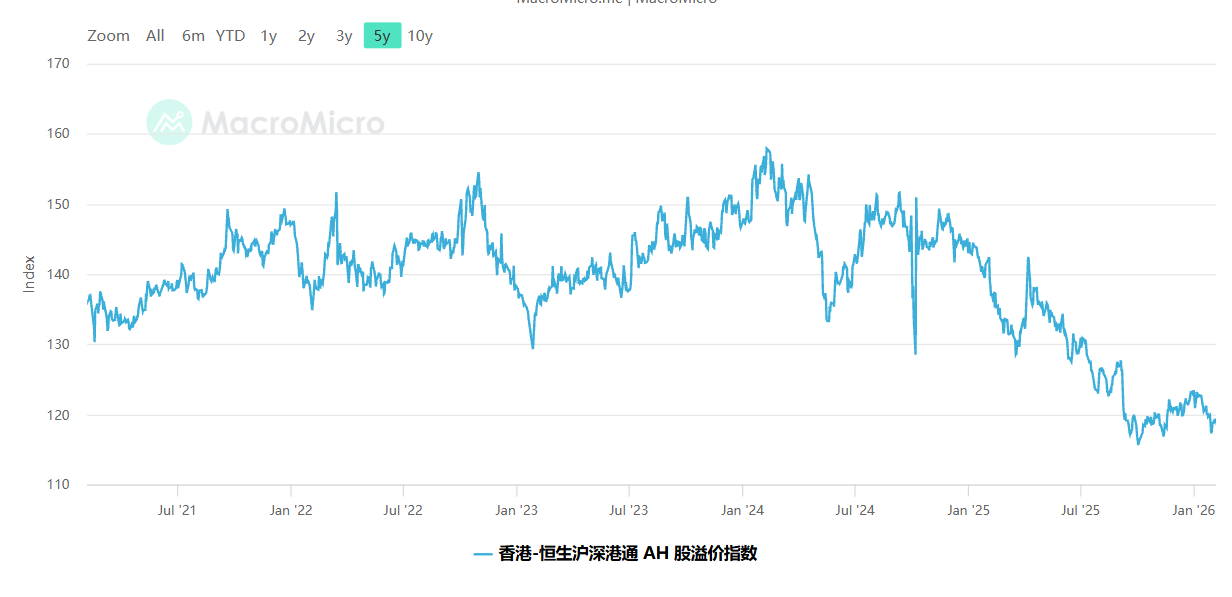
Core Viewpoint - The article discusses the narrowing of the AH premium, highlighting the significant reduction in the discount rate for companies listing in Hong Kong compared to their A-share counterparts, driven by improved liquidity in the Hong Kong market and increased participation from mainland investors [2][3]. Group 1: AH Premium Trends - Dongpeng Beverage's H-share discount rate at 14% is the second lowest since 2015, compared to an average discount of about 33% [2]. - The AH premium index has decreased from a near ten-year high of 161.36 points in February 2024 to 119.44 points by February 6, 2026, returning to levels seen in 2019 [2]. - The narrowing of the AH premium is attributed to the recovery of liquidity in the Hong Kong market, driven by increased southbound capital participation, a weak dollar environment, and improved profitability in Hong Kong stocks [2]. Group 2: Southbound Capital Influence - Historical trends show that a reduction in AH premium often coincides with increased participation from southbound capital, which has reached a record net inflow of 1.4 trillion HKD in 2025 [3]. - As of February 6, 2026, southbound capital has accumulated a net inflow of over 120 billion HKD since the beginning of the year [3]. - Southbound capital has improved liquidity in the Hong Kong market, with A-share annual turnover rates at 373% compared to only 105% for Hong Kong stocks as of June 2025 [3]. Group 3: Valuation Disparities - Some leading companies have experienced a phenomenon where H-shares are priced higher than A-shares, with notable examples including CATL and China Merchants Bank [4]. - The preference of foreign capital for globally competitive stocks leads to more generous valuations for these companies, resulting in lower AH premiums [5]. - The structural differences in investor bases between A-shares and H-shares contribute to the valuation disparities, with institutional investors dominating the Hong Kong market [3][5]. Group 4: Market Dynamics and Future Trends - The "Matthew Effect" is evident in the market, where leading stocks are favored while smaller companies face greater valuation challenges [6]. - Recent IPOs show that smaller A+H companies tend to have larger discount rates, with those under 10 billion HKD often seeing discounts around 50% [7]. - The trend of narrowing AH premiums is expected to continue, with high-quality leading stocks potentially experiencing persistent premium situations [9][10].

险资2025年41次举牌港股成主战场 AH价差下长线资金锁定高股息资产
Chang Jiang Shang Bao· 2026-01-11 23:33
Core Viewpoint - In 2025, insurance capital has demonstrated its role as a stabilizer in the capital market, highlighted by significant investments in major banks, marking a peak in insurance capital's engagement in equity markets [2][5]. Group 1: Insurance Capital Activities - China Ping An Life Insurance Co., Ltd. disclosed its acquisition of 20% stakes in Agricultural Bank of China and China Merchants Bank H-shares, triggering regulatory requirements for disclosure [3]. - In 2025, insurance companies executed 41 equity acquisitions, the highest in nearly a decade, with over 70% of these involving H-shares [5][7]. - Ping An Life led the charge with 15 acquisitions in 2025, including multiple transactions involving Agricultural Bank and China Merchants Bank [5][6]. Group 2: Market Trends and Analysis - The insurance sector's investment strategy has shifted towards large, traditional insurance companies, moving away from smaller, aggressive firms [5]. - As of September 30, 2025, the total investment balance of the insurance industry reached 37.5 trillion yuan, with stock allocations increasing by 55.1% year-on-year [5]. - The H-share market has become a primary focus for insurance capital, with a notable presence of banks and other sectors, indicating a strategic shift towards long-term value investments [7]. Group 3: Valuation and Returns - The H-share market offers significant valuation advantages, with many acquired companies showing substantial AH price differentials, providing opportunities for insurance capital to acquire quality assets at lower prices [8]. - The dividend yields of the banks involved in acquisitions range from 1.03% to 5.15%, enhancing the attractiveness of these investments for insurance capital [8].