
AI与数字技术

Search documents
“十五五”双碳行业全产业链研究与前景趋势预测预判专项报告
Xin Lang Cai Jing· 2025-12-08 12:25
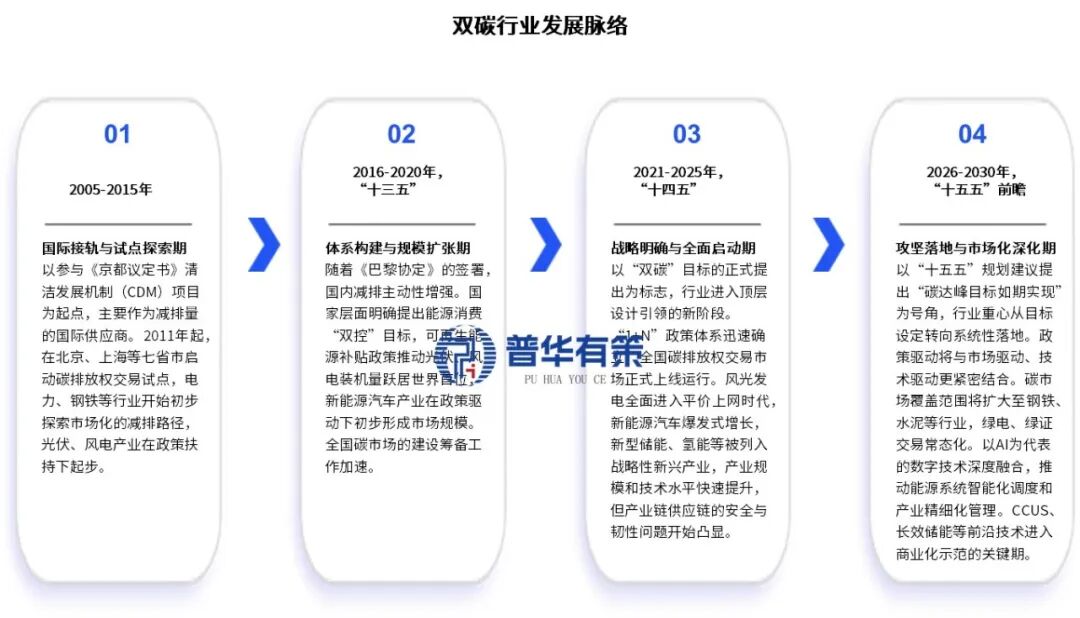
Core Viewpoint - The dual carbon industry is positioned as a strategic emerging industry aimed at achieving carbon peak and carbon neutrality, encompassing a range of economic activities, technological research, industrial manufacturing, and service provision to build a green low-carbon circular economy [1][12]. Industry Development History - The industry has evolved through various stages, transitioning from pilot projects to comprehensive efforts in carbon reduction [92]. Industry Chain Analysis Upstream - Resources, Materials, and Core Equipment - The upstream sector includes critical mineral resources such as lithium, cobalt, nickel, rare earths, and silicon materials, which are essential for production equipment and software. This sector is capital and technology-intensive, directly influencing cost control and technological advancement in the midstream manufacturing sector. China has significant advantages in photovoltaic silicon materials and rare earth permanent magnets, but still faces risks in high-end chips and precision instruments [3][95]. Midstream - Manufacturing, Integration, and Services - The midstream sector is the core of the industry chain, covering the manufacturing of photovoltaic modules, wind turbines, energy storage systems, and various digital solutions. Chinese companies have established a global advantage in this area, particularly in photovoltaic modules and power batteries. The trend is shifting from providing single devices to integrated solutions that combine wind, solar, storage, and hydrogen [4][96]. Downstream - Application and Operation - The downstream sector includes renewable energy power station operations, grid companies, and high-energy-consuming industries such as steel, chemicals, and cement. The demand from these sectors, driven by transformation needs and compliance pressures, is a fundamental driver of industry growth. The EU's Carbon Border Adjustment Mechanism (CBAM) is pushing Chinese export-oriented companies to procure green electricity and implement energy-saving modifications, creating substantial market demand [5][96]. Major Industry Development Trends - AI and digital technologies will deeply empower the industry, driving an intelligent revolution. AI will be integrated into various applications, including power forecasting and carbon management, transforming digitalization from a supportive tool to a core element of productivity and business model reconstruction [6][97]. - The construction of new energy systems will accelerate, shifting focus from single-point breakthroughs to system collaboration, emphasizing large-scale energy storage and smart grids [7][98]. - The decarbonization process in high-carbon industries such as steel and cement will accelerate, supported by technological innovation and financial tools [8][99]. - The carbon market will mature and become a core regulatory tool, with innovations in green financial products [9][100]. - International competition over green standards will intensify, with Chinese companies leveraging their full industry chain advantages to participate in global green supply chain restructuring [10][102].

阿布扎比能源局参加2025阿布扎比国际石油展
Shang Wu Bu Wang Zhan· 2025-11-06 03:45
Core Viewpoint - The Abu Dhabi Department of Energy (DoE) will participate in the 2025 Abu Dhabi International Petroleum Exhibition and Conference (ADIPEC 2025) to showcase its leading practices in energy security, regulation, and innovative governance [1] Group 1: Event Participation - DoE will exhibit at ADIPEC 2025, focusing on energy governance and regulatory frameworks [1] - The exhibition will feature five interactive display areas, including the "Mayed" smart assistant and the digital regulatory platform "ASATEEL" [1] Group 2: Technological Integration - DoE aims to enhance the LPG and oil regulatory systems through AI and digital technologies [1] - The exhibition will also include a VR experience related to gas safety [1] Group 3: Strategic Goals - DoE emphasizes the importance of diversifying the energy structure, improving system efficiency, and expanding the use of renewable energy [1] - The overarching goal is to build a safer, smarter, and more sustainable energy system [1]