AI与边缘计算

Search documents
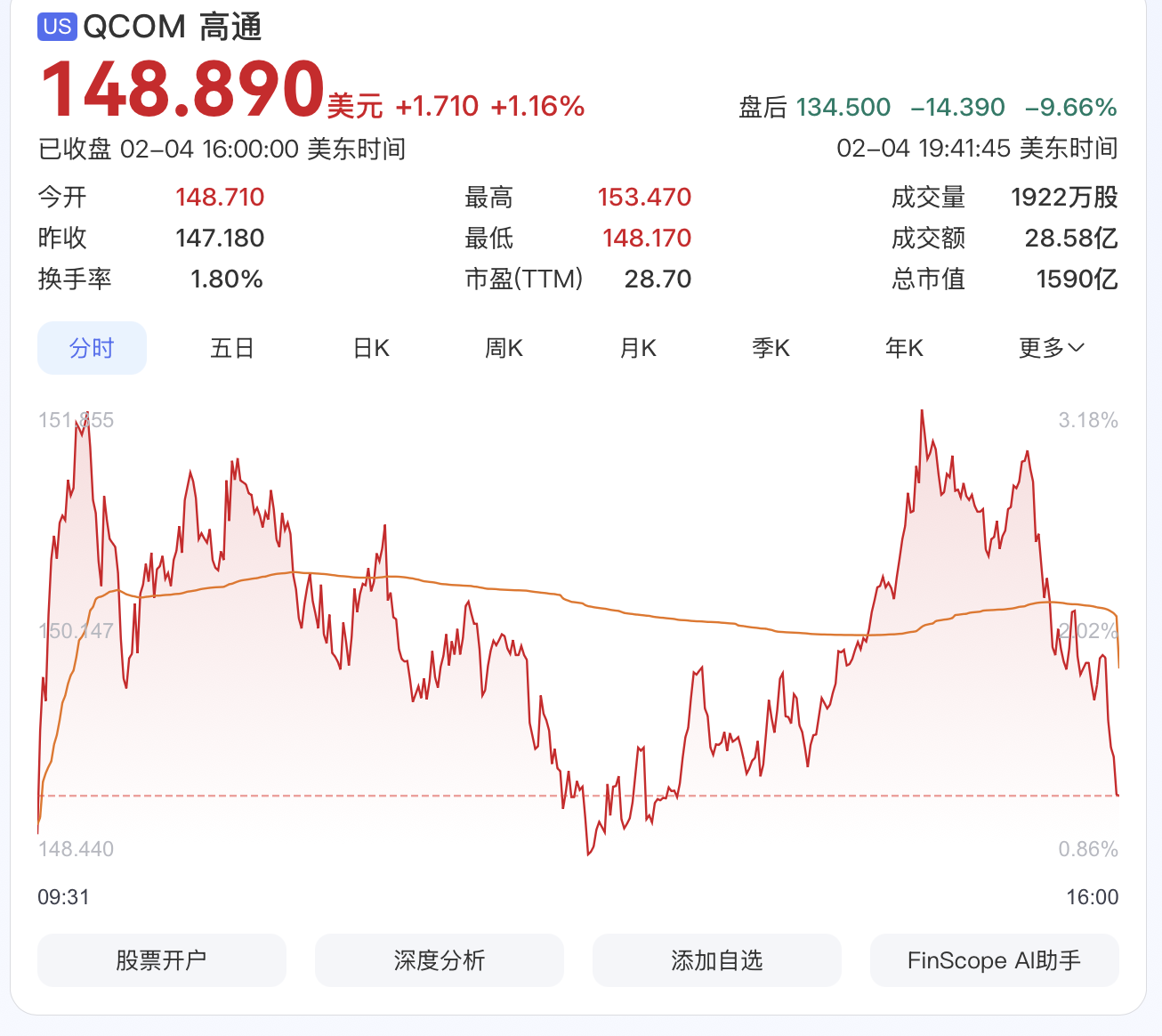
高通盘后股价大跌
Di Yi Cai Jing Zi Xun· 2026-02-05 01:23
Core Viewpoint - Qualcomm reported quarterly revenue and profit slightly above market expectations, but its guidance for the next quarter fell short of Wall Street estimates due to tight memory chip supply, leading to a nearly 10% drop in stock price in after-hours trading [2] Financial Performance - For the first fiscal quarter of 2026 ending December 28, 2025, Qualcomm achieved revenue of approximately $12.25 billion, a 5% year-over-year increase, exceeding analyst expectations of about $12.18 billion [2] - GAAP net profit was $3.004 billion, a 5.5% year-over-year decline, while non-GAAP net profit was $3.78 billion, a 3% year-over-year increase, slightly surpassing market expectations [2] - Semiconductor business (QCT) revenue was $10.61 billion, and licensing business (QTL) revenue was $1.59 billion, both showing year-over-year growth [2] Future Guidance - For the second quarter of fiscal 2026, Qualcomm expects revenue in the range of $10.2 billion to $11 billion, below the analyst consensus of over $11.1 billion [2] - Adjusted earnings per share are projected to be between $2.45 and $2.65, lower than the market estimate of around $2.89 [2] Supply Chain Challenges - Qualcomm indicated that the ongoing tight supply of memory chips is affecting smartphone manufacturers' production plans and inventory management, which in turn suppresses demand for its processors [2][3] - The CEO stated that the performance guidance pressure is primarily due to supply chain constraints rather than a significant decline in end-market demand [3] Market Trends - Due to limited memory supply, smartphone manufacturers are prioritizing high-end models, which supports Qualcomm's chip demand in the high-end Android smartphone market but puts pressure on mid-range and low-end model shipments [5] - The supply chain crisis triggered by memory shortages is posing challenges to the entire smartphone chip industry, affecting other major chip design companies as well [5] Strategic Expansion - In response to industry challenges and cyclical fluctuations in the smartphone market, Qualcomm plans to accelerate expansion in automotive, IoT, personal computing, and data center sectors [5] - In the latest quarter, Qualcomm's automotive chip business generated approximately $1.1 billion in revenue, a year-over-year increase of about 15%, while IoT business revenue was around $1.7 billion, up approximately 9% [5] Long-term Growth Opportunities - Qualcomm is focusing on AI and edge computing product lines, leveraging its chip technology across a wide range of applications from low-power devices to high-performance computing scenarios, which will be a key driver for long-term growth [6] - The ability to alleviate supply chain bottlenecks and achieve breakthroughs in emerging markets such as automotive, AI, and edge computing will be a focal point for investors in the coming quarters [6]


高通盘后股价大跌
第一财经· 2026-02-05 01:20
Core Viewpoint - Qualcomm reported slightly better-than-expected revenue and profit for the latest quarter, but its guidance for the next quarter fell short of Wall Street estimates due to tight memory chip supply, leading to a nearly 10% drop in stock price in after-hours trading [3][4]. Financial Performance - For the first fiscal quarter of 2026, Qualcomm achieved revenue of approximately $12.25 billion, a year-on-year increase of 5%, surpassing the analyst average expectation of about $12.18 billion [3]. - GAAP net profit was $3.004 billion, a decline of 5.5% year-on-year, while non-GAAP net profit was $3.78 billion, a year-on-year increase of 3%, slightly exceeding market expectations [3]. - Semiconductor business (QCT) revenue was $10.61 billion, and licensing business (QTL) revenue was $1.59 billion, both showing year-on-year growth [3]. Guidance and Market Impact - For the second quarter of fiscal 2026, Qualcomm expects revenue in the range of $10.2 billion to $11 billion, below the analyst consensus of over $11 billion [3]. - Adjusted earnings per share are projected to be between $2.45 and $2.65, lower than the market estimate of around $2.89 [3]. Supply Chain Challenges - Qualcomm highlighted that the ongoing tight supply of memory chips is affecting smartphone manufacturers' production plans and inventory rhythms, which in turn suppresses demand for its processors [4]. - CEO Cristiano Amon stated that the pressure on guidance is primarily due to supply chain constraints rather than a significant decline in end-market demand [4]. Market Trends - Due to limited memory supply, smartphone manufacturers are prioritizing high-end models, which supports Qualcomm's chip demand in the high-end Android smartphone market but puts pressure on mid-range and low-end model shipments [6]. - The supply chain crisis triggered by storage issues is posing challenges to the entire smartphone chip industry, affecting other major chip design companies as well [6]. Strategic Focus - Qualcomm plans to accelerate expansion in automotive, IoT, personal computers, and data center sectors to address industry challenges and cyclical fluctuations in the smartphone market [6]. - In the latest quarter, automotive chip revenue was approximately $1.1 billion, a year-on-year increase of about 15%, while IoT business revenue was about $1.7 billion, a year-on-year increase of about 9% [6]. Future Outlook - The ability of Qualcomm to alleviate supply chain bottlenecks and achieve breakthroughs in emerging markets such as automotive, AI, and edge computing will be a focal point for investors in the coming quarters [8].

内存短缺拖累业绩预期,高通盘后股价下跌近10%
Di Yi Cai Jing· 2026-02-05 00:56
Core Viewpoint - The ongoing global memory chip supply constraints are impacting smartphone manufacturers' production plans and inventory management, which in turn affects Qualcomm's processor shipment demand. Group 1: Qualcomm's Financial Performance - Qualcomm reported revenue of approximately $12.25 billion for the first fiscal quarter of 2026, a 5% year-over-year increase, exceeding analyst expectations of about $12.18 billion [1] - The company's GAAP net profit was $3.004 billion, a 5.5% decline year-over-year, while non-GAAP net profit was $3.78 billion, a 3% increase, slightly surpassing market expectations [1] - The semiconductor business (QCT) revenue was $10.61 billion, and the licensing business (QTL) revenue was $1.59 billion, both showing year-over-year growth [1] Group 2: Future Guidance and Market Impact - For the second quarter of fiscal 2026, Qualcomm expects revenue between $10.2 billion and $11 billion, below the analyst consensus of over $11 billion [1] - Adjusted earnings per share are projected to be in the range of $2.45 to $2.65, lower than the market estimate of around $2.89 [1] - The supply chain constraints are primarily due to memory chip shortages, affecting smartphone manufacturers' production schedules and inventory levels, thereby suppressing demand for Qualcomm's processors [1][2] Group 3: Industry Challenges and Strategic Focus - The memory supply crisis is posing challenges to the entire smartphone chip industry, with other major chip design companies also facing impacts from inventory adjustments and slowed production [5] - Qualcomm is accelerating its expansion into automotive, IoT, personal computing, and data center sectors, with automotive chip revenue reaching approximately $1.1 billion, a 15% year-over-year increase, and IoT revenue around $1.7 billion, a 9% increase [5] - Despite short-term impacts from memory supply constraints on smartphone business, Qualcomm's focus on automotive connectivity chips, edge devices, and future data center opportunities is expected to provide new growth avenues [5] Group 4: Future Outlook - The ability of Qualcomm to alleviate supply chain bottlenecks and achieve breakthroughs in emerging markets such as automotive, AI, and edge computing will be a key focus for investors in the coming quarters [6]
英特尔代工,终于找到大客户
半导体行业观察· 2025-07-27 03:17
Core Viewpoint - Intel is experiencing a potential turnaround with new developments in its 14A process technology, which may involve collaboration with Apple and interest from Nvidia [3][4]. Group 1: Intel's 14A Process Technology - Intel's upcoming 14A process will introduce the second generation of RibbonFET and PowerDirect power delivery architecture, building on the PowerVia technology from its 18A process [3]. - The 14A process is targeted at applications in AI and edge computing, with early versions of the 14A Process Development Kit (PDK) provided to key customers, including Nvidia and Apple, for testing [3]. Group 2: Market Dynamics and Competition - Intel's future in the advanced process competition is uncertain, as the company has stated it will exit if it cannot attract significant external customer orders for its 18A and 14A processes [3]. - The semiconductor supply chain is currently dominated by TSMC, leaving major tech companies with limited options regarding node pricing and capacity allocation [4]. - Apple's consideration of Intel's 14A process is significant, as it may diversify its supply chain, especially with TSMC expected to launch its A14 process around the same time [4]. Group 3: Nvidia's Interest - Nvidia has shown interest in collaborating with Intel for its foundry business, driven by the strong demand in the AI sector, indicating that Nvidia cannot rely solely on one foundry [4].



深圳MCU龙头赴港IPO!市值超140亿,年销3亿颗芯片
芯世相· 2025-07-04 09:09
Core Viewpoint - The article discusses the recent IPO application of Guomin Technology, a leading platform MCU company in Shenzhen, and highlights its market position, financial performance, and growth strategies in the semiconductor industry, particularly in the MCU segment. Group 1: Company Overview - Guomin Technology was established in 2000 and became the first integrated circuit design company listed on the Shenzhen Stock Exchange's Growth Enterprise Market in April 2010, with a current market capitalization exceeding 14 billion RMB [8]. - The company ranks among the top five Chinese enterprises in the global platform MCU market based on projected revenue for 2024 [11]. Group 2: Financial Performance - Guomin Technology reported cumulative revenues of 3.4 billion RMB over three years, with losses exceeding 800 million RMB [15]. - The company's revenues for 2022, 2023, and 2024 were 1.195 billion RMB, 1.037 billion RMB, and 1.168 billion RMB, respectively, with corresponding losses of 19 million RMB, 594 million RMB, and 256 million RMB [21]. - The gross profit margins for the same years were 35.6%, 1.7%, and 15.6%, with a significant decline in 2023 attributed to market oversupply and price drops [27][28]. Group 3: Product and Market Position - Guomin Technology has transitioned from specialized market chips to general-purpose MCUs and high-end products like edge AI computing, while also developing a diverse product line including BMS chips and RF chips [16][18]. - The company has achieved significant market presence in five core downstream sectors: consumer electronics, industrial control, digital energy, smart home, and automotive electronics [16]. Group 4: R&D and Innovation - Over 30% of Guomin Technology's workforce is dedicated to R&D, with more than 350 patents held in China [32][34]. - The company operates six R&D centers in major cities and is expanding its research capabilities internationally [33]. Group 5: Customer and Supplier Dynamics - The top five customers contributed 41.4%, 43.4%, and 46.4% of total revenue in 2022, 2023, and 2024, respectively, with the largest customer accounting for 26.0%, 29.5%, and 28.9% of total revenue [39]. - The company’s procurement from the top five suppliers represented 56.4%, 41.8%, and 44.3% of total procurement in the same years, indicating a strong reliance on key suppliers [41]. Group 6: Strategic Outlook - The article emphasizes the growth potential of the MCU market driven by AI, robotics, and new energy applications, positioning Guomin Technology to enhance its competitive edge through high-performance, integrated MCU products [52][54].