高通处理器

Search documents
高通FY26Q1财报一览:核心手机业务遭内存重创,DRAM可得性决定全年手机市场规模
Xin Lang Cai Jing· 2026-02-08 02:12
Core Viewpoint - Qualcomm's FY26 Q1 financial results show a mixed performance with revenue growth but declining net profit, highlighting challenges in the mobile and automotive sectors while emphasizing the need for new growth drivers like AI [3][11][12]. Financial Performance - Revenue for FY26 Q1 reached $12.25 billion, a 5% year-over-year increase and a 9% quarter-over-quarter increase [3] - GAAP gross margin was 54.6%, down 1.2 percentage points year-over-year and 0.7 percentage points quarter-over-quarter [3] - GAAP net profit was $3 billion, a 6% year-over-year decline, with a net profit margin of 24.5% [3] - Non-GAAP net profit was $3.78 billion, down 1% year-over-year but up 16% quarter-over-quarter [3] - The company expects FY26 Q2 revenue to be between $10.2 billion and $11 billion, indicating a 3% year-over-year decline at the midpoint [3] Business Segments Mobile - Mobile revenue was $7.82 billion, a 3% year-over-year increase, accounting for 64% of total revenue [5] - Qualcomm secured 75% of the new Samsung flagship product's share, aligning with previous expectations [5] - The mobile sector is facing challenges due to memory supply and pricing constraints, with Chinese OEMs reducing annual production forecasts [5] Automotive - Automotive revenue reached $1.1 billion, a 15% year-over-year increase, but growth is slowing [6] - Qualcomm signed a long-term supply agreement with Volkswagen Group, covering multiple brands [6] - The company maintains a revenue target of $8 billion for the automotive segment by FY29 [6] IoT - IoT revenue was $1.69 billion, a 9% year-over-year increase, representing 14% of total revenue [7] - The launch of the X2 Plus platform targets the enterprise market, with plans for 150 devices featuring the X Elite/Plus platforms [7] - Qualcomm aims for $14 billion in IoT revenue by FY29 [7] Data Center - Qualcomm's data center segment is progressing with its only publicly announced customer being HUMAIN [9] - The company is expanding its CPU roadmap to include RISC-V alongside Arm [9] - Management is optimistic about future revenue opportunities in the data center space, with a target for significant revenue growth by FY27 [9] Challenges and Outlook - All business segments are facing growth bottlenecks, necessitating new growth avenues such as AI [11] - Qualcomm's revenue from China accounted for 46% in FY25, raising concerns amid geopolitical tensions [11] - The company is experiencing a significant impact on its core mobile business due to imbalances in memory supply and demand [12] - Despite optimistic guidance for automotive and data center growth, uncertainties regarding memory supply recovery pose risks to overall revenue and profit for FY26 [12]


“存储荒”压顶!高通股价暴跌超8%
Guan Cha Zhe Wang· 2026-02-06 06:13
Core Viewpoint - Qualcomm reported its Q1 FY26 earnings on February 4, 2024, exceeding market expectations, but its outlook was negatively impacted by a global memory shortage, leading to a significant drop in stock price [1][2]. Financial Performance - For Q1 FY26, Qualcomm achieved revenue of approximately $12.25 billion, a 5% year-over-year increase, surpassing analyst expectations of around $12.18 billion [3]. - GAAP net profit was $3.004 billion, a decline of 5.5% year-over-year, while non-GAAP net profit was $3.78 billion, a 3% increase, slightly exceeding market expectations [3]. - The semiconductor business (QCT) generated revenue of $10.61 billion, and the licensing business (QTL) brought in $1.59 billion, both showing year-over-year growth [3]. Guidance and Market Outlook - For Q2 FY26, Qualcomm expects revenue in the range of $10.2 billion to $11 billion, below the analyst consensus of over $11 billion [3]. - Adjusted earnings per share are projected to be between $2.45 and $2.65, lower than the market estimate of approximately $2.89 [3]. Segment Performance - Qualcomm's mobile business revenue reached $7.82 billion, a 3% year-over-year increase [5]. - The IoT segment saw a 9% year-over-year growth in revenue, totaling $1.69 billion, which includes industrial-grade chips and chips for Meta's smart glasses [5]. - The automotive segment experienced a significant 15% year-over-year increase in revenue, reaching $1.1 billion, with Qualcomm supplying chips to major automotive manufacturers like Toyota [5]. Supply Chain Challenges - Qualcomm highlighted ongoing global memory chip supply constraints, with large orders for data center memory affecting the availability for smartphones and other devices, thereby suppressing processor shipment demand [5]. - The CEO noted that while smartphone demand remains strong, supply chain issues are anticipated, and customers may shift focus to high-end models to better absorb cost pressures from rising memory prices [5].

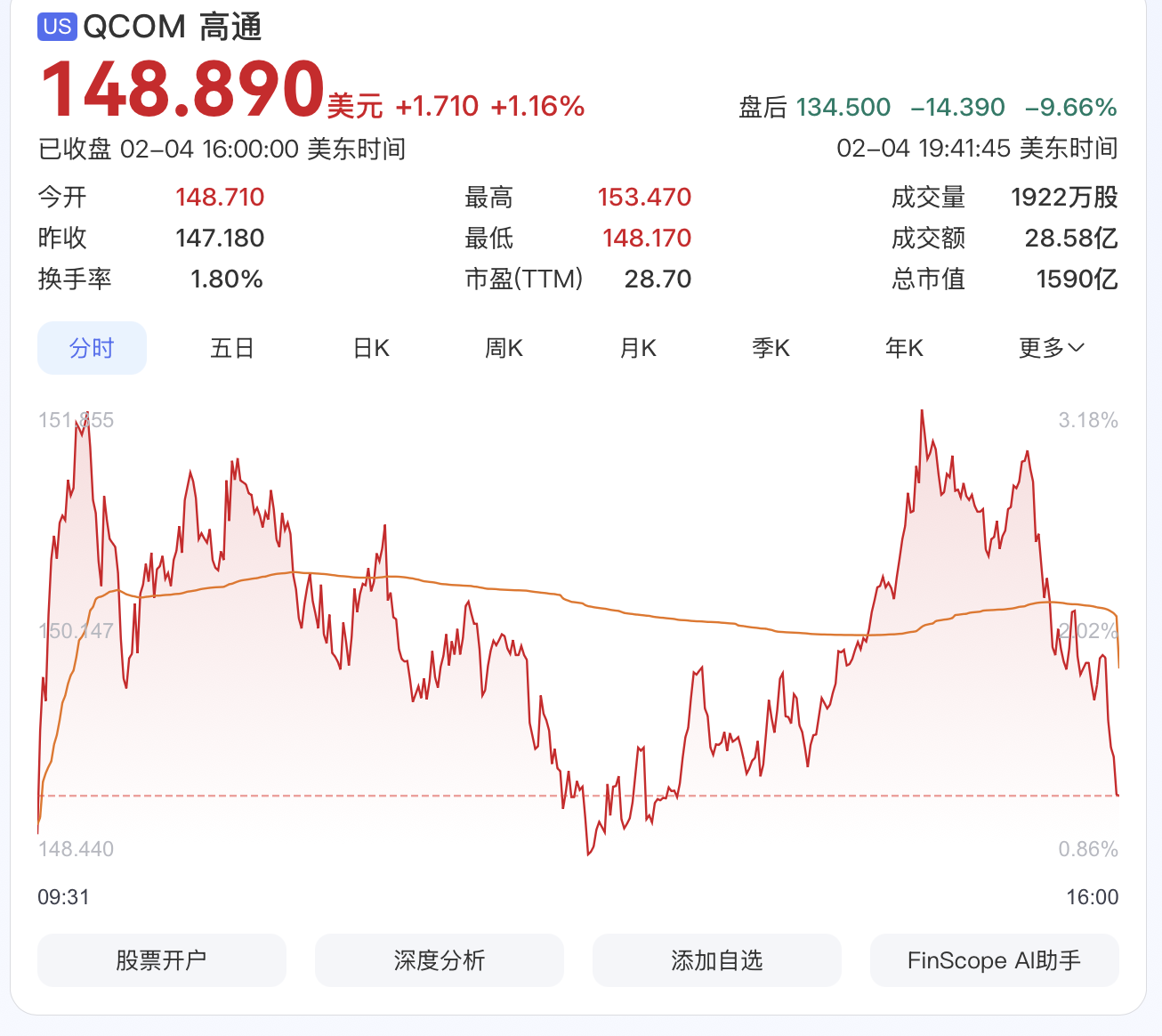
高通盘后股价大跌
Di Yi Cai Jing Zi Xun· 2026-02-05 01:23
Core Viewpoint - Qualcomm reported quarterly revenue and profit slightly above market expectations, but its guidance for the next quarter fell short of Wall Street estimates due to tight memory chip supply, leading to a nearly 10% drop in stock price in after-hours trading [2] Financial Performance - For the first fiscal quarter of 2026 ending December 28, 2025, Qualcomm achieved revenue of approximately $12.25 billion, a 5% year-over-year increase, exceeding analyst expectations of about $12.18 billion [2] - GAAP net profit was $3.004 billion, a 5.5% year-over-year decline, while non-GAAP net profit was $3.78 billion, a 3% year-over-year increase, slightly surpassing market expectations [2] - Semiconductor business (QCT) revenue was $10.61 billion, and licensing business (QTL) revenue was $1.59 billion, both showing year-over-year growth [2] Future Guidance - For the second quarter of fiscal 2026, Qualcomm expects revenue in the range of $10.2 billion to $11 billion, below the analyst consensus of over $11.1 billion [2] - Adjusted earnings per share are projected to be between $2.45 and $2.65, lower than the market estimate of around $2.89 [2] Supply Chain Challenges - Qualcomm indicated that the ongoing tight supply of memory chips is affecting smartphone manufacturers' production plans and inventory management, which in turn suppresses demand for its processors [2][3] - The CEO stated that the performance guidance pressure is primarily due to supply chain constraints rather than a significant decline in end-market demand [3] Market Trends - Due to limited memory supply, smartphone manufacturers are prioritizing high-end models, which supports Qualcomm's chip demand in the high-end Android smartphone market but puts pressure on mid-range and low-end model shipments [5] - The supply chain crisis triggered by memory shortages is posing challenges to the entire smartphone chip industry, affecting other major chip design companies as well [5] Strategic Expansion - In response to industry challenges and cyclical fluctuations in the smartphone market, Qualcomm plans to accelerate expansion in automotive, IoT, personal computing, and data center sectors [5] - In the latest quarter, Qualcomm's automotive chip business generated approximately $1.1 billion in revenue, a year-over-year increase of about 15%, while IoT business revenue was around $1.7 billion, up approximately 9% [5] Long-term Growth Opportunities - Qualcomm is focusing on AI and edge computing product lines, leveraging its chip technology across a wide range of applications from low-power devices to high-performance computing scenarios, which will be a key driver for long-term growth [6] - The ability to alleviate supply chain bottlenecks and achieve breakthroughs in emerging markets such as automotive, AI, and edge computing will be a focal point for investors in the coming quarters [6]
内存短缺拖累业绩预期,高通盘后股价下跌近10%
Di Yi Cai Jing· 2026-02-05 00:56
Core Viewpoint - The ongoing global memory chip supply constraints are impacting smartphone manufacturers' production plans and inventory management, which in turn affects Qualcomm's processor shipment demand. Group 1: Qualcomm's Financial Performance - Qualcomm reported revenue of approximately $12.25 billion for the first fiscal quarter of 2026, a 5% year-over-year increase, exceeding analyst expectations of about $12.18 billion [1] - The company's GAAP net profit was $3.004 billion, a 5.5% decline year-over-year, while non-GAAP net profit was $3.78 billion, a 3% increase, slightly surpassing market expectations [1] - The semiconductor business (QCT) revenue was $10.61 billion, and the licensing business (QTL) revenue was $1.59 billion, both showing year-over-year growth [1] Group 2: Future Guidance and Market Impact - For the second quarter of fiscal 2026, Qualcomm expects revenue between $10.2 billion and $11 billion, below the analyst consensus of over $11 billion [1] - Adjusted earnings per share are projected to be in the range of $2.45 to $2.65, lower than the market estimate of around $2.89 [1] - The supply chain constraints are primarily due to memory chip shortages, affecting smartphone manufacturers' production schedules and inventory levels, thereby suppressing demand for Qualcomm's processors [1][2] Group 3: Industry Challenges and Strategic Focus - The memory supply crisis is posing challenges to the entire smartphone chip industry, with other major chip design companies also facing impacts from inventory adjustments and slowed production [5] - Qualcomm is accelerating its expansion into automotive, IoT, personal computing, and data center sectors, with automotive chip revenue reaching approximately $1.1 billion, a 15% year-over-year increase, and IoT revenue around $1.7 billion, a 9% increase [5] - Despite short-term impacts from memory supply constraints on smartphone business, Qualcomm's focus on automotive connectivity chips, edge devices, and future data center opportunities is expected to provide new growth avenues [5] Group 4: Future Outlook - The ability of Qualcomm to alleviate supply chain bottlenecks and achieve breakthroughs in emerging markets such as automotive, AI, and edge computing will be a key focus for investors in the coming quarters [6]