AI原生6G

Search documents
英伟达新动作?欲打造“AI原生6G”
2 1 Shi Ji Jing Ji Bao Dao· 2026-03-08 02:25
Core Insights - The 2026 Mobile World Congress (MWC) highlighted the significant role of AI in the telecommunications industry, with Nvidia positioning itself as a leader in AI-driven 6G technology [1][7] - Nvidia's CEO emphasized the need for AI-native networks that integrate AI from the ground up, transforming communication towers into AI supercomputers [1] - The establishment of the AI-RAN alliance by Nvidia aims to redefine 6G networks and enhance the integration of AI with radio access networks [2][5] Group 1: Nvidia's Strategy and Developments - Nvidia has been progressively entering the telecommunications sector since 2019, initially focusing on 5G software-defined RAN and evolving towards 6G solutions [4][5] - The company launched the AI-RAN alliance in February 2024, which includes major players like SoftBank, Ericsson, and Nokia, but notably excludes Huawei and ZTE [5][6] - Nvidia's AI-native 6G strategy includes the introduction of the Nemotron LTM model and the Aerial platform, which supports the development and deployment of AI-driven telecommunications solutions [7][8] Group 2: Industry Perspectives and Challenges - Analysts believe that while the integration of AI and 6G is a natural progression, Nvidia faces significant challenges in successfully implementing its vision, particularly in scaling its solutions [2][10] - The absence of Chinese telecom operators in the AI-RAN alliance is seen as a major hurdle for Nvidia, as successful communication standards require global collaboration [9][10] - The competitive landscape indicates that Nvidia must ensure its chips remain relevant and marketable, especially amid geopolitical tensions that could impact its position in the telecommunications sector [10]



庄思民:高通以AI原生6G加速下一代无线技术落地
Huan Qiu Wang· 2026-02-27 10:30
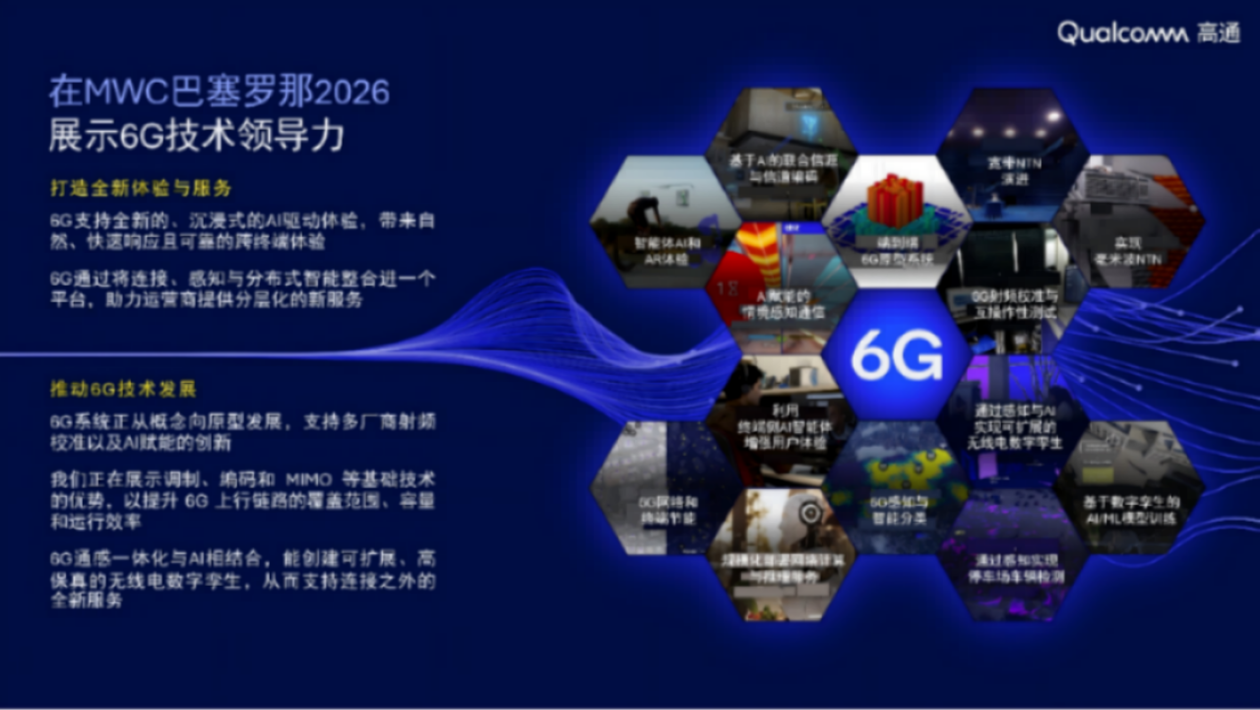
Core Viewpoint - Qualcomm is set to showcase its advancements in 6G technology at the upcoming MWC 2026, focusing on intelligent and efficient engineering practices, with three core themes: evolution of 6G foundational technologies, AI-native design for new experiences, and a digital twin platform empowered by perception [1][7]. Group 1: 6G Foundational Technology Evolution - The development of 6G begins with scalable system design choices, emphasizing efficient use of bandwidth, improved spectrum efficiency, and advancing air interface technologies towards greater intelligence [3]. - Qualcomm will present an end-to-end 6G prototype system that integrates technologies such as massive MIMO, probabilistic shaping, and full-duplex subband, enhancing spectrum efficiency and increasing throughput for data-intensive applications [3]. - Collaborations with leading infrastructure suppliers for 6G RF calibration and interoperability testing are underway to validate key RF front-end performance targets, advancing the early ecosystem of 6G [3]. Group 2: AI-Native Experience and Services - The core challenge for wireless communication systems has shifted from mere bit transmission to ensuring a consistent experience across all scenarios, with distributed computing, collaborative communication, and context-aware adaptability becoming key research areas for 6G [4]. - Four core technological achievements will be showcased: AI and AR experiences leveraging distributed computing, AI-enabled context-aware communication, scalable network computing and inference services, and enhanced cellular experiences through AI agents [4]. Group 3: Integrated Sensing and Communication (ISAC) - ISAC extends wireless communication beyond mere connectivity into the realm of perception, creating new service opportunities and pathways for efficient wireless system operation [5]. - Key demonstrations will include real-time target detection and tracking capabilities, scalable radio digital twins, AI/ML model training based on synthetic data, and energy-efficient 6G networks [5]. Group 4: Non-Terrestrial Networks (NTN) - The evolution of non-terrestrial networks is crucial for achieving comprehensive broadband coverage in 6G, with advancements in millimeter-wave NTN technologies being explored [6]. - Next-generation broadband access terminals will utilize millimeter-wave spectrum to provide robust, high-speed satellite connections across wider areas, including direct satellite connections to various devices [6]. Group 5: Future Development of 6G Technology - The wave of 6G is fully underway, with Qualcomm actively participating in 3GPP's research on new capabilities and architectures for 6G [7]. - The company aims to continue its focus on AI-native experiences, perception-enabled infrastructure, and radio digital twins, leveraging its extensive experience in mobile communication technology evolution [7].