算力网络

Search documents
提气!一张全自研高速网正撑起中国算力大动脉
第一财经· 2026-03-13 03:09
Core Viewpoint - The article emphasizes the critical role of computing power in the AI era, highlighting the rapid deployment of large-scale intelligent computing centers as a reflection of the expanding AI applications across various industries [1][5][15]. Group 1: Computing Power Infrastructure - The deployment of the scaleFabric high-speed network at the national supercomputing internet core node has attracted hundreds of AI model vendors and numerous universities and research institutions [1]. - The scaleFabric network, developed by Zhongke Shuguang, represents a significant leap from merely increasing the number of computing cards to enhancing network efficiency, which is crucial for maximizing the value of computing clusters [3][7]. - The demand for computing power for large model training is doubling approximately every 3.5 months, with AI application performance also improving significantly every 9 months [5][6]. Group 2: Network Efficiency and Challenges - The current intelligent computing networks face challenges such as high latency, difficulty in coordination, and operational issues, necessitating a shift towards integrated and self-researched solutions [5][6]. - Research indicates that communication time in dense models accounts for 10% to 20%, while in Mixture of Experts (MoE) models, it can reach 40% to 60%, highlighting the importance of network efficiency in determining cluster value [6][7]. Group 3: Technological Advancements - The scaleFabric network features an ultra-high bandwidth of 800Gb/s per port and end-to-end transmission latency of less than 1 microsecond, significantly enhancing scalability and reducing overall network costs by 30% compared to existing solutions [8][15]. - The choice of InfiniBand (IB) technology over RDMA over Converged Ethernet (RoCE) allows for better performance and lower latency, making it suitable for large-scale networks [10][11]. Group 4: Market Impact and Future Outlook - The introduction of the scaleFabric network is expected to reshape the domestic computing power landscape, providing a cost-effective alternative to imported IB solutions and enabling easier maintenance and operation of large clusters [15][16]. - The demand for high-bandwidth products is anticipated to grow, with the IBTA organization projecting a need for 1.6Tb/s IB products by 2028, indicating a competitive landscape for next-generation AI model training [15][16].



能源早新闻丨特朗普:将“稍微”减少战略石油储备以降低油价,以应对美国和以色列空袭伊朗引发的油价上涨
中国能源报· 2026-03-12 22:33
Industry Standards - The Ministry of Industry and Information Technology approved 453 industry standards, including 5 for the chemical industry, 2 for petrochemicals, 4 for black metallurgy, 1 for non-ferrous metals, 33 for building materials, 182 for machinery, 71 for light industry, 4 for electronics, and 151 for telecommunications [2] Domestic News - Tax data indicates that China's technology innovation is showing a good development trend, with high-tech industry sales revenue increasing by 16.1% year-on-year in the first two months of the year. High-tech service industry sales revenue grew by 17.2%, with significant increases in technology intermediary services and natural scientific research [3] - A large solid-state hydrogen storage device has been successfully exported from Shanghai, marking a breakthrough in China's self-developed solid-state hydrogen technology. The estimated hydrogen transport scale for related projects in 2026 is about 500 tons [3] - Researchers from Tianjin University proposed a new green and efficient preparation method for two-dimensional transition metal carbides (MXene), providing a new pathway for large-scale applications [3] Energy Sector - The "Long Electric into Hunan" project has delivered over 230 billion kilowatt-hours of electricity, with renewable energy accounting for over 40% of the total [4] - In the first two months of the year, the retail sales of new energy passenger vehicles in China reached 1.06 million units, a year-on-year decline of 25.7% [4] - 24 enterprises in Yunnan have been recognized as national-level green factories, covering various sectors such as chemicals, non-ferrous metals, new energy, printing, and equipment manufacturing, indicating a continuous improvement in industrial green development [4] International News - The International Energy Agency agreed to release 400 million barrels of strategic oil reserves, the largest release in history, to address global oil supply tensions due to military actions involving the US and Israel against Iran [5] - The US President announced plans to "slightly" release the strategic oil reserves to mitigate rising oil prices caused by military actions in Iran [6] - Two oil tankers were attacked in Iraqi waters, leading to the suspension of all oil terminal operations in the country [6] - The Netherlands is considering establishing an emergency natural gas supply system in response to recent volatility in international natural gas prices due to military actions in Iran [6] Corporate News - Inner Mongolia Power Group signed a construction management agreement with the State Grid Corporation for the Dalarate-Mongolia 1000 kV AC transmission project, with the State Grid investing in the project and Inner Mongolia Power Group managing on-site construction [7]
英伟达新动作?欲打造“AI原生6G”
2 1 Shi Ji Jing Ji Bao Dao· 2026-03-08 02:25
Core Insights - The 2026 Mobile World Congress (MWC) highlighted the significant role of AI in the telecommunications industry, with Nvidia positioning itself as a leader in AI-driven 6G technology [1][7] - Nvidia's CEO emphasized the need for AI-native networks that integrate AI from the ground up, transforming communication towers into AI supercomputers [1] - The establishment of the AI-RAN alliance by Nvidia aims to redefine 6G networks and enhance the integration of AI with radio access networks [2][5] Group 1: Nvidia's Strategy and Developments - Nvidia has been progressively entering the telecommunications sector since 2019, initially focusing on 5G software-defined RAN and evolving towards 6G solutions [4][5] - The company launched the AI-RAN alliance in February 2024, which includes major players like SoftBank, Ericsson, and Nokia, but notably excludes Huawei and ZTE [5][6] - Nvidia's AI-native 6G strategy includes the introduction of the Nemotron LTM model and the Aerial platform, which supports the development and deployment of AI-driven telecommunications solutions [7][8] Group 2: Industry Perspectives and Challenges - Analysts believe that while the integration of AI and 6G is a natural progression, Nvidia faces significant challenges in successfully implementing its vision, particularly in scaling its solutions [2][10] - The absence of Chinese telecom operators in the AI-RAN alliance is seen as a major hurdle for Nvidia, as successful communication standards require global collaboration [9][10] - The competitive landscape indicates that Nvidia must ensure its chips remain relevant and marketable, especially amid geopolitical tensions that could impact its position in the telecommunications sector [10]


中国银河证券:市场需求高增叠加集采提价 光纤光缆上行周期打开
Zhi Tong Cai Jing· 2026-03-02 09:00
Core Viewpoint - China Telecom has announced an emergency procurement project for fiber optic cables in its Guangdong branch for Q1 2026, indicating a significant price increase in the fiber optic market, with the maximum price for GJYXFCH-1 core cable set at 310 yuan per kilometer, reflecting a 45.36% increase from previous prices [1][2]. Group 1: Procurement Details - The procurement focuses on FTTH butterfly-shaped fiber optic cables, with a maximum response price of 1,726,955.49 yuan for the project [2]. - The previous maximum price for GJYXFCH-1 core cable was 213.27 yuan per kilometer, highlighting a substantial price increase in the current procurement [2]. Group 2: Market Trends - The demand for fiber optic cables is increasing, with operators raising procurement prices; for instance, China Telecom's procurement prices for G.652.D cables have risen by over 31% year-on-year, with some prices increasing by as much as 64.29% [3]. - The price of G.652.D fiber has exceeded 50 yuan per core kilometer, compared to 20 yuan in November 2025 and 35.6 yuan in January 2026, indicating a robust market [3]. Group 3: Industry Outlook - The fiber optic market is experiencing sustained price increases due to rapid growth in AI and computing networks, with a projected global demand increase of 4.1% for fiber optic cables by 2025, and a 75.9% increase in data center fiber cable demand [4]. - Supply constraints are expected to persist due to the long expansion cycle for optical fiber preform, which is approximately two years, suggesting continued price potential for fiber optic cables [4]. Group 4: Key Companies - The report highlights several core manufacturers in the fiber optic cable sector, including Zhongtian Technology, Hengtong Optic-Electric, Yangtze Optical Fibre and Cable, TeFa Information Technology, Yongding Co., and FiberHome Technologies [5].




机构称中国市场G.652.D单模光纤价格创下近七年新高,长飞光纤再创新高丨盘中线索
2 1 Shi Ji Jing Ji Bao Dao· 2026-02-24 02:14
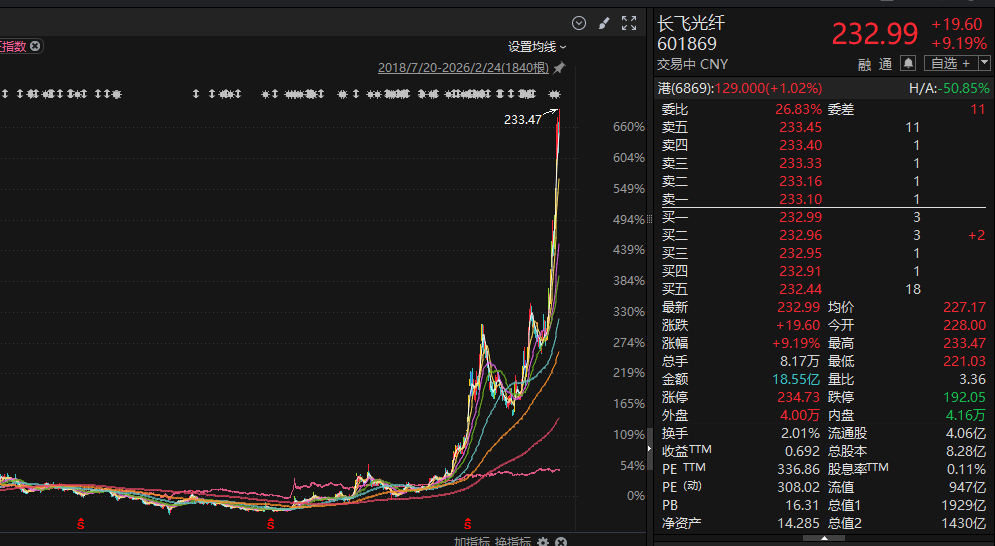
Group 1 - The optical fiber sector is experiencing a strong upward trend, with Changfei Fiber reaching new highs [1] - The demand for high-performance optical fibers and cables is surging due to the global AI wave, leading to unprecedented needs for low latency and high bandwidth [3] - The average price of G.652.D single-mode optical fiber in China reached 35 yuan per core kilometer in January 2026, marking a nearly seven-year high, with a monthly increase of over 75% [3] Group 2 - The optical fiber industry is confirmed to be in a price-up cycle, with increasing prices driven by heightened demand from overseas markets [4] - Major domestic clients are expected to accept price increases, benefiting leading companies in the optical fiber and cable sector [4] - Recommendations include Changfei Fiber, Hengtong Optic-Electric, and Zhongtian Technology, as these companies are likely to benefit from the price surge and improved profitability [4]

刷新纪录!美国GDP第一次突破30万亿,中国占比却卡在六成?
Sou Hu Cai Jing· 2026-02-22 11:07
Group 1 - The core point of the article is the comparison of GDP between the United States and China, highlighting that while the US is projected to reach a GDP of $30 trillion by 2025, China is at approximately $19.6 trillion, representing about 63% of the US figure [1][10][28] - The growth rates are crucial, with the US maintaining a growth rate of around 2% while China is between 4% and 5%, suggesting that if this trend continues, the GDP ratio could change over the years [3][10] - The quality of growth is emphasized, with the US focusing on high-profit sectors such as chips, operating systems, and cloud services, which provide significant pricing power globally [3][5] Group 2 - The revenue models of leading global companies, predominantly American, rely on long-term subscriptions and patent royalties, resulting in slower expansion but higher profits [5] - China's economy is characterized by a solid manufacturing base and a complete industrial chain, with sectors like new energy and high-end manufacturing on the rise [5][22] - Research and development investments in China are increasing, but the country still lacks full control over core technologies and standards, which are essential for determining profit distribution [6][20] Group 3 - Historical context shows that major power competition is often determined by industrial waves rather than single-year performances, with current key areas being artificial intelligence and clean energy [8][26] - The nominal GDP figures can be misleading due to inflation and exchange rate fluctuations, with nearly $900 billion of the US GDP growth attributed to price increases rather than actual production [12][18] - The purchasing power parity (PPP) perspective indicates that China's GDP may already surpass that of the US, although nominal values are often used for international rankings [14][18] Group 4 - The US dollar's dominance in global trade and finance gives it significant pricing power, affecting how GDP is calculated and perceived internationally [16][20] - The structural differences in industry and development stages between the US and China are highlighted, with the US being a high-income society and China still transitioning towards that status [24][26] - The potential for China to convert its manufacturing advantages into technological and brand advantages is crucial for future growth and profit margins [26][28]

马力全开!订单已排到了下半年
Nan Jing Ri Bao· 2026-02-19 22:31
Core Insights - The company is experiencing a significant increase in orders, with production capacity fully utilized and exports expected to double, particularly targeting North America and Europe [7][11] - The demand for high-performance optical fibers is surging due to the global AI wave and the need for low-latency, high-bandwidth capabilities in computing networks [5][3] - The company has expanded its production capacity by 8 million core kilometers and plans to produce approximately 34 million core kilometers in 2025, with an expected increase to 40 million core kilometers in 2026 [7] Production and Operations - The company operates 38 optical fiber production lines at full capacity, with ongoing efforts to meet delivery demands despite existing backlogs [7] - During the Spring Festival, the company maintained production to support global computing network construction, emphasizing its commitment to continuous operation [5][11] - Quality control is a critical aspect of the production process, with rigorous testing to ensure optical fibers meet performance standards before delivery [10] Market Trends - The price of G.652.D single-mode optical fibers in the Chinese market reached a nearly seven-year high of over 35 yuan per core kilometer, with a monthly increase of over 75% in January [5] - The introduction of high-strength anti-micro-bending optical fibers is a key innovation, reducing signal loss by approximately 30% under various conditions, which is crucial for efficient data transmission in busy computing networks [3]

印尼电信市场新规实施,第一太平资产投产与宏观经济动向引关注
Jing Ji Guan Cha Wang· 2026-02-18 16:51
Industry Policy and Environment - The Indonesian Ministry of Communication and Information Technology issued Ministerial Regulation No. 469 on December 7, 2025, mandating that 187 types of telecommunications products must obtain DJID certification to enter the market, affecting smart appliances, IoT devices, and consumer electronics. This regulation will be enforced in 2026, impacting compliance progress and market adaptability of telecom equipment suppliers [1]. - Indonesia's GDP growth was 5.11% in 2025, with Q4 growth reaching 5.39%, exceeding expectations. Economic performance in 2026 will be influenced by the effectiveness of fiscal policies, commodity price fluctuations, and central bank monetary policies. Capital Economics predicts a potential 75 basis point rate cut by the central bank, which could enhance market liquidity [3]. - A trade agreement between Indonesia and the United States has reduced some export uncertainties, but concerns over commodity price volatility and fiscal sustainability may still affect market sentiment. Continuous monitoring is required to assess whether infrastructure investments, including telecommunications, are supported by fiscal expansion policies [5]. Company Project Progress - The Silangan copper-gold project under First Pacific is expected to commence production in Q1 2026, potentially releasing profit elasticity during a strong cycle in non-ferrous metal prices. Additionally, PLDT's fintech platform, Maya, achieved semi-annual profitability in 2025, with a focus on user growth and commercialization deepening in 2026 [2]. Industry Status - Global operators are accelerating resource allocation towards emerging fields such as computing networks and 6G research. As an emerging market in Southeast Asia, Indonesia's telecom operators need to be closely monitored for their progress in 5G coverage, green data center initiatives (e.g., PUE below 1.25), and AI computing power deployment [4].

2026年1月直播卫星用户达15544万户
Xin Lang Cai Jing· 2026-02-06 11:26
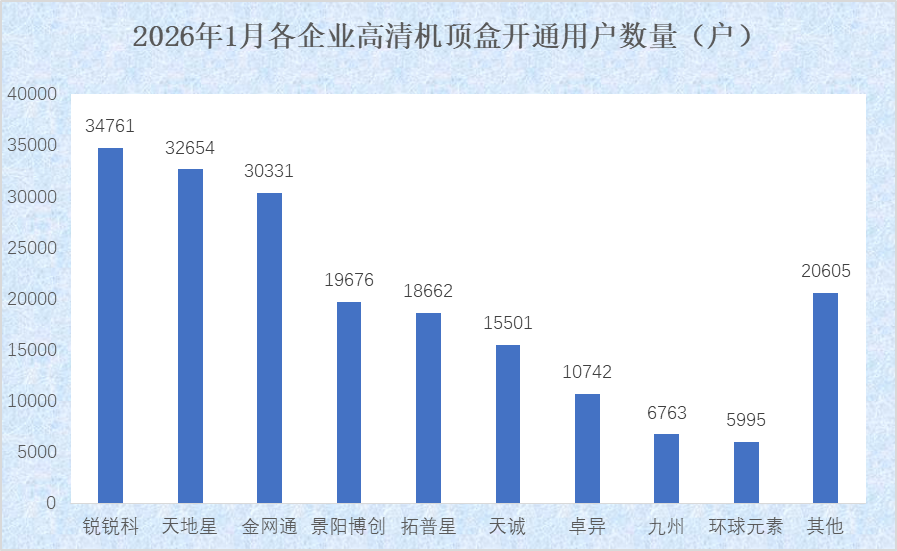
Group 1 - As of January 31, 2026, the satellite broadcasting center has developed a total of 155.44 million satellite broadcasting users and 10.36 million HD users [1][4] - In the current month, 190,000 new HD users were added, with data from 32 set-top box companies contributing to the HD user growth [1][4] Group 2 - The industry is actively pursuing the multi-billion satellite market, with operators competing for market share [3][7] - There is a significant push towards the implementation of new technologies such as AI in manufacturing and the development of 6G to expand smart terminal capabilities [3][7]
重磅!scaleX万卡超集群破纪录!
国芯网· 2026-02-05 13:13
Core Insights - The national supercomputing internet core node has officially launched, featuring the deployment of three sets of the Sunway scaleX 30,000-card super cluster system, marking it as the largest domestic AI computing power pool in operation [1][3]. Group 1: Strategic Significance - The core node is a major infrastructure project supported by multiple stakeholders, including national ministries and local governments, highlighting its strategic importance for the integrated computing power network in China [3]. - The successful deployment of the domestic 30,000-card super cluster sets multiple industry records and serves as a national model for computing power network construction [3]. Group 2: Technical Innovations - The scaleX super cluster features the world's first high-density single cabinet design, significantly increasing computing density by 20 times and achieving a PUE value as low as 1.04 [3]. - It is the first domestic super cluster capable of integrating 10,240 accelerator cards, representing the largest scale of domestic computing clusters [3]. Group 3: Open Architecture - The cluster is designed with an open architecture for AI computing, breaking away from traditional single-technology stack dependencies, allowing support for multiple brands of AI accelerator cards and compatibility with mainstream AI software ecosystems [3][4]. - This open architecture addresses the challenges of heterogeneous computing interconnectivity, optimizing resource allocation and enhancing overall computing efficiency and performance [4]. Group 4: Market Implications - The scaleX super cluster acts as an open resource pool, facilitating connections between different AI computing resources and users, and providing a rapid deployment platform for various AI applications [4]. - Following the core node's launch, it is expected to become a central hub for computing power in central China, effectively linking green computing resources from the west with demand from the east, and playing a crucial role in nationwide computing power distribution [4].