
非地面网络(NTN)

Search documents
庄思民:高通以AI原生6G加速下一代无线技术落地
Huan Qiu Wang· 2026-02-27 10:30
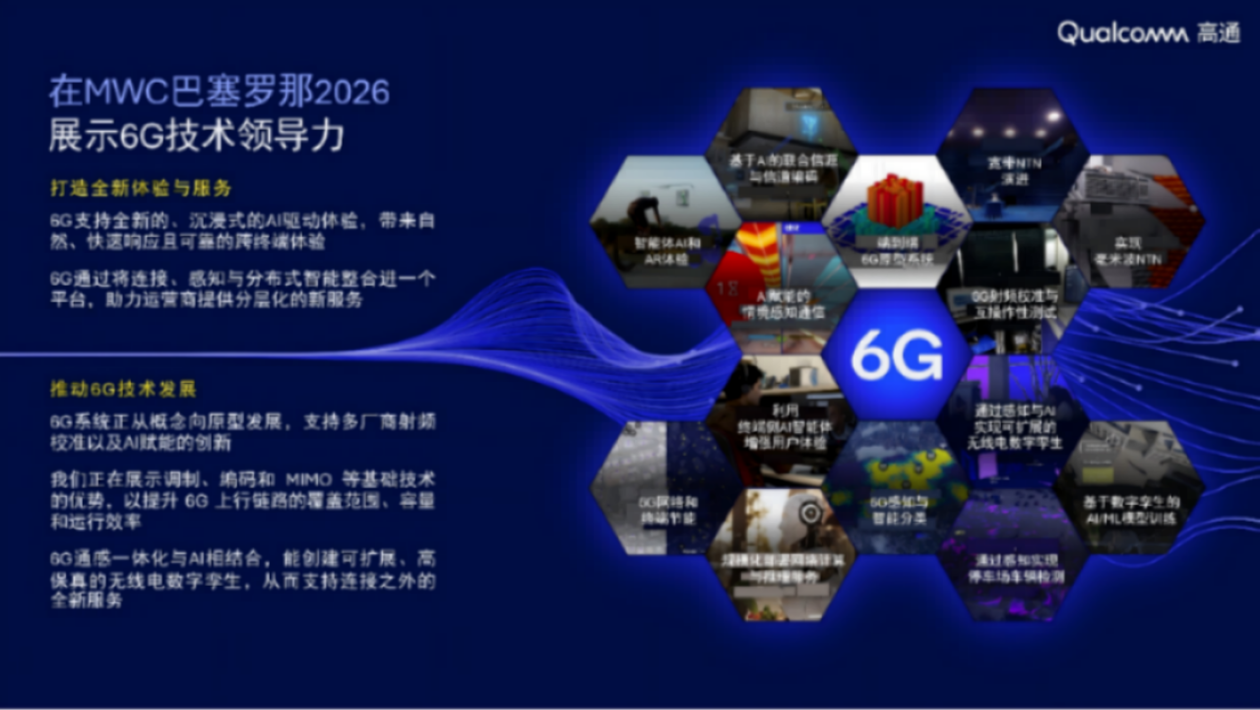
Core Viewpoint - Qualcomm is set to showcase its advancements in 6G technology at the upcoming MWC 2026, focusing on intelligent and efficient engineering practices, with three core themes: evolution of 6G foundational technologies, AI-native design for new experiences, and a digital twin platform empowered by perception [1][7]. Group 1: 6G Foundational Technology Evolution - The development of 6G begins with scalable system design choices, emphasizing efficient use of bandwidth, improved spectrum efficiency, and advancing air interface technologies towards greater intelligence [3]. - Qualcomm will present an end-to-end 6G prototype system that integrates technologies such as massive MIMO, probabilistic shaping, and full-duplex subband, enhancing spectrum efficiency and increasing throughput for data-intensive applications [3]. - Collaborations with leading infrastructure suppliers for 6G RF calibration and interoperability testing are underway to validate key RF front-end performance targets, advancing the early ecosystem of 6G [3]. Group 2: AI-Native Experience and Services - The core challenge for wireless communication systems has shifted from mere bit transmission to ensuring a consistent experience across all scenarios, with distributed computing, collaborative communication, and context-aware adaptability becoming key research areas for 6G [4]. - Four core technological achievements will be showcased: AI and AR experiences leveraging distributed computing, AI-enabled context-aware communication, scalable network computing and inference services, and enhanced cellular experiences through AI agents [4]. Group 3: Integrated Sensing and Communication (ISAC) - ISAC extends wireless communication beyond mere connectivity into the realm of perception, creating new service opportunities and pathways for efficient wireless system operation [5]. - Key demonstrations will include real-time target detection and tracking capabilities, scalable radio digital twins, AI/ML model training based on synthetic data, and energy-efficient 6G networks [5]. Group 4: Non-Terrestrial Networks (NTN) - The evolution of non-terrestrial networks is crucial for achieving comprehensive broadband coverage in 6G, with advancements in millimeter-wave NTN technologies being explored [6]. - Next-generation broadband access terminals will utilize millimeter-wave spectrum to provide robust, high-speed satellite connections across wider areas, including direct satellite connections to various devices [6]. Group 5: Future Development of 6G Technology - The wave of 6G is fully underway, with Qualcomm actively participating in 3GPP's research on new capabilities and architectures for 6G [7]. - The company aims to continue its focus on AI-native experiences, perception-enabled infrastructure, and radio digital twins, leveraging its extensive experience in mobile communication technology evolution [7].


工业和信息化部:推动卫星通信充分融入新发展格局 到2030年发展卫星通信用户超千万
Shang Hai Zheng Quan Bao· 2025-08-27 18:33
Core Viewpoint - The Ministry of Industry and Information Technology (MIIT) has released guidelines aimed at optimizing business access and promoting the development of the satellite communication industry, with a target of over 10 million satellite communication users by 2030, enhancing the integration of satellite communication into the new development pattern to support high-quality economic and social development [1][2][3] Group 1: Market Expansion and Application Scenarios - The guidelines emphasize orderly market expansion and the continuous exploration of application scenarios, including the promotion of satellite internet system construction and application services, and the initiation of commercial trials for low-orbit satellite communication [1][2] - The guidelines also highlight the importance of satellite communication in emergency communication, prioritizing national emergency needs and utilizing various satellite resources for efficient service provision during natural disasters and other emergencies [2] Group 2: Industry Ecosystem and Technological Development - The guidelines call for the cultivation and expansion of the satellite communication industry ecosystem, focusing on key technology breakthroughs and product development to enhance supply levels of core components, chips, and terminal devices [2] - The integration of satellite communication with emerging technologies such as 5G/6G and artificial intelligence is encouraged to accelerate innovation in satellite communication technologies [2][3]