
AI可穿戴设备

Search documents
高增长神话褪色,微电新能源IPO面临“天花板”挑战
凤凰网财经· 2026-01-28 14:15
Core Viewpoint - The article discusses the IPO application of Guangdong Micro Battery New Energy Co., Ltd. (referred to as "Micro Battery New Energy") on the Hong Kong Stock Exchange, highlighting its position as a leading provider of micro lithium-ion battery solutions and the challenges it faces in a slowing consumer electronics market [2][6][16]. Group 1: Company Overview - Micro Battery New Energy is recognized as a global leader in high-performance and high-safety micro lithium-ion battery solutions, focusing on overcoming core challenges in battery materials and design [6]. - The company ranks among the top five suppliers globally in various micro lithium-ion battery sectors, with a shipment of 103.2 million consumer-grade smart terminal batteries, ranking fourth globally and second among Chinese suppliers, and 86.9 million wireless earphone batteries, ranking second globally and first among Chinese suppliers [7]. Group 2: Financial Performance - The company's revenue is projected to grow from RMB 351.62 million in 2023 to RMB 532.86 million in 2024, with a net profit increase from RMB 6.795 million to RMB 58.096 million during the same period [13][14]. - The gross profit margin is expected to improve from 29% in 2023 to 35% in 2024, indicating a healthy financial trajectory compared to many other consumer electronics supply chain companies that remain in loss or marginal profit [13][14]. Group 3: Market Challenges - The overall growth of the consumer electronics market is slowing, with a compound annual growth rate of only 1.4% for global consumer-grade smart terminal lithium-ion battery shipments from 2020 to 2024, raising concerns about the future of the micro battery sector [16]. - Despite the potential growth from new wearable devices like smart glasses and rings, the uncertainty in innovation pace for consumer electronics could lead to a rapid decline in demand elasticity if new AI wearable devices do not meet expectations [16]. Group 4: Investment Considerations - As the company approaches its IPO, it may need to reshape its capital narrative to align with the evolving market demands and the shift from grand narratives of new energy to real consumer needs [17].


扎克伯格大砍预算 Meta现实实验室将裁员10%
Feng Huang Wang· 2026-01-12 22:53
Core Insights - Meta plans to lay off 10% of its Reality Labs division as part of a broader strategy to reallocate funds from certain virtual reality products to other AI wearable devices [1] - The layoffs are expected to begin this week, following CEO Mark Zuckerberg's directive to executives to find budget cuts within the Reality Labs division [1] - Reality Labs, which includes teams developing VR headsets, AI glasses, and metaverse products, has been incurring losses of billions of dollars each quarter due to ongoing investments in products that have not generated substantial revenue [1] Financial Overview - The Reality Labs division currently employs approximately 15,000 staff members [1] - Discussions among Meta executives in December included potential budget cuts of up to 30% for the metaverse team within Reality Labs [1]


深圳市星联未来科技有限公司获“A轮”融资,金额数千万人民币
Sou Hu Cai Jing· 2026-01-08 23:58
Core Insights - Shenzhen Xinglian Future Technology Co., Ltd. has recently completed an A-round financing, raising several tens of millions of RMB, with the investment firm being Xinglian Future SATELLAI [1] Company Overview - Shenzhen Xinglian Future Technology Co., Ltd. was established in 2024 and is located in Shenzhen, primarily engaged in software and information technology services [1] - The company has a registered capital of 147,853 RMB and completed its A-round financing in 2026, with the transaction amount being several tens of millions of RMB [1] Intellectual Property - The company holds 5 trademark registrations and 11 patents, along with 3 administrative licenses [1] Shareholders - The shareholders of Shenzhen Xinglian Future Technology Co., Ltd. include Mao Hanyong, Gu Yan, Zhangjiagang Lingyi Venture Capital Partnership (Limited Partnership), Xiamen Lingyi Venture Capital Partnership (Limited Partnership), and Yangzhou Future Light Cone Equity Investment Partnership (Limited Partnership) [1]
路透社:阿里巴巴正瞄准Meta主导的AI可穿戴设备市场
Zhong Guo Jing Ji Wang· 2025-11-27 11:04
Core Insights - Alibaba has officially entered the AI wearable device market with the launch of its first AI glasses, Quark AI Glasses, marking a significant move in a sector dominated by Meta [1] - The starting price for the Quark AI Glasses is 1,899 yuan, and they resemble ordinary glasses, differentiating them from other head-mounted devices [1] - The Quark AI Glasses are deeply integrated with Alibaba's ecosystem products such as Taobao, Alipay, and Gaode, allowing users to perform tasks like real-time translation and product comparison [1] - In early November, Alibaba upgraded its Qianwen AI assistant and launched the Qianwen app, indicating a more aggressive strategy in the consumer AI market [1] - The competition in the AI wearable device sector is intensifying, with major tech companies like Meta, Apple, and Samsung actively participating [1] Company Developments - The Quark AI Glasses are part of Alibaba's strategy to enhance its presence in the consumer AI market [1] - The integration of the glasses with Alibaba's existing services aims to provide users with enhanced functionalities [1] - The launch follows a significant upgrade to Alibaba's AI assistant, showcasing the company's commitment to advancing its AI capabilities [1] Industry Context - The AI wearable device market is currently dominated by Meta, which holds approximately 80% market share in the VR headset segment [1] - Other competitors include Apple with its Apple Vision Pro headset and Samsung, which recently released the Galaxy XR headset integrated with Google's Gemini [1] - The competitive landscape is characterized by rapid advancements and innovations from various global tech companies [1]

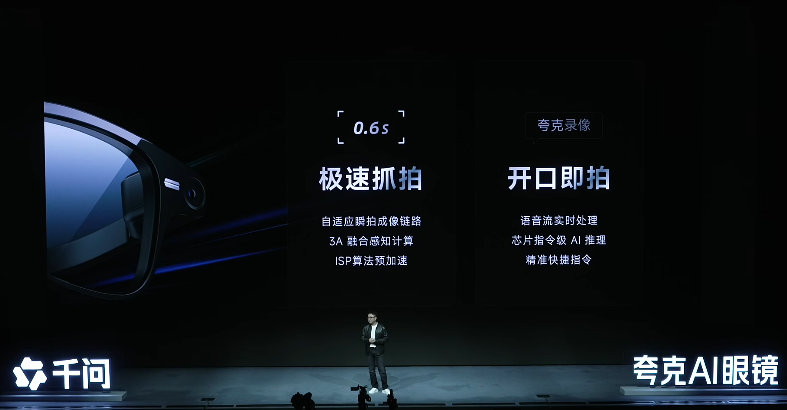
夸克AI眼镜发布会:第一人称视角的拍摄眼镜,开口即拍
Hua Er Jie Jian Wen· 2025-11-27 06:38
Group 1 - Alibaba has launched the Quark AI glasses, marking its entry into the AI wearable device market dominated by Meta [1] - The glasses feature rapid capture capabilities, allowing users to take photos simply by speaking [1] - Alibaba's Vice President, Wu Jia, announced that the personal assistant app, Qianwen, has surpassed 10 million downloads within a week of its public testing [3] Group 2 - The Quark AI glasses are designed for first-person perspective photography [4]
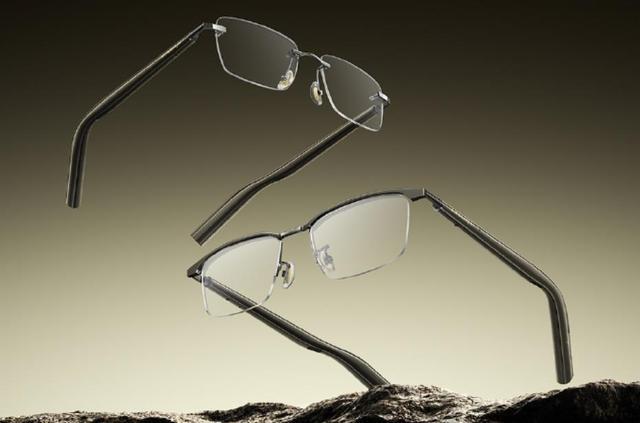
蜂巢科技打造可穿戴生态“潜力股”:界环AI音频眼镜特别版旨在做 “超级秘书”
Huan Qiu Wang Zi Xun· 2025-11-19 05:00
Core Insights - The article highlights the rising potential of smart audio glasses as a wearable device that integrates seamlessly into daily life, with a projected global shipment of over 5.03 million units by 2025 and an average daily usage time exceeding 7 hours [1][12]. Group 1: Product Features and Innovations - The "Jiehuan AI Audio Glasses Special Edition" is positioned as an "all-day super secretary," utilizing the Superhexa VUI 2.0 voice interaction system to enhance efficiency in high-frequency scenarios such as meeting notes and cross-language communication [2][4]. - The product transitions from merely playing music or answering calls to offering proactive services, leveraging advancements in AI technologies like voice recognition and real-time translation [4][11]. - The glasses feature a lightweight design, with the titanium frameless model weighing only 26.4 grams, ensuring comfort for extended wear [8]. Group 2: User Experience and Functionality - The glasses provide a comprehensive voice interaction loop, allowing users to capture conversations during meetings and generate structured summaries post-meeting, thus improving decision-making processes [4][5]. - The integration of AI capabilities is designed to enhance user convenience, enabling features like daily schedule reminders and quick note organization with minimal effort [5][9]. - The product supports cross-platform applications for both Android and iOS, ensuring a consistent user experience across devices [9]. Group 3: Market Position and Future Outlook - The smart audio glasses are seen as a potential mainstream wearable device, combining practicality with fashion, unlike the saturated smartwatch and fitness tracker markets [12]. - The article emphasizes the need for ongoing improvements in voice recognition accuracy in complex environments and the importance of privacy in handling recorded data [12]. - The emergence of the "super secretary" concept reflects a shift in technology towards understanding and assisting users, indicating a promising future for AI-integrated wearable devices [11][13].
估值36亿美元的可穿戴设备Whoop,在AI时代展示了哪些新价值?
3 6 Ke· 2025-11-07 10:14
Core Insights - Whoop, an AI wearable device company founded in 2012, initially focused on sleep and recovery for professional athletes, achieving a valuation of $3.6 billion as a unicorn in the sports wearable sector [1][4] - The company has integrated generative AI technology into its devices, enhancing accuracy and expanding its potential applications [1][6] - Whoop completed a $200 million Series F funding round in August 2021, led by SoftBank Vision Fund 2, with participation from various investors including notable athletes [1][2] Company Overview - Whoop was co-founded by Will Ahmed, John Capodilupo, and Aurelian Nicolae, who met at Harvard [2] - The initial idea stemmed from Ahmed's desire to monitor training, recovery, and sleep data as a Harvard athlete [4] Product Development - The release of Whoop 4.0 in September 2023 introduced the Whoop Coach, an AI health assistant that provides personalized fitness guidance based on user data and the latest sports science [6][9] - Whoop 5.0 features upgraded sensors, a redesigned processor for improved efficiency, and a 14-day battery life, while the new Whoop MG series includes medical-grade ECG sensors [7][11] Health Functionality - Whoop focuses on three core pillars: sleep, recovery, and consumption, generating daily recovery scores to assess user readiness [9][10] - The device tracks various metrics, including heart rate variability (HRV), resting heart rate, and sleep performance, to provide insights into user health [10][12] Targeted Features - Whoop 5.0 includes a menstrual cycle tracking feature for women, offering insights into hormonal changes and their effects on health [10] - The Whoop MG can perform on-demand ECG readings and estimate blood pressure, although the latter is still in testing [11] Business Model - Whoop operates on a subscription-based model, where hardware costs are included in the membership fee, with the highest tier (Whoop MG) priced at $359 annually [12] - The company aims to provide ongoing value to users, addressing challenges faced by previous fitness tech products that struggled with user retention and perceived value [13][14] Industry Outlook - The success of AI-native wearable devices hinges on their ability to deliver high-value health insights and maintain user engagement over time [15] - The market for AI-driven health wearables is expected to grow, with investments in early-stage companies indicating strong interest in this sector [15][16]

受益北美大客户放量 贝隆精密前三季度营业收入同比增长14.76%
Quan Jing Wang· 2025-11-03 05:03
Core Insights - Beilong Precision (301567) reported a revenue of 297.77 million yuan for the first nine months of 2025, reflecting a year-on-year growth of 0.10% and a significant recovery in Q3 with a revenue of 117.44 million yuan, up 14.76% year-on-year and 24.09% quarter-on-quarter, reversing the downward trend observed in the first half of the year [1] Group 1: Company Performance - The company specializes in precision structural component manufacturing and R&D, leveraging advanced manufacturing technologies to provide high-value products for leading firms in niche markets [1] - Beilong Precision has established long-term partnerships with renowned companies such as Sunny Optical, Amphenol, Samsung Electro-Mechanics, and TDK Group, showcasing strong customer loyalty and industry standing [2] - The company has increased its R&D investments and is involved in the Ningbo "Kechuang Yongjiang 2035" key R&D plan, focusing on miniaturization, lightweight, and integration of structural components [2] Group 2: Market Trends - The global mobile camera module market is projected to reach $41.57 billion by 2030, with a compound annual growth rate (CAGR) of 3.6% from 2024 to 2030 [3] - The VR market is also expanding, with predictions indicating that the market for VR large space solutions will exceed $12 billion by 2025, with China accounting for over 40% of this market [3] - Beilong Precision is not only focusing on the domestic market but is also accelerating its international market presence, with products being utilized by well-known North American mobile brands and international VR brands [3] Group 3: Future Growth Strategies - The company aims to deepen relationships with existing clients while expanding into new product areas that align with its product positioning, thereby increasing the value of individual supply units and exploring other application fields [4] - Recent developments include acquiring three new high-quality clients in the VCM motor industry and deepening collaborations with Samsung Electro-Mechanics and TDK Group, which are expected to drive new growth engines for the company [4]