
AI应用投资

Search documents
一个月50多家公司被投资,这个赛道已经火了丨投中嘉川
Xin Lang Cai Jing· 2026-02-09 03:22
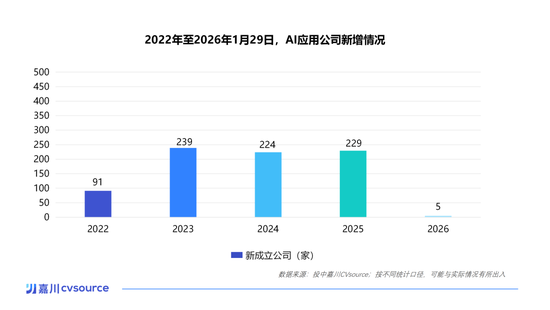
Core Insights - The focus of AI investment is shifting from large models to application-based companies, as evidenced by recent funding activities and the establishment of new firms in the sector [3][27][32]. Investment Trends - In the past month, notable investments have been made in AI application companies by various investors, including Hillhouse Capital and Xiaomi co-founder Wang Chuan [2][4][5]. - A total of 788 AI application companies were established in China since 2022, with nearly 60% located in Beijing, Shanghai, Shenzhen, and Hangzhou [3][20][27]. - The peak of AI application investment occurred in 2025, with 577 companies securing funding, indicating a significant increase in investment activity [3][37]. Company Highlights - ThetaWave AI, founded by two young entrepreneurs, has developed an AI education product that has attracted nearly one million users and achieved an annual recurring revenue (ARR) of one million USD [4][28]. - Other companies receiving investment include Clipto.AI, Trooly.AI, and ZAST.AI, which focus on various AI applications such as multi-modal operating systems and AI user research platforms [4][28]. - In the automotive sector, Yitu Technology, founded by a former executive from Zebra Smart Mobility, has received investments from ByteDance and Chery, highlighting the growing interest in AI applications in vehicles [6][31]. Regional Distribution - The majority of newly established AI application companies are concentrated in four major cities: Beijing, Shanghai, Shenzhen, and Hangzhou, with Beijing's Haidian District being the most prominent area for AI talent and innovation [20][23][45]. - Investment funds are also proliferating in these regions, with Beijing establishing a 10 billion RMB AI industry investment fund, and numerous other funds being set up in Shanghai, Shenzhen, and Hangzhou [25][49]. Future Outlook - The AI application market is expected to remain a hot investment area, with predictions indicating that AI will be a major focus for investment in the next 20 years as it permeates various industries [26][49].

37万亿公募背后的权益暗战
Bei Jing Shang Bao· 2026-01-29 16:07
Core Viewpoint - The A-share market is experiencing an upward trend with record trading volumes, while gold and silver prices are reaching new highs, prompting fund managers to reassess their investment strategies for 2026 [1][10]. Group 1: Fund Performance and Trends - Public fund sizes have reached a new high of 37.71 trillion yuan by the end of 2025, marking a 2.65% increase from the previous quarter [3]. - The growth in fund size is primarily driven by equity funds, with mixed and stock funds reaching 3.68 trillion yuan and 6.05 trillion yuan, respectively, showing significant growth from the previous year [3]. - The top three heavy stocks held by public funds at the end of 2025 were Ningde Times, Zhongji Xuchuang, and Xinyi Technology, with total holdings of 181.83 billion yuan, 162.14 billion yuan, and 124.58 billion yuan [4]. Group 2: Changes in Heavy Stocks - The heavy stock list for public funds has seen notable changes, with some consumer stocks being replaced by technology leaders, indicating a shift in investment focus [4][5]. - The top ten heavy stocks at the end of 2025 included new entries like Alibaba and Zijin Mining, while consumer stocks like Midea Group and Wuliangye were removed [4]. Group 3: Investment Strategies - Fund managers are maintaining a long-term focus on certain sectors while adjusting specific stock selections based on market conditions [9]. - The performance of funds has been strong, with several achieving over 50% returns early in 2026, particularly those investing in gold stocks [6]. - The emphasis on AI applications is growing, with funds like Rongtong Mingrui significantly adjusting their portfolios to include AI-related stocks, indicating a strategic pivot towards emerging technologies [8]. Group 4: Market Outlook - The overall sentiment for the A-share market in 2026 is optimistic, with expectations of a structural shift in investment focus compared to 2025, potentially leading to a comprehensive revaluation of Chinese assets [10]. - Fund managers are optimistic about the long-term upward trend of gold prices, driven by global economic shifts and the weakening of the US dollar, suggesting continued investment in gold assets [10].

2026年春晚“骐骥驰骋”背后:AI云、文创消费、舞台科技三大主线
Zhi Tong Cai Jing· 2026-01-21 02:05
Group 1: AI and Technology Integration - The 2026 Spring Festival Gala marks a significant transformation with ByteDance's Volcano Engine becoming the exclusive AI cloud partner, indicating a shift of cloud and AI technology from a supportive role to a core production platform for the event [1] - The technology architecture of Volcano Engine has evolved to an AI cloud-native stage, with daily usage reaching 63 trillion tokens, supporting a wide range of complex scenarios across major automotive brands and top brokerage firms [1] - The gala's AI cloud platform will handle key tasks such as intelligent content generation, personalized recommendations, and high-concurrency real-time rendering, establishing itself as the "technological backbone" of the event [1] Group 2: Hardware and Infrastructure Support - Runze Technology provides high-density cabinets and liquid cooling solutions that effectively support AI training and inference tasks, crucial for the gala's 8K live broadcast and real-time AI rendering [2] - Inspur Information's products are essential for supporting high-concurrency, low-latency AI tasks during the gala, with the company being a long-term server supplier for ByteDance [2] - Yacon's services ensure the AI cloud platform operates continuously under peak pressure, highlighting the importance of stability and low latency in the gala's technical infrastructure [2] Group 3: Consumer Engagement and Content Creation - Zhongke Lanyun's chips are widely used in smart devices, serving as the first hardware entry point for users to interact with the gala's AI cloud services [3] - Liou Co. is responsible for traffic operation and commercialization of interactive segments during the gala, utilizing AI-generated content to enhance audience engagement [3] - BlueFocus is pioneering the application of virtual human technology in large-scale events, providing integrated solutions that combine creativity, technology, and operations for the gala [4] Group 4: Market Trends and Consumer Behavior - The Spring Festival Gala's merchandise, including the "Four Horse Team" limited edition blind boxes, sold out rapidly, indicating a strong consumer demand and the effectiveness of the cultural content-IP commercialization model [6] - Companies with IP operation capabilities and flexible supply chains are expected to benefit from the long-term rise of national consumption, as demonstrated by the successful development of official merchandise for the gala [6] - The gala serves as a testing ground for advanced display and communication technologies, with implications for future commercial performances and urban light shows, indicating a potential growth trajectory for related industries [8] Group 5: Investment Opportunities and Industry Dynamics - The event highlights a shift in investment logic from theme-driven to fundamental value driven by scenario validation, with companies positioned to convert industry opportunities into specific growth momentum [8] - The success of cultural IP during the gala illustrates a new phase in national consumption, where companies that can transform traditional cultural resources into sustainable business assets will thrive [9] - Capital markets should recognize the dual nature of the "Spring Gala concept," balancing short-term event-driven attributes with long-term industry value, as companies with strong technological and operational capabilities will gain competitive advantages [9]
模型能力-算力成本与Agent成熟度共振-迎接AI应用投资元年
2026-01-07 03:05
Summary of Conference Call Records Industry Overview - The conference call discusses the AI application industry, highlighting significant advancements in model capabilities, cost reductions in computing power, and the maturity of AI agents, setting the stage for a major investment year in AI applications in 2026 [1][5][7]. Key Points and Arguments AI Model and Cost Developments - Since 2023, the cost of using tokens has significantly decreased, reducing the expenses for enterprises utilizing large models and enhancing economic returns, which lays the foundation for large-scale AI application launches [1][2]. - The transition from hardware to software in the tech industry is at a critical juncture, with expectations that 2026 will mark the beginning of a new investment era in AI applications [1][5]. Market Dynamics and Growth - The release of OpenAI's Deepseek R1 model in Q1 and Q2 of 2025 has accelerated application development, with notable performance in the domestic inference and computing sectors, particularly in chip and IDC fields [4][8]. - By the end of 2026, it is anticipated that AI business revenue for companies in China and the U.S. will exceed 10%, indicating a critical turning point in product maturity and customer acceptance [7][11]. Competitive Landscape - Chinese companies such as ByteDance, Kuaishou, and Alibaba are gaining global influence, with Alibaba recognized for its open-source model. Startups like Zhipu and Minimax are also performing well, showcasing China's competitive edge in large model technology [1][11][12]. - The gap between China's top large models and leading U.S. models has narrowed to 3 to 6 months, indicating significant progress in the domestic AI landscape [12]. Investment Strategies - The investment strategy for 2026 focuses on AI applications, with a historical context of the tech industry's investment patterns indicating a shift towards software and innovative business models [2][5][17]. - Investors are encouraged to focus on domestic advancements in large models and multi-modal technologies, which are expected to drive substantial growth in downstream inference and training demands [17][18]. Additional Important Insights - The AI application sector is witnessing a diversification of business models, including subscription services and performance-based pricing, which are reshaping the software industry [16]. - The rapid advancements in AI applications are not only limited to established companies but also include significant contributions from startups, indicating a robust ecosystem for innovation [9][10]. Conclusion - The conference call emphasizes the transformative potential of AI applications, driven by advancements in model capabilities, cost efficiencies, and a competitive landscape that is increasingly favorable for Chinese firms. The anticipated investment boom in 2026 is supported by a solid foundation of technological progress and market readiness [1][5][7][17].