A股投资

Search documents
我发誓再也不玩港股了!
集思录· 2026-03-27 13:26
Core Viewpoint - The article discusses the contrasting experiences and perceptions of investing in Hong Kong stocks compared to A-shares, highlighting a general skepticism towards the Hong Kong market and a preference for the A-share market due to perceived protections for investors [1][5][6]. Group 1: Investment Experiences - The author mentions two previous investments in Hong Kong stocks, both resulting in significant losses, reinforcing a belief that A-shares are superior [1]. - Some investors express confidence in Hong Kong stocks, citing successful investments in companies like Tencent and 康方生物, indicating that there are opportunities for profit despite market volatility [9][11]. - The article reflects a shift in sentiment among investors, with some losing faith in the Hong Kong market after negative experiences [8]. Group 2: Market Characteristics - The current trading volume and liquidity of Hong Kong stocks suggest they should be viewed as a sector within the broader A-share market, characterized by volatility and speculative trading [4]. - The article notes that the Hong Kong market is heavily influenced by international financial conditions, which can lead to significant fluctuations in stock performance [9][10]. - There is a perception that the Hong Kong market has become less relevant, with some suggesting it is on the verge of being forgotten due to changes in IPO regulations and market dynamics [6]. Group 3: Investment Strategies - Some investors advocate for a strategy focused on high dividend yield stocks within the Hong Kong market, suggesting a more conservative approach to investing [12]. - The discussion includes the importance of understanding market rules and dynamics, with some investors emphasizing the need for careful analysis before making investment decisions [7]. - The article highlights the potential for high returns in the Hong Kong market, particularly if investors can navigate the complexities and volatility effectively [10].



浮盈已超千万!“花生油大王”家族狂买A股,1个多月耗资3个亿
证券时报· 2026-02-19 00:28
Core Viewpoint - The article discusses the recent investment activities of the Sun Meng family, associated with the Lu Hua Group, in the A-share market, highlighting their strategic moves and potential implications for future market participation [3][4][10]. Group 1: Investment Activities - The Lu Hua Group, although not yet listed, has shown active participation in the A-share market, particularly through its subsidiary, Lu Hua Dao Sheng, which invested approximately 100 million yuan in Su Yan Jing Shen, acquiring 9.63 million shares at 10.38 yuan per share, raising nearly 1.8 billion yuan [4]. - Lu Hua Dao Sheng also participated in the investment in Shen Kai Co., acquiring 475.06 million shares at 8.42 yuan per share for about 40 million yuan, resulting in a current floating profit exceeding 24 million yuan due to the stock's positive performance [5]. - The family has also invested in Wa Jin Ke, acquiring 5.07 million shares at 31.67 yuan per share, totaling 1.61 billion yuan [7]. Group 2: Company Performance - The Lu Hua Group reported a revenue of 18.629 billion yuan and a net profit of 2.746 billion yuan for 2023, with Q1 2024 figures showing a revenue of 5.387 billion yuan and a net profit of 804 million yuan [10]. - As of March 2024, the audited net assets attributable to the parent company were 12.401 billion yuan, with the overall valuation of the Lu Hua Group exceeding 20 billion yuan following a capital increase from Jin Long Yu [10].



中国股市重现动能!富达国际最新发声
券商中国· 2026-02-04 15:12
Core Viewpoint - The article discusses the economic outlook for China in 2026, highlighting potential fiscal policy support for household income to boost domestic demand [1]. Group 1: Economic Forecast - The central bank is expected to maintain a moderately accommodative stance, with a projected policy interest rate cut of about 10 basis points and a reserve requirement ratio reduction of approximately 50 basis points [2]. - The GDP growth target for China this year is likely around 4.5% to 5%, driven by manufacturing, diversified export markets, and resilient infrastructure investment [2][3]. - Fiscal deficit is projected to remain at about 4%, with a slight increase in local government special bonds to support infrastructure spending [3]. Group 2: Market Insights - The Chinese stock market is showing renewed momentum, supported by policies focused on consumption, real estate stabilization, and structural reforms [3]. - Consumer spending is seen as a long-term growth pillar, with improving fundamentals expected to enhance consumer confidence and release pent-up demand [3]. - Investment opportunities exist in the consumer sector, particularly in sportswear and tourism, as valuations have reached a low point [4].

37万亿公募背后的权益暗战
Bei Jing Shang Bao· 2026-01-29 16:07
Core Viewpoint - The A-share market is experiencing an upward trend with record trading volumes, while gold and silver prices are reaching new highs, prompting fund managers to reassess their investment strategies for 2026 [1][10]. Group 1: Fund Performance and Trends - Public fund sizes have reached a new high of 37.71 trillion yuan by the end of 2025, marking a 2.65% increase from the previous quarter [3]. - The growth in fund size is primarily driven by equity funds, with mixed and stock funds reaching 3.68 trillion yuan and 6.05 trillion yuan, respectively, showing significant growth from the previous year [3]. - The top three heavy stocks held by public funds at the end of 2025 were Ningde Times, Zhongji Xuchuang, and Xinyi Technology, with total holdings of 181.83 billion yuan, 162.14 billion yuan, and 124.58 billion yuan [4]. Group 2: Changes in Heavy Stocks - The heavy stock list for public funds has seen notable changes, with some consumer stocks being replaced by technology leaders, indicating a shift in investment focus [4][5]. - The top ten heavy stocks at the end of 2025 included new entries like Alibaba and Zijin Mining, while consumer stocks like Midea Group and Wuliangye were removed [4]. Group 3: Investment Strategies - Fund managers are maintaining a long-term focus on certain sectors while adjusting specific stock selections based on market conditions [9]. - The performance of funds has been strong, with several achieving over 50% returns early in 2026, particularly those investing in gold stocks [6]. - The emphasis on AI applications is growing, with funds like Rongtong Mingrui significantly adjusting their portfolios to include AI-related stocks, indicating a strategic pivot towards emerging technologies [8]. Group 4: Market Outlook - The overall sentiment for the A-share market in 2026 is optimistic, with expectations of a structural shift in investment focus compared to 2025, potentially leading to a comprehensive revaluation of Chinese assets [10]. - Fund managers are optimistic about the long-term upward trend of gold prices, driven by global economic shifts and the weakening of the US dollar, suggesting continued investment in gold assets [10].

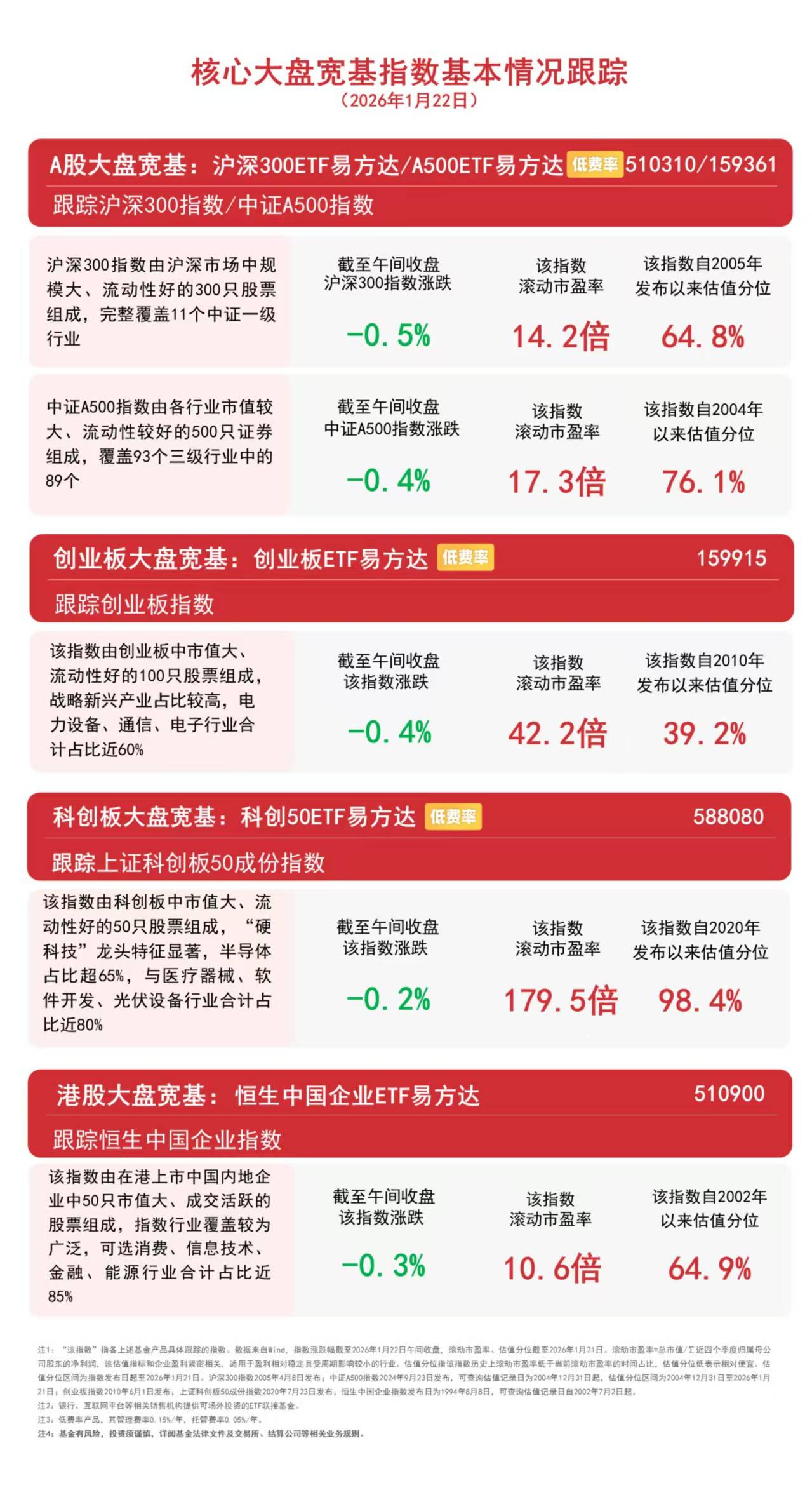
超3200只个股飘红,关注A500ETF易方达(159361)、沪深300ETF易方达(510310)等产品投资机会
Sou Hu Cai Jing· 2026-01-22 05:17
Market Overview - On January 22, A-shares experienced a collective adjustment with over 3,200 stocks in the market showing gains [1] - Major sectors that performed well included natural gas, commercial aerospace, military equipment, photovoltaic devices, steel, coal, cultivated diamonds, and chemical industries [1] - Conversely, sectors such as precious metals, photolithography machines, semiconductors, insurance, and batteries lagged behind [1] - The major indices closed with the CSI 500 index down 0.4%, the CSI 300 index down 0.5%, the ChiNext index down 0.4%, and the STAR Market 50 index down 0.2% [1] Index Performance - The CSI 300 index, which consists of 300 large-cap stocks from the A-share market, recorded a decline of 0.5% with a rolling P/E ratio of 14.2 times [3] - The CSI 500 index, comprising 500 stocks with good liquidity, fell by 0.4% and had a rolling P/E ratio of 17.3 times [3] - The ChiNext index, which includes 100 large-cap stocks from the ChiNext board, also decreased by 0.4% with a rolling P/E ratio of 42.2 times [4] - The STAR Market 50 index, made up of 50 large-cap stocks from the STAR Market, had not specified its performance data in the provided text [5] Hong Kong Market - The Hang Seng China Enterprises Index, which tracks 50 large-cap and actively traded stocks listed in Hong Kong, saw a decline of 0.3% with a rolling P/E ratio of 10.6 times [6]
中证A500指数投资价值分析:布局核心资产正当时
Guoxin Securities· 2025-12-30 07:30
Group 1 - The current period is a strategic opportunity for increasing allocation to A-shares, with a favorable macroeconomic environment and potential recovery in fundamentals expected to support market growth into 2026 [1][12][20] - The A500 Index represents China's core assets, balancing traditional and emerging industries, and is expected to see increased demand for capital allocation due to its relative advantages in valuation, profitability, and dividends [2][32][38] - The A500 ETF, managed by GF Fund Management, aims to closely track the A500 Index while achieving superior performance and demonstrating strong tracking error control [3][51][54] Group 2 - The A500 Index is characterized by a more balanced industry composition, with significant weights in new productivity sectors such as electric equipment, electronics, and pharmaceuticals, while maintaining a balance with traditional sectors [2][32] - The A500 Index shows a favorable valuation compared to other broad-based indices, with a current P/E ratio of 16.9x, which is near historical averages, and a P/B ratio of 1.7x, indicating relative valuation attractiveness [27][34] - The profitability of the A500 Index is higher than the overall A-share market, with a return on equity (ROE) of 10.1% compared to 8.4% for the broader market, reflecting the strength of its constituent companies [34][39] Group 3 - The A500 ETF is designed to provide efficient and transparent access to leading companies across various sectors, with a focus on passive investment strategies [3][45] - The fund has outperformed the A500 Index with a cumulative net value growth rate of 18.85%, exceeding the index's growth of 14.71% [51][54] - The fund's management team, led by experienced managers, has demonstrated strong capabilities in portfolio management and operational efficiency [55][56]
翻1倍,翻2倍,2025年A股基金前20强交卷
Zheng Quan Shi Bao· 2025-12-29 07:25
Group 1 - The core viewpoint of the articles highlights that a group of fund managers focusing on core technology assets in the A-share market have achieved impressive performance, with returns ranging from 125% to 236% for the top 20 funds in the market [1][2] - These top-performing funds have maintained low exposure to Hong Kong stocks, often below 10% or even zero, allowing them to concentrate on A-share core assets [1][2] - The strategy of focusing on familiar markets rather than diversifying into less understood areas is seen as a prudent approach for achieving performance breakthroughs [1][3] Group 2 - The performance of leading A-share funds reflects a deep understanding of the pricing efficiency in the A-share market, which is influenced heavily by local investor sentiment [4] - Fund managers have noted that maintaining a high allocation to A-share core assets allows for better capture of market opportunities, particularly in sectors like AI chips and semiconductors [3][4] - The differences in market characteristics between A-shares and Hong Kong stocks necessitate distinct investment strategies, as A-share funds often struggle when applying their strategies to the Hong Kong market without proper adjustments [4][5] Group 3 - The divergence in performance between A-share funds and professional Hong Kong QDII funds stems from differences in stock selection logic and investment philosophies [5][6] - A-share fund managers tend to prioritize growth potential, while professional Hong Kong investors focus more on financial quality and valuation matching [5][6] - The contrasting investment approaches highlight the need for A-share fund managers to adapt their strategies when entering the Hong Kong market, emphasizing the importance of understanding local market dynamics [6][7]
A股慢牛为何赚不到钱?“影子美联储”来了,黄金又要重写历史!2026趋势预言
Sou Hu Cai Jing· 2025-12-29 04:11
Group 1 - In 2026, the U.S. is expected to continue its interest rate cuts, while A-shares may maintain a "slow bull" market driven by sectors like AI, semiconductors, humanoid robots, and low-altitude economy [1][6] - The A-share market is becoming more institutionalized and focused on leading companies in the technology and AI sectors, while other sectors like consumption and real estate are experiencing a lack of funding and continued price stagnation [6][8] - The investment landscape in 2026 will be shaped by two main factors: monetary easing and the practical application of AI, with concerns about AI's production efficiency not covering computing costs [8] Group 2 - The Hong Kong stock market in 2026 is expected to remain stable, influenced by domestic macroeconomic fundamentals and overseas dollar liquidity [9] - The 2026 economic policy framework emphasizes practical effects and long-term health, focusing on expanding domestic demand, technological innovation, risk mitigation, and social welfare [15] - The real estate market is shifting from "incremental thinking" to "stock thinking," with opportunities arising from deep optimization and value reassessment of existing cities [16] Group 3 - The gold market is expected to remain bullish, with prices projected to reach between $4,800 and $5,000 per ounce, driven by a declining interest rate environment and ongoing central bank purchases [22][23] - The price of lithium carbonate has surged, and the low-altitude economy is facing challenges related to battery costs, which may catalyze advancements in battery technology [21] - Silver prices have increased significantly, driven by a combination of inventory crises, industrial demand, and capital accumulation, with a focus on maintaining a calm approach to investment during periods of market volatility [26][28]

抓住A股核心机遇不放 二十强基金低配港股
Zheng Quan Shi Bao· 2025-12-28 18:13
Core Insights - In the context of the investment wave towards Hong Kong stocks in 2025, a group of fund managers focusing on core technology assets in the A-share market has achieved impressive performance, with returns ranging from 125% to 236% for the top 20 funds [1][2]. Group 1: Performance and Strategy - The top-performing A-share funds have maintained low exposure to Hong Kong stocks, with many keeping their allocation below 10% or at zero, allowing for a high concentration in A-share core assets [1][2]. - For instance, the Guangfa Growth Navigator fund reduced its Hong Kong stock allocation from approximately 28% in June to about 4% by the end of the third quarter, effectively avoiding volatility in the Hong Kong market [2]. - Other funds, such as the Yongying Technology Smart Selection fund, also maintained low Hong Kong stock allocations, focusing primarily on the A-share market [2]. Group 2: Market Dynamics and Investment Logic - A-share market pricing reacts more directly to local hot sectors, making it easier to capture market opportunities by maintaining a high allocation to core A-share assets [3]. - The difference in market characteristics between A-shares and Hong Kong stocks necessitates a tailored investment strategy, as A-share funds often struggle when applying their strategies to the Hong Kong market without proper adjustments [4]. - Funds that heavily invested in Hong Kong stocks without adapting their strategies have generally underperformed, highlighting the importance of understanding market dynamics [4]. Group 3: Investment Philosophy - A-share fund managers tend to focus on growth potential and sector performance, while professional Hong Kong funds prioritize financial quality, cash flow, and dividend potential [5][6]. - For example, the Hong Kong stock Jiangnan Buyi, valued at approximately HKD 10 billion, has been recognized for its strong cash flow and dividend history, which A-share funds have overlooked [6]. - The contrasting investment philosophies between A-share and Hong Kong funds illustrate the need for A-share managers to adapt their approaches when considering investments in the Hong Kong market [5][6]. Group 4: Challenges and Considerations - A-share fund managers need to approach Hong Kong investments with caution, recognizing the significant influence of global liquidity and market sentiment on pricing [7][8]. - Understanding the unique pricing mechanisms and investor structures in the Hong Kong market is crucial for A-share fund managers venturing into this space [7][8]. - The potential for long-term returns exists in the Hong Kong market, particularly through identifying high-dividend yielding assets, which can provide an alternative strategy for A-share fund managers [8].
血亏百万老股民泣血总结:A股散户最常跳的六个坑,希望你没有
Sou Hu Cai Jing· 2025-12-19 00:08
Core Insights - Retail investors in A-shares face high loss rates due to a lack of discipline and understanding of market dynamics, often falling into six controllable pitfalls [1][4]. Group 1: Common Pitfalls - The first pitfall is the failure to set stop-loss orders, which accounts for 32% of retail investor losses, with those not using stop-losses averaging a 45% loss, 2.3 times higher than disciplined investors [1]. - The second pitfall involves emotional trading, where retail investors have a turnover rate nine times that of institutions, with a win rate of less than 30% when chasing stocks hitting the daily limit up [1][3]. - The third pitfall is frequent trading, with retail investors holding positions for an average of only 3.2 months, leading to lower returns due to high transaction costs [3]. Group 2: Misguided Strategies - The fourth pitfall is reliance on rumors and tips, with 40% of losses attributed to following recommendations from influencers or online forums, often entering at high price points [3][4]. - The fifth pitfall is using leverage, which has a 78% probability of leading to liquidation for retail investors, resulting in total loss of capital and potential debt to trading platforms [4]. - The sixth pitfall is a lack of understanding of fundamental metrics, with 70% of retail investors unable to interpret key indicators like PE and PB, leading to poor investment decisions [4]. Group 3: Recommendations for Improvement - To mitigate losses, retail investors should establish a simple system that includes setting stop-loss and take-profit levels, defining their investment capabilities, and maintaining a cash reserve to manage volatility [4][5].