AI时代能源

Search documents
马斯克一句“愚蠢至极”,又得罪了整个硅谷
虎嗅APP· 2025-12-18 13:57
Core Viewpoint - Elon Musk criticized the pursuit of small nuclear fusion reactors on Earth, arguing that the sun serves as a free and efficient nuclear fusion reactor, and called for a halt to investments in such projects unless they are purely for scientific experimentation [5][7]. Group 1: Investment Landscape in Nuclear Fusion - In Silicon Valley, nuclear fusion is viewed as a long-term infrastructure investment rather than a fleeting trend, with nearly $10 billion in private capital expected to flow into the sector by July 2025 [9]. - Major tech figures, including Bill Gates and Jeff Bezos, have made significant investments in nuclear fusion, with Gates' Breakthrough Energy Ventures focusing on long-term clean energy strategies [9][10]. - Commonwealth Fusion Systems (CFS) has raised nearly $3 billion, emerging as a leading contender in the fusion startup space due to its high-temperature superconducting tokamak technology [10][11]. Group 2: The Narrative of Nuclear Fusion - Nuclear fusion is often framed as an "infinite energy" solution, promising abundant fuel sources and minimal carbon emissions, which is particularly appealing in the context of rising energy demands from AI [16]. - The International Energy Agency (IEA) projects that global data center electricity demand will approach 945 terawatt-hours (TWh) by 2030, with AI-specific loads increasing fourfold [16]. - 84% of fusion companies believe they can achieve grid connection by the 2030s, with over half targeting completion by 2035, driven by technological advancements like high-temperature superconductors [16]. Group 3: Challenges and Criticism of Nuclear Fusion - Musk highlighted significant engineering challenges facing terrestrial nuclear fusion, including the need for reactors to produce more energy than they consume, which remains unproven [18][19]. - The cost of building the first commercial fusion reactors is projected to be in the hundreds of billions, with construction timelines exceeding ten years, raising questions about economic viability [19]. - Musk argues that solar energy, which has seen a cost reduction of over 89% in the past decade, is a more practical and cost-effective solution compared to the uncertain future of nuclear fusion [19]. Group 4: Alternative Energy Strategies - Musk advocates for solar energy and storage technologies as the most viable and economically sound energy solutions, proposing that a solar panel area of 100 miles by 100 miles could power the entire United States [20]. - Tesla is actively working on solar products and energy storage systems to address the intermittency issues of traditional solar energy [20][21]. - Musk's vision includes deploying solar energy satellites in space, which would provide continuous power without atmospheric interference, further enhancing energy reliability for AI applications [21][22]. Group 5: Conclusion on Energy Transition - The debate between Musk and other tech leaders reflects differing philosophies on risk and return in energy technology, with fusion representing high-risk, high-reward potential, while solar energy offers more immediate and certain returns [25]. - The future of energy will require balancing the uncertainties of emerging technologies like nuclear fusion with the pressing need for reliable energy sources in the AI era [25].

马斯克一句“愚蠢至极”,又得罪了整个硅谷
3 6 Ke· 2025-12-17 04:17
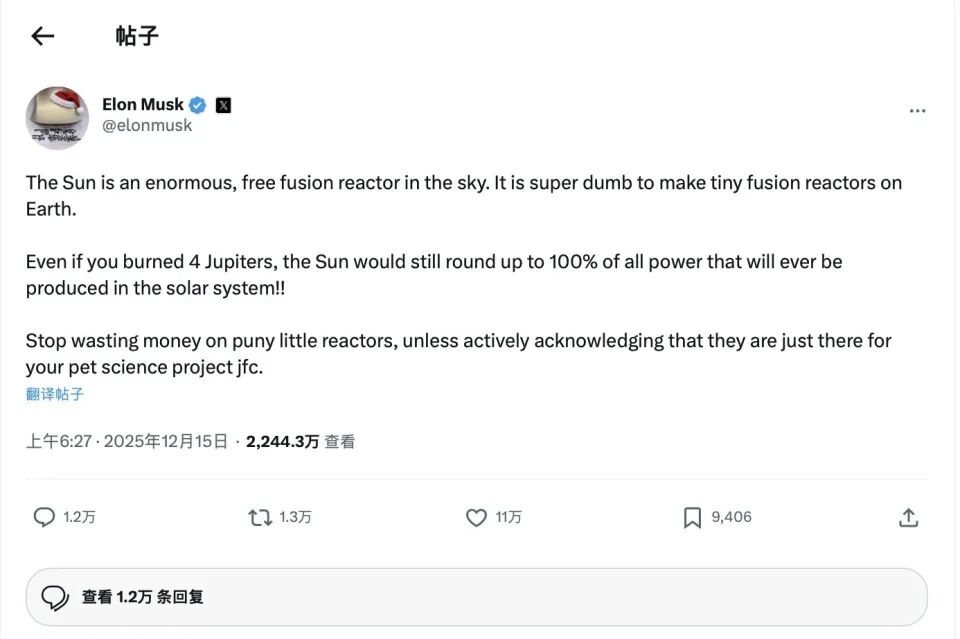
Core Viewpoint - Elon Musk criticized the investment in small nuclear fusion reactors, arguing that the sun serves as a free and efficient nuclear fusion reactor, making such investments "super dumb" [1][2]. Group 1: Investment Landscape in Nuclear Fusion - Significant investments in nuclear fusion have been made by prominent figures in Silicon Valley, including Bill Gates, Jeff Bezos, and Sam Altman, with nearly $10 billion in private capital expected to flow into the sector by July 2025 [5][6]. - The fusion industry is viewed as a long-term infrastructure investment rather than a typical "hot trend," with a focus on developing a "civilization-level infrastructure" that could reshape human technological capabilities [5][6]. - Commonwealth Fusion Systems (CFS) has raised nearly $3 billion, focusing on high-temperature superconducting tokamak technology, which is seen as a promising path toward practical fusion energy [6][7]. Group 2: Diverging Perspectives on Nuclear Fusion - Musk's skepticism towards nuclear fusion highlights the engineering challenges and economic impracticalities associated with terrestrial fusion reactors, which he believes cannot compete with solar energy [15][17]. - The narrative surrounding nuclear fusion as a source of "unlimited energy" continues to attract investment, despite repeated delays in its commercialization [13][14]. - Musk argues that the costs and complexities of developing nuclear fusion reactors are not justified when solar energy has become significantly cheaper and more efficient [16][18]. Group 3: Alternative Energy Strategies - Musk advocates for solar energy and energy storage technologies as the most viable and economically sound solutions for future energy needs, proposing a comprehensive approach that includes both terrestrial and space-based solar energy systems [18][19]. - The concept of deploying solar AI satellites in near-Earth orbit aims to leverage the advantages of space for energy collection, providing continuous power without the limitations faced by ground-based solar systems [19][20]. - The ongoing debate between nuclear fusion and solar energy reflects broader themes in energy transition, emphasizing the need for a balanced approach to risk and return in energy investments [21].
山高新能源(01250.HK),新能源3.0的领航者
Ge Long Hui· 2025-06-03 09:09
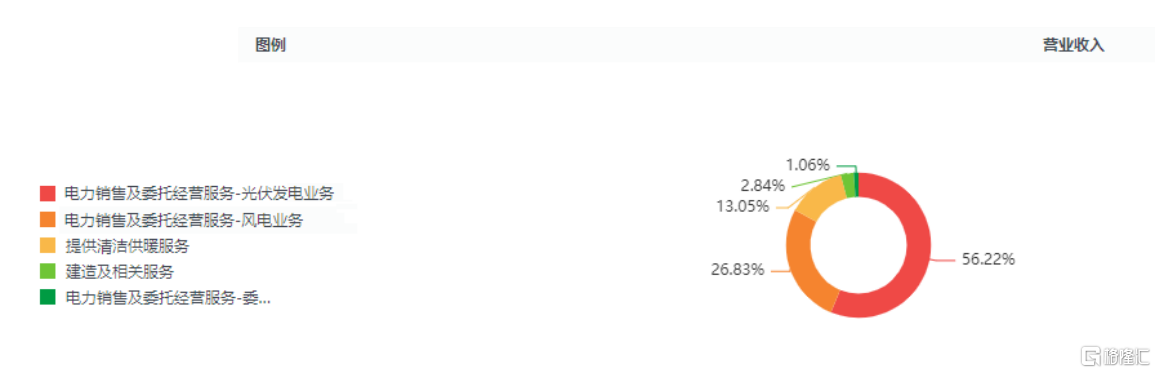
Core Viewpoint - The energy sector is undergoing a significant transformation driven by the rapid development of AI and the increasing demand for energy, marking a pivotal moment in history for energy consumption and production [3][4]. Group 1: Company Overview - The company, Shango New Energy, is transitioning from a traditional energy supplier to a comprehensive energy solution provider, focusing on the intersection of green energy and computing power [4][7]. - As of December 2024, Shango New Energy operates 54 centralized photovoltaic power stations with a total installed capacity of 2,602 MW, 920 MW of distributed photovoltaic power stations, and 19 wind power stations with a capacity of 1,176 MW [8]. - The company has achieved significant growth in its wind power business, with revenue reaching 1.187 billion yuan in 2024, a year-on-year increase of 24.2%, contributing to 26.8% of total revenue [8][10]. Group 2: Industry Trends - The global energy landscape is shifting towards renewable sources, with the National Energy Administration aiming for non-fossil energy to account for 60% of power generation by 2025 [11]. - The digital energy market is rapidly expanding, with the market size growing from 654.42 billion yuan in 2015 to 1,105.15 billion yuan in 2022, indicating a burgeoning trillion-level market [14][16]. - The integration of energy and transportation is becoming a key trend, with expectations of significant investment growth in this sector, potentially exceeding one trillion yuan [24][27]. Group 3: Strategic Collaborations - Shango New Energy has formed strategic partnerships with major tech companies like Century Internet and Huawei to enhance its capabilities in green energy supply and computing power infrastructure [18][19]. - The collaboration with Century Internet aims to create a comprehensive energy ecosystem that integrates green energy production and computing power consumption [18]. - The partnership with Huawei focuses on developing smart energy solutions, leveraging Shango's renewable assets to provide customized green energy for data centers [19]. Group 4: Financial Performance - In 2024, Shango New Energy reported a revenue of 4.423 billion yuan and a net profit of 463 million yuan, reflecting a year-on-year growth of approximately 32% [29][30]. - The company's asset-liability ratio was maintained at 60%, with cash and equivalents exceeding 3.6 billion yuan, indicating strong financial health [29].