AI电力危机

Search documents
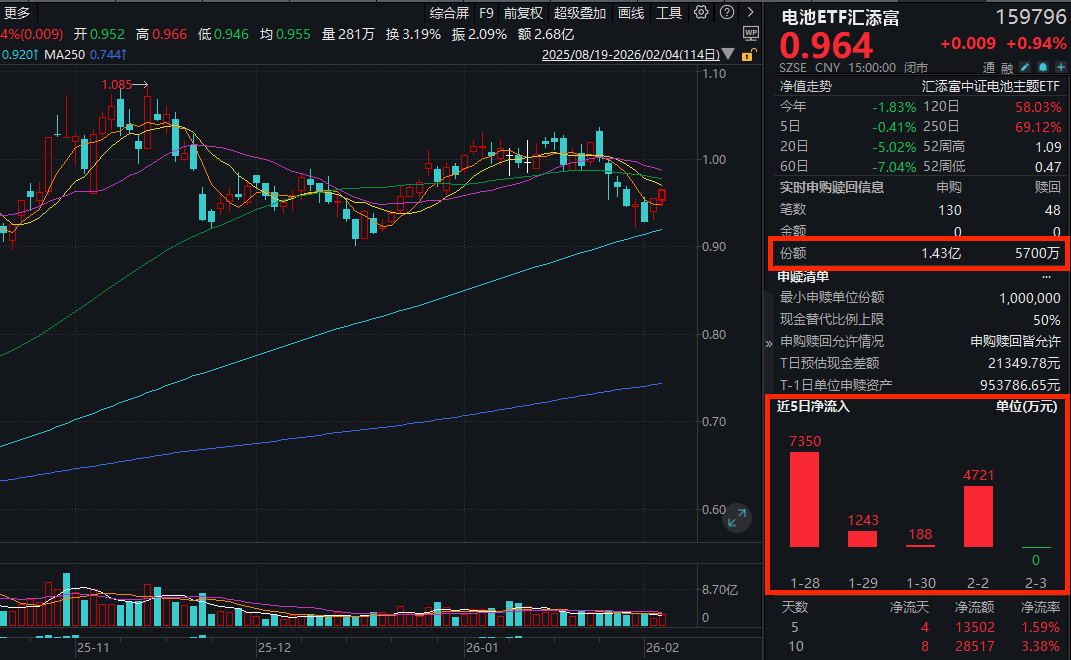
电池板块异动拉升!宁德时代涨近5%,电池ETF汇添富(159796)翻红冲高涨近1%,全天“吸金”8200万元!马斯克:锂电池生产重大突破!
Sou Hu Cai Jing· 2026-02-04 09:32
Core Viewpoint - The battery sector is experiencing a resurgence, with significant inflows into the battery ETF Huatai (159796), which saw a nearly 1% increase and a total trading volume exceeding 260 million yuan, indicating renewed investor interest [1][3]. Group 1: Market Performance - The battery ETF Huatai (159796) has attracted net inflows of 82 million yuan, with four out of the last five days showing strong investor interest [1]. - Key component stocks within the ETF include Silver Wheel Holdings, which hit the daily limit, and others like Fulin Precision Engineering, Aotai, and CATL, which saw gains of over 5% [3]. Group 2: Strategic Developments - Fulin Precision Engineering announced a strategic partnership with CATL to increase capital in its subsidiary, Jiangxi Shenghua [5]. - Tesla's recent announcement regarding dry electrode manufacturing is expected to lower costs and enhance production flexibility, marking a significant technological breakthrough in lithium battery production [5]. Group 3: Market Growth Projections - The global lithium battery intelligent equipment market is projected to grow from 49.8 billion yuan in 2024 to 137.2 billion yuan by 2029, with a compound annual growth rate (CAGR) of 22.5% [5]. - The demand for lithium carbonate is expected to remain strong due to rapid developments in the energy storage sector, supported by recent policy changes from the National Development and Reform Commission [7]. Group 4: Investment Strategy - The battery sector's fundamentals and technological catalysts are likely to support continued strong stock performance, but the complexity of the industry suggests that index investments may be a more effective strategy [8]. - The Huatai battery ETF (159796) has a significant focus on energy storage, with 18.7% of its index dedicated to this segment, and a high concentration of solid-state battery technology at 45%, positioning it well for future growth [8][10].


大涨!四万亿砸中赛道
Ge Long Hui A P P· 2026-01-16 08:51
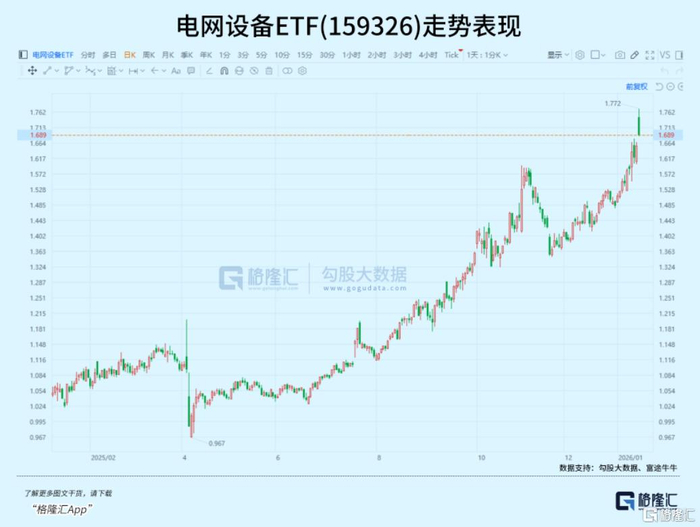
Group 1 - The core message highlights a significant investment plan by the State Grid, with a projected fixed asset investment of 4 trillion yuan during the 14th Five-Year Plan, representing a 40% increase compared to the previous plan [3] - The investment in the power grid is expected to create a clear growth space for the industry over the next five years, focusing on green transformation and the construction of a new power system [7] - The unique ETF for power grid equipment has seen substantial capital inflow, with over 24.39 billion yuan in net inflow in the past five days, indicating strong market interest [8][10] Group 2 - The demand for power grid equipment is expected to surge due to the rapid growth of AI and data centers, which are projected to consume a significant portion of electricity in the coming years [11][12] - The structural shortage of power transformers in North America, exacerbated by aging infrastructure and high demand, presents a lucrative opportunity for Chinese suppliers [15][18] - The global average annual investment in power grids is projected to reach 500 billion USD from 2022 to 2030, with Chinese companies likely to benefit significantly from this trend [18]
引爆全球危机!美国停电时长暴涨80%,中国却早已布局47年
Sou Hu Cai Jing· 2025-12-17 13:42
Group 1 - The average power outage duration for U.S. users is projected to increase by 80% in 2024, reaching approximately 662.6 minutes, or nearly 11 hours, compared to the previous year [3][6] - In Virginia and Texas, the outage durations have increased by 228% and 176% respectively, with Texas experiencing a more than 700% increase compared to a decade ago [3][6] - The average retail electricity price in the U.S. is expected to rise by 13% from 2022 to 2025, with typical household electricity costs increasing from $1,683 to $1,902 annually [6][8] Group 2 - Nearly 80 million Americans are now forced to choose between paying electricity bills and other essential expenses, making electricity costs the second-largest energy expenditure after vehicle fuel [8][11] - The aging U.S. power grid is a significant issue, with an average service life of about 40 years and 70% of transformers exceeding their 25-year design life [8][11] - AI is projected to consume nearly 11.7% of U.S. electricity by 2030, up from 4% in 2023, with significant energy demands from data centers [11][13] Group 3 - The U.S. is facing challenges in power generation, with a rapid exit from coal, aging nuclear plants, and insufficient growth in renewable energy sources [13][21] - By 2030, the U.S. is expected to retire 94 GW of power generation capacity, while only adding 260 GW of new sources, leading to a dangerous gap in supply [13][21] - In contrast, China's power generation capacity has surged to 3.35 billion kilowatts by the end of 2024, a 58-fold increase since 1978 [21][26] Group 4 - China has implemented a systematic approach to power generation and distribution, including the "East Data West Computing" initiative, which directs data centers to energy-rich western regions [23][31] - The average electricity price in China is approximately $0.08 per kilowatt-hour, significantly lower than the U.S. average of $0.13 [26][31] - China's renewable energy capacity is projected to exceed 1.4 billion kilowatts by the end of 2024, with significant investments in wind and solar power [21][33] Group 5 - The differences in the energy landscape between the U.S. and China stem from varying development models and institutional designs, with the U.S. lacking a unified national energy strategy [26][31] - China's centralized planning allows for large-scale projects like ultra-high voltage transmission lines, while the U.S. struggles with fragmented state policies [31][35] - The U.S. faces inefficiencies in its power system due to outdated regulatory frameworks, while China has maintained continuous investment in modernizing its grid [35][41]