AI破坏交易

Search documents
“这个动作,真正的变盘信号!”美银Hartnett最新警告
华尔街见闻· 2026-02-17 11:30
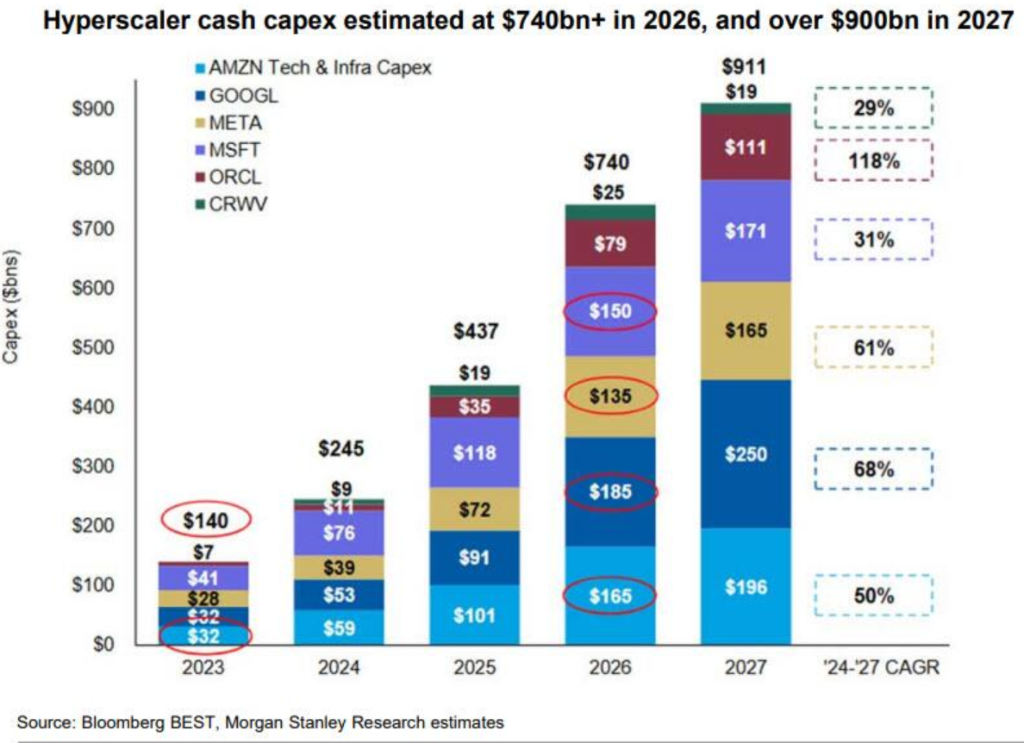
Group 1 - The core viewpoint of the article highlights a significant shift in AI capital expenditure from a "money printing machine" to a "money shredding machine," indicating potential liquidity and asset pricing upheaval [2] - Michael Hartnett from Bank of America has raised his market warning level, emphasizing that the "AI disruption trade" is rapidly spreading from the tech sector to traditional services [2][3] - The projected capital expenditure for hyperscalers has surged to $740 billion for 2026, up from a previous estimate of $670 billion, which poses financial risks [4] Group 2 - Hartnett warns that such massive investments could drive the free cash flow of the "Magnificent 7" tech companies towards zero or even negative [5] - To sustain this level of capital expenditure, tech giants may be forced into a large-scale bond issuance, indicating a shift towards "creditization" of previously strong balance sheets [8] - The narrative in the market is shifting from "awe of AI" to "being impoverished by AI," suggesting a growing concern over the financial implications of AI investments [9] Group 3 - A clear trading signal is identified: a major AI hyperscaler announcing a reduction in capital expenditure could trigger a significant rotation from tech giants to Main Street assets [10] - The disruption effect of AI is not limited to tech stocks; it is rapidly spreading to traditional service sectors, with various industries experiencing significant impacts [11][12] - Hartnett notes that once a sector is recognized as an "AI victim," its stock price recovery may take a long time, as seen with Indian tech stocks [12] Group 4 - Political factors are intensifying the asset rotation, with Hartnett highlighting the upcoming State of the Union address as a critical moment for potential policy shifts [14][16] - The article discusses the disparity in support for Trump between Wall Street and Main Street, with rising dissatisfaction among the public regarding inflation [15] - Hartnett suggests that if there is no "Trump bump" post-address, the government may adopt more aggressive affordability policies, benefiting small-cap stocks over tech giants [17] Group 5 - Despite a recent influx of $463 billion into global equities, the Bull & Bear Indicator remains in the "sell" zone, indicating ongoing caution in risk assets [21] - Hartnett emphasizes that the sell signal for risk assets, which began in December, is still valid until panic-driven cash hoarding occurs [22] - The article details recent capital flows, showing significant movements into stocks, bonds, and cash, with notable declines in tech and cryptocurrency assets [23][24] Group 6 - Hartnett reflects on the "great rotation" over the past 50 years, where major political and financial events have shifted asset leadership, suggesting a new cycle is emerging [25][26] - The next structural leaders are expected to be emerging markets and small-cap stocks, driven by shifts in service and manufacturing sectors [28] - The article concludes with a perspective on global rebalancing, emphasizing low asset allocation in China and India, which are now among the world's largest economies [31]


“这个动作,真正的变盘信号!”美银Hartnett最新警告
Hua Er Jie Jian Wen· 2026-02-17 10:50
Group 1 - The core message of the report indicates a significant shift in AI capital expenditure from a "money printing machine" to a "money shredding machine," suggesting potential liquidity and asset pricing upheaval [1] - The expected capital expenditure for hyperscalers has surged to $740 billion by 2026, up from a previous estimate of $670 billion, highlighting the alarming financial implications of such spending [2][3] - This excessive investment could push the free cash flow of the "Magnificent 7" tech companies towards zero or even negative values, indicating severe financial strain [3] Group 2 - To sustain this level of capital expenditure, tech giants may be compelled to engage in large-scale bond issuance, indicating a shift from previously strong balance sheets to a more credit-dependent model [5] - The narrative in the market is shifting from "awe of AI" to "being impoverished by AI," reflecting growing concerns over the financial sustainability of such investments [6] - A clear catalyst for reversing this trend would be an announcement from a major AI hyperscaler regarding a reduction in capital expenditure, which could trigger a significant rotation of assets from tech giants to Main Street [7] Group 3 - The disruptive effects of AI are rapidly spreading beyond the tech sector into traditional service industries, with significant impacts observed in sectors such as insurance, wealth management, real estate services, and logistics [8][9] - The first sector to be disrupted by AI, Indian tech stocks, has not seen any buying support since being labeled as "AI victims," indicating a prolonged period of price recovery challenges [10] Group 4 - Political factors are intensifying the asset rotation, with upcoming events such as the State of the Union address on February 24 being highlighted as critical moments for market sentiment [14][15] - The report suggests that if there is no significant boost from political figures, the government may adopt more aggressive affordability policies to address public concerns over inflation, which could favor small-cap stocks over large tech companies [16] Group 5 - The report notes a historical shift in the correlation between the Japanese yen and the Nikkei index, indicating a potential long-term bullish signal for Japanese equities [18][19] - Despite recent inflows into global equities, the Bull & Bear Indicator remains in the "sell" zone, suggesting that the adjustment in risk assets is not yet complete [23][24] - The analysis of the past 50 years of asset leadership transitions indicates that significant political and financial events often redefine market leaders, with emerging markets and small-cap stocks poised to be the next leaders [26][29]