
AI虚拟细胞

Search documents
AI虚拟代谢:西湖大学李子青团队联合上海人工智能实验室、百图生科和上海创智学院提出AI虚拟细胞代谢研究范式
合成生物学与绿色生物制造· 2026-03-30 02:56
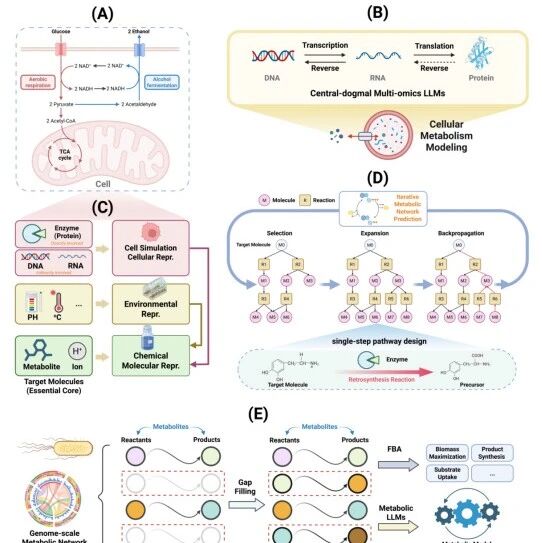
Core Viewpoint - The article introduces the groundbreaking concept of "AI Virtual Metabolism" (AIVM), establishing a new research paradigm driven by "AI + multi-omics" for reconstructing metabolic networks, which fills a significant gap in the field of virtual metabolism research [4][5]. Group 1: Challenges in Metabolic Pathway Reconstruction - The traditional biochemical reconstruction methods are limited by the scarcity of experimental data, making it difficult to address highly branched metabolic pathways and complex regulatory mechanisms [5]. - Existing AI methods primarily focus on static, template-based chemical reaction predictions and fail to simulate the dynamic processes within living organisms [5]. - A major challenge is enabling AI to not only predict chemical bond formations and breakages but also to understand enzyme specificity, thermodynamic boundaries, and complex system regulations [5]. Group 2: AIVM Core Paradigm - AIVM is a novel conceptual framework that integrates three dimensions: 1. Deep integration of AI and multi-omics, utilizing large language models trained on genomic, transcriptomic, proteomic, and metabolomic data for hierarchical representation of cellular functions [7]. 2. Strict biological constraint filters that ensure generated metabolic pathways are biologically feasible by incorporating enzyme specificity and thermodynamic feasibility [7]. 3. Expansion from single-pathway design to whole-genome models, allowing dynamic simulation and optimization of entire cellular metabolic networks [7]. Group 3: Future Vision - The introduction of AIVM signifies a shift in metabolic engineering research from "rule-driven" to "discovery-driven," positioning AI as a true "AI metabolic scientist" rather than just a supportive tool [8]. - By coupling multi-omics features with the topology of genome-scale metabolic models (GEMs), AI agents can autonomously propose new metabolic pathway hypotheses and recommend enzyme modification strategies [8]. - This paradigm is a crucial step towards achieving a complete virtual cell, providing new perspectives for understanding life processes and supporting microbial chassis optimization, green manufacturing of high-value compounds, and precision medicine [8]. Group 4: Conclusion - The work demonstrates the immense potential of AI for Science in the life sciences, marking a transition from data scarcity to paradigm establishment [9]. - Although fully replacing wet lab experimentation will take time, AIVM has outlined a future vision of a programmable, modular, and biologically compliant "virtual cell" [9]. - The article emphasizes the importance of integrating gene regulatory capabilities validated by the Virtual Cell Challenge (VCC) with the metabolic reconstruction capabilities defined by AIVM to approach a "living" digital twin of a cell [9].

用Diffusion构建「AI虚拟细胞」,14项指标霸榜!Mila唐建团队破解单细胞「破坏性」测序难题
量子位· 2026-03-12 07:48
Core Insights - The article discusses the breakthrough of PerturbDiff, a new AI model developed by the Mila team, which addresses the challenges of predicting drug responses in single-cell genomics by treating the distribution of cell populations as a random variable rather than relying on paired single-cell data [1][3][28]. Group 1: Model Innovation - PerturbDiff has achieved state-of-the-art (SOTA) results in predicting single-cell responses by utilizing a novel approach that models the distribution of cell populations instead of individual cells [3][28]. - The model incorporates a concept of "functional diffusion," allowing it to operate in a high-dimensional function space, which is essential for accurately representing the variability in biological responses [10][12]. Group 2: Theoretical Foundations - The model challenges the static assumptions of previous methods, which treated drug response distributions as fixed, highlighting the dynamic nature of biological systems influenced by various unseen variables [4][6]. - PerturbDiff employs advanced mathematical tools such as Reproducing Kernel Hilbert Space (RKHS) and Kernel Mean Embedding (KME) to effectively model complex population dynamics [9][11]. Group 3: Performance Metrics - PerturbDiff has demonstrated superior performance in multiple evaluations, including the Tahoe100M dataset, achieving high accuracy in predicting differential expression genes (DEGs), which are critical for assessing drug effects [18][20]. - The model's ability to generalize from limited data has been enhanced through marginal pretraining on a large dataset of unperturbed single-cell transcriptomes, leading to significant improvements in low-data scenarios [22][25]. Group 4: Biological Implications - The insights gained from the model's performance suggest that biological perturbations are not random but follow specific trajectories within existing cellular state manifolds, providing a deeper understanding of cellular responses to drugs [26][28]. - The development of PerturbDiff represents a significant step towards creating an ultimate "AI virtual cell" capable of accurately simulating perturbation responses, which could revolutionize drug discovery and development processes [29].
构建AI虚拟细胞基础模型,「百曜科技」获数千万元天使轮融资|早起看早期
36氪· 2025-10-24 03:05
Core Insights - The article highlights the growing interest in the "AI virtual cell" sector, driven by advancements in technology and data acquisition methods like single-cell sequencing, which have led to an explosion of multi-omics data [2][4]. Company Overview - Baiyao Technology recently completed a multi-million yuan angel round of financing, led by Fengrui Capital, with Shunxi Capital participating and Mingde Capital serving as the exclusive financial advisor [3]. - The founding team of Baiyao Technology released a pre-trained single-cell model in 2023, which has been iteratively improved to understand gene regulation and cellular state changes, simulating real cell behavior [3]. Technological Advancements - The single-cell model developed by Baiyao Technology integrates biological prior knowledge, enhancing learning directionality and producing results that align with biological logic [3]. - The model incorporates over 100 million single-cell gene expression data and conducts cross-species pre-training with human and mouse data, enabling the potential for effective translation of animal experiment data to predict human cell responses [3][4]. Industry Trends - The article notes that both the U.S. and China are actively promoting the use of foundational AI models for life simulation, with China's "14th Five-Year Plan" emphasizing the accelerated development of biotechnology and the establishment of major national scientific infrastructure in AI life sciences [4]. - Companies like Xaira Therapeutics and Asimov are already exploring applications of AI virtual cell models in areas such as tumor target discovery and stem cell differentiation [4]. Investment Perspectives - Investors view the virtual cell as a promising area, with the potential to significantly reduce trial-and-error costs and timelines in drug development and scientific research [6]. - Baiyao Technology is recognized for its deep expertise in virtual cell research, having developed multiple foundational and specialized models, and is collaborating with domestic and international pharmaceutical companies [6]. Future Outlook - The construction of AI virtual cells is described as a complex and resource-intensive endeavor, with potential investments reaching "hundreds of billions of dollars" to create comprehensive virtual cell models [5]. - The article emphasizes that the current technology is still in its early stages, but companies like Baiyao Technology are positioned to lead in high-quality data accumulation and algorithm iteration, potentially optimizing efficiency and costs in life sciences research and biopharmaceutical industries [5].

构建AI虚拟细胞基础模型,「百曜科技」获数千万元天使轮融资 | 36氪首发
3 6 Ke· 2025-10-24 00:17
Company Overview - Baiyao Technology, an AI virtual cell platform company, recently completed several million yuan in angel round financing led by Fengrui Capital, with participation from Shunxi Capital and Baidu Ventures, and Mingde Capital serving as the exclusive financial advisor [1] - The founding team of Baiyao Technology released a knowledge-enhanced, cross-species, billion-level data single-cell pre-training model in 2023, followed by a rapid iteration to launch the first graph-structured single-cell pre-training model [1][2] - Baiyao Technology's single-cell foundational model integrates biological prior knowledge, enhancing learning directionality and producing results that align closely with biological logic [1][3] Industry Trends - The "AI virtual cell" sector has gained significant attention in recent years due to advancements in technology, particularly in single-cell sequencing, which has led to an explosive growth of multi-omics data [2] - The emergence of self-attention mechanisms and self-supervised pre-training strategies has provided powerful tools for processing high-dimensional and complex life science data, enabling detailed characterization and dynamic simulation of cells [2] - Both the U.S. and China are actively promoting the use of foundational AI models for life simulation, with China's "14th Five-Year Plan" emphasizing the accelerated development of biotechnology and the establishment of major national scientific infrastructure in AI life sciences [2] Challenges and Opportunities - Constructing AI virtual cells is a complex and multi-dimensional challenge, requiring significant computational power and data resources, with potential investments reaching "hundreds of billions of dollars" [3] - The current AI virtual cell technology is still in its early development stages, with Baiyao Technology and similar companies having validated the theoretical path from 0 to 1 for their initial virtual cell models [3] - The characteristics of large models in this field suggest a strong Matthew effect, where companies that maintain a lead in high-quality data accumulation and algorithm iteration could achieve exponential optimization in efficiency and cost for life science research and biopharmaceutical industries [3] Investor Insights - Investors view cells as the fundamental unit of life and the main battleground for disease causation and drug development, with virtual cells expected to empower various scientific research and drug development scenarios, significantly reducing trial and error costs and timelines [4] - The integration of massive multi-omics data with Transformer algorithms enables the construction of high-fidelity virtual cells, breaking down barriers between mechanism research and application development, ushering in a new era for life sciences [5]