合成生物学

Search documents
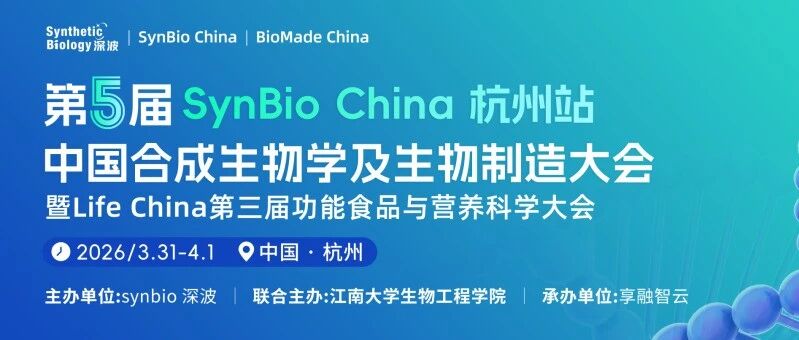
明天杭州见!第五届中国合成生物学及生物制造大会暨Life China第三届功能食品与营养科学大会,即将开幕!
synbio新材料· 2026-03-30 03:46
Conference Overview - The fifth Synbio China conference will be held in Hangzhou on March 31 to April 1, 2026, at the Hilton Garden Inn [7][9] - The conference aims to gather 1,000 participants and is organized by Synbio Deep Wave and Jiangnan University [7][8] Venue and Accommodation - The main venue is the Hilton Garden Inn, located at 600 Jinsada Avenue, Qiantang District, Hangzhou [6][7] - Accommodation options include: - Hilton Garden Inn: 550 RMB per night including breakfast [6] - Holiday Inn: 238 RMB for a double room, excluding breakfast [6] - City Hotel: 238 RMB for a double room, excluding breakfast [6] Transportation - Transportation options to the venue include: - Taxi from Hangzhou East Station: approximately 25 minutes [4] - Metro from Hangzhou East Station: Line 1 to Jinsahu Station, about 30 minutes [4] - Taxi from Hangzhou Xiaoshan International Airport: approximately 40 minutes [4] Agenda Highlights - The conference will feature various sessions, including: - Day 1 AM: Focus on bio-manufacturing industry ecology and functional food science [10] - Day 1 PM: Specialized sessions on food and skincare [10] - Day 2 AM: Focus on functional ingredients and bio-manufacturing innovation [10] - Day 2 PM: Discussions on future food and all-age nutrition [10] Keynote Speakers - Notable speakers include: - An academic from the German Academy of Engineering discussing low-carbon bio-manufacturing technologies [14] - Experts from Jiangnan University and other institutions presenting on various bio-manufacturing topics [15][19] Industry Collaboration - The conference will facilitate networking and collaboration among industry professionals, researchers, and investors [34] - Opportunities for exhibitors and sponsors to showcase their products and services related to synthetic biology and bio-manufacturing [34]

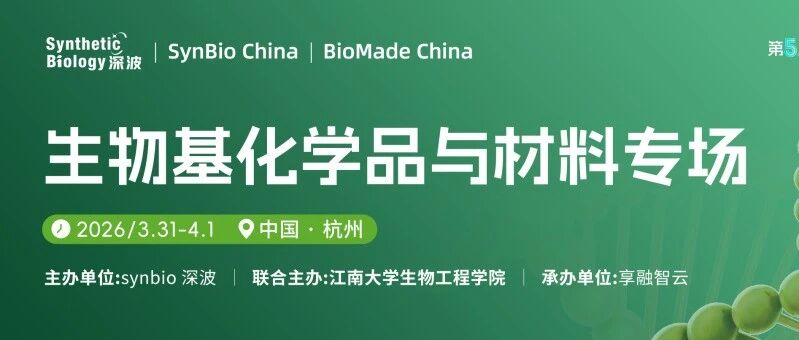
4月1日杭州【生物基化学品与材料专场】议程速看,免费报名参会!
synbio新材料· 2026-03-30 03:46
Conference Overview - The Fifth China Synthetic Biology and Biomanufacturing Conference will be held on March 31 to April 1, 2026, at the Heda Hilton Garden Inn in Hangzhou, with an expected attendance of 1,000 participants [5][6]. - The conference is organized by Synbio Deep Wave and co-hosted by Jiangnan University School of Biological Engineering, with support from various media outlets [5]. Venue and Accommodation - The conference will take place at Heda Hilton Garden Inn, located at 600 Jinsada Avenue, Qiantang District, Hangzhou [5]. - Accommodation options include: - Heda Hilton Garden Inn: 550 RMB per night including breakfast [5]. - Holiday Inn Hangzhou Jins Lake: 238 RMB for a double room, 280 RMB for a twin room, excluding breakfast [4]. - Boin City Hotel: 238 RMB for both double and twin rooms, excluding breakfast [4]. Transportation - Transportation options to the venue include: - Taxi from Hangzhou East Station: approximately 25 minutes [5]. - Metro Line 1 from Hangzhou East Station to Jinsahu Station: approximately 30 minutes [5]. - Taxi from Hangzhou Xiaoshan International Airport: approximately 40 minutes [5]. - Bus from Hangzhou Xiaoshan International Airport to Jinsahu Station: approximately 50 minutes [5]. Agenda Highlights - The conference will feature various sessions, including: - "Synthetic Biology Empowering New Materials" by Zhang Kechun, Professor at West Lake University [10]. - "Key Technologies and Applications for Constructing Microbial Cell Factories" by Chen Xiulai, Professor at Jiangnan University [12]. - "Next-Generation Industrial Biotechnology for High-Performance PHA Production" by Lan Yuxuan, Co-founder of Beijing Microstructure Biotechnology Co., Ltd. [14]. - "Industrialization Innovation and Implementation of Starch-Based Biomanufacturing Driven by Synthetic Biology" by Zhou Wenzhi, Founder and CEO of Jiangsu Sanmu Biotechnology Co., Ltd. [20]. Business Cooperation Opportunities - The conference offers exhibition opportunities for companies involved in synthetic biology and modern biotechnology applications, including project roadshows and sponsorship options [22].
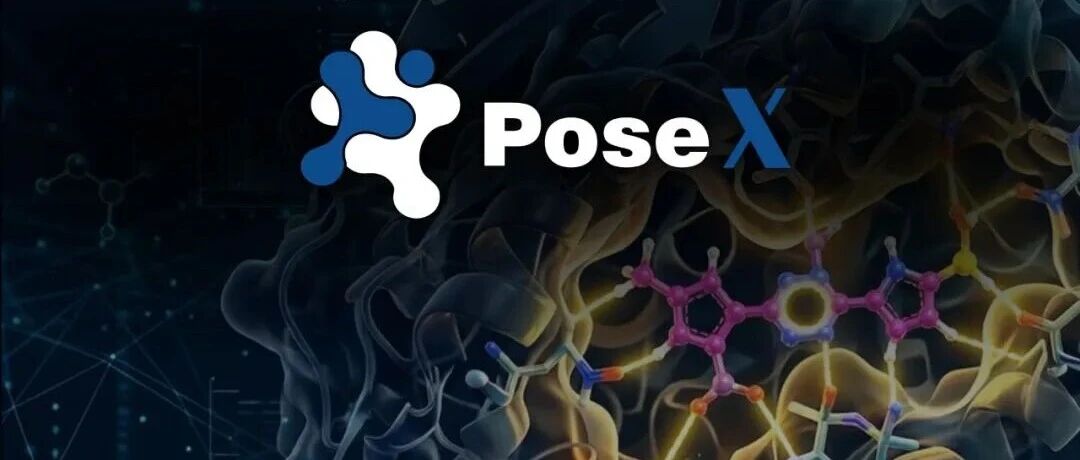
吸金王!微元合成完成3亿元A+轮融资,联合斯坦福大学等在ICLR2026发布AI生物计算开放合作平台PoseX
合成生物学与绿色生物制造· 2026-03-30 02:56
Core Viewpoint - MicroCyto has completed a 300 million RMB A+ round of financing, which will enhance its capabilities in AI-driven biological manufacturing and strengthen its technological leadership in the field [2]. Group 1: Financing and Strategic Partnerships - The financing round was participated by Henan Investment Group and Tan Ruiqing, who have extensive experience in the chemical industry and AI infrastructure [2]. - The funds will be used to expand the application boundaries of AI biological computing and increase investment in core technology research and development [2]. Group 2: Technological Advancements - MicroCyto, in collaboration with prestigious institutions like Stanford University and Princeton University, will present its latest achievement, PoseX, at the ICLR 2026 conference [3]. - PoseX aims to address the challenges of molecular docking in real-world scenarios, providing a robust digital foundation for bio-manufacturing and enzyme design [4]. Group 3: Industry Challenges - The molecular docking field faces significant challenges, particularly in cross-docking scenarios where the protein structure can change dynamically [6]. - There has been a lack of a unified, high-quality benchmark to evaluate algorithms in cross-docking situations, leading to failures in real-world applications [6]. Group 4: PoseX Platform Features - PoseX has created the world's first large-scale cross-docking benchmark, with datasets containing 718 self-docking samples and 1,312 cross-docking samples [7]. - The platform integrates 24 representative algorithms, including both physical methods and AI-based approaches, showcasing a comprehensive evaluation of docking methods [10]. Group 5: Key Findings - AI docking methods, particularly SurfDock and AlphaFold3, have surpassed traditional physical methods in accuracy and robustness for challenging cross-docking tasks [11]. - The study revealed that AI methods can significantly improve docking performance when pocket information is explicitly modeled [18]. Group 6: Application Prospects - PoseX is expected to accelerate the development of high-value bio-based products by optimizing metabolic pathways and enzyme designs, reducing the time from laboratory to industrial application [23][24]. - The platform can significantly lower research and development costs and risks, compressing traditional screening processes from months to days or weeks [25]. Group 7: Conclusion - The release of PoseX represents a significant collaboration between MicroCyto and leading academic institutions, marking a step forward in redefining biological manufacturing through AI [27].
AI虚拟代谢:西湖大学李子青团队联合上海人工智能实验室、百图生科和上海创智学院提出AI虚拟细胞代谢研究范式
合成生物学与绿色生物制造· 2026-03-30 02:56
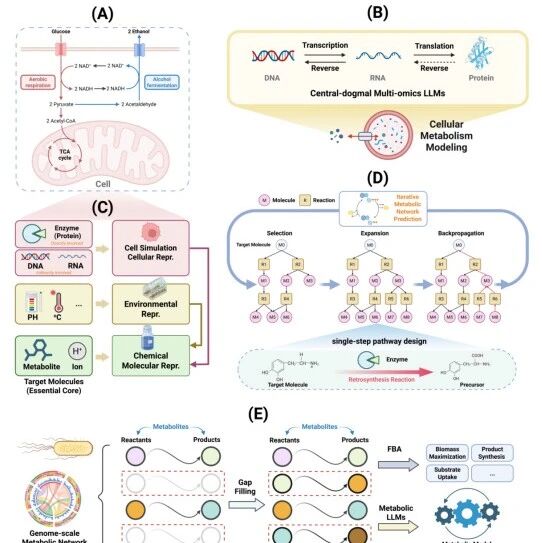
Core Viewpoint - The article introduces the groundbreaking concept of "AI Virtual Metabolism" (AIVM), establishing a new research paradigm driven by "AI + multi-omics" for reconstructing metabolic networks, which fills a significant gap in the field of virtual metabolism research [4][5]. Group 1: Challenges in Metabolic Pathway Reconstruction - The traditional biochemical reconstruction methods are limited by the scarcity of experimental data, making it difficult to address highly branched metabolic pathways and complex regulatory mechanisms [5]. - Existing AI methods primarily focus on static, template-based chemical reaction predictions and fail to simulate the dynamic processes within living organisms [5]. - A major challenge is enabling AI to not only predict chemical bond formations and breakages but also to understand enzyme specificity, thermodynamic boundaries, and complex system regulations [5]. Group 2: AIVM Core Paradigm - AIVM is a novel conceptual framework that integrates three dimensions: 1. Deep integration of AI and multi-omics, utilizing large language models trained on genomic, transcriptomic, proteomic, and metabolomic data for hierarchical representation of cellular functions [7]. 2. Strict biological constraint filters that ensure generated metabolic pathways are biologically feasible by incorporating enzyme specificity and thermodynamic feasibility [7]. 3. Expansion from single-pathway design to whole-genome models, allowing dynamic simulation and optimization of entire cellular metabolic networks [7]. Group 3: Future Vision - The introduction of AIVM signifies a shift in metabolic engineering research from "rule-driven" to "discovery-driven," positioning AI as a true "AI metabolic scientist" rather than just a supportive tool [8]. - By coupling multi-omics features with the topology of genome-scale metabolic models (GEMs), AI agents can autonomously propose new metabolic pathway hypotheses and recommend enzyme modification strategies [8]. - This paradigm is a crucial step towards achieving a complete virtual cell, providing new perspectives for understanding life processes and supporting microbial chassis optimization, green manufacturing of high-value compounds, and precision medicine [8]. Group 4: Conclusion - The work demonstrates the immense potential of AI for Science in the life sciences, marking a transition from data scarcity to paradigm establishment [9]. - Although fully replacing wet lab experimentation will take time, AIVM has outlined a future vision of a programmable, modular, and biologically compliant "virtual cell" [9]. - The article emphasizes the importance of integrating gene regulatory capabilities validated by the Virtual Cell Challenge (VCC) with the metabolic reconstruction capabilities defined by AIVM to approach a "living" digital twin of a cell [9].
Cell子刊:西湖大学李子青团队等提出AI虚拟细胞代谢研究新范式
生物世界· 2026-03-30 00:00
Core Viewpoint - The article introduces the concept of "AI Virtual Metabolism" (AIVM), establishing a new paradigm for metabolic network reconstruction driven by AI and multi-omics data, aiming to advance the understanding of biology and metabolic engineering [2][7][21]. Group 1: AI Virtual Metabolism Framework - AIVM combines retro-synthetic reasoning from chemistry with biological constraints to enhance the feasibility of metabolic pathway predictions [3][8]. - The framework utilizes large language models trained on multi-omics data to generate hierarchical representations of cellular functions, guided by the central dogma of molecular biology [8][21]. - AIVM incorporates various biological constraints, such as enzyme specificity and thermodynamic feasibility, to ensure realistic pathway predictions [8][9]. Group 2: Metabolic Pathway Reconstruction - The reconstruction of cellular metabolic pathways is crucial for understanding energy production, biosynthesis of macromolecules, and cellular signaling [5][12]. - Traditional biochemical methods face challenges due to limited experimental data and the complexity of metabolic networks, making complete reconstruction difficult [5][6]. - AI advancements offer a promising paradigm shift, enabling predictions of metabolic pathways without complete mechanistic understanding [6][21]. Group 3: Applications and Future Directions - The AIVM framework is envisioned to facilitate the engineering of microbial chassis for sustainable production of high-value compounds and therapeutic interventions [9][11]. - A hypothetical scenario illustrates the reconstruction of the artemisinic acid pathway in yeast, demonstrating the potential of AIVM to generate testable design hypotheses [11][12]. - Future applications may include optimizing microbial platforms and enhancing the supply of precursors for downstream processes [9][11]. Group 4: Challenges and Considerations - Key challenges include the need for large-scale, high-quality datasets to enhance biological realism and the complexity of extending predictions to eukaryotic organisms [22]. - The integration of computational modeling with experimental workflows is essential to address these challenges and establish biological credibility [22][21]. - The vision of an AI-enabled Virtual Cell is becoming a reality, providing powerful tools to accelerate optimization in metabolic engineering [22][21].

4月1日!西湖大学/江南大学/微构工场/利夫生物/三黍生物等专家齐聚杭州【生物基化学品与材料专场】,免费报名参会!
synbio新材料· 2026-03-28 09:30
Conference Overview - The Fifth China Synthetic Biology and Biomanufacturing Conference will be held on March 31 to April 1, 2026, at the Heda Hilton Garden Inn in Hangzhou [5][6] - The conference aims to gather around 1,000 participants, focusing on advancements in synthetic biology and biomanufacturing [5] Registration and Participation - Free registration is available, with a limited number of spots, and participants are encouraged to share the event link on social media for additional benefits [3][10] - Attendees must wear their registration badges at all times during the event [5] Transportation and Accommodation - Transportation options include taxi and metro services from Hangzhou East Station and Hangzhou Xiaoshan International Airport to the conference venue [5] - Recommended hotels include Heda Hilton Garden Inn, with room rates starting at 550 CNY per night, and other nearby hotels with varying prices [5] Agenda and Sessions - The conference will feature multiple sessions across two days, including topics such as biomanufacturing industry ecology, functional foods, and innovative projects in biomanufacturing [8][9] - Notable speakers include Zhang Kechun from West Lake University, who will discuss synthetic biology-enabled new materials, and Chen Xiulai from Jiangnan University, focusing on key technologies in microbial cell factory construction [12][15] Business Collaboration Opportunities - The conference offers exhibition spaces for companies involved in synthetic biology and modern biotechnology applications, providing various sponsorship and promotional opportunities [25][26]
生工生物全资收购曙芯生物
仪器信息网· 2026-03-27 08:59
Core Viewpoint - The acquisition marks a significant milestone for Shenggong Bio, completing its full industry chain layout from "automation equipment - core raw materials - reagent consumables - technical services" for independent control [1][4]. Group 1: Acquisition Details - Shenggong Bio has officially announced the full acquisition of core assets and personnel from Shenzhen Shuxin Biotechnology Co., Ltd. This acquisition is a crucial step in the company's domestic layout of the synthetic biology industry chain [2]. - The acquisition represents a deep integration of two major strengths in the domestic life sciences field, which will drive a transformation in the market landscape for high-end synthetic equipment and high-throughput synthesis technology [2]. Group 2: New Department Formation - The newly formed High-Core Synthesis Department will leverage Shenggong Bio's large-scale production capacity, nationwide service network, and comprehensive supply chain system. It aims to integrate the team's equipment R&D capabilities, AI algorithm advantages, and core technologies [3]. - The department will focus on the "bottleneck" areas of the upstream synthetic biology industry, creating a comprehensive platform for domestic high-end synthetic equipment and technical services that encompasses R&D, production, sales, and service [3]. Group 3: Product Matrix - The company plans to gradually establish a complete product matrix centered around high-throughput chip DNA synthesizers and automated bacterial selection instruments. This will include customized biological chip synthesis CRO services and supporting reagent consumables [3]. - The goal is to meet user needs throughout the entire process from DNA synthesis to strain selection [3].

下周!西湖大学/江南大学/微构工场/利夫生物/三黍生物等专家齐聚杭州【生物基化学品与材料专场】,免费报名参会!
synbio新材料· 2026-03-27 02:46
Core Viewpoint - The article emphasizes the importance of bio-based chemicals and materials as a key pillar of the bio-manufacturing industry, highlighting their potential to replace traditional petroleum-based products in various sectors such as packaging, textiles, and automotive, driven by global green transformation and carbon neutrality goals [2]. Event Details - The "5th China Synthetic Biology and Bio-Manufacturing Conference" will be held in Hangzhou from March 31 to April 1, 2026, with a focus on bio-based chemicals and materials [3]. - The conference is expected to attract around 1,000 participants and is organized by synbio深波, in collaboration with Jiangnan University [3]. Forum Agenda - The forum will feature a dedicated session on bio-based chemicals and materials, with notable speakers including: - Zhang Kechun, Professor at West Lake University, discussing "Synthetic Biology Empowering New Materials" [6]. - Chen Xiulai, Professor at Jiangnan University, presenting on "Key Technologies and Applications for Microbial Cell Factory Construction" [11]. - Lan Yuxuan, Co-founder of Beijing Microstructure Biotechnology Co., discussing "Next-Generation Industrial Biotechnology for Low-Cost Production of High-Performance PHA" [13]. - Zhou Wenzhi, CEO of Jiangsu Sanmu Biotechnology Co., focusing on "Industrialization Innovation and Implementation of Starch-Based Bio-Manufacturing Driven by Synthetic Biology" [19]. Industry Impact - The conference aims to gather insights from academia, industry, and research to promote high-quality development in the bio-based chemicals and materials sector, which is seen as crucial for the global green transition [2].
AI实验室来了,人人都能做科学家了?
阿尔法工场研究院· 2026-03-27 00:05
Core Insights - Ginkgo Bioworks aims to expand its Boston-based autonomous lab and create an AI-driven biological research platform, deploying multiple RAC systems to lower the cost and accessibility of scientific experiments [1] Group 1: AI and Scientific Revolution - The combination of AI and automated laboratories is expected to fundamentally change the paradigm of scientific research and the biopharmaceutical industry, leading to true disruption [1] - Previous technological revolutions did not fundamentally alter the biotechnology and biopharmaceutical sectors, but AI's integration is seen as a game-changer [1] Group 2: Ginkgo Bioworks' Strategic Focus - Ginkgo's mission is to make biology more engineering-friendly, focusing on "programming cells" [1] - The company's strategic emphasis has shifted from "AI-designed biology" to making laboratory testing and validation cheaper and faster, viewing the latter as a solvable engineering problem [1] Group 3: AI-Driven Automated Laboratories - Collaboration with OpenAI has demonstrated that AI models can autonomously design and conduct scientific experiments, achieving a 40% efficiency increase in optimizing "cell-free protein synthesis" through six iterations [2] - The cost structure of scientific research is revolutionized, with over 95% of costs currently attributed to labor, lab space, and equipment, while automated labs can flip this structure, making reagents the primary cost and achieving over tenfold data output efficiency [2] - AI scientists can work 24/7 and share raw experimental data in real-time, enhancing collaboration and learning compared to the traditional publication model [2] - Ginkgo addresses the challenge of automating diverse and non-standardized laboratory tasks by integrating third-party equipment and using AI to convert natural language instructions into executable code for robots [2] Group 4: Biotechnology Application Prospects - Currently, 85% of the biotechnology market is focused on therapeutics, indicating a narrow application ecosystem [3] - Promising new directions include consumer-grade biotechnology, such as GLP-1 drugs in the "health enhancement" sector, which has a market potential that far exceeds disease treatment [3] - Continuous health monitoring at the molecular level through frequent blood tests is seen as a way to achieve personalized health interventions [3] - The share of biotechnology transactions from Chinese companies has recently increased, attributed to lower costs and faster clinical trial processes in China [3] - The U.S. needs to leverage AI and automated laboratories to enhance research efficiency and maintain technological competitiveness [3]


官宣!江南大学 陈修来教授确认出席,并分享:《微生物细胞工厂构建关键技术及应用》
synbio新材料· 2026-03-26 05:56
Core Viewpoint - The "5th SynBio China Conference on Synthetic Biology and Biomanufacturing" will be held in Hangzhou from March 31 to April 1, 2026, focusing on advancements in synthetic biology and biomanufacturing [2][8]. Group 1: Conference Details - The conference will feature a special session on bio-based chemicals and materials, with Professor Chen Xiulai from Jiangnan University presenting on "Key Technologies and Applications for Microbial Cell Factory Construction" [2][8]. - The event is expected to attract around 1,000 participants and is organized by SynBio Deep Wave in collaboration with Jiangnan University [8]. - Various sessions will cover topics such as biomanufacturing industry ecology, functional food and nutrition science, and applications of biomanufacturing technology [9]. Group 2: Research Contributions - Professor Chen Xiulai's research addresses critical issues in microbial chemical synthesis, including low flux, high dispersion, and slow rates, by developing new strategies for enhancing metabolic flow and controlling cell lifespan [4][5]. - The research has led to significant economic and social benefits by improving the production of organic acids, amino acids, and other multi-carbon chemicals, addressing industry challenges such as low yields and long fermentation cycles [5]. Group 3: Agenda Highlights - The agenda includes presentations on various topics, such as the construction of microbial cell factories, low-cost production of high-performance PHA, and the development of bio-based materials [13]. - Notable speakers include Zhang Kechun from Westlake University and other industry leaders, discussing innovations in synthetic biology and biomanufacturing [13]. Group 4: Participation and Collaboration - The conference offers opportunities for exhibitors from synthetic biology and modern biotechnology sectors, providing a platform for showcasing technologies and products [16]. - Free registration is available for attendees, with limited spots, emphasizing the importance of early registration [19].