
AI辅助学习

Search documents
每天只学 2 小时,成绩却排全美前 1%?AI 正在重新定义「好学校」
3 6 Ke· 2025-12-22 02:31
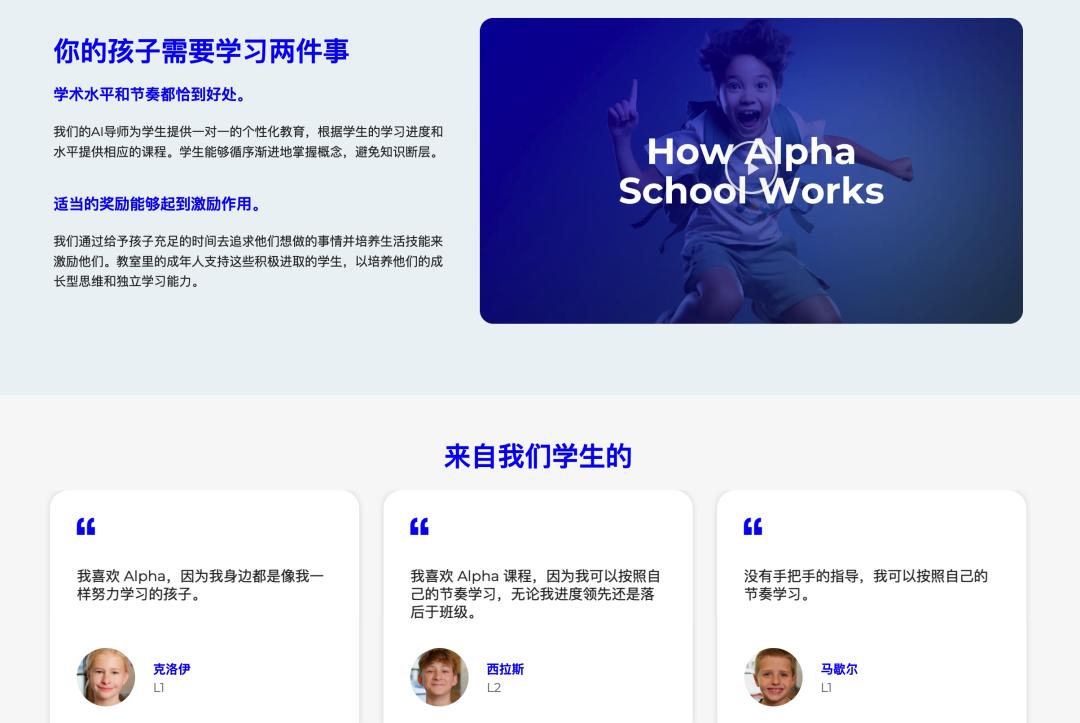
Core Insights - The emergence of advanced AI models like Google's Gemini3 is raising concerns among parents about the future competitiveness of their children in an AI-dominated educational landscape [1][2] - The traditional methods of rote memorization and repetitive training are becoming less valuable as AI can outperform students in various academic tasks [2] - The potential for children to learn solely through AI tools raises questions about the necessity of traditional schooling [3][4] Educational Models - The current educational landscape is diverging into three distinct models: traditional schools, complete self-study, and a hybrid model [6][10] - Traditional schools follow a fixed curriculum and standardized testing, which can be inflexible and not cater to individual learning paces [7][8] - Complete self-study allows for personalized learning but often lacks the discipline and structure needed for most students to succeed [9] - The hybrid model, exemplified by Alpha School, combines AI's capabilities with human guidance to enhance learning outcomes [10] Alpha School's Performance - Alpha School has achieved remarkable results, with students scoring in the top 1% on MAP tests and an average SAT score of 1470 out of 1600 [11][13] - Students spend only 2 hours daily on core subjects, focusing the rest of their time on skills like public speaking and teamwork, leading to learning efficiencies of over 2 times compared to traditional schools [13][17] - The school utilizes AI to identify students' weaknesses and tailor learning experiences, making it a unique educational experiment [17][19] AI's Role in Education - AI serves three primary roles at Alpha School: tutor, assistant, and partner [23][26] - As a tutor, AI provides personalized instruction and practice, adapting to each student's learning needs [26] - As an assistant, AI helps manage learning progress and reminders, offering consistent support [27][28] - As a partner, AI provides immediate feedback and emotional support, enhancing the learning experience [30] Teacher and Student Dynamics - The role of teachers at Alpha School shifts from traditional lecturing to guiding students in goal-setting and overcoming psychological barriers to learning [31][32] - Students are encouraged to develop new skills such as questioning, evaluating AI responses, and building their knowledge systems [34] - Peer interactions remain crucial for social learning, with collaborative projects and activities fostering essential interpersonal skills [36] Future of Education - The Alpha School experiment suggests that while AI may take over knowledge delivery, the socialization aspect of education will remain vital [36] - Future educational models may increasingly rely on AI for content delivery while focusing human resources on project-based learning and creativity [36] - Parents are encouraged to engage with AI actively and guide their children in using it as a tool for problem-solving rather than avoidance [36][37]

论文自动变漫画PPT!Nano Banana同款用秘塔免费生成,还有一对一语音讲解
量子位· 2025-12-09 05:39
Core Viewpoint - The article discusses the innovative features of the AI tool "秘塔" (Mita), which offers a comic-style presentation generation similar to "Nano Banana 2," enhancing the learning experience by transforming complex texts into engaging visual formats [1][4][12]. Group 1: Product Features - Mita provides over 20 different styles for generating presentations, allowing users to choose their preferred visual format [5][18]. - The tool can convert academic papers and reports into clear, illustrated PowerPoint presentations with accompanying voice explanations, making learning more efficient [6][10][11]. - Users can upload their own materials or search for online resources, and the AI will automatically create a presentation based on the provided content [15][20]. Group 2: Accessibility and User Experience - Mita emphasizes a zero-threshold approach, offering free access without the need for complicated applications or waiting lists [8][48]. - The platform refreshes daily with 100 points, equivalent to 100 pages of PPT, which is sufficient for most users' learning needs [49][51]. - The tool is designed to facilitate self-learning, transforming the process of creating presentations from a burden into a shortcut for knowledge acquisition [56][57]. Group 3: Market Positioning - Unlike many competitors that focus on aesthetic templates and animations, Mita prioritizes internal input and user-driven learning scenarios [54][55]. - The product evolution reflects a commitment to reducing barriers to information access, moving from simple searches to deeper understanding and comprehension [58][59]. - Mita's approach represents a significant opportunity for users, as it aims to democratize knowledge acquisition through technology [60][61].

瞭望 | 扬长避短AI赋能中小学教育
Xin Hua She· 2025-06-17 06:22
Core Viewpoint - The rapid development of generative AI technology in education raises concerns about its potential to weaken students' critical thinking and deep learning abilities, necessitating careful guidelines for its use in primary and secondary education [1][3]. Group 1: AI in Education - The Ministry of Education's guidelines emphasize avoiding the simple copying of AI-generated content in student assignments and discourage the overuse of AI in creative tasks to preserve individual thought and expression [1][2]. - A survey indicated that 40% of students used various AI tools for completing homework, highlighting the prevalence of AI-assisted learning among middle and primary school students [3]. - Teachers report that reliance on AI tools for homework can diminish students' independent thinking and cognitive development, as they bypass critical problem-solving processes [3][4]. Group 2: Risks of AI Dependency - There are concerns that students may become addicted to AI tools, leading to decreased academic performance and engagement in learning activities [4]. - The reliability of AI-generated content is questioned, as inaccuracies in data and algorithms can mislead students and compromise their understanding of fundamental concepts [5]. - Instances of AI producing inappropriate or misleading content raise alarms about the potential negative impact on students' values and educational quality [5]. Group 3: Strategies for Effective AI Use - Schools are exploring innovative ways to integrate AI into teaching, such as incorporating AI discussions in group activities to enhance student engagement and critical thinking [6][7]. - Open-ended assignment designs are being implemented to encourage independent research and creativity, moving away from traditional standardized answers [7]. - Educators stress the importance of guiding students to understand AI as a supportive tool rather than a replacement for their own thinking and creativity [8][9]. Group 4: Collaborative Efforts and Safety Measures - Collaboration between schools and families is crucial to monitor and guide students' use of AI tools, ensuring a balanced approach to technology in education [9][10]. - Recommendations include developing AI systems tailored for educational purposes, enhancing safety features, and ensuring content appropriateness for different age groups [10].