
AI驱动的产业变革

Search documents
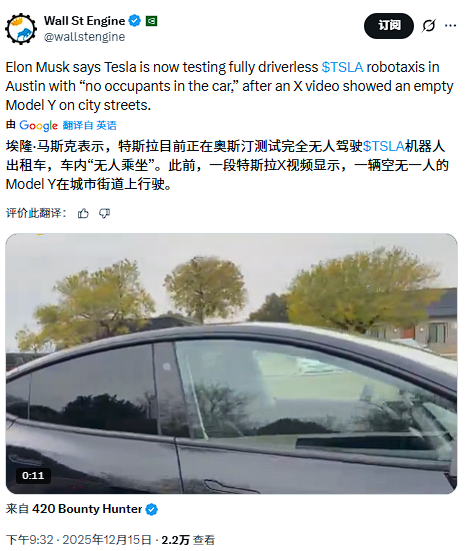
开启“全无人测试”,特斯拉的“Robotaxi故事”进入关键验证期
Hua Er Jie Jian Wen· 2025-12-16 11:48
Core Insights - Tesla has officially launched fully autonomous Robotaxi testing in Austin, marking a critical validation phase for its autonomous driving commercialization strategy [1][3] - Morgan Stanley views this development as a significant catalyst for validating Tesla's Robotaxi strategy [1][5] Expansion Strategy - Tesla aims to remove safety supervisors from its Robotaxi service, aligning with its goal to enhance safety metrics post-removal, which is crucial for expanding into new states and cities by 2026 [7] - The production of the Cybercab, designed specifically for autonomous driving, is targeted for April 2026, which is expected to further reduce costs and accelerate adoption [7] Fleet Growth Projections - Morgan Stanley predicts that Tesla's Robotaxi fleet will grow from 200 vehicles in 2025 to 1,000 in 2026, and continue to expand to 30,000 by 2030, ultimately reaching 1 million by 2035 [8] - The projected passenger miles for Robotaxi services are expected to increase from nearly zero in 2026 to 40.8 billion miles by 2035, reflecting advancements in safety validation, regulatory approval, and technology optimization [8] Cost Advantages - Tesla is expected to achieve an operational cost of $0.59 per mile by 2028, significantly lower than competitors like Waymo at $0.75, traditional ride-sharing services at $0.99, and private vehicle costs at $0.81 [12][14] - This cost advantage stems from a vertically integrated technology stack, the specifications of the Cybercab, and the choice of a pure vision sensor solution [14] Data Collection and FSD Deployment - The successful operation of the Robotaxi fleet is crucial for collecting real-world autonomous driving data, which will serve as key evidence for regulatory discussions and the rollout of unsupervised Full Self-Driving (FSD) for personal vehicles [15][16] - Morgan Stanley anticipates that by 2035, the FSD penetration rate for Tesla's personal vehicles will reach 70%, with an estimated vehicle count of around 35 million [16] Competitive Positioning - The automotive industry is approaching a pivotal moment driven by AI, with Tesla's lead in data, computing power, and algorithms significantly outpacing most electric vehicle competitors [18] - Morgan Stanley's DCF valuation model sets a target price of $425 for Tesla, based on various business segments, while maintaining a "hold" rating and an "in-line" industry outlook [18]


统联精密2024年营收突破8亿元 迈入多元化发展新阶段
Zheng Quan Shi Bao Wang· 2025-04-25 01:16
Core Insights - The company achieved a revenue of 814 million yuan in 2024, representing a year-on-year growth of 44.93% [1] - The net profit attributable to shareholders reached 74.63 million yuan, up 26.99% year-on-year [1] - The non-MIM precision components business saw a revenue increase of 101.89%, surpassing the MIM components revenue for the first time [1] Financial Performance - The comprehensive gross margin for 2024 was 38.34%, a decrease of 1.57 percentage points year-on-year [2] - The gross margin for MIM products improved to 42.06%, an increase of 2.04 percentage points due to optimized processes [2] - The gross margin for non-MIM precision components was 37.96%, down 2.57 percentage points as new businesses are still in the penetration phase [2] Production and Capacity Expansion - The company is steadily advancing its domestic and international capacity expansion, with factories in Changsha and Vietnam entering phased production [2] - Some target customers have completed site audits, indicating progress in capacity deployment [2] Research and Development - R&D investment for 2024 was 97.55 million yuan, reflecting an 18.04% increase [2] - The company is focusing on new lightweight materials and 3D printing technologies to enhance its technological reserves and capacity layout [2] Strategic Direction - The company aims to leverage new materials and processes as entry points, utilizing differentiated technical solutions to seize opportunities in AI-driven industrial transformation [2] - The goal is to extend products into high value-added segments, ensuring sustainable and stable development while maintaining profitability [2]
