AI驱动的反通胀

Search documents
国泰海通:沃什获提名 联储的独立性变化与美债策略应对
Xin Lang Cai Jing· 2026-01-31 14:41
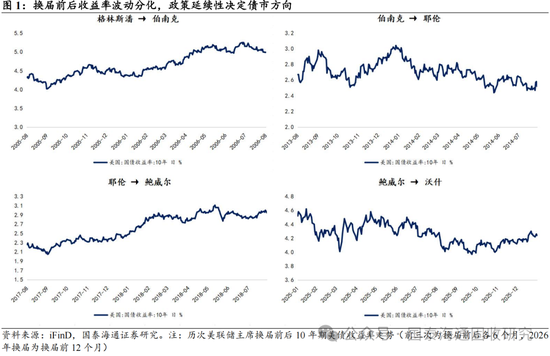
Group 1 - The core viewpoint of the article emphasizes the changing policy tendencies of Kevin Warsh and the persistent independence dilemma of the Federal Reserve, suggesting a defensive approach to U.S. Treasury investments with a focus on duration neutrality and volatility control [1] Group 2 - Historical patterns indicate that the transition of the Federal Reserve chairperson typically leads to increased yield volatility, adjustments in curve shapes, and re-evaluation of risk premiums, with the highest policy uncertainty occurring 6-12 months before and after the transition [1][2] - The yield curve often undergoes structural adjustments during chair transitions, with the perception of the new chair as either dovish or hawkish influencing the short and long ends of the curve [2] - The MOVE Index, which measures bond market volatility, tends to rise by 15-25% during chair transitions, reflecting increased market uncertainty regarding policy paths [2] Group 3 - Kevin Warsh, a prominent figure with a background in finance and government, has a history of advocating for a hawkish stance on inflation and monetary policy, emphasizing the Federal Reserve's responsibility in managing inflation [3][4] - Warsh's policy stance has evolved recently, showing a shift from a traditional hawkish position to a more pragmatic approach that supports interest rate cuts, raising discussions about the sustainability of this shift [8][9] Group 4 - The article discusses the implications of Trump's influence on the Federal Reserve, highlighting the division among board members regarding policy independence and the potential for political pressures to affect monetary policy decisions [10][11] - Warsh's nomination appears to create an internal contradiction for Trump, as Warsh's hawkish tendencies may conflict with the administration's desire for aggressive rate cuts [11][12] Group 5 - The Federal Reserve's recent decision to pause interest rate cuts reflects a balance between economic growth and inflation concerns, with internal disagreements among board members indicating ongoing policy debates [16][20] - Economic indicators show resilience, with a notable GDP growth rate of 4.4% in Q3 2025, driven by consumer spending and government recovery efforts, while inflation remains a significant challenge [20][21] Group 6 - The article suggests a cautious investment strategy in U.S. Treasuries, advocating for a balanced approach that considers both potential interest rate cuts and the risks associated with inflation and policy uncertainty [24][25]


国泰海通 · 固收|沃什获提名:联储的独立性变化与美债策略应对
国泰海通证券研究· 2026-01-31 14:26
Group 1 - The article discusses the implications of Kevin Warsh's potential nomination as the Federal Reserve Chair, highlighting the tension between his hawkish monetary policy stance and the political pressures from the Trump administration [1][10]. - Historical patterns indicate that changes in Federal Reserve leadership often lead to increased volatility in the bond market, with significant shifts in yield curves and risk premiums observed during transition periods [2][3]. - Warsh's background as a "Wall Street-White House-Federal Reserve" elite positions him uniquely to navigate the complexities of monetary policy, having previously served in various influential roles [5][6]. Group 2 - Warsh's policy positions have evolved, showing a shift from a strict inflation hawk to a more pragmatic approach that supports interest rate cuts, influenced by technological advancements like AI [8][9]. - The article emphasizes the potential for increased uncertainty in monetary policy under Warsh's leadership, particularly regarding the independence of the Federal Reserve amidst political pressures [14][15]. - The Federal Reserve's recent decision to pause interest rate cuts reflects a balancing act between economic growth and persistent inflation, indicating a cautious approach moving forward [17][19]. Group 3 - The article suggests a defensive strategy for U.S. Treasury investments, recommending a neutral duration stance while being prepared for both steepening and flattening yield curves [23][24]. - It advises maintaining a balanced credit risk exposure, favoring high-quality credit bonds while avoiding low-rated securities that are sensitive to interest rate changes [24][25]. - The need for liquidity management is highlighted, with recommendations to increase cash and high-liquidity short-term securities to prepare for future interest rate adjustments [25].