AI ToC

Search documents
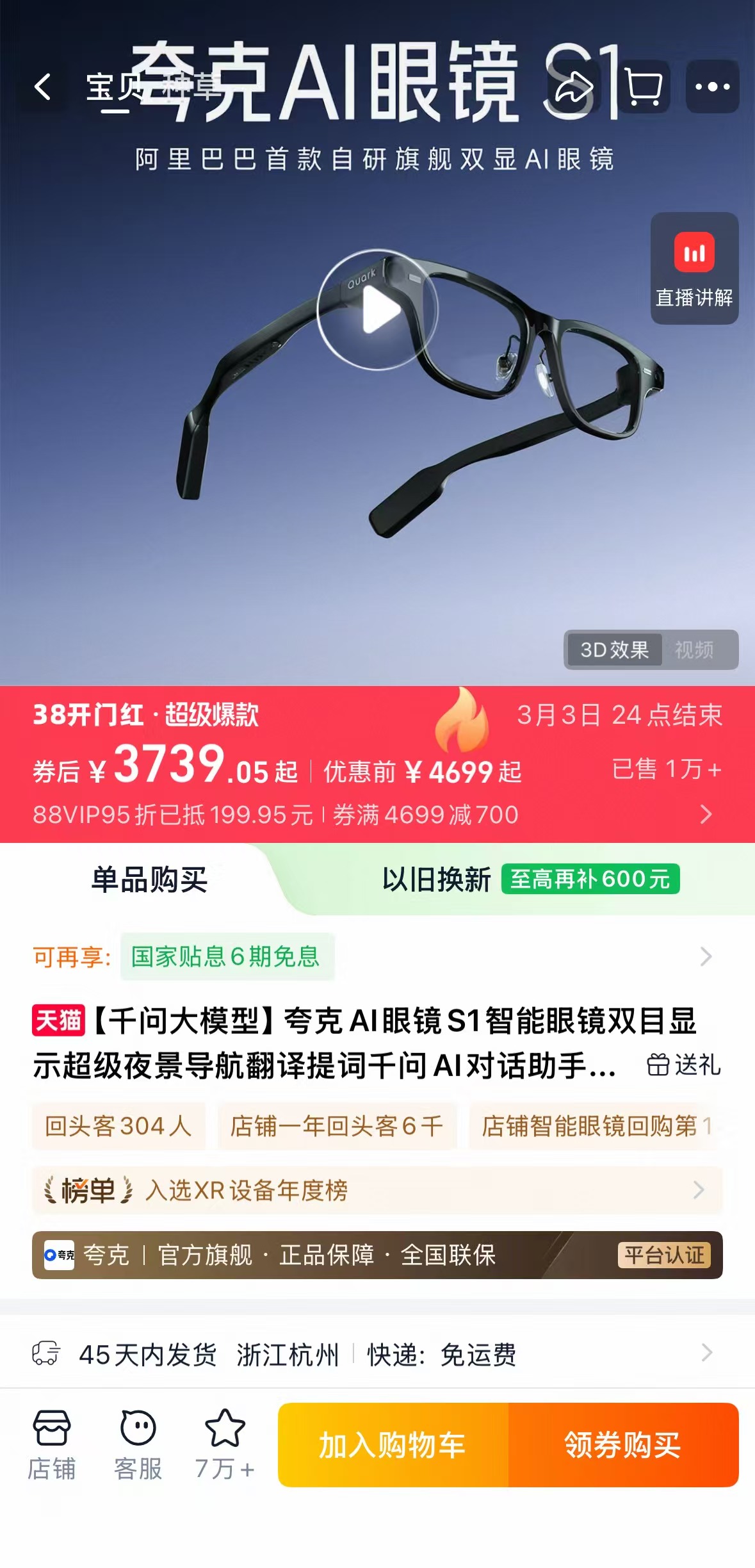
从红包大战烧至AI硬件:千问将发布AI眼镜
Di Yi Cai Jing· 2026-02-27 12:27
Group 1 - The core viewpoint of the articles revolves around Alibaba's entry into the AI hardware market with its personal AI assistant "Qwen," which aims to create a seamless integration of AI across various devices, including AI glasses, rings, and headphones [1][2][3] - Alibaba's strategy focuses on establishing a native AI entry point for consumer interactions, shifting its emphasis back to the Qwen app after initial attempts with other AI applications did not yield significant results [2][3] - The launch of Qwen AI glasses is seen as a pivotal move to enhance user experience and expand Alibaba's ecosystem into the physical world, with the glasses designed to integrate functionalities like food delivery and ride-hailing [3][4] Group 2 - The current competitive landscape for AI glasses indicates that while major companies are entering the market, significant investment in talent, marketing, and user experience is required to stand out [4][7] - IDC forecasts that global smart glasses shipments will exceed 23.7 million units by 2026, with China's market expected to surpass 4.9 million units, suggesting a potential for substantial growth [4] - Sales data shows that despite some models like the Quark AI glasses S1 achieving high sales, the overall market for AI glasses remains in its infancy, with total sales for top models only around 130,000 units [7][8]


夸克不想「吃豆包」,而要做中国版ChatGPT
Di Yi Cai Jing· 2025-10-24 13:53
Core Insights - Quark has launched a conversational AI assistant integrated into its existing app, prioritizing AI search and browser capabilities before introducing the chatbot feature [1][4][26] - The chatbot's design and functionality differ significantly from competitors, focusing on logical and objective outputs rather than emotional engagement [6][20] - Quark's approach leverages its extensive tool ecosystem, allowing users to perform various tasks directly through the chatbot interface, enhancing user experience [25][26] Product Development - Quark's chatbot was introduced on October 23, 2023, as part of the app's update, providing users with dual access points for search and assistance [4][29] - The integration of the chatbot is not merely a feature addition but a strategic move to unify Quark's existing productivity tools into a cohesive user experience [26][30] - The underlying technology for the chatbot is based on Alibaba's latest Qwen model, which has shown strong performance in international benchmarks [20] Market Positioning - Quark aims to capture a larger share of the AI ToC market by combining AI search and chatbot functionalities, addressing similar user needs and expanding usage scenarios [29][30] - Recent data indicates that Quark leads in daily active users among AI applications, suggesting a strong market presence compared to competitors [29] - The launch of the chatbot is part of a broader strategy, referred to as the "C plan," which includes plans for AI hardware and further integration of AI capabilities across platforms [30]
分分合合,钉钉回到“无招”时代
Bei Jing Shang Bao· 2025-04-01 13:12
Core Viewpoint - Alibaba Group plans to acquire shares from Chen Hang (alias: Wuzhao), the founder of Two Hydrogen and One Oxygen Company, with Chen set to become the CEO of DingTalk after the transaction. This move indicates a strategic shift for DingTalk as it aligns with Alibaba's future vision for the platform [2]. Group 1: Leadership Changes - Chen Hang's return to DingTalk is unexpected, as he previously left to align with Alibaba's cloud integration strategy, which focused on larger enterprises, while DingTalk's mission was to serve small and medium-sized enterprises [3]. - The current CEO of DingTalk, Ye Jun (alias: Buqiong), will return to Alibaba Group for another role, marking a significant leadership transition within the company [2]. Group 2: Business Performance and Strategy - As of March 31, 2020, DingTalk had over 300 million users and more than 50 million enterprises using the platform, showcasing its rapid growth [3]. - Under Ye Jun's leadership, DingTalk achieved significant commercial success, with subscription revenue exceeding 3 billion yuan in the 2025 fiscal year [4]. - The strategic emphasis on "cloud and DingTalk integration" has diminished, and DingTalk is now positioned as an independent company, which may allow for more focused development [4]. Group 3: Future Direction - Chen Hang's return is seen as a move to align DingTalk with Alibaba's intelligent strategy, positioning it as a key product for AI applications targeting the enterprise sector [5]. - Alibaba's future strategy emphasizes user-centric and AI-driven approaches, with DingTalk expected to play a crucial role in enhancing enterprise collaboration through AI [4][5].