千问app

Search documents
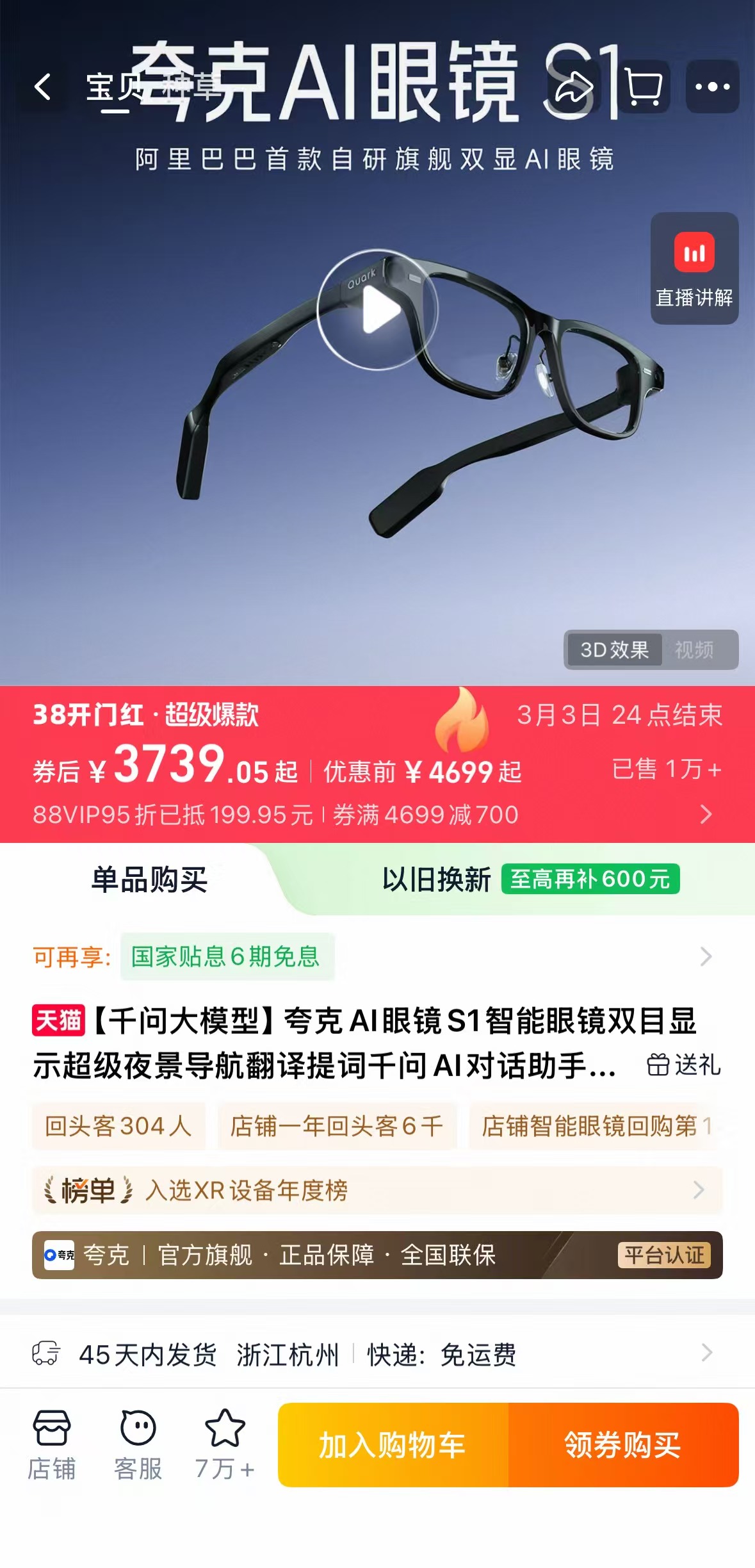
从红包大战烧至AI硬件:千问将发布AI眼镜
Di Yi Cai Jing· 2026-02-27 12:27
Group 1 - The core viewpoint of the articles revolves around Alibaba's entry into the AI hardware market with its personal AI assistant "Qwen," which aims to create a seamless integration of AI across various devices, including AI glasses, rings, and headphones [1][2][3] - Alibaba's strategy focuses on establishing a native AI entry point for consumer interactions, shifting its emphasis back to the Qwen app after initial attempts with other AI applications did not yield significant results [2][3] - The launch of Qwen AI glasses is seen as a pivotal move to enhance user experience and expand Alibaba's ecosystem into the physical world, with the glasses designed to integrate functionalities like food delivery and ride-hailing [3][4] Group 2 - The current competitive landscape for AI glasses indicates that while major companies are entering the market, significant investment in talent, marketing, and user experience is required to stand out [4][7] - IDC forecasts that global smart glasses shipments will exceed 23.7 million units by 2026, with China's market expected to surpass 4.9 million units, suggesting a potential for substantial growth [4] - Sales data shows that despite some models like the Quark AI glasses S1 achieving high sales, the overall market for AI glasses remains in its infancy, with total sales for top models only around 130,000 units [7][8]


红包、模型与算力:马年春节AI战役全记录
Xin Lang Cai Jing· 2026-02-24 08:32
Core Viewpoint - The Chinese tech industry is engaged in a significant AI battle during the Spring Festival, with major companies like ByteDance, Alibaba, Tencent, and Baidu investing heavily to capture market share and user engagement [4][32][39]. Investment and Spending - ByteDance invested over 1 billion yuan in the Spring Festival campaign, while Alibaba spent 3 billion yuan on promotions through its AI assistant, Qianwen [4][32]. - Tencent and Baidu also contributed significantly, with Tencent investing 1 billion yuan and Baidu 500 million yuan to drive AI application traffic [4][32]. User Engagement and AI Application Penetration - During the Spring Festival, over 100 million users engaged with AI applications for various tasks, such as sending greetings and making purchases [5][33]. - ByteDance reported 1.9 billion interactions with its AI product, Doubao, on New Year's Eve, while Alibaba noted nearly 200 million users utilized Qianwen for orders [5][33]. Competitive Landscape - The competition is likened to a "Midway battle," where losing could mean losing the future in the AI sector [4][32]. - Companies are racing to capture user attention and engagement, with significant marketing efforts centered around the Spring Festival [4][32]. Strategic Moves and Partnerships - The CCTV Spring Festival Gala is identified as a critical battleground for these companies, with past successes in leveraging the event for user growth [6][36]. - ByteDance quickly secured a partnership for the Spring Festival Gala, while Tencent hesitated and later sought alternative advertising opportunities [7][38]. Technological Development and Challenges - Companies are focusing on enhancing their AI models, with ByteDance's Doubao 2.0 and Alibaba's Qwen models being central to their strategies [41][42]. - The competition has led to increased capital expenditures on AI infrastructure, with companies needing to ensure sufficient computational resources to support their applications [45]. Regulatory Environment - The market regulatory authority has intervened, reminding companies to avoid "involutionary" competition, which could impact their aggressive marketing strategies during the Spring Festival [22][51].

“淘宝闪购是集团里程碑意义战役” 阿里核心管理层给员工打气
Xin Lang Cai Jing· 2026-02-12 08:24
Core Insights - Alibaba is committed to investing heavily in Taobao Flash Purchase, with no concerns about losses for the next three years, as part of a strategic push in the instant retail sector [1][21][22] Investment Strategy - The management has set a goal for 2026 to increase investment in Taobao Flash Purchase beyond the previous year, focusing on instant retail [2][22] - The emphasis is on high-value orders over 30 yuan and improving operational efficiency in delivery [3][23] Market Positioning - As of now, Meituan holds over 50% market share in the food delivery sector, while Taobao Flash Purchase has around 40%, with JD.com below 5% [6][26] - The strategy has shifted from merely increasing order volume to enhancing the quality of orders, aiming for 60% of orders to be above 30 yuan [6][26] Competitive Dynamics - The competition is intensifying, with both Taobao Flash Purchase and Meituan focusing on delivery efficiency and rider availability [7][27] - Taobao Flash Purchase has improved its delivery times in southern cities, surpassing Meituan in areas like Guangzhou and Shenzhen [8][28] Infrastructure Development - Instant retail requires long-term investment and is currently in the warehouse construction phase, with a focus on high-demand categories like pharmaceuticals, alcohol, and fresh produce [10][30] - Alibaba is building multiple delivery warehouses to support instant retail, including around 200 front warehouses and plans for additional ones [33] User Engagement and AI Integration - The launch of the AI assistant Qianwen has accelerated the push for Taobao Flash Purchase, with significant investments aimed at cultivating consumer habits in using AI for shopping [17][36] - The app saw a surge in daily active users, reaching approximately 7.5 million shortly after a promotional campaign [19][37] Future Outlook - The company is exploring various scenarios for in-store business and aims to capture a larger market share from Meituan by summer 2026 [3][23] - The integration of instant retail with Alibaba's main e-commerce platform is expected to enhance visibility and drive traffic to Taobao Flash Purchase [12][31]

阿里要继续大投入淘宝闪购,三年不担心亏损
Xin Lang Cai Jing· 2026-02-11 11:57
Core Insights - The new round of instant retail competition has begun, accelerated by the AI assistant battle [3][26] - Alibaba's management encourages bold moves in flash sales, aiming for significant investment in instant retail by 2026 [4][28] - The focus for Taobao Flash Sales includes high-value orders and precise operational improvements in food delivery and instant retail [5][29] Group 1: Market Strategy - Taobao Flash Sales plans to increase its investment in 2026, focusing on instant retail and high-value orders above 30 yuan [4][28] - The strategy includes enhancing delivery efficiency and targeting specific high-demand categories like pharmaceuticals, beverages, and fresh produce [5][29] - The goal is to surpass Meituan's market share by summer 2026, with a focus on high-quality orders [7][31] Group 2: Competitive Landscape - The current market share is approximately 50% for Meituan and 40% for Taobao Flash Sales, with JD.com below 5% [9][34] - Taobao Flash Sales has shifted its focus from order volume growth to increasing the proportion of high-quality orders to 60% [9][34] - Both companies are competing on delivery capabilities, with Taobao Flash Sales aiming to match Meituan's delivery times [10][35] Group 3: Operational Enhancements - Taobao Flash Sales is implementing a "super computing system" to optimize delivery processes and reduce costs [10][35] - The company is expanding its delivery capacity with multiple logistics lines, enhancing its operational efficiency [11][36] - In southern regions, Taobao Flash Sales has improved delivery times, surpassing Meituan in cities like Guangzhou and Shenzhen [12][36] Group 4: Infrastructure Development - Instant retail requires long-term investment and infrastructure development, with a focus on building warehouses for efficient delivery [14][38] - Taobao Flash Sales is currently stabilizing its daily order volume at around 10 million, which is about half of Meituan's [17][41] - Alibaba is constructing dedicated warehouses for instant retail, with plans to expand its logistics network significantly [18][42] Group 5: AI Integration and User Engagement - The competition for AI entry points is intensifying, with significant investments from Alibaba to cultivate consumer habits in AI-assisted shopping [21][45] - The launch of the Qianwen app has led to a surge in user engagement, with daily active users increasing dramatically during promotional events [22][46] - The integration of AI into shopping experiences is seen as a critical area for future growth, despite potential challenges in user retention [23][47]

传媒板块继续爆发,两只影视ETF触及涨停丨ETF晚报
2 1 Shi Ji Jing Ji Bao Dao· 2026-02-10 10:20
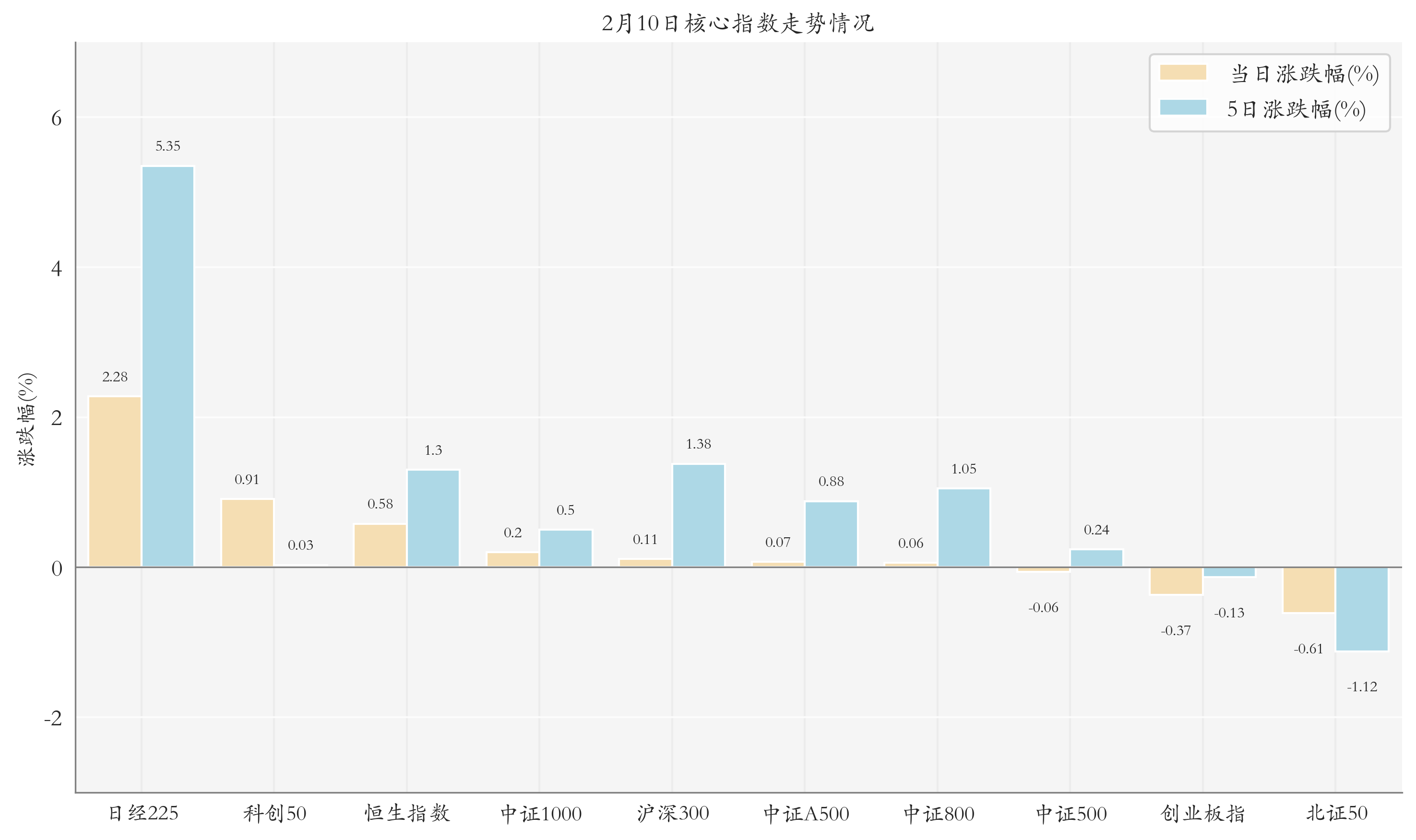
ETF Industry News - The three major indices showed mixed results, with the Shanghai Composite Index rising by 0.13%, the Shenzhen Component Index increasing by 0.02%, and the ChiNext Index declining by 0.37. Multiple ETFs in the media sector saw significant gains, with the Film ETF (159855.SZ) up by 9.98%, the Film ETF (516620.SH) rising by 9.48% and hitting a temporary limit, and the Gaming ETF (159869.SZ) increasing by 5.56% [1][2][3]. Market Trends - According to Huaxin Securities, the media sector is expected to be supported by AI applications and domestic discretionary consumption. By January 2026, digital marketing advertising is anticipated to be revitalized by AI applications, with major internet companies like Tencent, Alibaba, and Baidu launching cash digital red envelopes to attract new customers for AI products during the Spring Festival [2]. - The A-share ETF market is experiencing a shift in funding patterns as of 2026, with traditional broad-based ETFs seeing outflows while ETFs in high-growth sectors such as chemicals, communications, and non-ferrous metals are attracting inflows. This trend aligns with the latest earnings forecasts from listed companies, highlighting three core investment themes: AI, price increase chains, and overseas expansion [3]. Daily Market Overview - The A-share market indices showed varied performance, with the Shanghai Composite Index closing at 4128.37 points, the Shenzhen Component Index at 14210.63 points, and the ChiNext Index at 3320.54 points. The Nikkei 225, STAR Market 50, and Hang Seng Index performed well, with daily increases of 2.28%, 0.91%, and 0.58%, respectively [4]. - In terms of sector performance, the media, comprehensive, and home appliance sectors led the day with increases of 4.27%, 2.15%, and 1.11%, while real estate, food and beverage, and retail sectors lagged behind with declines of -1.4%, -1.31%, and -0.87% [4]. ETF Market Performance - The overall ETF market showed varied performance across different categories. Cross-border ETFs performed the best with an average increase of 0.59%, while commodity ETFs had the worst performance with an average decline of -0.38% [10]. - The top-performing ETFs today included the Film ETF (159855.SZ), the Film ETF (516620.SH), and the Gaming ETF (159869.SZ), with returns of 9.98%, 9.48%, and 5.56%, respectively [13]. Trading Volume by ETF Category - The top three ETFs by trading volume were the A500 ETF Huatai (563360.SH) with a trading volume of 8.525 billion, the A500 ETF Southern (159352.SZ) with 6.167 billion, and the CSI A500 ETF (159338.SZ) with 5.562 billion [17].
影视ETF(516620)盘中10cm涨停,AI应用及春节档催化影视板块表现
Mei Ri Jing Ji Xin Wen· 2026-02-10 06:38
Core Viewpoint - The media sector is expected to be supported by AI applications and consumer demand, with significant developments anticipated in 2026, particularly around digital marketing and advertising [1] Group 1: AI Applications and Consumer Demand - AI applications are expected to reignite interest in digital marketing advertising, particularly with the GEO model, as major internet companies engage in promotional activities [1] - The collaboration between Douyin and the new media Spring Festival Gala, along with Alibaba's sponsorship of major TV events, indicates a strong push for AI-driven content [1] - The cinema sector is poised for a diverse lineup during the 2026 Spring Festival, catering to various viewing preferences, with AIGC playing a crucial role in both upstream and downstream activities [1] Group 2: AIGC and Digital Marketing - The transition from subscription-based monetization to digital marketing advertising, such as GEO, is a key area of interest for the commercialization of AI [1] - The 2026 AI Spring Festival is highlighted as a significant event for monitoring developments in the AIGC sector, including digital marketing, e-commerce, AI content, and new interactive experiences [1] Group 3: Industry Index and ETF - The Film and Television ETF (516620) tracks the CSI Film and Television Index (930781), which includes publicly listed companies involved in film production, distribution, and exhibition [1] - The index reflects the overall performance of companies in the film industry, focusing on cultural and entertainment sectors, with a concentration in the telecommunications services industry [1]
AI春晚催化AIGC,影视ETF(516620)大涨7.5%,关注AI应用与板块估值
Mei Ri Jing Ji Xin Wen· 2026-02-09 07:25
Group 1 - The core viewpoint is that AI applications and domestic discretionary consumption are expected to continuously support the media sector, particularly with the resurgence of digital marketing advertising driven by AI in 2026 [1] - In January 2026, digital marketing advertising is anticipated to be revitalized by the popularity of GEO, while in February, major internet companies are expected to engage in digital red envelopes to attract new customers for AI products [1] - Douyin has become a partner for the new media program "Vertical Screen Watching Spring Festival Gala" in collaboration with the Central Television, while Alibaba's Qianwen app is sponsoring the Spring Festival Gala of four major TV stations, showcasing creative programs using AI-generated videos and image recognition [1] Group 2 - The cinema sector is expected to benefit from the diverse film lineup during the 2026 Spring Festival, catering to various viewing demands, with the cinema chain being a focal point for AIGC [1] - The upstream of the cinema chain is the landing point for AIGC, while the downstream extends to IP and AI experience economy [1] - The Film and Television ETF (516620) tracks the CSI Film and Television Index (930781), which selects listed companies involved in film production, distribution, and screening to reflect the overall performance of the film industry in the A-share market [1]
大厂AI入口争夺战升级,港股互联网ETF(513770)逆市涨逾1.5%日线3连阳,东方甄选绩后猛涨14%
Xin Lang Cai Jing· 2026-01-29 02:45
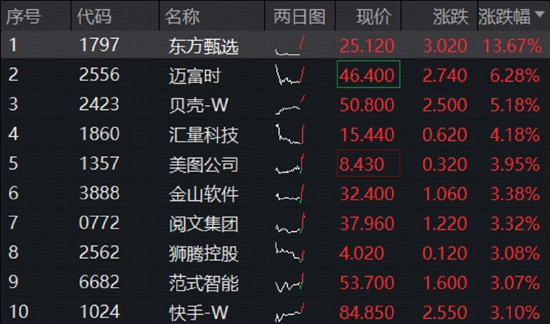
Core Viewpoint - The Hong Kong stock market experienced fluctuations, with internet giants showing resilience, particularly Kuaishou and Xiaomi, which rose nearly 2%, while Oriental Selection surged 13% after its earnings report, indicating strong performance in the AI application sector [1][8]. Company Performance - Oriental Selection reported total revenue of 2.312 billion yuan for the six months ending November 30, 2025, representing a year-on-year increase of 5.7% [1][8]. - The gross profit for Oriental Selection was 842 million yuan, up 14.5% year-on-year, with a gross margin improvement to 36.4% [1][8]. - Notably, Oriental Selection turned a net loss of 96.5 million yuan in the same period last year into a net profit of 239 million yuan [1][8]. Market Trends - The Hong Kong internet ETF (513770) saw a price increase of 1.59%, marking three consecutive days of gains, with a net inflow of 1.392 billion yuan over the past 20 days [2][8]. - Major AI application companies, including Mifus and Reading Group, saw significant gains, reflecting a competitive landscape in the AI sector [1][8]. Industry Insights - The internet giants are engaged in an AI application traffic battle, with accelerated deployment expected by the end of 2025 and into 2026, as indicated by various industry analysts [4][11]. - Domestic large model manufacturers are enhancing user and revenue scales through frequent model iterations and overseas expansion, leveraging social activities during the Spring Festival to capture consumer AI entry points [11][12]. Investment Opportunities - The Hong Kong internet ETF (513770) and its linked funds are positioned to track the CSI Hong Kong Internet Index, with top-weighted stocks including Alibaba, Tencent, Xiaomi, and Kuaishou, collectively accounting for nearly 77% of the index [12][13]. - For investors seeking to balance technology exposure with lower volatility, the Hong Kong Large Cap 30 ETF (520560) is recommended, featuring a mix of high-growth tech stocks and stable dividend-paying companies [13].
产业链催化不断,AI人工智能ETF(512930)备受关注
Xin Lang Cai Jing· 2026-01-23 06:15
Group 1 - The core viewpoint of the news highlights the ongoing growth and investment opportunities in the artificial intelligence (AI) sector, driven by various industry developments and events [1][2] - The China Securities AI Theme Index (930713) shows mixed performance among its constituent stocks, with Zhongke Xingtou leading with a 14.50% increase, while AI ETF (512930) is currently priced at 2.37 yuan [1] - The third National AI Application Scenario Innovation Challenge is set to take place from January 23 to 25 in Suzhou, indicating a focus on innovation and application in the AI field [1] - Zhejiang Wenlian reported that its AI programmatic advertising tool "Paizhi" has achieved a cumulative consumption of over 250 million yuan by 2025, reflecting a year-on-year growth of 500% [1] - DeepSeek plans to release its V4 model in February 2026, which is expected to surpass the programming capabilities of Claude and GPT series, potentially reshaping the global AI market competition [1] Group 2 - The AI Theme Index includes 50 listed companies that provide essential resources, technology, and application support for AI, reflecting the overall performance of AI-related securities [2] - As of December 31, 2025, the top ten weighted stocks in the AI Theme Index account for 58.08% of the index, with companies like Zhongji Xuchuang and Xinyi Sheng among the leaders [2] - The AI ETF closely tracks the performance of the AI Theme Index, with various connection options available for investors [2]
东方证券:维持阿里巴巴-W“买入”评级 AI驱动阿里云有望继续加速
Zhi Tong Cai Jing· 2026-01-15 02:00
Core Viewpoint - Oriental Securities maintains a "Buy" rating for Alibaba-W (09988), forecasting FY2026-2028 revenues of 1,030.7 billion, 1,143.2 billion, and 1,251.8 billion yuan, with adjusted net profits of 91.6 billion, 135.8 billion, and 176.1 billion yuan respectively. The estimated market value of the company is 35,656 billion yuan, corresponding to a per-share value of 207.7 HKD, driven by AI in Alibaba Cloud and a steady reduction in losses in e-commerce despite industry challenges [1]. E-commerce Sector - The e-commerce industry is experiencing a slowdown, with a projected FY26Q3 CMR of 1,054.8 billion yuan (yoy +3.4%). The overall growth rate is declining due to high base effects and tax policy impacts, with online retail growth rates of 4.9% and 1.5% in October and November 2025 respectively, showing significant deceleration [1]. - The company has increased its commission rate by 0.6%, which has neutralized the positive impact on CMR, indicating continued pressure in the first half of FY26 due to high base effects [1]. Instant Retail - The estimated loss for the company's instant retail business in FY26Q3 is around 21.5 billion yuan, with an average loss per unit of 3.7 yuan, improved from the expected 4.0 yuan. The quarter shows a clear trend of reduced losses, with healthy market share and order structure [2]. - Taobao Flash, as a key high-frequency consumption scenario, plays a significant role in user retention and traffic within the ecosystem, with expectations for continued investment in maintaining market share and reducing losses in the medium to long term [2]. Cloud Intelligence Group - The Cloud Intelligence Group is expected to achieve revenues of 434.9 billion yuan in FY26Q3 (yoy +37.0%), with external revenue accelerating significantly compared to Q2. The demand for AI cloud services continues to grow rapidly, supported by increased investments in AI applications [3]. - Alibaba Cloud, as the only full-stack AI cloud provider in China, is anticipated to benefit from a flywheel effect that drives both revenue and profit growth through enhanced demand for computing power and application scenarios [3]. Other Segments - The AIDC segment is projected to incur a loss of 1.89 billion yuan in FY26Q3, primarily due to increased seasonal losses from promotional activities. The segment is expected to continue its trend of reduced losses [4]. - Other segments are expected to incur a total loss of 7.12 billion yuan in FY26Q3, driven by increased spending on AI model training and applications. The company is enhancing its AI product offerings and increasing investments in consumer-facing AI applications [4]. AI Application Development - Alibaba's model development capabilities are strong, with ongoing enhancements in multi-modal and agent capabilities. Upcoming releases of major model updates are expected to further expand AI application scenarios [5]. - The company is optimistic about the potential breakthroughs in native AI applications and the empowerment of other business segments through AI advancements [5].