
ETF命名规范化

Search documents
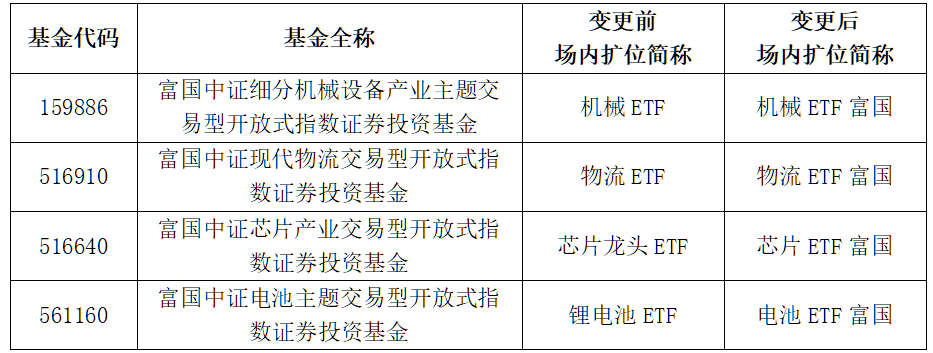
持续推进ETF命名规范化 富国基金旗下第二批4只ETF完成更名
Quan Jing Wang· 2026-02-27 03:15
Core Viewpoint - The article highlights the ongoing standardization of ETF naming in China's market, with Fuguo Fund actively responding to regulatory requirements by renaming its ETFs to enhance clarity and transparency for investors [1][3][7]. Group 1: ETF Renaming and Standardization - Fuguo Fund has completed the renaming of 12 ETFs, with an additional 38 ETFs set to be renamed by the end of March [1][4]. - The recent renaming includes four ETFs, focusing on sectors such as machinery, high-end manufacturing, and new energy, following a standardized naming convention of "core investment element + ETF + fund manager" [3][4]. - The new names aim to provide clearer product identification, with examples including "Mechanical ETF Fuguo" and "Logistics ETF Fuguo," which enhance brand recognition and product clarity [2][3]. Group 2: Investor Experience and Market Context - Over half of Fuguo Fund's ETFs now comply with naming standards, improving the overall investor experience by simplifying the selection process in a complex investment landscape [4][5]. - The standardization of ETF names is part of a broader industry movement to enhance market transparency and protect investors, addressing the confusion caused by similar product names [6][7]. - The regulatory push for standardized naming is expected to lead to a more competitive environment focused on product quality, fee structures, and long-term performance [7].

景顺长城旗下两只ETF简称焕新 创业板50ETF景顺、纳指科技ETF景顺出道
Xin Lang Cai Jing· 2026-02-04 08:02
Group 1 - The core point of the article is the wave of ETF renaming initiated by public institutions to comply with the standardized naming requirements of the Shanghai and Shenzhen Stock Exchanges, enhancing investor experience [1][3][4] - The recent renaming includes "那只柯基" to "纳指科技ETF景顺" and "创业50ETF" to "创业板50ETF景顺," with product codes remaining unchanged, ensuring no substantial impact on holder rights [1][3][4] - The ETF market has seen rapid growth, with 1,404 non-monetary ETFs and a total scale of 5.3 trillion yuan as of January 31, 2026, highlighting the need for standardized naming due to increased product numbers and management firms [4] Group 2 - The "纳指科技ETF景顺" is the only ETF in the domestic market tracking the Nasdaq Technology Market Cap Weighted Index, focusing on key companies like Microsoft, Apple, Nvidia, and Google, with a scale of 12.669 billion yuan and a net value growth rate of 32.81% over the past year [2][5] - The "创业板50ETF景顺" tracks the ChiNext 50 Index, covering high-profile stocks in strategic emerging industries, with a scale of 4.879 billion yuan and a net value increase of 139.83% over the past two years [2][5] - In November 2025, the "创业板50ETF景顺" was listed as a depositary receipt on the Thai Stock Exchange, marking it as the first product linked to the ChiNext 50 Index in Thailand, while also being recognized in Europe through the registration of the first ChiNext 50 UCITS ETF [2][5] Group 3 - The company has been focusing on the ETF business, developing a diverse product line that includes broad-based, thematic, cross-border, and Smart Beta ETFs, catering to various investor needs across multiple markets [2][5] - The push for ETF naming standardization is part of the company's ongoing efforts to enhance ETF support services and improve investor allocation experiences [2][5]

嘉实基金58只ETF完成标准化命名
Sou Hu Cai Jing· 2026-01-23 01:37
Core Viewpoint - In response to the standardized naming requirements of the Shanghai and Shenzhen Stock Exchanges, the company announced a collective renaming of 31 ETFs to enhance investor experience, adopting a standardized naming model of "Underlying Index + ETF + Manager Name" [1][4]. Group 1: Renaming Details - The renaming includes 16 products from the Shenzhen Stock Exchange and 15 from the Shanghai Stock Exchange, resulting in a total of 58 products that have undergone naming standardization, while all product codes remain unchanged [1][5]. - Key products affected by the renaming include the "沪深300ETF嘉实" (159951) and "中证500ETF嘉实" (159922), which are significant in scale, along with various thematic ETFs such as "集成电路ETF嘉实" (562820) and "绿色电力ETF嘉实" (159625) [3][4]. Group 2: Investor Experience Enhancement - The new naming convention aims to provide clarity by incorporating essential information about the underlying index, product type, and management, thereby reducing information screening costs for investors [4][5]. - The company emphasizes that the changes are designed to align product names more closely with their investment targets, making it easier for investors to understand the products at a glance [4][5]. Group 3: Product Line and Market Position - The company has established a diverse ETF product line, with over 60 ETFs covering various asset classes, including broad-based, sector, bond, cross-border, and commodity ETFs, totaling approximately 368.28 billion yuan in assets under management [5]. - The company is recognized as one of the first in the domestic market to engage in passive investment, focusing on a customer-driven approach to product development and service ecosystem [5].
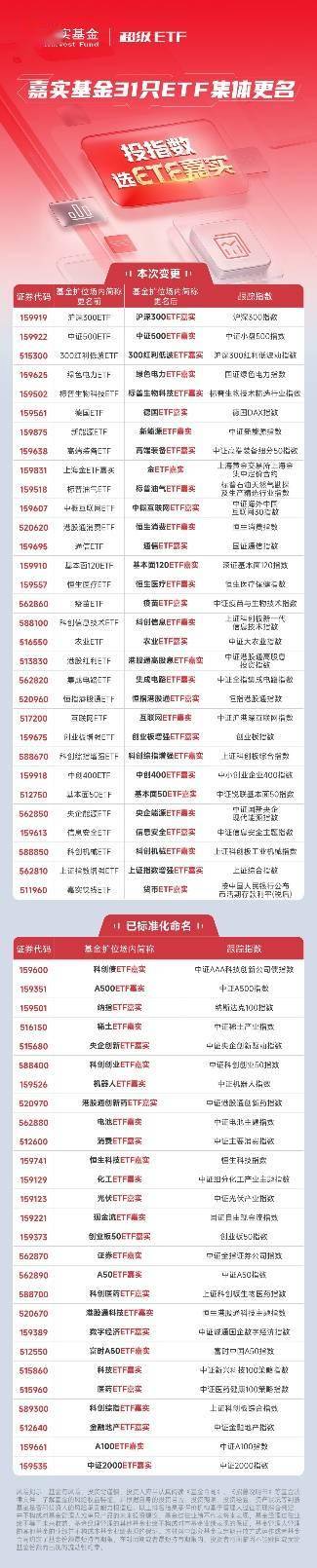
嘉实31只ETF集体更名 夯实指数投资“所见即所得”
中国基金报· 2026-01-23 01:22
Core Viewpoint - In response to the standardized naming requirements of the Shanghai and Shenzhen Stock Exchanges, the company announced a collective renaming of 31 ETF products to enhance investor experience, adopting a standardized naming model of "Underlying Index + ETF + Manager Name" [1]. Group 1: Renaming Details - The renaming includes 16 products from the Shenzhen Stock Exchange and 15 from the Shanghai Stock Exchange, resulting in a total of 58 products that have undergone naming standardization, while all product codes remain unchanged [1]. - Notable products that have been renamed include "沪深300ETF嘉实" (159951) and "中证500ETF嘉实" (159922), which correspond to the large-scale products with over 100 billion in size [8]. Group 2: Investor Experience Enhancement - The new naming convention aims to provide clarity for investors by clearly indicating the underlying index, product type, and management company, thereby reducing information screening costs and helping investors quickly grasp the core characteristics of the products [8]. - The addition of the "嘉实" suffix enhances brand recognition and makes the product's affiliation more intuitive [8]. Group 3: Product Line and Market Position - As one of the first fund companies to engage in passive investment, the company has developed a diverse ETF product line, with over 60 ETFs covering various asset classes, totaling approximately 368.28 billion [10]. - Key products include the "沪深300ETF嘉实" with over 190 billion in size, and several other ETFs such as "科创债ETF嘉实" and "纳指ETF嘉实," each exceeding 10 billion in size [10].
华夏基金38只ETF产品更名
Jing Ji Wang· 2026-01-13 09:52
Group 1 - The core viewpoint of the article is that Huaxia Fund has officially launched a renaming initiative for its first batch of 38 ETF products, adopting a standardized naming structure to enhance investor recognition and selection efficiency [1][2] - The new naming convention requires all listed ETFs to follow the format "Core Element of Investment Target + ETF + Fund Manager Name" by March 31, 2026, as mandated by the Shanghai and Shenzhen Stock Exchanges [2] - The ETF market in China is experiencing significant growth, with a projected total scale of 6.02 trillion yuan by the end of 2025, making it the second-largest ETF market globally, with over 1,381 products across various asset classes [1] Group 2 - The renaming initiative aims to address long-standing issues of confusion and low recognition in ETF product names, thereby improving market transparency and trading efficiency [2] - The standardized naming will allow investors to easily locate relevant ETFs by simply entering keywords related to the target index, significantly reducing search difficulty [2] - For Huaxia Fund, the new naming standard will further highlight its product advantages in niche markets, facilitating better brand recognition and promoting healthy competition [2]
ETF命名全面规范化 助投资者便捷识别
Sou Hu Cai Jing· 2026-01-10 05:31
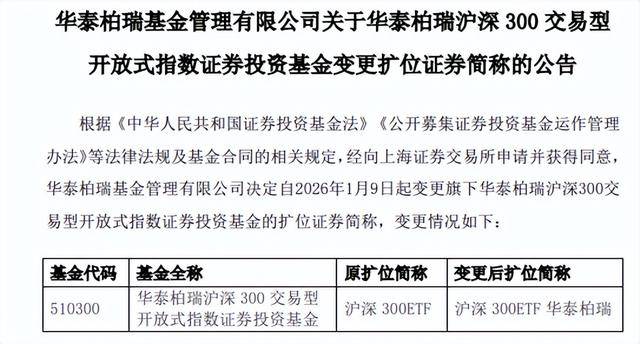
Core Viewpoint - The A-share market's largest ETF has officially changed its name from "CSI 300 ETF" to "CSI 300 ETF Huatai-PB," reflecting a broader trend towards standardized naming conventions in the ETF market to enhance product recognition and investor decision-making efficiency [1][4]. Group 1: Name Change and Standardization - The name change of the ETF is part of a broader initiative by Huatai-PB and other fund companies to standardize ETF naming conventions, which will now follow a format of "core elements of the investment target + ETF + fund manager abbreviation" [1][4]. - The new naming standard aims to improve product identification and reduce confusion among investors, as previously, multiple ETFs tracking the same index had different names, complicating the investment process [4][5]. Group 2: Regulatory Framework and Transition Period - The Shanghai and Shenzhen Stock Exchanges announced a new regulation requiring all ETF products to adopt standardized naming by March 31, 2026, providing a sufficient transition period for existing products [5][6]. - This regulation is seen as a significant step towards enhancing market transparency and investor convenience, marking a move towards a more mature and internationalized ETF market in China [5][8]. Group 3: Industry Impact and Investor Benefits - The standardization of ETF names is expected to lower information screening costs for investors, allowing them to focus more on core factors such as index value, product fees, and tracking errors when making investment decisions [7][8]. - The unified naming convention is viewed as a sign of the ETF market's maturation, shifting competition from name marketing to enhancing product management capabilities and investor services, ultimately fostering long-term healthy development in the ETF sector [8].
ETF更名潮!6万亿市场迈向规范化新阶段
Sou Hu Cai Jing· 2026-01-09 10:50
Core Viewpoint - The Chinese ETF market is undergoing a significant transformation with the implementation of standardized naming conventions for ETFs, marking a move towards greater transparency and regulation in the industry [2][6]. Group 1: Market Changes - On January 7, 2026, Huatai-PB Fund announced the name change of its large-scale "CSI 300 ETF" to "CSI 300 ETF Huatai-PB," reflecting the new regulatory requirements [2][4]. - This name change is part of a broader initiative to standardize the naming of ETFs in a market that exceeds 6 trillion in size and has nearly 1,400 products, moving away from previous naming inconsistencies [4][6]. Group 2: Regulatory Drivers - The direct impetus for the naming standardization comes from the revised fund business guidelines issued by the Shanghai and Shenzhen Stock Exchanges in November 2025, which require existing ETFs to adjust their names by March 31, 2026 [6][9]. - The previous naming issues included "same index different names" and "same name different indices," which increased the information filtering and identification costs for investors [6][7]. Group 3: Implications for Investors and Market - The new naming convention aims to reduce confusion for investors, thereby lowering the risk of mistakenly purchasing the wrong products [10][11]. - With standardized names, competition among fund companies will shift focus from catchy names to the actual performance metrics and service quality, enhancing the overall market environment [11][12]. - This move towards a clearer, more transparent market is seen as a crucial step for the long-term healthy development of all market participants [12].
ETF更名潮!6万亿市场迈向规范化新阶段
市值风云· 2026-01-09 10:09
Core Viewpoint - The comprehensive standardization of ETF naming is a significant step towards enhancing market transparency and maturity, moving beyond mere uniformity of names [3][11]. Group 1: Background and Context - In early 2026, a fundamental transformation in China's ETF market began, marked by the renaming of the Huatai-PineBridge's "Giant" Hu-Shen 300 ETF to "Hu-Shen 300 ETF Huatai-PineBridge" [3][5]. - This renaming is part of a broader regulatory response aimed at standardizing and clarifying the naming conventions within a vast ETF market exceeding 6 trillion yuan in size and nearly 1,400 products [5][8]. Group 2: Issues with Previous Naming Conventions - The previous ETF naming conventions faced two main issues: "same index different names" and "same name different indices," leading to confusion among investors [7][8]. - Such ambiguities increased the cost of information filtering and identification for investors in a rapidly expanding market [8]. Group 3: New Naming Standards - The new regulations require that ETF names follow a standardized format: "core investment target + ETF + fund manager," enhancing clarity and transparency [9][10]. - For enhanced ETFs, the naming structure will be "core investment target + enhanced + ETF," also including the fund manager's abbreviation [9]. Group 4: Implications of Standardization - The standardization of ETF naming allows investors to quickly and accurately identify products based on their names, significantly improving market transparency [11]. - This change reduces the risk of mispurchases due to name confusion, providing tangible benefits and protections for investors [11]. - It also shifts the competitive landscape for fund companies, emphasizing operational strengths and service quality over mere name appeal [11]. - Overall, this move represents a critical step towards a mature and rational market environment, fostering fair competition and transparent information [11].
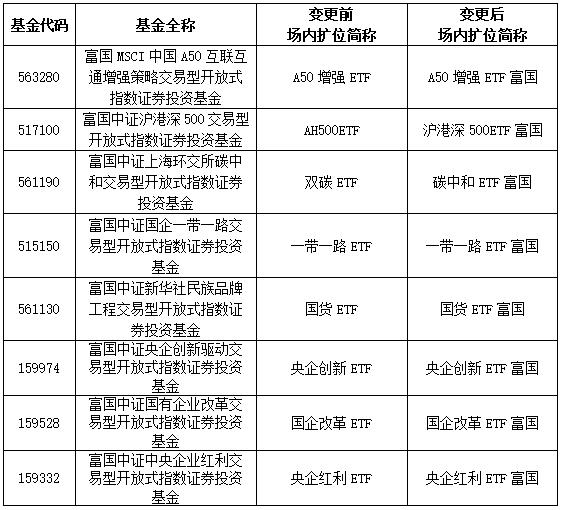
标识统一易辨识富国基金旗下首批8只ETF变更场内简称
Zhong Guo Jing Ji Wang· 2026-01-08 19:13
Core Viewpoint - The announcement by the company regarding the adjustment of the trading abbreviations for eight ETFs is a proactive response to the regulatory requirements aimed at standardizing ETF naming conventions, enhancing product recognition, and improving investor decision-making efficiency [1][3][4]. Group 1: ETF Naming Adjustments - The first batch of eight ETFs includes five listed on the Shanghai Stock Exchange and three on the Shenzhen Stock Exchange, covering broad-based, thematic, and enhanced strategy categories [1][6]. - The new naming format follows a standardized structure of "core elements of the investment target + ETF + fund manager abbreviation," which significantly improves product identification [1][6]. Group 2: Market Context and Regulation - The ETF market in China has experienced rapid growth, leading to issues with inconsistent naming conventions, which complicate investor decision-making [3][4]. - The new regulations, effective by March 31, 2026, require all existing products to comply with the standardized naming structure, marking a significant step towards enhancing market transparency and investor convenience [4][5]. Group 3: Benefits for Investors - The standardized naming will lower the information screening threshold, allowing investors to quickly and accurately identify the underlying indices and fund managers, thus reducing confusion and search costs [7]. - This shift is expected to refocus industry competition on improving product management capabilities and investor services, contributing to the long-term healthy development of the ETF market [7]. Group 4: Company Commitment - As one of the "old ten" public fund companies in China, the company actively participates in the domestic ETF sector, with 82 ETFs and 56 ETF-linked funds, ranking third in the industry by the end of 2025 [8]. - The company’s completion of the first batch of standardized naming reflects its commitment to investor interests and adherence to regulatory requirements, aligning with industry development trends [8].
规模超4000亿!这只“巨无霸”ETF更名
Guo Ji Jin Rong Bao· 2026-01-08 14:01
Core Viewpoint - The renaming of the Huatai-PB CSI 300 ETF to "Huatai-PB CSI 300 ETF" reflects regulatory requirements for standardized naming in the ETF market, marking a significant change for the largest ETF in China with a scale nearing 440 billion yuan [1][3][4]. Group 1: ETF Renaming and Regulatory Compliance - The Huatai-PB CSI 300 ETF will officially change its name on January 9, 2026, in compliance with new regulatory standards for fund naming [1][4]. - The renaming is part of a broader initiative by the Shanghai and Shenzhen Stock Exchanges to standardize ETF naming conventions, requiring the inclusion of the fund manager's name and the investment target [4][5]. - This change serves as a practical example for other ETFs to follow, promoting a unified naming process across the industry [4][5]. Group 2: Market Impact and Industry Response - The renaming initiative is seen as a response to regulatory demands and aims to enhance product recognition, addressing issues of name homogeneity that can lead to confusion [5][6]. - It is expected to strengthen brand awareness and accountability among fund companies, fostering a more transparent and fair market environment [5][6]. - The standardization of ETF names is anticipated to benefit investors by improving the differentiation between funds and their managers, thereby enhancing investment efficiency [5][6].
