沪深300ETF华泰柏瑞

Search documents
ETF周报20260323-0327:能源替代或是ETF投资者主要思路-20260330
East Money Securities· 2026-03-30 14:56
Group 1 - The overall market for stock ETFs (excluding cross-border) experienced a net outflow of 12.22 billion, which is a decrease of 5.58 billion compared to the previous week, indicating an expansion of net outflow scale [1][9] - The A-share industry and thematic ETFs saw a net outflow of 15.79 billion, an increase of 8.79 billion from the previous period, showing continued outflow pressure in industry and thematic ETFs [1][11] - The Hong Kong stock ETFs continued to experience net outflows, with the outflow amount increasing to 4.12 billion, including a net outflow of 1.78 billion from cross-border industry and thematic ETFs [1][14] Group 2 - In the broad-based ETF category, there was an overall net outflow of 1.16 billion, while the CSI 300 saw relatively large inflows, with most broad-based ETFs experiencing outflows [2][17] - In the Smart Beta and major industry categories, dividend and cash flow strategies remain relatively high certainty directions in an uncertain environment [2][17] - In the segmented industry, sectors such as non-ferrous metals, chemicals, and oil and petrochemicals continue to face significant outflow pressure, with energy substitution remaining a core strategy (coal replacing oil, secondary energy/new energy replacing fossil energy) [2][21] Group 3 - The top five stock ETFs with net inflows from March 23 to 27 were the Energy Storage Battery ETF (E Fund) (+1.07 billion), CSI 300 ETF (Huatai-PB) (+1.05 billion), Sci-Tech 50 ETF (E Fund) (+0.94 billion), CSI 300 ETF (Hua Xia) (+0.94 billion), and Free Cash Flow ETF (Hua Xia) (+0.92 billion) [3][25] - The top five stock ETFs with net outflows during the same period were A500 ETF (Hua Xia) (-2.65 billion), Non-ferrous Metals ETF (Southern) (-1.68 billion), CSI 1000 ETF (Hua Xia) (-1.23 billion), SSE 50 ETF (Hua Xia) (-1.21 billion), and Non-ferrous Metals ETF (Hua Xia) (-1.16 billion) [3][25] - For cross-border ETFs, the top five with net inflows were the Hang Seng Technology ETF (E Fund), Hang Seng Technology ETF (Tianhong), Hang Seng Technology ETF (Hua Xia), China Concept Internet ETF (E Fund), and Hang Seng Technology ETF (Dacheng) [3][25]
金工ETF点评:行业主题ETF周净流出262.29亿元,钢铁、基础化工拥挤变幅较大
Tai Ping Yang Zheng Quan· 2026-03-27 13:25
Investment Rating - The report indicates a net outflow of 26.229 billion yuan from industry-themed ETFs this week, with significant fluctuations observed in the steel and basic chemical sectors [2][31][36]. Core Insights - As of March 20, 2026, there are a total of 1,456 listed ETFs in mainland China, with a total scale of 5.10 trillion yuan. Among these, stock ETFs account for the largest share, both in number (1,140) and scale (2.95 trillion yuan) [7][8]. - The A-share market saw a decline this week, with the Shanghai Composite Index closing at 3,957.05, reflecting a drop of 3.38%. Notably, the communication and banking sectors experienced gains of 2.10% and 0.36%, respectively, while the non-ferrous and basic chemical sectors faced declines of 11.82% and 10.53% [13][14][21]. - In terms of fund flows, broad-based ETFs saw a net inflow of 9.078 billion yuan, with the top three inflows coming from the CSI 500 ETF Southern (+4.450 billion yuan), the CSI 300 ETF Huatai-PB (+4.333 billion yuan), and the SSE 50 ETF (+3.056 billion yuan). Conversely, industry-themed ETFs experienced a net outflow of 26.229 billion yuan, with the top outflows from the chemical ETF (-4.373 billion yuan) and the non-ferrous metal ETFs [31][32][36]. Summary by Sections ETF Market Overview - As of March 20, 2026, the total number of ETFs is 1,456, with stock ETFs being the most prevalent, comprising 78.30% of the total number and 57.76% of the total scale [7][8][10]. Domestic and International Equity Market Index Performance - The A-share market indices showed a downward trend, with the Shanghai Composite Index down 3.38%. The communication and banking sectors were the only ones to show positive performance this week [13][14][21]. Stock ETF Fund Flows - Broad-based ETFs had a net inflow of 9.078 billion yuan, while industry-themed ETFs saw a significant net outflow of 26.229 billion yuan, indicating a shift in investor sentiment [31][32][36]. Industry Congestion Monitoring - The report highlights that the utility and communication sectors are currently experiencing higher congestion levels, while the automotive and textile sectors are less congested, suggesting potential investment opportunities [34][36].
A股险守3800点,机构提醒:别乱接飞刀
21世纪经济报道· 2026-03-23 15:47
Market Overview - On March 23, the A-share market faced significant declines, with the Shanghai Composite Index dropping 3.63% to 3813.28 points, and the Shenzhen Component Index falling 3.76% [1] - The trading volume surged to 2.45 trillion yuan, indicating panic selling and stop-loss actions among investors [1] Investment Sentiment - Investment institutions advise against panic selling and suggest waiting for a clearer market bottom before identifying undervalued stocks with strong fundamentals and high dividends [1][8] - A public fund investor cautioned that the current market conditions are risky for bottom-fishing, especially in the tech sector, which has not yet fully adjusted [1] Geopolitical Impact - The market downturn is attributed to geopolitical tensions in the Middle East, particularly concerning the Strait of Hormuz, which could lead to prolonged oil supply constraints [2] - Brent crude oil prices surged above $100, reaching $109, raising inflation expectations and complicating the Federal Reserve's interest rate decisions [4] Global Market Reactions - Global risk assets suffered, with the Nikkei 225 index dropping 3.48% and the Korean Composite Stock Price Index plummeting 6.49% [4] - Analysts identified four main factors contributing to the market turmoil: escalating geopolitical risks, rising inflation fears, a hawkish stance from the Federal Reserve, and internal market dynamics leading to forced selling [4] Sector Performance - The coal and oil & gas sectors were the only ones showing strength, benefiting from high oil prices, while gold, traditionally seen as a safe haven, experienced significant declines [6] - The volatility in precious metals indicates a shift in traditional safe-haven logic, with investors favoring energy and high-dividend stocks [6] Liquidity Concerns - There are growing concerns about potential liquidity crises, with estimates suggesting that some funds may hit stop-loss levels, leading to forced selling in mid-cap and tech sectors [7] - Analysts recommend maintaining a cautious approach, avoiding high-volatility stocks, and waiting for clearer market signals before making investment decisions [7] Future Outlook - The market is expected to stabilize once geopolitical tensions ease and panic selling subsides, with key indicators being reduced trading volumes and a return of foreign capital [9] - Investment strategies should focus on defensive assets with high dividends and growth potential in sectors like AI and resources, which are expected to remain strong despite short-term volatility [10][11]


ETF周报:行业及主题ETF流出压力显现-20260323
East Money Securities· 2026-03-23 09:09
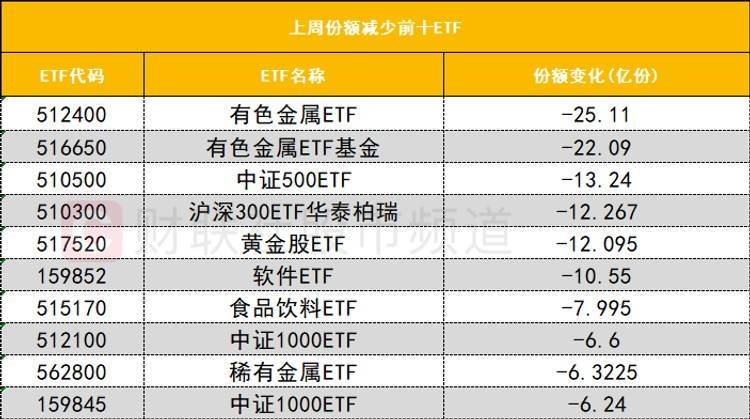
Group 1 - The overall market for stock ETFs (excluding cross-border) experienced a net outflow of 66.4 billion from March 16 to 20, 2026, indicating a slight decrease in outflow compared to the previous week [10][12] - A-shares industry and thematic ETFs saw a significant net outflow of 245.9 billion, highlighting the pressure on these sectors [12][19] - The Hong Kong stock ETFs continued to show net outflows, although the magnitude of outflow has narrowed compared to the previous period, with a slight net inflow of 1.5 million in cross-border industry and thematic ETFs [15][19] Group 2 - Significant outflow pressure was observed in the non-ferrous metals, chemical, and oil and petrochemical sectors, while sectors such as brokerage, healthcare, and new energy saw inflows [22][24] - The representative ETFs with the highest net inflows included the CSI 500 ETF from Southern Fund (+44.5 billion), the Huatai-PB CSI 300 ETF (+43.3 billion), and the Shanghai Stock Exchange 50 ETF from Huaxia (+30.6 billion) [26] - Conversely, the ETFs with the largest net outflows were the chemical ETF (-43.7 billion), non-ferrous metals ETF from Southern Fund (-34.8 billion), and the A500 ETF from Huaxia (-28.4 billion) [26] Group 3 - In the cross-border ETF segment, the top inflows were seen in the China Concept Internet ETF from E Fund, the Hang Seng Technology ETF from E Fund, and the Hang Seng Technology ETF from Huaxia [26] - The overall net inflow for broad-based ETFs was 90.8 billion, with varying degrees of inflow in the CSI 300, CSI 500, and Shanghai 50 indices, while the CSI A500 saw significant outflows [19][21] - Smart beta and major industry ETFs showed that dividend and cash flow strategies are relatively more stable in uncertain environments [21]
ETF跟踪研究:ETF市场周度更新-20260323
Yin He Zheng Quan· 2026-03-23 04:44
ETF Market Overview - As of March 23, 2026, the total number of ETFs in the market reached 2,310, with a total scale of 1,234.5 billion yuan and a weekly trading volume of 123.4 billion yuan. The number of newly added funds this week was 13 [1][3]. - Equity funds dominate the market, with thematic equity funds accounting for 30.6% of the total number, and their scale reaching 1,234.5 billion yuan, representing 60.1% of the total scale. Bond ETFs had the highest weekly trading volume, accounting for 25.3% [1][4]. Fund Inflow and Outflow - The inflow of funds last week was primarily concentrated in broad-based indices and bond ETFs, with the top inflow being the Short-term Bond ETF from Hai Fu Tong, which saw an inflow of 1.2 billion yuan. The latest scale of this fund is 12.3 billion yuan [5][6]. - In contrast, resource and chemical ETFs experienced significant outflows, with the chemical ETF seeing an outflow of 1.2 billion yuan, and the non-ferrous metal ETF experiencing an outflow of 1.1 billion yuan [7][8]. Industry Sector Fund Flow - Only the financial real estate and pharmaceutical sectors saw a slight net inflow of funds, with the financial real estate sector receiving 1.2 billion yuan and the pharmaceutical sector 0.3 billion yuan. Other sectors, including consumption and technology, experienced net outflows [13][14]. New ETF Listings - Last week, a total of 13 new ETFs were listed, all of which were equity funds covering various sectors, themes, and cross-border categories. The largest new listing was the Agricultural and Fishery ETF from Invesco, with a scale of 1.2 billion yuan [16][17]. Core Broad-based Index and ETF Performance - The performance of core broad-based indices showed significant divergence, with the ChiNext index rising against the trend, achieving a weekly return of 3.5%. In contrast, the CSI 300 index saw the largest weekly decline of 2.3% [18][19].
资金回流部分宽基ETF 市场主线向“盈利驱动”切换
Zhong Guo Zheng Quan Bao· 2026-02-26 20:28
Group 1 - The South Korea-China Semiconductor ETF (513310) surged by 9.64%, leading the market on February 26, with a premium rate of 21.10% and a turnover rate exceeding 125% [2][3] - The semiconductor equipment sector continues to rise, driven by a sustained "supply-demand imbalance" in the global storage industry, which is expected to maintain its upward trend until after 2027 [2] - The strong performance of the semiconductor design sector is attributed to Nvidia's impressive earnings report and the ongoing demand for AI computing power, alongside accelerated domestic industry development and supportive policies [2] Group 2 - The short-term bond ETF Hai Futong (511360) recorded a transaction volume exceeding 66 billion yuan, ranking first in the market [3] - Several A500 ETFs, including A500 ETF Fund (512050) and A500 ETF Huatai Baichuan (563360), saw significant trading volumes, indicating renewed investor interest in broad-based ETFs [3] - There was a notable net inflow into the Hang Seng Technology and Hong Kong internet-themed ETFs, suggesting a shift in investor sentiment despite market volatility [4] Group 3 - The market is expected to transition from valuation-driven logic to earnings-driven logic, with a focus on the quality of earnings, cash flow, and dividend capabilities of listed companies [5] - The dual focus on cyclical and technology sectors is emerging, with the performance of both sectors likely to depend on the verification of fundamental strengths [5][6] - In the context of economic recovery, the market is anticipated to maintain a volatile upward trend, favoring large and mid-cap blue-chip stocks [6]
资金回流部分宽基ETF市场主线向“盈利驱动”切换
Zhong Guo Zheng Quan Bao· 2026-02-26 20:28
Group 1 - The South Korea-China semiconductor ETF (513310) surged by 9.64%, leading the market, with a premium rate of 21.10% and a turnover rate exceeding 125% [1] - The semiconductor equipment sector continues to rise, driven by a sustained "supply-demand imbalance" in the global storage industry, which is expected to maintain its upward trend until after 2027 [1] - The strong performance of the semiconductor design sector is attributed to Nvidia's impressive earnings report and the confirmation of long-term resilience in AI computing demand, alongside accelerated domestic industry development and supportive policies [2] Group 2 - The short-term bond ETF (511360) recorded a transaction volume exceeding 66 billion yuan, ranking first in the market, while several A500 ETFs also saw significant trading volumes [2] - There has been a notable net inflow of funds into the Hang Seng Technology and Hong Kong internet-themed ETFs, indicating a reversal in market sentiment despite overall market fluctuations [3] - The market is expected to maintain a volatile upward trend, with large and mid-cap blue-chip stocks likely to outperform in the context of economic recovery [4]
ETF份额剧变,量化数据看清新增量的偏爱
Sou Hu Cai Jing· 2026-02-17 01:53
Group 1 - The core message emphasizes the importance of understanding the underlying trading behaviors behind market movements rather than reacting to superficial price changes [1] - Many investors fall into the trap of making decisions based solely on market trends, leading to losses when they chase after rising stocks or sell off during declines [1][2] - Quantitative data can reveal four core trading behaviors: bullish dominance, profit-taking, bearish dominance, and short covering, which help in understanding the true market intentions [2][5] Group 2 - The article illustrates that even when a stock appears to be on an upward trend, it may be dominated by profit-taking behavior, indicating potential price adjustments ahead [5][11] - It highlights that profit-taking does not necessarily lead to a market decline, as large funds may realize profits during upward trends, similar to a store clearing inventory during a sale [6][12] - The article also points out that negative news does not always result in market downturns; sometimes, it can create opportunities for investors who recognize the underlying buying activity [12][14] Group 3 - The core value of quantitative thinking is to help investors avoid subjective judgments based on emotions and news, instead relying on objective data to understand market behaviors [15][17] - By utilizing quantitative data, investors can maintain a rational perspective and avoid making impulsive decisions based on market fluctuations [16][17] - The article encourages a shift from emotional trading to a more analytical approach, which is essential for responsible capital management [17]
迎春节 基金密集派发“红包”
Shang Hai Zheng Quan Bao· 2026-02-16 09:27
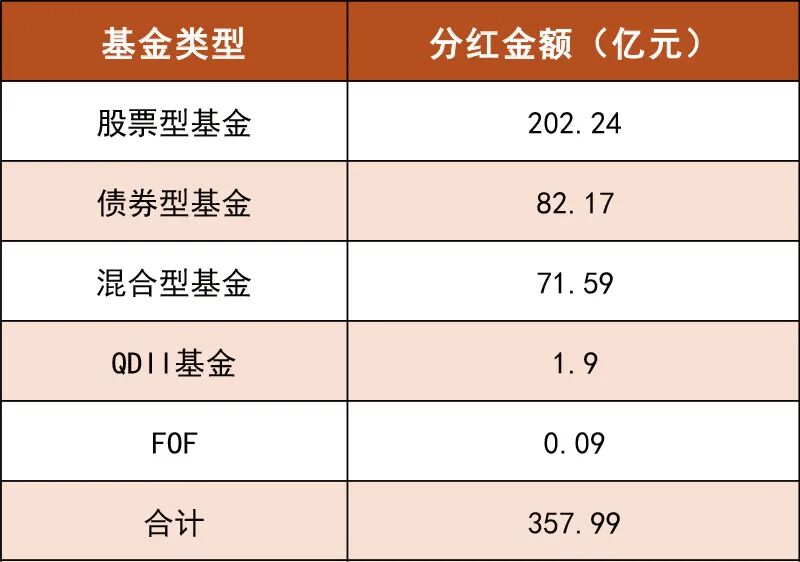
Group 1 - The core viewpoint of the article highlights a significant increase in public fund dividends, with nearly 36 billion yuan distributed before the Spring Festival, marking a growth of over 35% compared to the previous year [1][3] - In 2026, stock funds have emerged as the dominant force in the dividend distribution, contributing over 56% of the total dividends, amounting to approximately 202.24 billion yuan, which is a 158% increase year-on-year [3][4] - Conversely, bond funds have seen a substantial decrease in dividend payouts, totaling 82.17 billion yuan, a decline of 47.81% compared to the previous year [3][4] Group 2 - The largest contributors to stock fund dividends include the Huatai-PB CSI 300 ETF, which distributed 98.11 billion yuan, followed by the E Fund CSI 300 ETF at 44.79 billion yuan [4][5] - The increase in stock fund dividends is attributed to two main factors: the recovery of the A-share market in 2025, leading to substantial distributable profits, and a greater emphasis on investor returns within the public fund industry [6][8] - In contrast, bond funds have faced challenges due to a turbulent bond market in 2025, resulting in lower distributable income and a decrease in overall dividend amounts [6][9] Group 3 - Dividend-themed funds have also played a significant role in the current dividend wave, with these funds focusing on high-dividend, stable cash flow companies, collectively distributing over 2 billion yuan this year [8] - Fund managers are increasingly recognizing the value of dividend assets, especially in a low-interest-rate environment, where stable dividend returns are becoming a scarce source of income [9] - The rebalancing of dividend indices in December 2025 has led to an average dividend yield of around 5%, making dividend assets more attractive for reallocating funds from traditional savings and investment products [9]
超百亿,“跑了”!
Zhong Guo Ji Jin Bao· 2026-02-11 06:17
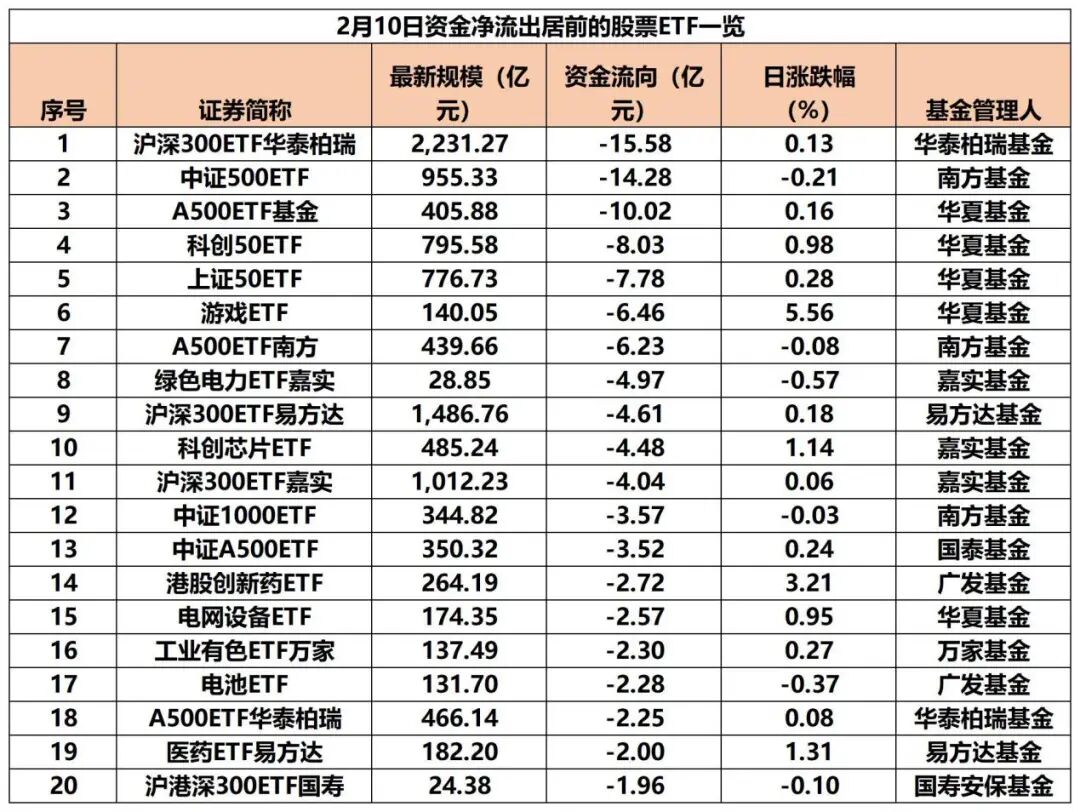
Core Viewpoint - The stock ETF market experienced a net outflow of over 10.26 billion yuan on February 10, with significant movements in various thematic ETFs and broad-based ETFs [2][4][5]. Group 1: Market Overview - On February 10, the three major A-share indices showed mixed results, with the Shanghai Composite Index rising by 0.13%, the Shenzhen Component Index increasing by 0.02%, and the ChiNext Index declining by 0.37% [2]. - The overall market saw a net outflow of 10.26 billion yuan in stock ETFs, including cross-border ETFs [2]. Group 2: ETF Performance - The net inflow for the China Film Index-related ETFs was the highest, reaching 1.339 billion yuan, while the net outflow for the CSI 300 Index-related ETFs was the largest at 2.904 billion yuan [2]. - Over the past five days, the Hang Seng Technology Index-related ETFs saw inflows exceeding 8.5 billion yuan, and the SGE Gold 9999 Index-related ETFs attracted over 6.2 billion yuan [2]. Group 3: Fund Company Insights - E Fund's ETF had a latest scale of 661.58 billion yuan, with an increase of 1.05 billion yuan. The China Internet ETF from E Fund had a scale of 41.921 billion yuan, with a net inflow of 158 million yuan [2]. - Huaxia Fund's Robot ETF and Sci-Tech Semiconductor ETF had significant net inflows of 527 million yuan and 117 million yuan, respectively, with latest scales of 25.818 billion yuan and 8.196 billion yuan [3]. Group 4: Thematic ETF Trends - Popular thematic ETFs such as the Film ETF, Robot ETF, and Satellite ETF saw the highest net inflows, while broad-based ETFs like the CSI 300 ETF and CSI 500 ETF were the biggest losers in terms of net outflows [4][5]. - The Media ETF from GF Fund received the most net inflow, amounting to 460 million yuan, and has seen a year-to-date increase of over 26%, making it one of the top performers in the market [3]. Group 5: Future Market Outlook - The investment focus may shift from January's credit and liquidity performance to macroeconomic and industrial cues as the market enters a relatively quiet period for macro data [6]. - The core assets in the market are currently at historical median valuation levels, suggesting potential for valuation recovery, supported by stable profit expectations and a warming trend in foreign capital inflows [6].