ETF资金流向分化

Search documents
1月14只ETF扩容逾百亿 释放什么信号?
2 1 Shi Ji Jing Ji Bao Dao· 2026-02-03 13:07
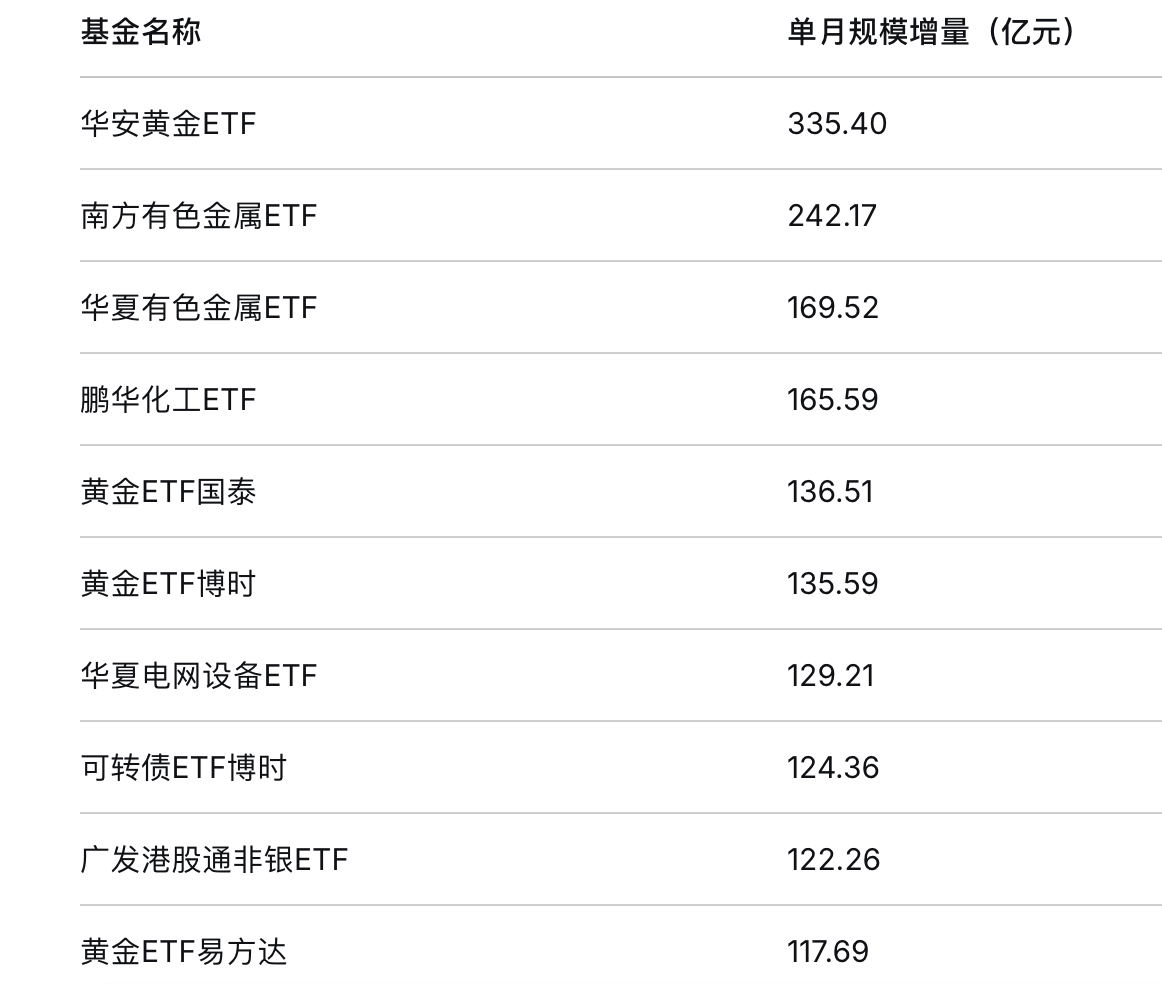
Core Insights - In early 2026, ETF fund flows showed significant divergence, with core broad-based ETFs experiencing large net outflows, while industry-themed ETFs gained popularity and saw substantial inflows [1][9] - The preference for industry-themed ETFs highlights a consensus among investors regarding the support from industrial policies and the positive fundamentals in specific sectors [1][6] ETF Performance - As of January 31, 2026, 14 ETFs had their scales increase by over 10 billion yuan, including 7 stock ETFs, 4 commodity ETFs, 2 cross-border ETFs, and 1 bond ETF [3] - Notable increases in scale included the Huaan Gold ETF (335.4 billion yuan), Southern Nonferrous Metals ETF (242.17 billion yuan), and Huaxia Nonferrous Metals ETF (169.52 billion yuan) [4][7] - The stock ETFs that saw significant scale growth were primarily industry-focused, indicating a market signal for bullish sentiment in related sectors [5][6] Market Trends - The overall ETF fund flow in January 2026 reflected a structural shift, with significant net outflows from core broad-based ETFs and inflows into industry-specific ETFs and gold [9][10] - The A-share market experienced a transition from exuberance to cooling, with the Shanghai Composite Index surpassing 4100 points before entering a consolidation phase [9][11] Investment Strategies - Institutions suggest that the market in February will likely experience volatility, with a focus on "growth and cyclical" dual strategies while being cautious of overheating sectors [11][12] - Recommended investment strategies include focusing on global manufacturing recovery, traditional industry improvements, and technology growth, particularly in AI applications and robotics [12][13]

股票ETF成交活跃 行业主题产品“吸金”显著
2 1 Shi Ji Jing Ji Bao Dao· 2026-01-27 13:18
Core Viewpoint - The A-share market is experiencing a cooling trend, leading to a significant shift in ETF investments from broad-based ETFs to sector-specific ETFs, with substantial net outflows from major broad-based ETFs and inflows into thematic ETFs [1][2][3] Summary by Sections ETF Market Dynamics - As of January 23, 2026, the total net outflow from the CSI 300 ETF and the CSI 1000 ETF reached 336.9 billion and 78 billion respectively since the beginning of the year, while thematic ETFs, particularly in resources and technology, attracted a total of 158.5 billion in net inflows [1][4] - The week of January 12-16 saw a net outflow of 141.6 billion from stock ETFs, which increased to 333.1 billion in the following week, marking a historically significant outflow [1][2] Performance of Broad-based vs. Thematic ETFs - From January 19-23, the CSI 300 ETF experienced a net outflow of 237.3 billion, while the CSI 1000 ETF and the SSE 50 ETF saw outflows of 71.7 billion and 36.1 billion respectively [2] - The net outflows for the CSI 300 ETF, CSI 1000 ETF, and SSE 50 ETF from January 5-23 were approximately 336.9 billion, 78 billion, and 56.2 billion respectively [2] Institutional Investor Behavior - Institutional investors hold a significant portion of ETFs, with over 1.5 trillion in ETF holdings reported as of the end of Q4 2025, primarily in the CSI 300 ETF [3] - Despite the outflows, the CSI 300 ETF remains a major holding for institutional investors, with an estimated 1 trillion still held in ETFs by these investors [3] Sector-specific ETF Inflows - Thematic ETFs, particularly in sectors like non-ferrous metals and chemicals, have seen strong inflows, with 50 ETFs collectively attracting 158.5 billion from January 5-23 [4][5] - Notably, three ETFs exceeded 10 billion in net inflows, including the Southern Non-ferrous Metals ETF (12.6 billion), Huaxia Power Grid Equipment ETF (11.9 billion), and Penghua Chemical ETF (10.3 billion) [5] Market Outlook - Analysts suggest that the shift in ETF investments indicates a structural rebalancing rather than a complete exit from the market, which may lead to deeper market trends and structural opportunities [7][8] - The current market dynamics suggest a transition from valuation recovery to a phase driven by fundamentals, with a focus on sectors with clear industry trends and performance support [8]
1月21日ETF资金持续撤离:沪深300ETF单日流出超582亿,化工、电网设备ETF成“避风港”
Xin Lang Cai Jing· 2026-01-22 02:15
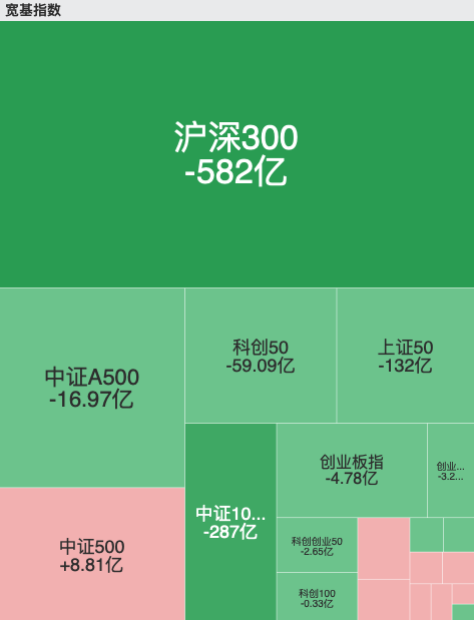
Core Viewpoint - The ETF market experienced a divergent capital flow on January 21, with broad index products facing significant redemption pressure, while certain sector-themed ETFs attracted capital, becoming a "safe haven" in the market [10]. Index Performance - The net outflow for the CSI 300-related ETFs reached 58.198 billion yuan in a single day, significantly increasing compared to previous days [11]. - The CSI 1000 index ETF followed with a net outflow of 28.685 billion yuan, indicating pressure on small and mid-cap styles [11]. - The SSE 50 and STAR 50 ETFs recorded net outflows of 13.226 billion yuan and 5.909 billion yuan, respectively [11]. - Notably, the CSI 500 ETF was the only bright spot among mainstream broad indices, recording a small net inflow of 0.881 billion yuan [11]. Weekly Data - For the week from January 16 to January 21, the net outflow for the CSI 300-related ETFs totaled 178.8 billion yuan, with the CSI 1000 and CSI 500 experiencing net outflows of 57.9 billion yuan and 19.9 billion yuan, respectively [4][15]. Product-Level Analysis - The Huatai-PB CSI 300 ETF (510300.SH) saw the largest single-day net outflow of 16.828 billion yuan, becoming the main source of capital withdrawal [16]. - The Huaxia CSI 300 ETF (510330.SH) and the E Fund CSI 300 ETF (510310.SH) had net outflows of 14.456 billion yuan and 13.815 billion yuan, respectively, while the Harvest CSI 300 ETF (159919.SZ) also saw an outflow of 13.251 billion yuan [16]. - The combined net outflow from these four leading CSI 300 ETFs approached 58.4 billion yuan, significantly contributing to the overall market pressure [16]. Sector-Themed ETFs - In contrast to broad indices, certain sector-themed ETFs received capital inflows, particularly in the chemical, gold, dividend, and consumer sectors [18]. - The Huaxia Electric Grid Equipment ETF (159326.SZ) recorded a net inflow of 1.438 billion yuan, while the Penghua Chemical ETF (159870.SZ) saw a net inflow of 0.826 billion yuan [18]. - Other notable inflows included the Yongying Gold Stock ETF (517520.SH) with 0.574 billion yuan, and the Huatai-PB Dividend ETF (510880.SH) and Low-Volatility Dividend ETF (512890.SH) with inflows of 0.508 billion yuan and 0.461 billion yuan, respectively [18].