Federal Reserve Rate Cut

Search documents
Gold (XAUUSD) Price Forecast: Can Gold Rally If Treasury Yields Stay Elevated?
FX Empire· 2026-03-30 05:25
Group 1 - The ongoing war between the U.S. and Iran is contributing to rising oil prices, which in turn is raising inflation concerns and pushing Treasury yields higher [1] - Gold prices are experiencing downward pressure due to increased yields and reduced expectations for Federal Reserve rate cuts, despite geopolitical risks [1][4] - A strong jobs report could further elevate yields and negatively impact gold prices, while weak jobs data may signal stagflation, a scenario the Federal Reserve aims to avoid [3] Group 2 - Geopolitical tensions can cause price spikes in gold, but the current market dynamics indicate that yields and central bank actions are the primary drivers of gold price movements [4] - As long as yields remain high and central bank selling is a possibility, any rallies in gold prices are likely to be sold off [5] - If yields begin to decline, there may be a quick resurgence of buyers in the gold market, especially following recent price fluctuations [5]


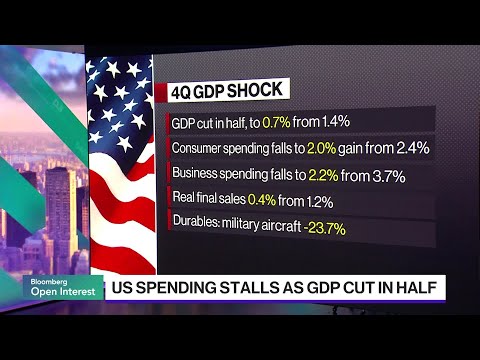
US Consumer Spending Stalls, GDP Takes a Hit
Bloomberg Television· 2026-03-13 14:40
Wall Street is digesting a raft of economic data that could bolster the case for a Federal Reserve rate cut in 2026. The FOMC meets next week. Bloomberg's Michael McKee reports on consumer spending and US GDP growth. -------- More on Bloomberg Television and Markets Like this video? Subscribe and turn on notifications so you don't miss any videos from Bloomberg Markets & Finance: https://tinyurl.com/ysu5b8a9 Visit http://www.bloomberg.com for business news & analysis, up-to-the-minute market data, features, ...
Can AI's Benefits Spread Beyond A Handful Of Tech Giants?
Seeking Alpha· 2026-02-05 04:25
Market Overview - The market rally of 2025 saw the S&P 500 increase by approximately 18% by the end of the year, although this rally was initially concentrated before broadening late in the year [4] - Current corporate valuations, including price-to-earnings ratios, are considered stretched, with the S&P 500's trailing twelve-month P/E ratio estimated at around 26, significantly higher than its historical average of approximately 16.1 [5] - The S&P 500 market capitalization is currently close to 200% of GDP, marking an unprecedented high [8] Federal Reserve's Impact - The Federal Reserve's decisions on interest rate cuts are pivotal for market direction, with two scenarios outlined: cutting "because they can" may support market performance, while cutting "because they should" could indicate economic weakness and negatively impact equities [12][15] - Historical trends suggest that equities may initially rise after the first Fed rate cut, but this is contingent on economic data, particularly inflation rates [12] Macroeconomic Risks - Key macroeconomic risks include Treasury funding, the Fed's balance sheet, and bond market volatility, which could signal shifts in liquidity affecting market valuations [16] - Persistent inflation remains a significant concern, with inflation rates above target in most countries, which could impact market stability [19] AI's Potential - The promise of artificial intelligence (AI) presents a potential upside for the market, with the possibility of a productivity boom that could drive earnings estimates higher [17][18] - If AI benefits are realized broadly, they could serve as a fundamental justification for current and potentially higher valuations in the equity market [18]
Digital Asset Funds See $454M Weekly Outflows as Fed Rate-Cut Hopes Fade: CoinShares
Yahoo Finance· 2026-01-12 12:20
Core Insights - Digital asset investment products experienced $454 million in net outflows last week, indicating a significant reversal in investor sentiment that has erased early-year gains [1] - The outflows followed a four-day period where $1.3 billion was withdrawn, nearly negating the $1.5 billion inflows seen in the first two trading days of 2026 [1] Economic Context - The shift in sentiment is closely linked to diminishing expectations for a US Federal Reserve interest rate cut in March, as recent macroeconomic data suggests persistent inflation [2] - Initial investor optimism was driven by hopes of early monetary policy easing by the Federal Reserve, but stronger economic indicators and labor market data have led to a risk-off approach in digital asset investments [3] Market Dynamics - The majority of outflows were concentrated in the US, with US-listed products seeing $569 million withdrawn, contrasting with positive sentiment in non-US markets [5] - Germany led inflows with $58.9 million, followed by Canada at $24.5 million and Switzerland at $21 million, highlighting a divergence in investor behavior between the US and Europe [5] Asset-Level Withdrawals - Bitcoin saw the largest outflows, losing $405 million over the week, while short-Bitcoin products experienced $9.2 million in outflows, indicating mixed investor conviction [6] - Ethereum followed with $116 million in outflows, reflecting caution towards large-cap digital assets [7] Selective Inflows - Despite the overall risk-off sentiment, certain altcoins attracted fresh capital, with XRP leading inflows at $45.8 million, followed by Solana at $32.8 million and Sui at $7.6 million [8] - These inflows suggest selective positioning by investors into assets perceived to have stronger near-term catalysts amid macroeconomic uncertainty [8]
HELOC rates today, December 26, 2025: Rates may bottom out before the next Fed rate cut
Yahoo Finance· 2025-12-26 11:00
Core Insights - The national average rate on home equity lines of credit (HELOC) has decreased in line with the prime rate, currently at 6.75%, with expectations for stabilization until the next Federal Reserve rate cut [1] - Home equity has reached a record high of nearly $36 trillion, indicating significant value tied up in residential properties [2] - The average weekly HELOC rate is reported at 7.44%, based on applicants with a minimum credit score of 780 and a maximum combined loan-to-value ratio of 70% [2] HELOC Interest Rates - HELOC interest rates are determined differently from mortgage rates, typically based on an index rate plus a margin, with the current prime rate at 6.75% [4] - Lenders have flexibility in pricing HELOCs, influenced by factors such as credit score and debt levels, making it advisable for borrowers to shop around for the best rates [5] - National HELOC rates may include introductory offers that last for a limited time before adjusting to a higher rate [6] Market Trends - With mortgage rates remaining low, homeowners are less likely to sell their homes, making HELOCs an attractive option for accessing home equity without refinancing [3] - Lenders are responding to the Federal Reserve's rate cuts by offering lower introductory rates, such as FourLeaf Credit Union's 5.99% APR for 12 months on HELOCs up to $500,000 [8] Borrowing Considerations - When considering a HELOC, borrowers should compare rates, fees, repayment terms, and minimum draw amounts to find the best deal [9] - A HELOC allows homeowners to access only the amount needed from their equity, avoiding interest on unused credit [9] - For homeowners with low primary mortgage rates and significant equity, now may be an optimal time to secure a HELOC for various uses, including home improvements or personal expenses [11] Payment Structure - For a $50,000 HELOC at a 7.50% interest rate, the monthly payment during the 10-year draw period would be approximately $313, with the understanding that rates are variable and payments may increase during the repayment period [12]
AU vs. NEM: Which Gold Mining Stock Is the Better Buy Right Now?
ZACKS· 2025-12-24 19:06
Core Viewpoint - AngloGold Ashanti PLC (AU) and Newmont Corporation (NEM) are both major gold producers benefiting from rising gold prices, which are currently around $4,500 per ounce, reflecting a 70.6% increase over the past year [2][19]. AngloGold Ashanti (AU) - AU has a diversified portfolio with operations in multiple countries, including South Africa, Argentina, and Ghana, and has made significant acquisitions, including Augusta Gold Corp and Centamin, enhancing its production capabilities [3][4]. - The company reported a 17% year-over-year increase in gold production to 768,000 ounces in Q3 2025, with gold revenues rising 61.9% to $2.37 billion [5]. - Projected gold production for 2025 is between 2.9 million and 3.225 million ounces, indicating a year-over-year growth of 9-21% [6]. - Despite facing higher operating costs, AU generated a record $920 million in free cash flow in Q3, a 141% increase year-over-year, and ended the quarter with $3.9 billion in liquidity [8]. - The company is focused on its Full Asset Potential program to mitigate inflationary impacts and streamline operations, particularly in the U.S. [9]. Newmont Corporation (NEM) - NEM is one of the largest gold producers globally, with operations in Nevada, Peru, and Ghana, and has recently achieved commercial production at the Ahafo North project, expected to produce 275,000 to 325,000 ounces annually [12]. - The company produced 1.42 million ounces of gold in Q3 2025, a 15% decrease year-over-year due to reduced grades and planned shutdowns [14]. - NEM anticipates maintaining its expected gold production for 2025 at 5.9 million ounces, down from 6.85 million ounces in 2024 [15]. - The company generated a record free cash flow of $1.6 billion in Q3, marking the fourth consecutive quarter with over $1 billion in free cash flow [15]. Earnings Estimates - The Zacks Consensus Estimate for AU's 2025 earnings is $5.51 per share, indicating a year-over-year growth of 149.3% [16]. - For NEM, the earnings estimate for 2025 is $6.06 per share, reflecting a year-over-year increase of 74.1% [18]. Price Performance & Valuation - Over the past year, AU's stock has increased by 297.3%, while NEM's stock has risen by 179.4% [19]. - AU is trading at a forward 12-month earnings multiple of 11.54X, while NEM is at 14.94X [20]. Investment Consideration - Both AU and NEM are well-positioned to benefit from the ongoing gold price rally, but AU has shown stronger price performance and a more attractive valuation, making it a more compelling investment choice at this time [23][24].



Will Fed’s Latest Rate Cut Be Powell’s Last?
Yahoo Finance· 2025-12-11 05:01
Core Viewpoint - The Federal Reserve's Open Market Committee (FOMC) cut the key overnight borrowing rate to 3.5%-3.75%, aligning with market expectations, but future rate cuts may be limited due to inflation concerns [1][2][3] Group 1: Federal Reserve Actions - The FOMC's decision to cut rates was a 9-3 vote, indicating a division among members regarding the need for further cuts to support the labor market versus concerns about inflation [2] - The Fed's preferred inflation gauge is currently at 2.8%, above the 2% target, with expectations to decrease to approximately 2.4% by the end of 2026 [2] - The FOMC's dot plot suggests only one rate cut is anticipated in 2026, indicating a higher threshold for future cuts [3] Group 2: Market Reactions - Rate-sensitive investments saw a rally, with the small-cap Russell 2000 index increasing by 1.3% and the State Street SPDR S&P Homebuilders ETF rising by 3% [5] - Historical data indicates that stocks perform well during non-recession periods when the Fed cuts rates, averaging a 15% annualized return since 1970 [5] - Some analysts caution that optimism regarding the pace of future rate cuts may be overstated, suggesting that the anticipated timeline for lower interest rates could be longer than expected [5]
What the Fed rate cut means for your money
CNBC Television· 2025-12-10 20:15
The Fed just wrapped up its final meeting of the year and cut its benchmark rate by a quarter of a percentage point. [music] It's the third straight rate reduction this year. So, what does it mean for your money.I'm Sharon Eper, the senior personal finance correspondent at CNBC [music] and editor of the Money 101 newsletter. Just because the Fed cut rates doesn't mean your borrowing costs are going to automatically go down. Consumers with short-term variable rate debt, like credit card debt, will [music] se ...
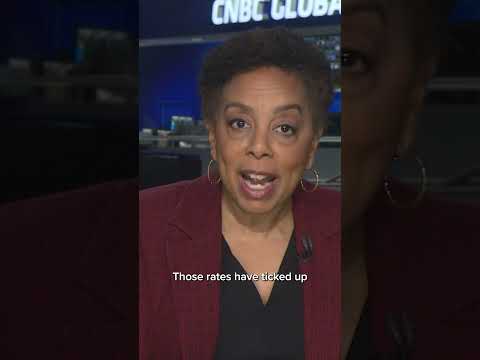
Fed rate cut is 'insurance' buffer against labor market, says economist Claudia Sahm
CNBC Television· 2025-12-10 19:13
Our next guest says today's cut is an insurance cut against a weakening labor market. Let's bring in Claudia Som, chief economist at New Century Adviserss, creator of the SOM rule. Claudia, it's great to see you.Let me just set this up a little bit because we had Jason Ferman earlier saying we shouldn't cut because of inflation and because of the deficit. Those pressures are still too high. Um, obviously others are are more doubbish.They think that we can and should. Explain where you come down on this. >> ...
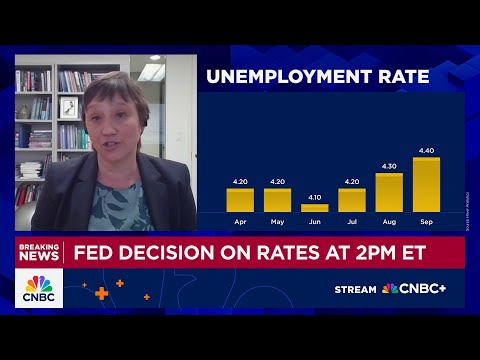
CNBC Fed Survey: 45% of respondents say the Fed should cut by 25 bps in December
Youtube· 2025-12-09 14:07
Group 1 - The CNBC Fed survey indicates a significant expectation for a hawkish cut, with 87% of respondents anticipating a rate cut this week, but only 45% believe it should happen, highlighting a historic differential in opinions [1] - The survey reveals that two dissenting votes are expected, with only 35% forecasting a rate cut by January [1] - The primary economic risks identified include high inflation, the potential bursting of the AI bubble, concerns over Fed independence, fiscal deficits, and administrative policy uncertainty [1] Group 2 - The growth outlook is projected to be 2% for this year, with expectations for higher growth next year, while inflation is anticipated to remain above the 2% target [1] - There is an expectation of significant stimulus from record tax refunds in the first half of 2026, which may lead to underestimating the risk of persistent inflation [1] - The job market is not expected to see much downside, with only a slight increase in the unemployment rate forecasted for next year and a decline anticipated in 2027 [1]