GDP核算方法

Search documents
国家统计局关于2024年国内生产总值最终核实的公告 - 国家统计局
Guo Jia Tong Ji Ju· 2025-12-29 09:36
Group 1 - The core point of the article is the final verification of China's GDP data for 2024, which shows a total nominal GDP of 13,480.66 billion yuan, a decrease of 10.18 billion yuan from the preliminary estimate, with a year-on-year growth of 5.0% at constant prices, consistent with the preliminary estimate [1][2][4]. Group 2 - The primary industries contributed 91.64 billion yuan with a growth rate of 3.7% [5]. - The secondary industries accounted for 490.305 billion yuan, growing at 6.8% [5]. - The tertiary industries reached 766.125 billion yuan, with a growth rate of 5.1% [5]. - The agricultural sector, including forestry, animal husbandry, and fishery, grew by 4.0% [5]. - The industrial sector, which includes manufacturing, grew by 5.5% [6]. - The construction industry saw a growth of 2.9% [6]. - The wholesale and retail sector grew by 6.5% [6]. - The transportation, warehousing, and postal sector grew by 6.7% [6]. - The accommodation and catering sector grew by 7.0% [6]. - The financial sector grew by 3.7% [6]. - The real estate sector experienced a decline of 2.2% [6]. - The information transmission, software, and IT services sector grew by 11.7% [6]. - The leasing and business services sector grew by 11.1% [6]. - Other industries grew by 3.9% [6].
中美GDP比例掉头向下,70%魔咒背后藏着猫腻,真实差距在变小?
Sou Hu Cai Jing· 2025-11-30 17:07
Group 1 - The core viewpoint is that the apparent decline in China's GDP proportion relative to the US is misleading, as it is influenced by factors such as exchange rates, inflation, and differing statistical methods [1][3][5] - China's actual economic growth rate in 2023 is 5.2%, nearly double the US's 2.9%, yet the GDP proportion to the US has decreased due to currency depreciation and inflationary pressures in the US [3][11] - The US Federal Reserve's interest rate hikes have led to a depreciation of the RMB by over 10% from late 2021 to early 2024, directly impacting the GDP comparison between China and the US [5][6] Group 2 - By the end of 2023, China's GDP, when calculated at 2021 exchange rates, would exceed $20 trillion, resulting in a proportion of over 73% compared to the US, rather than the currently reported 64% [8] - The nominal GDP growth rate for the US in 2023 is approximately 6.3%, while China's nominal growth rate is 4.6%, leading to a situation where China's actual growth is higher than its nominal growth [11] - The US's high inflation has inflated its nominal GDP figures, creating a false sense of economic prosperity, while the actual purchasing power of American citizens is declining [11][13] Group 3 - The US GDP calculation includes non-productive elements such as "imputed rent" for owner-occupied housing, which contributes significantly to its GDP but does not reflect actual production [15] - The structure of demand in the US economy is heavily reliant on consumer spending, accounting for about 80%, while China's consumer spending contribution is only 53.5% [17] - In terms of real economic indicators, China's manufacturing output is 1.67 times that of the US, with its primary and secondary industries significantly outpacing the US [17]

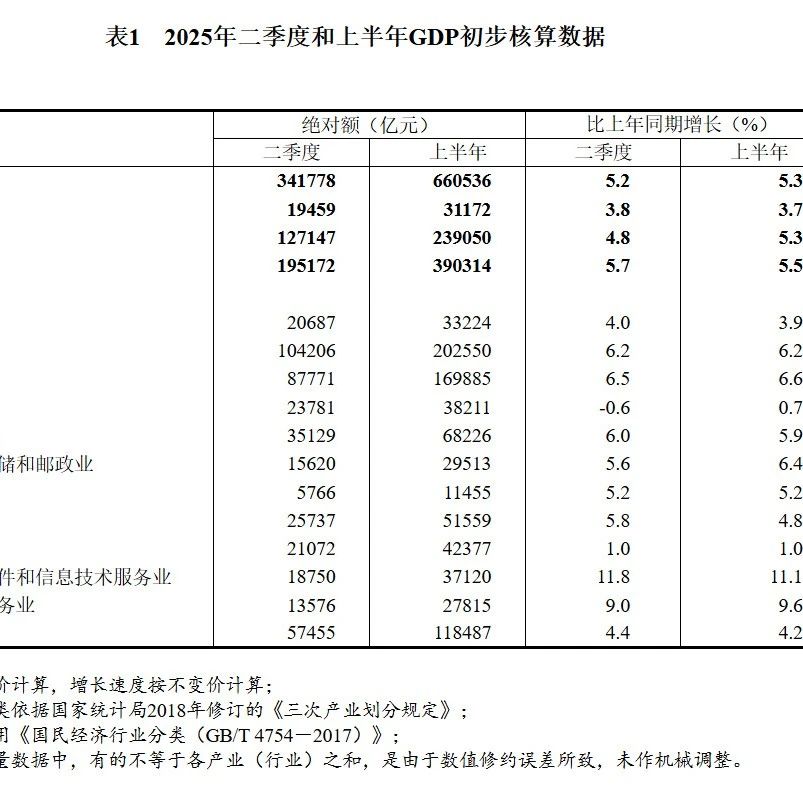
【数据发布】2025年二季度和上半年国内生产总值初步核算结果
中汽协会数据· 2025-07-16 06:59
Core Viewpoint - The article provides an overview of China's GDP accounting methods and preliminary results for the second quarter and first half of 2025, highlighting the importance of GDP as a key economic indicator and the methodologies used for its calculation [1][5]. Summary by Sections 1. GDP Accounting Overview - GDP is defined as the final result of production activities of all resident units in a country during a specific period, serving as a core indicator of national economic performance [5]. - There are three methods for GDP accounting: production method, income method, and expenditure method, each reflecting different aspects of economic activity [5]. 2. Accounting Scope - The production scope includes goods and services produced for other units, self-consumed goods, knowledge products for self-consumption, and housing services [6]. - The accounting subjects include all resident units within China's economic territory, excluding data from Hong Kong, Macau, and Taiwan [7]. 3. Accounting Frequency and Legal Basis - GDP is calculated quarterly, with a shift from cumulative to separate quarterly calculations starting from Q3 2015 [7][8]. - The accounting adheres to the Statistical Law of the People's Republic of China and follows the National Economic Accounting System [8]. 4. GDP Calculation Methods - The article details the classification system for GDP accounting, including the national economic industry classification and the three-sector classification [10]. - Various data sources are utilized for GDP calculation, including national statistical surveys and administrative records [11]. 5. Data Revision and Quality Assessment - The necessity for data revision is emphasized due to the preliminary nature of quarterly GDP estimates, which are later refined with more complete data [14]. - The quality of the underlying data and the methods used for GDP calculation are regularly evaluated to ensure accuracy and reliability [16][17]. 6. Data Publication - Preliminary GDP figures are typically released about 15 days after the end of the quarter, while final verified figures are published in January of the following year [19].