
Green Transformation

Search documents
中国思考-十五五规划:科技为纲、消费为辅
2026-03-12 09:08
Summary of the Conference Call on China's 14th Five-Year Plan Industry Focus - The conference call discusses the **14th Five-Year Plan (FYP)** of China, emphasizing a **technology-centric** approach and a calibrated rebalancing of the economy. Core Points and Arguments 1. **Focus on Technology and Supply-Side Policies** The 14th FYP reiterates a growth path centered on technology and supply-side policies, with clear quantitative targets for innovation and green transformation. However, the promotion of consumption is described in qualitative terms only, indicating a lack of concrete measures to stimulate consumer spending [3][8][11]. 2. **Quantitative Goals for Innovation** Specific quantitative goals include: - Average annual growth rate of R&D expenditure to exceed 7% - Increase the share of the digital economy in GDP from 10.5% to approximately 12.5% by 2030 - Maintain labor productivity growth above GDP growth [7][11][12]. 3. **Moderate Consumption Promotion** Despite an increase in the household consumption rate being a major goal, the plan lacks binding quantitative targets for consumption as a percentage of GDP. This aligns with past policy styles that avoid setting specific numerical goals for macroeconomic structural reforms [3][11]. 4. **Green Transition Goals** The plan aims to increase the share of non-fossil energy consumption in total energy consumption to 25% by the end of the plan period, indicating a shift from administrative reduction targets to a transformation of the energy system [8][12]. 5. **Challenges in Implementation** The plan highlights the need for a unified national market framework to regulate local government behavior. However, actual implementation may face challenges due to entrenched local interests and the need for reforms in local government assessment and tax systems [8][11]. 6. **GDP Growth Forecast** The GDP growth forecast for the year is maintained at 4.8% for real growth and 4.1% to 4.2% for nominal growth, reflecting a cautious outlook amid ongoing structural adjustments in the economy [8][13]. Other Important but Overlooked Content 1. **Sector-Specific Plans** There is an expectation of a series of industry-specific plans to translate the macro goals of the 14th FYP into actionable strategies within the next 6 to 12 months, focusing on technology independence, social security reform, and addressing employment impacts from AI [8][11][12]. 2. **Social Welfare Reforms** The plan includes clearer policy guidance for social welfare reforms, such as increasing pension support and easing access to social security for migrant workers, indicating a more systematic approach to social support [12]. 3. **Addressing AI Employment Impact** The government plans to release documents addressing the employment impacts of AI, which may include support for retraining and the creation of new high-tech jobs [12]. 4. **Institutional Reforms to Combat "Involution"** The focus is on establishing a more unified market entry system and regulatory framework to curb local protectionism and unhealthy competition, which may slow down the pace of implementation due to existing local interests [11][12]. This summary encapsulates the key insights from the conference call regarding China's 14th Five-Year Plan, highlighting the emphasis on technology and innovation while acknowledging the challenges in promoting consumption and implementing reforms.
中国思考-两会:科技为纲,宏观温和
2026-03-01 17:21
Summary of Key Points from the Conference Call Industry Overview - The report focuses on the Chinese economy and its macroeconomic policies as discussed during the National People's Congress (NPC) meetings in 2026, emphasizing technology and infrastructure as key areas of focus [1][6][11]. Core Insights and Arguments - **GDP Growth Target**: The GDP growth target remains around 5%, despite some provinces lowering their growth targets. There is speculation that the national target could be adjusted to 4.5-5%, but this is considered unlikely [3][11]. - **Policy Stance**: The policy approach is characterized as "supportive but not aggressive," indicating a cautious stance towards economic stimulus. The broad fiscal deficit is expected to remain at 11.6% of GDP, with the official deficit rate stable at 4% [3][11]. - **Fiscal Policy**: Initial fiscal measures are expected to be on par with the previous year, with a focus on technology and infrastructure. Support for consumption and real estate is described as moderate [1][11][15]. - **Supplementary Budget**: If economic momentum weakens, there may be a supplementary budget of 0.5% of GDP introduced mid-year to support certain service consumption and social welfare expenditures [3][11][15]. Additional Important Content - **Focus on Technology and Infrastructure**: The NPC meetings highlight a continued emphasis on self-sufficiency in technology and infrastructure development, with public spending prioritized in these areas [1][15][16]. - **Consumer Support Measures**: The anticipated consumer support measures are expected to be around 500-600 billion RMB, targeting specific areas such as trade-in programs and social welfare enhancements [11][15]. - **Real Estate Policy**: Following the NPC, there may be pilot programs for mortgage interest subsidies in select cities, reflecting a cautious approach to real estate support [11][15]. - **Future Macro Goals**: The upcoming five-year plan may shift from setting GDP growth targets to establishing quantitative goals in areas like AI, technology self-sufficiency, and green transformation [11][16]. - **Industry Development Blueprint**: Key sectors such as artificial intelligence, semiconductors, green energy, and biotechnology are expected to remain priorities, with a potential shift in industrial policy towards enhancing research ecosystems and promoting healthy competition [11][16]. This summary encapsulates the main themes and insights from the conference call, providing a comprehensive overview of the current economic outlook and policy direction in China.
新能源新车销售量远超预期,绿色转型“加速度”从何而来?
Ren Min Ri Bao· 2026-02-05 02:10
Group 1 - By 2025, the sales volume of new energy vehicles in China is expected to exceed 50% of total new car sales, significantly surpassing the initial target of 20% set in 2020 [1] - The increase in non-fossil energy consumption is projected to rise from 16% in 2020 to over 20% by 2025, indicating a strong commitment to green energy [2] - China's forest coverage rate has exceeded 25%, making it the fastest-growing country in terms of afforestation globally [2] Group 2 - Traditional industries are transforming; for example, Taiyuan Iron and Steel Group has shifted focus to high-end stainless steel, showcasing innovation in a high-emission sector [3] - Various regions in China are leveraging their unique resources for green energy production, such as Inner Mongolia's wind power and Qinghai's solar energy, contributing to a comprehensive renewable energy industry [3] - The Ant Forest initiative has engaged millions of users in environmental actions, leading to the planting of over 600 million trees, reflecting a societal shift towards sustainable living [4] Group 3 - China's GDP is projected to exceed 140 trillion yuan in 2025, with a growth rate of 5.0%, while energy consumption per unit of added value in major energy-intensive industries has significantly decreased [4] - The shift towards green production is enhancing economic growth, demonstrating that high-quality development can be achieved without following the traditional path of pollution [4] - The ongoing green transformation is not only an environmental necessity but also a crucial aspect of future development, emphasizing the importance of sustainable practices [4]
2026年电力行业展望:延续绿色转型与市场化改革双主线发展
大公信用· 2026-02-05 00:45
Investment Rating - The report indicates a positive outlook for the power industry, emphasizing the continuation of green transformation and market-oriented reforms in 2026 [1]. Core Insights - The power industry is expected to maintain a balance between supply and demand, with a significant increase in renewable energy installations and generation, while coal power transitions to a peak-shaving role [1][4]. - The overall credit status of the industry remains strong, with high-rated state-owned enterprises dominating the bond issuance landscape, reflecting significant financing advantages [1][19]. - The report highlights the need for improved system regulation and consumption capacity to support the accelerated green transition of the power supply structure [3][4]. Supply Capacity Analysis - The total installed power generation capacity in China reached 3,890 million kilowatts by the end of 2025, marking a 16.1% year-on-year increase, with renewable energy being the main driver of this growth [3]. - Wind and solar power installations reached a combined total of 1,840 million kilowatts, with solar power growing by 35.4% and wind power by 22.9% year-on-year [3]. - The transition of coal power to a peak-shaving role is becoming more pronounced, although the system's regulation and consumption capacity require urgent enhancement [3][4]. Demand Matching Capability Analysis - The total electricity consumption in China was 10.37 trillion kilowatt-hours in 2025, reflecting a 5.0% year-on-year growth, although the growth rate has slowed compared to previous years [6]. - The demand for electricity is expected to continue growing steadily in 2026, driven by the third industry and urban residents' electricity consumption [9]. Price Change Analysis - Fuel prices have declined, but installation costs are expected to rise, leading to continued pressure on electricity prices in 2026 [10][16]. - The average on-grid electricity price is anticipated to face downward pressure due to the marketization of electricity pricing and the rising costs of renewable energy installations [10][16]. Policy Direction - The report emphasizes that the focus for 2026 will be on deepening the green transition and improving the unified market system, with policies aimed at promoting efficient consumption of renewable energy [17][18]. - The establishment of a new power system and the construction of a national unified electricity market are highlighted as key areas for policy development [17][18]. Credit Rating Situation Analysis - The bond issuance scale in the power industry reached 1,797.64 billion yuan in 2025, a significant increase of 62.24% year-on-year, with the majority of issuers being high-rated state-owned enterprises [19][20]. - The report notes that the credit ratings of power enterprises remain high, with most issuers rated AAA, reflecting the industry's overall strong credit quality [20][26]. Cycle Development Outlook - The power demand is expected to grow steadily alongside economic recovery and electrification processes, maintaining a balance between supply and demand [28]. - The report anticipates that the electricity pricing mechanism will become more flexible, with potential downward pressure on market transaction prices [28][29].
确保清洁化运输不在“最后一公里”走偏
Zhong Guo Huan Jing Bao· 2026-02-03 23:09
Core Viewpoint - The article highlights the issue of companies engaging in deceptive practices to meet clean transportation assessments, undermining the original intent of policies aimed at improving transportation sustainability [1][5]. Group 1: Current Issues in Clean Transportation - Some companies are manipulating clean transportation assessments by switching to electric vehicles only at the last mile, distorting the policy's goal of achieving comprehensive clean transport [1]. - The Ministry of Ecology and Environment and 15 other departments set a target for clean transportation rates of 80% in key industries and 70% in other areas, but the implementation has been compromised by superficial compliance [1][5]. Group 2: Regulatory Challenges - The current assessment methods rely on static data from companies, which is outdated and allows for manipulation; a shift to real-time tracking and data analysis is necessary [2]. - A recommendation is made for the establishment of a national or regional regulatory platform that utilizes IoT and big data to monitor clean transportation effectively [2]. Group 3: Infrastructure and Support - Companies face challenges such as range anxiety and high costs associated with clean energy vehicles, which necessitates government support in developing charging and refueling infrastructure [3]. - Local governments should not only enforce compliance but also facilitate the transition to clean transportation by providing necessary infrastructure [3]. Group 4: Policy Recommendations - A balanced approach of incentives and constraints is needed to motivate companies to view green transformation as an opportunity rather than a cost burden [4]. - Suggestions include tax incentives for companies that exceed clean transportation targets and integrating supply chain sustainability into evaluation systems [4]. Group 5: Systemic Solutions - Addressing the "last mile switch" issue requires a comprehensive approach that includes upgrading regulatory practices, enhancing support systems, and fostering a collaborative governance model [5]. - The focus should be on ensuring that clean transportation policies are effectively implemented and that the original goals of these policies are achieved [5].
【前瞻分析】2025年中国铜冶炼行业供需现状及发展趋势分析
Sou Hu Cai Jing· 2026-02-03 20:57
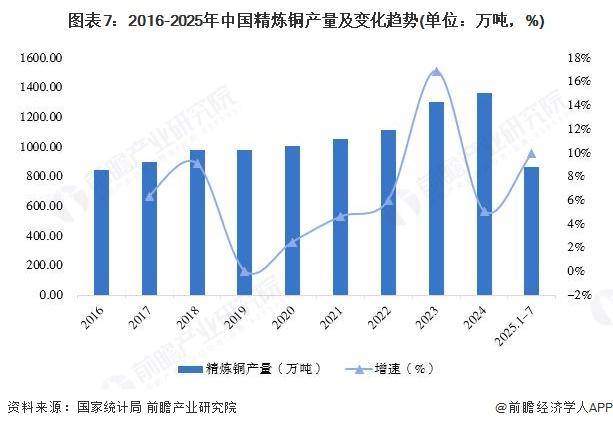
Group 1 - The core viewpoint of the articles highlights the growth and transformation of China's copper smelting industry, emphasizing the shift towards green and intelligent manufacturing in response to global trends and domestic demands [2][6]. - China's refined copper production is projected to reach 13.644 million tons in 2024, marking a 5.1% increase from 2023, with a year-on-year growth of 9.9% observed in the first seven months of 2025 [1][2]. - The copper smelting industry in China is experiencing a continuous trade deficit, with the total import and export value of related products reaching 811.856 billion yuan in 2024, and the trade deficit expanding by 114.513 billion yuan [6][7]. Group 2 - The average import price of copper smelting-related products has shown an upward trend from 2019 to July 2025, with significant increases during the 2020-2021 period due to supply chain disruptions caused by the COVID-19 pandemic [8]. - China's position as a major consumer in the global refined copper market is expected to strengthen, with the country's share of global refined copper production and sales anticipated to increase further [2].





山东两会观察|黄河口城市的破壁决心:东营擘画绿色转型新图景
Xin Lang Cai Jing· 2026-01-25 02:50
Core Viewpoint - Dongying City is focusing on a profound transformation towards a comprehensive green transition, as highlighted in the government work report, which identifies this as one of the key development themes for the new year [1][2]. Group 1: Ecological Restoration - The green transition in Dongying is rooted in systematic restoration of the Yellow River Delta's ecological foundation, with a focus on creating the Yellow River Estuary National Park [4]. - Significant investments have led to tangible results, including the restoration of 72,500 acres through reforestation and wetland recovery, and the addition of 74,000 acres of wetland since the 14th Five-Year Plan [4]. - The "Yellow River Estuary Wetland Restoration Model" has been developed, promoting a cycle of "one-time restoration, natural succession, and long-term stability" [4]. - Water management is crucial, with 241 kilometers of waterways cleared and an average annual ecological water replenishment of over 170 million cubic meters in recent years [4]. Group 2: Pollution Prevention - Pollution prevention is a key aspect of Dongying's transformation, with the city achieving top marks in provincial pollution prevention assessments [7]. - The average PM2.5 concentration in Dongying was reported at 24 micrograms per cubic meter from January to October 2025, marking the best improvement in the province [7]. - The proportion of good-quality water bodies in national control sections reached 66.7% during the same period, with a significant reduction in inferior water bodies [7]. Group 3: New Energy System - The establishment of a new energy system is a strategic focus for Dongying, aiming to fundamentally change the city's energy supply structure [9]. - By the end of 2025, renewable energy installed capacity is expected to reach 10.8838 million kilowatts, accounting for 69% of the total power generation capacity, a 40 percentage point increase from the end of the 13th Five-Year Plan [9]. - The city is developing offshore wind and solar energy projects, including the first gigawatt-level offshore solar project in the country [9]. - A significant project, the Dongying Zero Carbon Industrial Park, aims for 100% green electricity and zero-carbon production across the entire industrial chain [9]. Group 4: Future Development Plans - The report outlines plans for continued integrated development of wind, solar, and hydrogen energy, with an additional 800,000 kilowatts of renewable energy and new energy storage capacity expected in the year [11]. - The commitment to promoting comprehensive green transformation reflects Dongying's determination to reshape its development logic through systematic thinking [11].

央行出台八项金融政策:降准降息还有空间|川观智库·金融研究院
Xin Lang Cai Jing· 2026-01-15 14:20
Core Viewpoint - The People's Bank of China (PBOC) has introduced eight new financial policies aimed at supporting the high-quality development of the real economy, focusing on structural adjustments and precise support rather than short-term stimulus [1][2]. Group 1: Monetary Policy Adjustments - The PBOC announced a reduction of 0.25 percentage points in various structural monetary policy tool rates, with the one-year re-lending rate now at 1.25% [1]. - The new rates for agricultural and small business re-lending are set at 0.95%, 1.15%, and 1.25% for 3-month, 6-month, and 1-year terms respectively, while the re-discount rate is at 1.5% [1]. - There is still room for further interest rate cuts and reserve requirement ratio reductions, as the average reserve requirement ratio is currently at 6.3% [2]. Group 2: Support for Key Sectors - The PBOC will merge the quotas for agricultural and small business re-lending, increasing the re-lending quota by 500 billion yuan, with a dedicated quota of 1 trillion yuan for private enterprises [3]. - The quota for technology innovation and technological transformation re-lending has been raised from 800 billion yuan to 1.2 trillion yuan, expanding support to high R&D investment private SMEs [3]. - The minimum down payment ratio for commercial property loans has been lowered to 30%, aimed at promoting inventory reduction in the commercial real estate market [3]. Group 3: Focus on Structural Optimization - The policy adjustments target key weaknesses in the current economic operation, aiming to alleviate financing difficulties for private and small enterprises [4]. - The expansion of support for carbon reduction and service consumption reflects a strong emphasis on green transformation and the potential of service consumption to foster new growth drivers [4]. - The gradual implementation of these policies is expected to stabilize economic expectations and promote high-quality development [4].
Jiangxi Fengcheng Hosts Circular Economy Industry Innovation and Development Conference, Sharing Experience in Green Transformation of China's Counties
Globenewswire· 2026-01-08 11:38
Core Insights - The Circular Economy Industry Innovation and Development Conference was held in Fengcheng, Jiangxi Province, focusing on the theme "Circular Empowerment, Innovative Symbiosis" and attracting over 200 representatives from various sectors to discuss the development of the circular economy [1] Group 1: Circular Economy Development - Fengcheng has transformed into a national-level green industry demonstration base, with a total output value of the circular economy industry reaching 56.85 billion yuan in 2024 [2] - The industrial cluster in Fengcheng focuses on recycled copper, recycled aluminum, and recycled plastics, with recycled waste copper accounting for about 12% and recycled waste aluminum for about 7.3% of the national total [2] Group 2: Environmental Impact - The implementation of a closed-loop system for resources in Fengcheng has led to significant industrial upgrades and a reduction of carbon emissions by 11.76 million tons in 2024 through the utilization of recycled copper and aluminum [3] Group 3: Strategic Goals - The "Blue Book on the High-Quality Development of Circular Economy in Fengcheng, Jiangxi" was released, outlining the development logic and practical experiences of Fengcheng, with the goal of establishing a "national green supply chain hub" [4][5]
日本科技- 重估高盛目标价:AI 服务器电源光学、实体 AI、价格调整及业务重组将塑造 2026 年格局
Goldman Sachs· 2026-01-06 02:23
Investment Rating - The report maintains a "Buy" rating for several companies in the Japan Industrial Electronics sector, including Anritsu, Panasonic HD, Hitachi, Sumitomo Electric, Fujikura, SWCC, Mitsubishi Electric, and Daihen. Furukawa Electric and Fuji Electric are rated as "Neutral" [7]. Core Insights - The Japan Industrial Electronics sector is poised for growth driven by technological advancements in AI server power and optics, with companies like Hitachi, Mitsubishi Electric, and Panasonic actively developing new business models to leverage AI's importance [1][12]. - The report anticipates that the implementation of physical AI in social infrastructure will gain momentum, with conglomerates expected to progress in their business portfolio strategies by 2026 [1]. - The sector is experiencing a shift towards higher voltage systems in data centers, which presents opportunities for electrical equipment manufacturers skilled in high voltage applications [22][24]. Earnings Estimates and Target Prices - The report revises FY3/26E-FY3/28E operating profit estimates for the sector by an average of 0%/-1%/-1%, while raising 12-month target prices by an average of 4% [3][7]. - Specific target price adjustments include Anritsu from 2,400 million JPY to 2,600 million JPY, Panasonic HD from 2,100 million JPY to 2,300 million JPY, and Hitachi from 5,900 million JPY to 6,000 million JPY [7][3]. Technological Changes in AI Server Power - Companies like Hitachi and Mitsubishi Electric are increasing their presence in AI server power solutions, focusing on high-voltage DC systems to reduce conversion losses and improve efficiency [12][13]. - The report highlights the importance of battery backup units (BBUs) and hybrid supercapacitors (HSCs) in managing power fluctuations in generative AI data centers, with Panasonic having a strong position in BBUs [16][12]. Technological Changes in AI Server Optics - The report notes a significant shift towards higher communication speeds in data centers, moving from 200-400 Gbps to 800-1.6 Tbps, and the transition to Co-packaged Optics (CPO) [28][29]. - Companies such as Mitsubishi Electric, Sumitomo Electric, and Furukawa Electric are increasing production of optical devices and connectors to meet rising demand [30][31]. Implementation of Physical AI - Hitachi, Mitsubishi Electric, and Panasonic are focusing on integrating AI into industrial applications, with expectations of increased competition as software companies also enter the physical AI space [47][49]. - The report categorizes companies in the sector based on their involvement in AI infrastructure, AI-enabled revenues, and productivity gains, with Hitachi identified as a key beneficiary across all categories [48][49].