IPD集成产品开发流程

Search documents
强化多业务平台化服务能力,华勤技术预计2025年营收最高增长56%
Jin Rong Jie· 2026-01-22 10:19
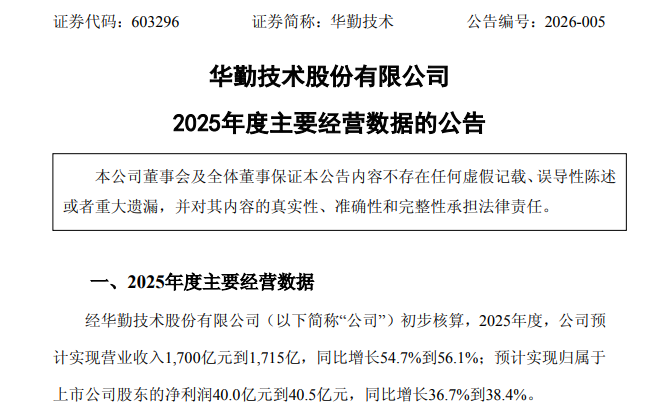
Core Viewpoint - Huqin Technology expects significant growth in revenue and net profit for the fiscal year 2025, driven by advancements in artificial intelligence and a robust product strategy [1][4]. Group 1: Financial Performance - The company anticipates revenue between 170 billion to 171.5 billion yuan, representing a year-on-year increase of 54.7% to 56.1% [1]. - Net profit is projected to be between 4 billion to 4.05 billion yuan, with a growth rate of 36.7% to 38.4% compared to the previous year [1]. Group 2: Strategic Initiatives - The company is leveraging its "3+N+3" smart product platform strategy and global industrial layout to enhance service capabilities across various sectors, including mobile terminals, personal computers, data centers, and automotive electronics [4][7]. - A recent issuance of 800 million yuan in technology innovation bonds, with a subscription multiple of 2.71, aims to optimize the company's financing structure [4]. Group 3: Business Development - The company maintains a competitive edge in both emerging and traditional sectors, with a focus on long-term strategic investments [5]. - The PC business is expected to exceed 30% revenue growth in the first three quarters of 2025, with total revenue projected to surpass 30 billion yuan [5]. - The data center business is performing exceptionally well, with revenue expected to double, reaching over 40 billion yuan for the year [7]. Group 4: Market Position and Challenges - The company has established itself as a leading ODM manufacturer in the smartphone sector, with a projected shipment increase of over 20% in the laptop business [6]. - A unique procurement model helps the company mitigate risks associated with rising storage chip prices, ensuring stable gross margins [6].


三季度净亏损超17亿元 冯兴亚:广汽进入“战时状态”
Xin Lang Cai Jing· 2025-10-24 13:01
Core Viewpoint - GAC Group reported a significant decline in net profit and sales due to intense competition in the domestic automotive industry and rapid changes in demand structure, leading to a "wartime state" for the company [1][2]. Financial Performance - In Q3 2025, GAC Group's total revenue was 24.318 billion yuan, a quarter-on-quarter increase of 6.98% but a year-on-year decrease of 14.62% - The net loss attributable to shareholders was 1.774 billion yuan, a reduction from the previous quarter but an increase of 377 million yuan compared to the same period last year - For the first three quarters, total revenue reached 66.272 billion yuan, down 10.49% year-on-year, with a net profit of 4.312 billion yuan, a staggering decline of 3691.33% [1]. Market Challenges - GAC Group's cumulative sales from January to September 2025 were 1.1837 million units, a year-on-year decline of 11.34% - All major brands under GAC, including GAC Honda and GAC Aion, experienced varying degrees of sales decline, highlighting issues in the company's transition to new energy vehicles and market competition [1]. Strategic Reforms - GAC has initiated several reforms, including the establishment of an operational headquarters, integrated operations for its own brands, the introduction of an integrated product development process (IPD), and personnel reforms - The product development cycle has been reduced from 30 months to 18-24 months, with a 10% decrease in development costs [2]. External Collaborations - GAC is seeking external partnerships, notably with Huawei to create a new brand "Qijing," which will feature Huawei's intelligent solutions and is set to launch its first model in mid-2026 - Additionally, GAC plans to collaborate with JD.com and CATL to launch the "National Good Car" Aion UTsuper during this year's Double Eleven shopping festival, featuring advanced battery technology [2]. Competitive Strategy - GAC is focusing on three key battles: user demand, product value, and service experience, adopting a "wartime rhythm" to ensure timely reforms and innovations - The company emphasizes the necessity of high-density operations to maintain continuous reform and innovation [3].

晚点独家丨广汽华望已规划两款新车,预计明年发布
晚点LatePost· 2025-07-10 12:30
Core Viewpoint - The collaboration between GAC Group and Huawei in the automotive sector is deepening, with the establishment of the new brand "HuaWang" aimed at the high-end market, specifically targeting the 300,000 yuan segment, and planning to launch two new models in the near future [4][5][9]. Group 1: Collaboration Details - GAC Group has been collaborating with Huawei since 2017, initially as one of the first companies to adopt Huawei's HI model, and the partnership has intensified since last year [7][9]. - The new brand HuaWang will feature two models, a sedan and an SUV, with powertrains including pure electric and range-extended options, expected to be launched next year [5][9]. - Huawei's involvement in the HuaWang project includes significant participation in vehicle definition, product design, research and development, and marketing, resembling the HI PLUS model [8][9]. Group 2: HI PLUS Model - The HI PLUS model represents an evolution from the HI model, allowing Huawei to have a greater role in the entire vehicle development process, including planning, design, and marketing [8][10]. - GAC has granted Huawei substantial decision-making power in the HuaWang project, with Huawei leading the product definition and positioning [9][10]. - The introduction of the HI PLUS model is a response to the increasing demand for deeper collaboration between traditional automakers and Huawei, as the automotive industry faces accelerated competition [10][11]. Group 3: Market Context - Huawei's automotive business has faced challenges, but recent successes with models like the AITO M7 have boosted sales and profitability, leading to increased collaboration opportunities with various automakers [10][11]. - The automotive industry is undergoing a phase of rapid elimination, prompting more traditional car manufacturers to seek partnerships with Huawei to enhance their market competitiveness [10][11]. - As Huawei expands its partnerships through the HI PLUS model, it faces the challenge of balancing resource allocation and maintaining product differentiation in a competitive market [11].