启境

Search documents
小K播早报|英伟达Q4营收大涨75% 海力士拟投资150亿美元扩建芯片产能
Xin Lang Cai Jing· 2026-02-26 00:21
Market Dynamics - Nvidia reported Q4 revenue of $68.1 billion, a 73% year-over-year increase, exceeding market expectations of $65.68 billion and up from $39.33 billion in the same period last year [1] - Data center revenue reached $62.3 billion, surpassing the expected $60.62 billion and up from $35.58 billion year-over-year [1] - Nvidia's Q4 gaming revenue was $3.7 billion, slightly below the analyst forecast of $4.01 billion [1] - The company anticipates Q1 revenue between $76.44 billion and $79.56 billion, compared to market estimates of $72.78 billion [1] Company Insights - Haiguang Information projected a 31.66% year-over-year increase in net profit for 2025, with total revenue expected to reach 14.376 billion yuan, a 56.91% increase [5] - Sainuo Medical reported a staggering 3,057.05% year-over-year increase in net profit for 2025, with total revenue of 525.41 million yuan, up 14.53% [6] - Nanya New Materials announced a 378.65% year-over-year increase in net profit for 2025, with total revenue of 5.228 billion yuan, a 55.52% increase [8] - Eko Optoelectronics reported a 307.63% year-over-year increase in net profit for 2025, with total revenue of 440.31 million yuan, up 77.36% [9] - Transsion Holdings experienced a 53.43% year-over-year decline in net profit for 2025, with total revenue of 65.623 billion yuan, down 4.5% [9] - Zhiyang Innovation announced the termination of its major asset restructuring plan, with stock resuming trading on February 26 [9] - Aibo Medical plans to acquire 68.31% of Demai Medical for 683 million yuan, leveraging synergies in product development and sales networks [10] Industry Developments - Guangzhou aims to deepen "Artificial Intelligence +" initiatives, focusing on enhancing computing power and promoting smart manufacturing and green manufacturing [2] - SK Hynix plans to invest 21.6 trillion won (approximately $15.1 billion) in a semiconductor factory in Yongin, with construction expected to run from March 2026 to December 2030 [3] - Meizu's mobile phone business is reportedly ceasing operations, with plans to officially delist in March 2026, while its FlymeAuto division will operate independently [4]

近20年首亏90亿元,广汽陷转型阵痛
Guo Ji Jin Rong Bao· 2026-02-03 10:43
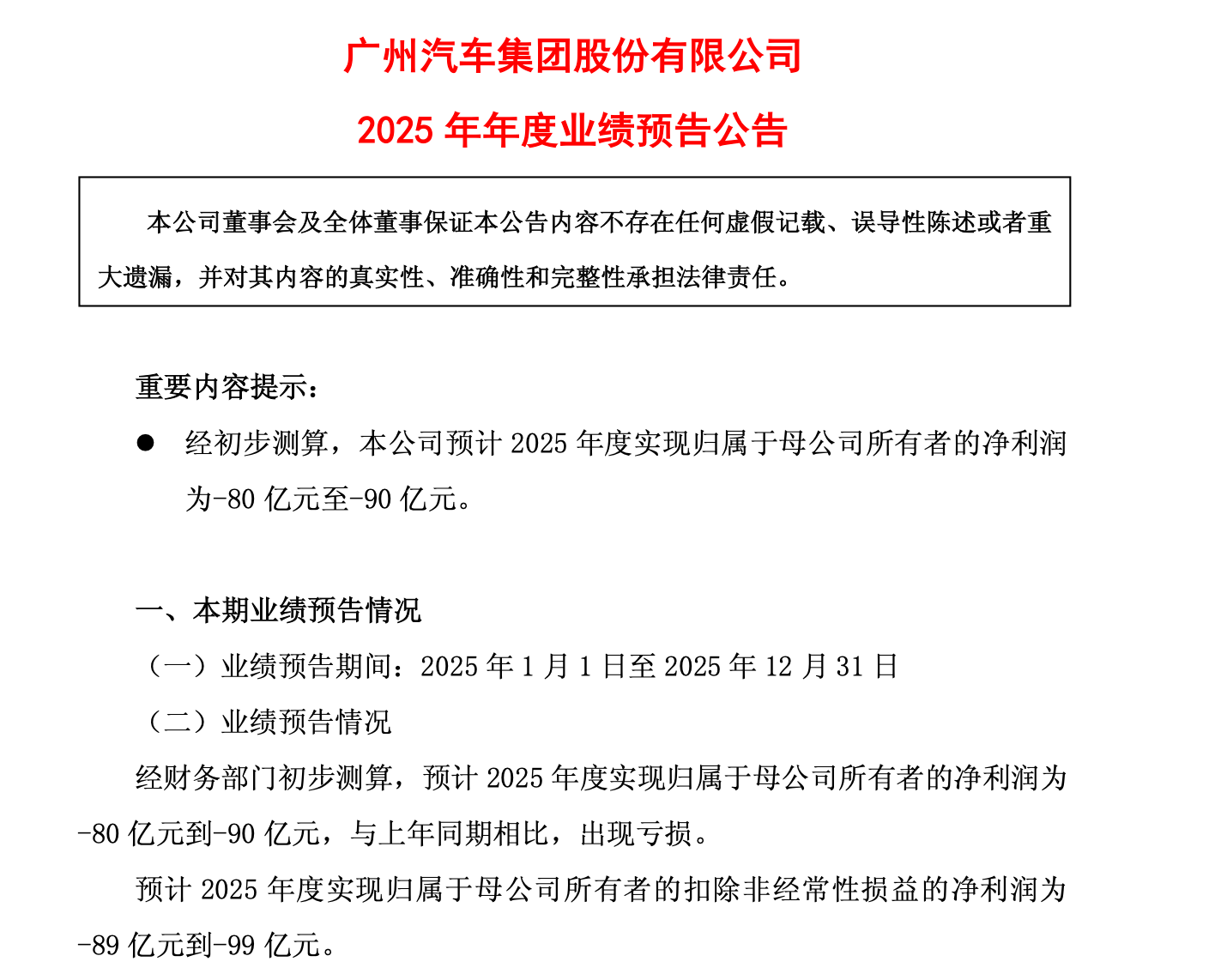
Core Viewpoint - GAC Group reported its first annual loss in nearly 20 years, with a projected net profit attributable to shareholders ranging from -8 billion to -9 billion yuan for 2025, marking a significant shift from profit to loss since 2006 [1][3]. Financial Performance - The net profit loss excluding non-recurring items is expected to be between -8.9 billion and -9.9 billion yuan, a substantial increase from a loss of 4.351 billion yuan in the same period of 2024 [5]. - Total vehicle sales for 2025 were 1.7215 million units, a decline of 14.06% year-on-year, falling short of the annual target of 2.3 million units [8]. Market Environment - The automotive market in China is undergoing a critical transformation towards electrification and intelligence, with intensified competition among over 40 domestic automakers, leading to squeezed profit margins [7]. - GAC Group increased sales investments in 2025, particularly in promoting its self-owned brand electric vehicles, which contributed to asset impairment losses [7]. Strategic Initiatives - The "Panyu Action" reform, initiated in November 2024, aims to enhance organizational structure, product development, and personnel management, with significant implementation in 2025 [8][10]. - The establishment of two new business units (BUs) for self-owned brands marks a shift from a traditional functional organization to a process-oriented one focused on user needs [10]. Leadership Changes - In February 2025, a new chairman was appointed, followed by a new general manager in November, along with a revamped management team to support the company's internationalization efforts [11]. International Expansion - GAC Group aims to leverage technology innovation and overseas markets as key growth drivers, with a target of selling 250,000 to 300,000 units overseas in 2026 [12][14]. - In 2025, overseas sales of GAC's self-owned brands reached nearly 130,000 units, a 47% increase year-on-year, with operations in 86 countries and regions [13]. Product Development - GAC Group partnered with Huawei to create the "Qijing" high-end smart electric vehicle brand, addressing a gap in the high-end market segment [13]. - The introduction of the "Qijing" brand is expected to shift GAC's focus from low-end volume sales to high-end premium offerings, enhancing profitability [13].


2026智驾迎来“价值深化”新一年
Zhong Guo Qi Che Bao Wang· 2026-01-23 09:15
Core Insights - The automotive industry is increasingly focusing on intelligent assisted driving, with companies like BYD investing over 100 billion yuan and forming specialized teams to enhance their capabilities [2] - The shift in the industry is moving from scale and accessibility to user experience, emphasizing the importance of value creation in the competitive landscape [3][12] Investment and Development - BYD has established a team of over 5,000 for assisted driving and aims to deploy its "Tian Shen Zhi Yan" system in over 2.5 million vehicles by December 2025, generating over 150 million kilometers of effective driving data daily [3] - The establishment of new companies, such as the joint venture between BAIC and Horizon Robotics, indicates a growing trend towards collaboration in the intelligent driving sector [2][4] Technological Pathways - Companies are adopting full-stack self-research as a key strategy to deepen their understanding of technology and user needs, with BYD exemplifying this approach through significant investment and team size [3][5] - Open collaboration with third-party solution providers is also becoming a vital strategy, allowing companies to enhance their systems' performance and functionality through shared resources [4][5] User Experience and Market Trends - The concept of "intelligent driving equity" is emerging, indicating a shift towards making advanced driving features accessible in the mid-range vehicle market, particularly in the 100,000 to 150,000 yuan price range [12][14] - User feedback highlights the importance of stability in high-frequency scenarios, ease of use in interaction design, and the need for cost-effective solutions [13][14] Industry Dynamics - Suppliers are transitioning from providing single hardware products to offering integrated software and hardware solutions, becoming deep partners in the development of intelligent driving systems [6][8] - The competitive focus is shifting from merely having intelligent driving capabilities to ensuring their reliability, safety, and user-friendliness in complex driving environments [7][11] Future Outlook - The industry is expected to evolve towards a model where technology is not only usable but also provides a good user experience, ultimately leading to a sustainable business model [14] - As regulations and infrastructure improve, the Chinese intelligent driving industry is poised for high-quality development on a global scale, driven by technology and user experience [14]
从“蔚小理”到“零鸿米”
Ren Min Ri Bao· 2026-01-16 10:17
Group 1 - The new energy vehicle (NEV) market is experiencing a shift in competitive dynamics, with new players like Leap Motor and Hongmeng Zhixing rising in sales rankings, while traditional brands like NIO, Xpeng, and Li Auto are adjusting their strategies [2] - The entry of internet companies into the automotive sector has led to innovative business models and product definitions, with NIO focusing on user experience through battery swapping, Xpeng emphasizing smart driving, and Li Auto expanding the concept of automotive living spaces [2] - The NEV industry is transitioning from electrification to intelligence, entering a phase where technological differentiation, cost efficiency, and global capabilities are critical for survival [2] Group 2 - The rise of "Zero, Hongmeng, and Xiaomi" reflects a new trend in the automotive industry's integration, supported by leading ICT companies like Huawei and Dahua, which provide technological advantages in smart cockpit and driving solutions [3] - Huawei's focus on ICT technology and its collaboration with automotive companies to enhance vehicle quality is becoming a consensus in the industry, with many manufacturers adopting Huawei's integrated product development and marketing systems [5] - The collaboration between GAC Group and Huawei in developing the Qijing automotive design center showcases the importance of user feedback in product design, highlighting the integration of advanced development processes [4]
广汽集团:以“市场+技术”双轮驱动向科技型企业转型
Zhong Guo Zheng Quan Bao· 2026-01-14 20:49
Core Viewpoint - GAC Group is undergoing a transformation towards a technology-driven enterprise through a series of reforms initiated by the "Panyu Action," focusing on "market + technology" as dual engines for growth [1][4]. Group 1: Four Engines of Development - GAC Group has introduced four core development engines: new technology, new products, new services, and new ecology, aiming to create a "new GAC" that is technology-leading, quality-leading, and ecology-leading [2][4]. - In new technology, GAC has launched the "Star Source Range Extender" to address user concerns about battery depletion, and the Quark electric drive motor has achieved over 99% efficiency, with over 1.3 million vehicles equipped with battery technology ensuring safety over 50 billion kilometers [2][3]. - The company plans to release nine new or updated models by 2026, focusing on user-driven product development through a comprehensive R&D system [2][6]. Group 2: Service and Ecosystem Innovations - GAC is expanding its service network by planning to add 600 brand experience stores, covering over 90% of county-level cities in China, and aims to complete 45 OTA updates by 2025, enhancing features for nearly 150,000 vehicle owners [3][4]. - The company is building a comprehensive ecosystem in collaboration with industry partners, including a strategic agreement with CATL for battery swapping and a nationwide charging network covering 204 cities [3][4]. Group 3: Strategic Focus and Future Goals - GAC Group's transformation is characterized by a shift from an engineering mindset to a user-centric approach in product development, integrating user needs into the entire R&D process [4][6]. - The company aims to cultivate a second growth curve during the 14th Five-Year Plan by focusing on local partnerships, strengthening its autonomous brand system, and enhancing strategic capabilities [6][7]. - By 2026, GAC plans to accelerate its reform initiatives, enhance brand leadership, and implement lean management to improve operational efficiency [7].
华为引望向广汽旗下公司转让启境商标
Xin Lang Cai Jing· 2026-01-12 06:33
Core Insights - Shenzhen Yingwang Intelligent Technology Co., Ltd. has transferred multiple "Qijing" trademarks to Guangzhou Huawang Automotive Technology Co., Ltd., with classifications including lighting, air conditioning, transportation tools, and website services, currently in a status of awaiting substantive examination [1] Company Overview - Guangzhou Huawang Automotive Technology Co., Ltd. was established in March 2025, with legal representative He Xianqing, and its business scope includes automobile sales, manufacturing of automotive parts and accessories, and wholesale of automotive spare parts [1] - The company is jointly owned by GAC Group and GAC Aion New Energy Automobile Co., Ltd. [1] Brand Development - "Qijing" is a high-end intelligent electric vehicle brand launched by GAC Group in collaboration with Huawei in September of the previous year, targeting the market segment above 300,000 yuan, with Huawei providing comprehensive solutions for intelligent driving, intelligent cockpit, and intelligent vehicle cloud [1]
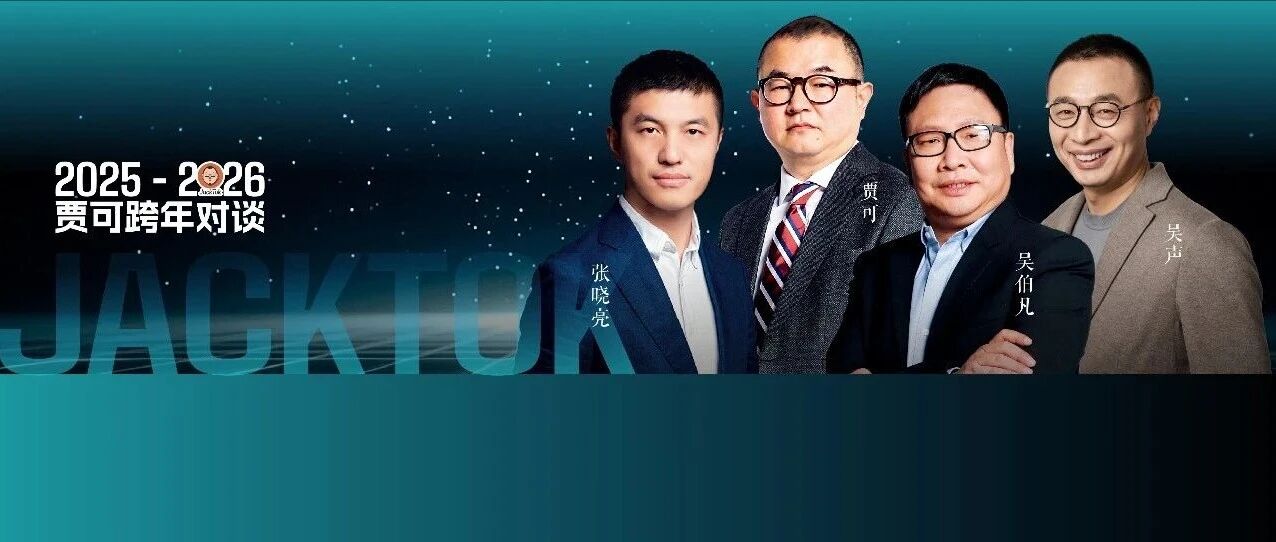
贾可吴伯凡吴声张晓亮,4万字2025-2026跨年对谈全文(下)
汽车商业评论· 2026-01-11 23:06
Core Viewpoint - The article discusses the evolving landscape of the Chinese automotive industry, focusing on the impact of personal branding (IP) of industry leaders, the rise of Huawei in automotive technology, and the trends in global expansion and regulatory changes in autonomous driving [4][5][6]. Group 1: Personal Branding in Automotive Industry - The debate on whether automotive leaders like Lei Jun and Wei Jianjun should develop personal brands (IP) has intensified, with differing opinions on its effectiveness and potential backlash [5][25]. - Lei Jun's recent challenges with Xiaomi's automotive ventures highlight the risks of personal branding, while Wei Jianjun's successful IP development reflects a more grounded approach [26][30]. - The article emphasizes the need for automotive leaders to focus on product quality and strategic management rather than solely on personal branding [31][35]. Group 2: Huawei's Role in Automotive Technology - Huawei's positioning as a service provider rather than a car manufacturer allows it to play a unique role in the automotive industry, focusing on empowering car manufacturers with advanced technologies [7][10]. - The introduction of Huawei's "Jing" and "Jie" series vehicles indicates a strategic expansion into the automotive market, with a focus on high-end segments [9][10]. - Huawei's technology capabilities, including smart cockpit and driving technologies, are seen as critical to its success in the automotive sector, potentially reshaping the competitive landscape [12][15]. Group 3: Trends in Global Expansion - The article notes a significant trend of Chinese automotive companies pursuing IPOs in Hong Kong, reflecting a renewed interest in capital markets and the need for ongoing funding in a capital-intensive industry [38][39]. - The global expansion of Chinese automotive brands is characterized by a shift towards local production and partnerships, moving beyond simple export strategies to more integrated approaches [43][45]. - The necessity for Chinese companies to adapt to local markets and consumer behaviors is emphasized, indicating a more mature approach to globalization [47][49]. Group 4: Regulatory Changes in Autonomous Driving - The Chinese government has implemented stricter regulations on L2 autonomous driving systems, reflecting a growing emphasis on safety following recent incidents [58][60]. - The approval of L3 autonomous driving systems indicates a positive regulatory environment for advanced driving technologies, with companies like Deep Blue and BAIC leading the way [58][61]. - The article suggests that the development of Robotaxi services is gaining momentum, with a focus on subscription-based models as a viable business strategy [61][63].



2025中国汽车行业十大年度品牌热点 | 精进2025——汽车行业10个十大年度盘点
Jing Ji Guan Cha Wang· 2026-01-09 09:33
Core Insights - The automotive industry in China experienced significant changes in 2025, characterized by a mix of opportunities and challenges, with a focus on innovation and collaboration among companies [2][4] - The report highlights the "Top Ten" annual reviews across various categories, reflecting the industry's evolving landscape [2] Group 1: Market Dynamics - The Chinese automotive market is undergoing accelerated differentiation and reshuffling, with leading companies expanding their ecosystems while some brands face pressure [4] - The competition has intensified, leading to a survival-of-the-fittest scenario, where some brands are on the brink of elimination [4][22] Group 2: Brand Influence - Chinese automotive brands are gaining global influence, with eight companies making it to the Fortune Global 500 list, marking a significant increase from previous years [5] - BYD, Geely, and Chery have notably improved their rankings, reflecting the rising global presence of Chinese brands [5] Group 3: Brand Strategy and Integration - Many automotive brands are restructuring their business architectures, with notable mergers and acquisitions, such as Geely's acquisition of Lynk & Co [7][8] - The trend of integrating brand operations is seen as a response to market pressures and a strategy to enhance competitiveness [9] Group 4: Technological Advancements - Companies are launching unique smart technology brands to keep pace with rapid advancements in intelligent technology, with several brands unveiling new systems and platforms [10] - The establishment of these technology brands is aimed at enhancing market perception and showcasing core competencies in smart mobility [11] Group 5: Foreign Brand Strategies - Foreign joint venture brands are initiating a "Localization 2.0" strategy, enhancing collaboration with local suppliers and adapting to the Chinese market [12] - This shift includes a focus on electric and intelligent vehicle development, indicating a more proactive approach to market integration [13] Group 6: Reputation Management - In response to negative online narratives, many automotive companies are taking legal action to protect their brand reputations, indicating a shift towards more aggressive reputation management strategies [19][20] - The industry is witnessing a rise in legal actions against misinformation, reflecting the importance of brand integrity in the digital age [21] Group 7: Market Exit and Brand Survival - Weaker automotive brands are facing significant challenges, with some declaring bankruptcy or undergoing restructuring to survive [22] - The industry is experiencing a natural selection process, where only the most adaptable brands are likely to thrive [23] Group 8: Sales Channel Evolution - The once-popular "supermarket store" model for car sales is losing traction, with many brands reassessing their sales strategies in favor of more traditional dealership models [24] - This shift indicates a move towards more sustainable and efficient sales practices in the automotive sector [25] Group 9: Luxury Brand Performance - The ultra-luxury automotive segment is facing declining sales in China, with several brands reporting significant drops in their sales figures [26] - The overall market conditions and changing consumer preferences are contributing to the challenges faced by these high-end brands [27]
百万交付之后 鸿蒙智行迎来“成长烦恼”
Zhong Guo Zheng Quan Bao· 2025-12-25 21:11
Core Insights - The company achieved a record of delivering one million vehicles in 43 months, marking the fastest milestone for new energy vehicle companies in China, with November deliveries reaching 81,864 units, a year-on-year increase of 89.61% [1] - The "Five Realms" matrix, consisting of multiple brands, is taking shape, with significant growth in the smart automotive ecosystem projected for 2025 [1][9] - Despite rapid growth, structural challenges are emerging within the new brands, particularly in sales adaptation and brand reputation [1][2] Brand Performance - The "Wenjie" brand remains dominant, with November sales of 51,677 units, accounting for 63% of total sales, while models M7, M8, and M9 are leading in their respective segments [2] - "Zun Jie" has surpassed the delivery volume of Porsche's Palamera in China, despite lower monthly sales of 2,000 units, indicating a strong reputation in the high-end market [2] - "Zhi Jie" has faced fluctuations in sales, with a peak of 12,000 units in November after a significant drop earlier in the year, highlighting the need for stable sales performance [2][3] Internal Challenges - The company needs to optimize product iteration and align with market demand, as evidenced by the delayed upgrades and inconsistent brand experiences across models [3][4] - "Xiang Jie" has a narrow market focus with only two models, leading to dependency on the performance of the S9T model, which has shown volatility in delivery numbers [4] - The internal resource allocation and market positioning between the "Five Realms" and the emerging "Jing" brands present challenges for ecosystem collaboration [6][9] Competitive Landscape - The rise of Huawei's "Jing" brands poses new challenges for the company's ecosystem, requiring effective resource distribution and differentiation in market positioning [6][7] - The competitive environment is intensifying, with rivals like Tesla and BYD optimizing their pricing strategies, while new entrants like Xiaomi and Zeekr accelerate product iterations [8] - The company plans to launch at least 11 new models by 2026, raising concerns about internal competition and resource coordination among multiple brands [8][9]
广汽集团启动自主品牌BU改革 昊铂埃安品牌渠道融合运营
Bei Jing Ri Bao Ke Hu Duan· 2025-12-20 07:07
Core Viewpoint - GAC Group is initiating a reform plan called "Panyu Action," focusing on the establishment of autonomous brand business units (BUs) to enhance internal resource integration and channel operation [1][3] Group 1: Reform Initiatives - The Haobo and Aion BUs have been established to maximize resource synergy and improve organizational management efficiency [3] - The Haobo brand will focus on the high-end market as "elite vehicles," while the Aion brand targets the mass market as "people's good cars" [3] Group 2: Channel Integration - The integration of sales channels for Haobo and Aion brands will occur in phases, with the first phase set to announce sales and service points by January 31, 2026, covering over 30 cities [3] - By March 31, 2026, a complete channel integration is expected, resulting in over 1,000 sales points and 100% coverage in cities above the fourth tier [3] Group 3: Service Network Expansion - The service network for Haobo is projected to grow from 200 to 1,000 locations, addressing service convenience issues for users [3] - Aion users will benefit from a wider range of product options, catering to their upgrading vehicle needs [3]