
Passive Investment

Search documents
2 Active Bonds ETFs Rise to the Top Early in 2026
Yahoo Finance· 2026-03-16 16:06
Core Insights - Bond-focused exchange-traded funds (ETFs) are appealing for investors seeking a passive investment strategy, allowing for offloading of portfolio management tasks [3] - Active management in bond ETFs can outperform passive counterparts due to market inefficiencies and the ability to respond to interest rate shifts [4] - Two active bond funds, PIMCO Multisector Bond Active ETF (PYLD) and another unnamed fund, are highlighted for their strong performance and dividend yields [7] Group 1 - Bond ETFs provide a low-lift investment approach, suitable for retail investors seeking stable income, especially during stock market volatility [3] - Active bond ETFs can capitalize on inefficiencies in the bond market, with analysis indicating that active funds outperform passive ones in two-thirds of rolling 10-year periods [4] - Active management allows for strategic responses to market changes, such as interest rate fluctuations and credit cycles, enhancing investment opportunities [5] Group 2 - The PIMCO Multisector Bond Active ETF (PYLD) employs a broad, multisector strategy, focusing on securitized bonds while also including investment-grade and high-yield credit [6] - Both PYLD and another leading active bond fund offer dividend yields of 5.9% or better, with notable total returns over the past year [7]
Will T. Rowe Price's Expansion Strategy Offset Rising Expenses?
ZACKS· 2026-03-09 17:40
Core Insights - Cost pressures are increasingly impacting the outlook for T. Rowe Price Group (TROW), with rising expenses beginning to affect profitability despite the company's strong brand and diversified assets under management (AUM) [1] Financial Performance - Over the past five years ending in 2025, TROW recorded a net revenue CAGR of 5.6%, driven by higher investment advisory fees and expanded investment capabilities [2] - Operating costs have risen at a CAGR of 13.9% during the same period, primarily due to increased spending on technology, employee compensation, and distribution efforts [2] Cost Drivers - Technology spending has become a significant cost driver as TROW upgrades its digital platforms and analytics tools to meet industry demands, which is increasing the company's expense base [3] - Rising compensation costs are also a concern as the firm competes for skilled professionals in portfolio management, analysis, and technology [3] Strategic Initiatives - TROW continues to focus on long-term growth through acquisitions, partnerships, and product development, including the acquisition of Oak Hill Advisors in February 2025, which enhances its position in alternative investments [4] - The company is also enhancing its investment offerings and distribution reach while improving retirement-focused solutions through advanced planning tools and fintech capabilities [4] Industry Context - The asset management industry is experiencing structural changes as investors shift towards passive investment vehicles like ETFs and index funds, making TROW's ongoing investments in technology and new products crucial for attracting additional assets [5] - TROW's peers, Franklin Resources and First Horizon, are facing similar expense challenges, with Franklin Resources experiencing a CAGR of 7.9% in expenses and First Horizon a CAGR of 8.9% [6][7][8] Market Performance - T. Rowe Price's shares have declined by 15.2% in the past six months, which is better than the industry's decline of 19.6% [9] - The company currently holds a Zacks Rank of 3 (Hold) [11]


Is It Time to Rebalance Toward the United States? ETFs in Focus
ZACKS· 2026-03-05 18:30
Core Insights - Concerns about AI-driven volatility in U.S. markets have led investors to seek global funds, particularly in Europe and Asia, due to fears of concentration risk within U.S. equities [1] - The ongoing U.S. conflict with Iran complicates the investment landscape, as disruptions to oil supplies could disproportionately affect economies reliant on imported fuel, especially in emerging markets and certain European countries [2] - Domestically oriented equities may provide a more resilient investment option, with the S&P 500 showing positive movement despite initial shocks from the Middle East conflict [3][4] Market Volatility and Investor Sentiment - The CBOE Volatility Index increased by approximately 26% from February 26 before declining about 11% since March 3, while the S&P 500 gained 0.78% in one day, marking a five-day return of 0.19% [4] - Investors face challenges in identifying areas of relative stability amid ongoing volatility, particularly with economies dependent on Middle Eastern oil being vulnerable [5] - Diverging views on the Middle East conflict cloud market outlook, with Goldman Sachs CEO noting a surprisingly benign market reaction [7] Investment Strategies - Investors are encouraged to increase exposure to U.S. markets through passive, long-term investment strategies to build resilient portfolios [8] - Equal-weighted index funds, such as Invesco S&P 500 Equal Weight ETF (RSP) and ALPS Equal Sector Weight ETF (EQL), can reduce concentration risk and provide diversified sector exposure [9] - Consumer staples ETFs, including Consumer Staples Select Sector SPDR Fund (XLP) and Vanguard Consumer Staples ETF (VDC), can offer stability and balance in portfolios during market downturns [12] Sector-Specific Opportunities - Utility ETFs, like Utilities Select Sector SPDR Fund (XLU) and Vanguard Utilities ETF (VPU), are considered defensive investments due to their low-beta nature and steady demand [13][14] - Value ETFs, such as Vanguard Value ETF (VTV) and Avantis U.S. Large Cap Value ETF (AVLV), focus on fundamentally strong stocks trading below intrinsic value, offering potential for stable returns [15] - Quality ETFs, including iShares MSCI USA Quality Factor ETF (QUAL) and Invesco S&P 500 Quality ETF (SPHQ), provide a strategic response to market uncertainty, serving as a buffer against potential headwinds [16]

Staying Invested, Diversified and Ahead With ETFs
ZACKS· 2026-02-18 17:36
Market Overview - The S&P 500 experienced a decline of approximately 1.3% last week due to AI-related volatility, but showed signs of stabilization with a 0.14% increase on Tuesday [1] - The concentration of the S&P 500 in the information technology sector is about 33%, highlighting concentration risk amid rising anxiety around AI disruption [4] Investor Sentiment - A record share of investors, approximately 35%, believe companies are overspending on AI, marking the largest concern in over two decades [2] - About 25% of investors view an "AI bubble" as a primary tail risk, while 30% cite aggressive AI capital expenditure by large tech firms as a leading credit risk [3] Diversification Strategies - Diversification is essential not only to mitigate technology exposure but also due to broader structural risks such as high U.S. national debt and complex geopolitical issues [5] - ETFs are recommended for diversification, providing benefits like tax efficiency and a disciplined investment approach [6][11] Investment Approaches - A buy-and-hold strategy is suggested for sustainable long-term returns, helping investors avoid emotional decision-making during market fluctuations [8] - Equal-weighted index funds, such as the S&P 500 Equal Weight Index, have gained 11.76% over the past year and 5.50% year-to-date, offering sector-level diversification [9] ETF Recommendations - Invesco S&P 500 Equal Weight ETF (RSP) has a 60.96% allocation to equities and a dividend yield of 2.47% [10][12] - iShares Core 80/20 Aggressive Allocation ETF (AOA) has 80.44% in equities and a dividend yield of 2.10% [12] - iShares Core 30/70 Conservative Allocation ETF (AOK) has 30.94% in equities and a dividend yield of 3.25% [13] - Multi-Asset Diversified Income Index Fund (MDIV) charges an annual fee of 0.75% and has a dividend yield of 6.10%, with significant exposure to dividend-paying equities and other asset classes [14]

Think It's Too Late to Buy Invesco QQQ Trust? Here's the 1 Reason Why There's Still Time.
The Motley Fool· 2026-02-16 22:03
Core Insights - The Invesco QQQ Trust has achieved a total return of 560% over the past decade, turning a $10,000 investment into $66,000 as of February 13 [1] - The shift in investment trends shows that passive investment funds have surpassed active funds for the first time in 2023, indicating a significant change in market dynamics [3] - The poor performance of active funds has contributed to the growing preference for low-cost passive investment options [4] Market Trends - The democratization of equity investing, facilitated by commission-free trading and access to quality research, has increased participation in the stock market among a broader population [3] - The trend of rising flows into passive funds is expected to continue, providing a long-term tailwind for investments like the Invesco QQQ Trust [6] - Despite short-term fluctuations, the long-term demand for passive investment options remains strong, which is favorable for patient investors [6] Key Data Points - The current price of the Invesco QQQ Trust is $601.92, with a day's change of 0.21% [5] - The day's trading range is between $596.42 and $606.48, while the 52-week range is from $402.39 to $637.01 [5] - The trading volume for the Invesco QQQ Trust is 69 million [5]


2.6万亿元! 公募去年整体盈利,宽基ETF表现抢眼
Shang Hai Zheng Quan Bao· 2026-01-22 18:37
Group 1 - The core viewpoint of the articles highlights that despite a loss of 110.1 billion yuan in Q4 2025 for public funds, the overall annual profit exceeded 2.6 trillion yuan, indicating a strong performance in equity assets throughout the year [1][2] - In Q4 2025, mixed and stock funds collectively lost over 180 billion yuan, while QDII funds lost 71.047 billion yuan, and public FOFs had a slight loss of 213 million yuan [1] - Fixed income products emerged as the main profit contributors in Q4 2025, with bond products earning 57.725 billion yuan, money market funds earning 44.18 billion yuan, and commodity funds profiting 39.266 billion yuan [1] Group 2 - For the entire year of 2025, all types of public funds achieved profitability, with mixed and stock funds collectively earning nearly 2 trillion yuan, showcasing the characteristics of a strong equity year [2] - The top 10 profitable fund products in Q4 were predominantly gold ETFs and related funds, with six gold ETFs making the list, indicating a significant shift in capital market dynamics [2] - The Huatai-PB CSI 300 ETF was the standout performer, earning 78.516 billion yuan, making it the only product to exceed 70 billion yuan in profit [3]
从籍籍无名中闯出天地,6万亿ETF市场5年养成
2 1 Shi Ji Jing Ji Bao Dao· 2026-01-07 12:45
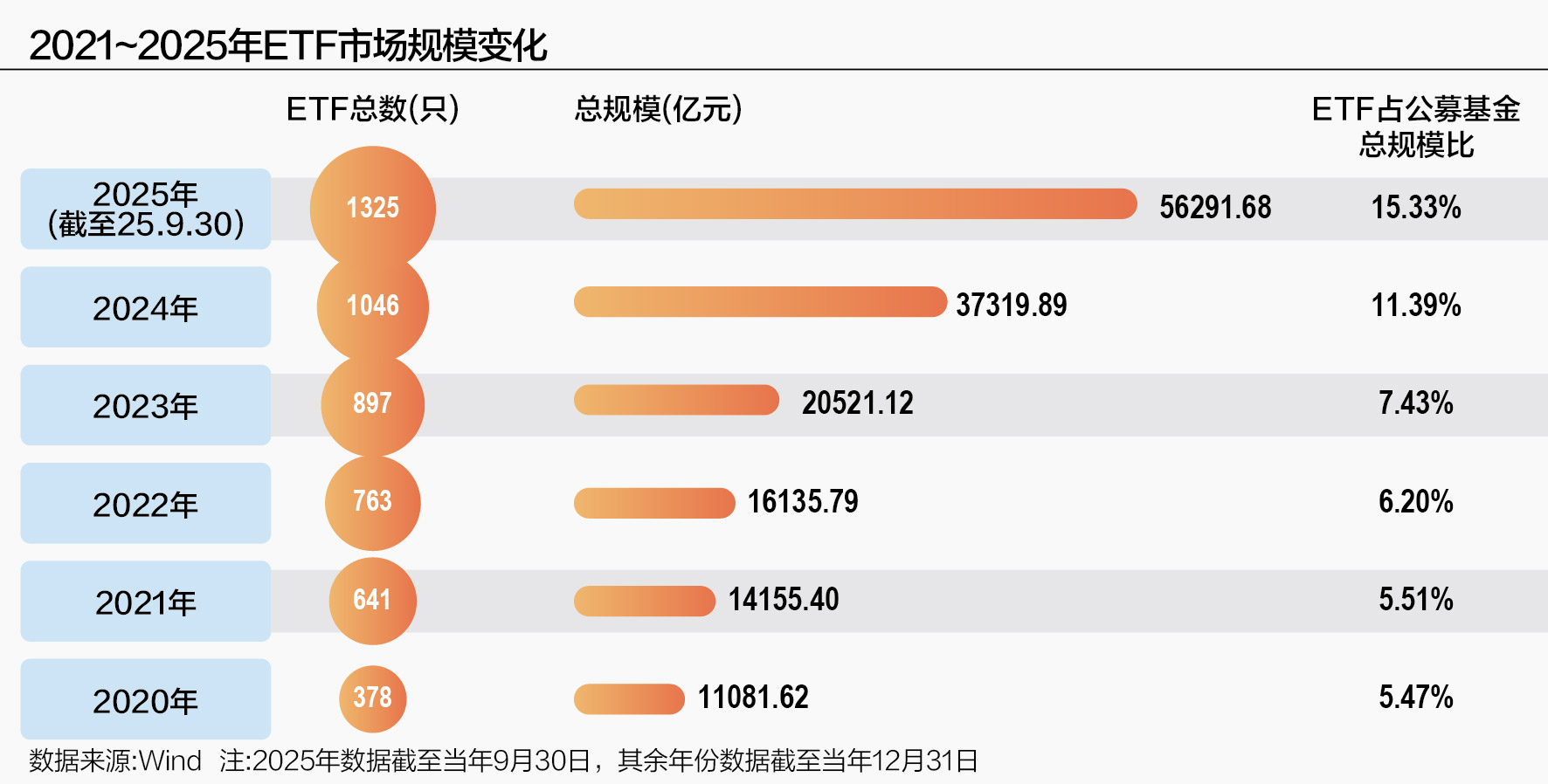
Core Insights - The ETF market in China has reached a significant milestone, with total assets surpassing 6 trillion yuan, reflecting a growth of over 60% year-on-year [3][5] - The rapid expansion of the ETF market is characterized by a shift from slow accumulation to accelerated growth, with a cumulative increase of 452.53% over the past five years [5][6] - The market is witnessing a consolidation of leading fund companies, with a clear top tier emerging in ETF management [7][10] Market Overview - As of December 2025, the total ETF market size reached 6.03 trillion yuan, with an increase of 2.29 trillion yuan within the year [3] - The number of ETF products has grown from 326 to 1402 over the past five years, with a total issuance of 1076 new products [6] - The total trading volume of ETFs has surged from 843.48 billion yuan to 3.96 trillion yuan, marking a growth of 369.51% [6] Management Competition - The top seven fund companies have maintained their positions in the ETF management scale, with 华夏基金 (China Asset Management) leading the market [7][10] - 华夏基金's ETF management scale increased from 187.9 billion yuan in 2020 to 957 billion yuan by the end of 2025 [10] - The entry threshold for the top ten ETF managers has significantly risen, with the requirement increasing from 30 billion yuan five years ago to 200 billion yuan by the end of 2025 [11] Index Performance - The 沪深300 index remains the most popular, with ETF assets linked to it reaching 1.185 trillion yuan by the end of 2025 [14] - The 中证A500 index has emerged as a new favorite, with its ETF size surpassing 300 billion yuan, reflecting a shift towards quality assets [15] - The diversification of asset classes in the top ten indices indicates changing investor preferences, with new themes and sectors gaining traction [16] Holder Structure - Institutional investors have solidified their dominance in the ETF market, increasing their share from 69.07% at the end of 2020 to 76.84% by mid-2025 [20] - The absolute scale of institutional holdings has grown from 743.8 billion yuan to 3.3 trillion yuan, indicating a fourfold increase [20] - Individual investors have shown consistent participation in equity ETFs, maintaining a net value share close to that of institutional investors [21] National Team Involvement - The "national team" has increasingly utilized ETFs as a tool for market stabilization, with significant purchases made during market fluctuations [22][23] - By the end of 2024, the central government’s holdings in ETFs had surged to over 1 trillion yuan, reflecting a strategic shift towards broader ETF investments [23][24] - The national team's involvement in ETFs is expected to play a crucial role in the future of China's capital market ecosystem [24]
基金分红2500亿,ETF频送“大红包”
Huan Qiu Wang· 2026-01-04 03:36
Group 1 - The total dividend distribution for public funds in 2025 is close to 250 billion yuan, maintaining a high level, with significant contributions from broad-based ETFs [1] - Bond funds remain the main contributors to public fund dividends, accounting for approximately 70% of the total dividend amount [1] - Major ETFs, particularly leading broad-based ETFs, have shown outstanding performance in single product and single dividend amounts, providing substantial returns to investors [1] Group 2 - A total of 14 funds have implemented single dividend distributions exceeding 1 billion yuan since 2025, with the Huatai-PB CSI 300 ETF exceeding 8 billion yuan in a single distribution [2] - The total dividend scale of ETFs has been steadily increasing, approaching 20%, making them an important force in the dividend market [2] - In terms of dividend frequency, medium to long-term pure bond funds dominate, being the most active in terms of dividend distributions [2] Group 3 - Some ordinary stock funds and mixed equity funds have distributed dividends more than 12 times within the year, indicating a proactive dividend strategy [4] - The rapid expansion of the ETF market has laid the foundation for the continuous increase in dividend scale, with broad-based ETFs becoming significant market tools [4] - Compared to actively managed products, broad-based ETFs offer wide coverage, transparent rules, and convenient trading, better meeting investors' long-term allocation and asset diversification needs [4] Group 4 - The changes in the 2025 fund dividend market reflect the optimization of product structure in the public fund industry and the maturation of investment concepts [5] - The frequent large dividends from broad-based ETFs signify the upgrade of passive investment products from mere "trading tools" to dual attributes of "allocation + income" [5] - The importance of dividends in fund operations has significantly increased, with fund companies placing greater emphasis on dividend arrangements to enhance investor experience and product attractiveness [5]

年内券商系LP出资超90亿元支持科技创新;ETF总规模突破5.8万亿元,创历史新高 | 券商基金早参
Mei Ri Jing Ji Xin Wen· 2025-12-22 01:40
Group 1 - The total investment from brokerage firms as limited partners (LPs) in private equity funds has exceeded 9.19 billion yuan this year, marking a year-on-year increase of 52.1% [1] - This investment supports technological innovation and industrial upgrading, reflecting the brokerage firms' commitment to serving the real economy [1] - The influx of capital from brokerage firms is expected to boost investor confidence in the technology sector, particularly in hard technology fields such as semiconductors and new energy [1] Group 2 - Public funds have adjusted their strategy towards hard technology and emerging industries, resulting in a floating profit exceeding 10.742 billion yuan from their investments [2] - A total of 39 public fund institutions participated in 85 A-share companies' private placements this year, with a total allocation amounting to 34.088 billion yuan, a year-on-year increase of 13.85% [2] - The shift in public fund investment strategies is expected to further attract market capital towards the technology sector, accelerating industry differentiation and promoting a transition to innovation-driven growth in the stock market [2] Group 3 - The total scale of the ETF market has surpassed 5.8 trillion yuan, achieving a historical high and increasing by over 2 trillion yuan within a year, representing a growth rate of over 50% [3] - Stock ETFs remain the mainstream in the market, accounting for more than 60% of the total scale, indicating a preference for core assets among investors [3] - The significant scale advantage of leading products and companies highlights the ongoing Matthew effect, which may accelerate industry consolidation and enhance market resource allocation efficiency [3]
2 Top Active JPMorgan ETFs Worth Buying and Holding for the New Year
Yahoo Finance· 2025-12-17 17:38
Core Insights - JPMorgan offers a range of ETFs that provide value for passive investors through competitive fees, unique strategies, and experienced management [1] - The article highlights new actively-managed ETFs from JPMorgan that may yield decent results in 2026 [2] JPMorgan Active Value ETF - The JPMorgan Active Value ETF (JAVA) is an actively-managed ETF with a silver Morningstar medalist rating and a net expense ratio of 0.44% [3] - This ETF focuses on U.S. large caps and is expected to outperform the S&P 500 over the long term, particularly as market valuations may lead to lower returns in the coming decade [3][5] - The ETF has a significant allocation to financials (24%) and healthcare (16%), with individual positions capped at 3% to manage risk [5][6] - Despite underperforming the S&P 500 by 3% this year, there is potential for a turnaround as high-priced stocks may negatively impact broader market returns [5] JPMorgan Tech Leaders ETF - The JPMorgan Tech Leaders ETF maintains all 62 holdings below a 5% weighting to mitigate single-stock concentration risk [6]
