嘉实沪深300ETF

Search documents
昆仑万维股价涨5.65%,嘉实基金旗下1只基金位居十大流通股东,持有695.89万股浮盈赚取2372.98万元
Xin Lang Ji Jin· 2026-02-24 03:25
Group 1 - The core point of the news is that Kunlun Wanwei's stock price increased by 5.65% to 63.80 CNY per share, with a trading volume of 5.383 billion CNY and a turnover rate of 7.04%, resulting in a total market capitalization of 80.092 billion CNY [1] - Kunlun Wanwei, established on March 27, 2008, and listed on January 21, 2015, is primarily engaged in comprehensive internet value-added services and new energy investment [1] - The revenue composition of Kunlun Wanwei includes: 38.37% from online advertising, 18.51% from Opera search, 15.61% from short drama platforms, 13.92% from overseas social networks, 6.40% from gaming, 4.27% from casual social entertainment platforms, 1.75% from AI software technology, and 1.16% from other businesses [1] Group 2 - Among the top ten circulating shareholders of Kunlun Wanwei, the Jiashi Fund has a position in the Jiashi CSI 300 ETF (159919), which entered the top ten shareholders in the third quarter with 6.9589 million shares, accounting for 0.55% of circulating shares [2] - The Jiashi CSI 300 ETF has a current scale of 197.124 billion CNY, with a year-to-date return of 0.82% and a one-year return of 22.46% [2] - The fund manager of Jiashi CSI 300 ETF is Liu Jiayin, who has been in the position for 9 years and 340 days, with a total fund asset scale of 222.447 billion CNY and a best return of 149.23% during the tenure [3]

ETF遭遇巨量抛盘,大A有情况?
Sou Hu Cai Jing· 2026-02-16 05:17
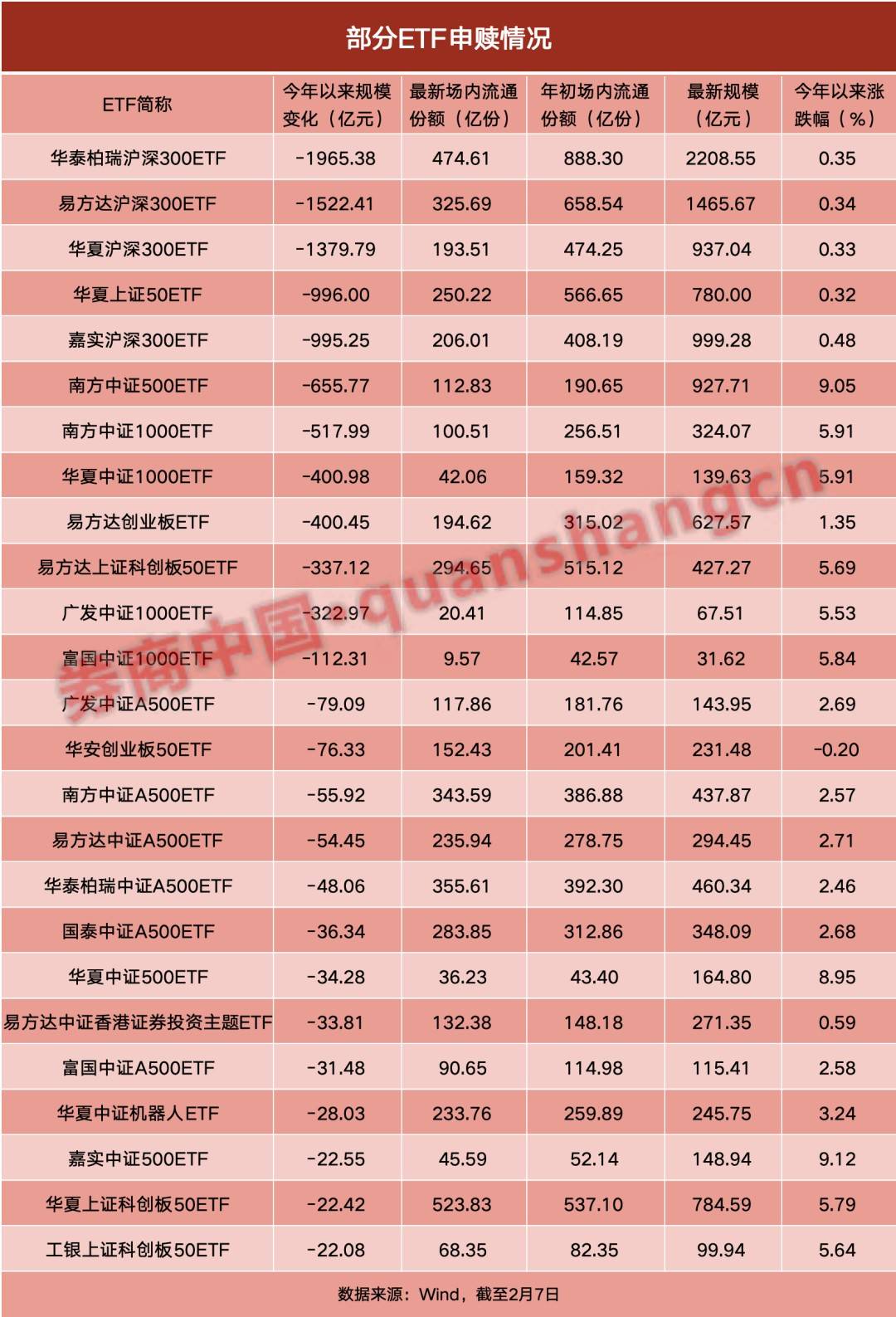
Core Viewpoint - The article discusses the significant outflows from broad-based ETFs since the beginning of the year, highlighting the importance of understanding the underlying behaviors of funds rather than reacting to market fluctuations [1] Group 1: ETF Fund Flows - Many ETFs have experienced substantial shrinkage in scale, with net outflows occurring for over ten consecutive trading days, peaking at over 130 billion [1] - Specific ETFs such as Huatai-PB CSI 300 ETF, E Fund CSI 300 ETF, and others have seen significant reductions in scale, with declines of 196.54 billion, 152.24 billion, and 137.98 billion respectively [2] Group 2: Institutional Participation - The article emphasizes the importance of identifying whether large institutional funds are actively participating in trading, as indicated by "institutional inventory" data [3] - Continuous participation from large funds suggests stability in the underlying asset, while a lack of participation can indicate potential volatility [5] Group 3: Market Adjustments - Market adjustments may not always indicate fund withdrawals; they can also reflect large funds engaging in "institutional shakeouts" to consolidate positions [8][10] - The presence of "institutional shakeouts" indicates that large funds are actively managing their positions, which can provide a foundation for future strategies [13] Group 4: Quantitative Analysis - Quantitative data offers a more objective perspective on market movements, helping to distinguish between panic and strategic adjustments by institutions [14] - Understanding the true motivations behind fund flows can lead to more rational investment decisions, moving beyond emotional reactions to market volatility [14]

投资好时节!头部公募,重要布局成型!
Sou Hu Cai Jing· 2026-01-28 04:51
Core Viewpoint - The year 2026 is identified as a critical window for laying out the dividends of high-quality economic development in China, with a focus on investment strategies and opportunities in various sectors, including macro policies, equity markets, and AI [1] Group 1: Investment Strategy and Product Offerings - Jiashi Fund has established a comprehensive product ecosystem that integrates both active and passive investment strategies, aiming to provide investors with tools for diversified market exposure and stable returns [1] - The total scale of ETFs in China has surpassed 6 trillion yuan, with Jiashi Fund managing approximately 330 billion yuan across 61 products, ranking among the top in the public fund market [2] - Jiashi Fund's ETF product matrix covers various sectors, including broad-based, industry-specific, thematic, and Smart Beta ETFs, facilitating one-click market access for investors [2][3] Group 2: Performance Highlights - Jiashi's HuShen 300 ETF and Zhongzheng 500 ETF have shown significant performance, with net value growth rates of 20.77%, 28.18%, and 124.58% since inception, outperforming benchmarks [2] - The Jiashi New Energy ETF achieved a net value growth rate of 44.08% over the past year, capitalizing on opportunities in the renewable energy sector [3] - The Jiashi Semiconductor ETFs, including the Zhongzheng Integrated Circuit ETF, have also performed well, with the Jiashi Rare Earth ETF and Rare Metal ETF showing impressive growth rates of 77.40% and 90.46% respectively over the past year [3] Group 3: Active Management and Sector Focus - Jiashi Fund has developed a robust active management capability, particularly in sectors like semiconductors and AI, with funds like Jiashi Technology Innovation Mixed Fund achieving a growth rate of 238.82% since inception [6] - The Jiashi Global Industry Upgrade Fund has provided a global investment tool with a net value growth rate of 53.99% over the past year, focusing on global industrial upgrade opportunities [7] - The company emphasizes a deep understanding of industry trends and employs a research methodology that supports the performance of its active products [7] Group 4: Client Services and Experience - Jiashi Fund has implemented a systematic service framework to enhance client experience, including tools like the Super Jiabei mini-program for retail investors to track market trends and achieve investment goals [4]
投资好时节!头部公募,重要布局成型!
券商中国· 2026-01-28 04:10
Core Viewpoint - The article emphasizes the importance of 2026 as a critical window for high-quality economic development in China, highlighting the investment strategies discussed at the 2026 Investment Strategy Summit hosted by Harvest Fund [1] Group 1: ETF Development - Harvest Fund has established a comprehensive ETF product matrix covering various sectors, including broad-based, industry, thematic, and Smart Beta ETFs, to meet diverse investor needs [2][3] - As of the end of last year, the total scale of ETFs in China exceeded 6 trillion yuan, with Harvest Fund managing approximately 330 billion yuan across 61 products, ranking among the top in the public fund market [3] - Notable ETFs include the Harvest CSI 300 ETF and Harvest CSI 500 ETF, which have shown significant net value growth rates of 20.77%, 28.18%, and 124.58% over different time frames, outperforming benchmarks [3] Group 2: Industry-Specific ETFs - Harvest Fund has launched multiple ETFs targeting high-growth sectors such as semiconductors and renewable energy, with the semiconductor ETFs achieving over 500 billion yuan in scale and the renewable energy ETF showing a net value growth rate of 44.08% [4] - The "rare earth brothers" ETFs have also performed exceptionally well, with net value growth rates of 77.40% and 90.46% over the past year [4] Group 3: Active Equity Products - In addition to passive products, Harvest Fund has developed a range of active equity funds focusing on sectors like semiconductors, AI, and advanced manufacturing, achieving impressive returns such as 47.73% over the past year for the Harvest Technology Innovation Mixed Fund [6][7] - The Harvest Global Industry Upgrade Fund has provided a global investment tool with a net value growth rate of 53.99% over the past year, while the Harvest Hong Kong Internet Core Assets Fund has also seen nearly 30% growth [8] Group 4: Investor Engagement and Services - Harvest Fund has prioritized investor engagement by developing a systematic service framework, including a mini-program for retail clients to track market trends and achieve investment goals [5] - The firm aims to cater to various investor preferences through a diverse product offering and enhanced customer service, ensuring comprehensive coverage of investment needs [5]

“国家队”减持、头部宽基缩水,ETF规模开年骤降3000亿元
Bei Jing Shang Bao· 2026-01-27 13:03
Core Viewpoint - The recent decline in the ETF market size, which has dropped to 5.67 trillion yuan from over 6 trillion yuan at the end of 2025, is attributed to the "national team" reducing its holdings in major ETFs, while the overall market remains active and resilient [1][3][8]. Group 1: ETF Market Size and Trends - As of January 26, the total ETF market size is approximately 5.67 trillion yuan, a decrease of over 300 billion yuan from the 6.02 trillion yuan recorded at the end of 2025 [1][3]. - Major ETFs such as Huatai-PB CSI 300 ETF, E Fund CSI 300 ETF, and others have experienced significant outflows, with nearly 700 billion yuan net outflow on January 26 alone [3][4]. - The largest ETF, Huatai-PB CSI 300 ETF, has seen its size shrink to about 285.35 billion yuan from a peak of nearly 440 billion yuan [4][5]. Group 2: National Team's Actions - The "national team," represented by Central Huijin and its asset management arm, has reduced its holdings in major ETFs, which has led to a decrease in the total shares of these funds [5][6]. - The total shares of Huatai-PB CSI 300 ETF have fallen to 605.17 billion shares as of January 26, down from 735.13 billion shares held by the "national team" at the end of 2025 [5][6]. Group 3: Market Regulation and Future Outlook - Regulatory actions have been taken to cool down the overheated market, including penalties for illegal stock recommendations and increasing margin requirements for investors [7][8]. - Analysts believe that the strict regulatory environment will enhance the investability of the Chinese market and support long-term growth, with a focus on sectors aligned with national strategies such as technology and high-end manufacturing [8][9]. - The long-term outlook for ETF growth remains positive, with expectations that the total market capitalization of stocks will continue to rise, leading to an increase in ETF sizes [9].

8个交易日股票型ETF净流出近5000亿元 市场成交额或是背后的核心考量因素
Shang Hai Zheng Quan Bao· 2026-01-25 18:54
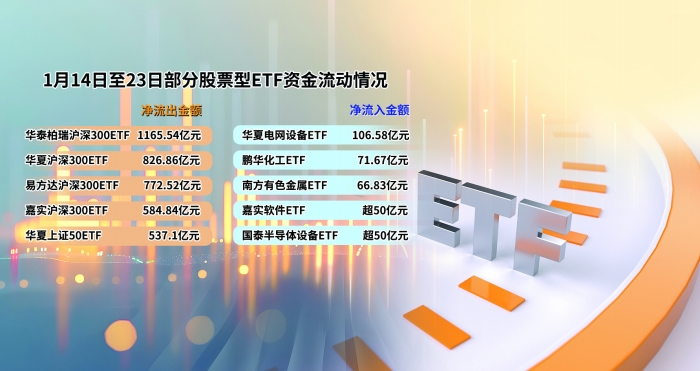
Core Viewpoint - The stock-type ETFs have experienced significant net outflows, totaling nearly 500 billion yuan over the past eight trading days, primarily driven by large-scale redemptions from broad-based ETFs [1][2][3]. Group 1: ETF Performance and Flows - Stock-type ETFs have seen a daily trading volume exceeding 240 billion yuan since January 14, with notable peaks above 300 billion yuan on January 16 and January 23 [2]. - The total net outflow from stock-type ETFs from January 14 to January 23 reached 496.68 billion yuan, with major outflows from broad-based ETFs such as Huatai-PB CSI 300 ETF (116.55 billion yuan), Huaxia CSI 300 ETF (82.69 billion yuan), and E Fund CSI 300 ETF (77.25 billion yuan) [2][4]. - Several large ETFs have seen their shares drop below the holdings of Central Huijin by the end of 2025, indicating a significant reduction in their market presence [3][4]. Group 2: Sector-Specific ETF Trends - In contrast to broad-based ETFs, sector-specific ETFs have attracted inflows, with notable net inflows into Huaxia Electric Grid Equipment ETF (10.66 billion yuan) and Penghua Chemical ETF (7.17 billion yuan) [4]. - Some sector-specific ETFs have reached all-time high share counts, such as the Southern Nonferrous Metals ETF, which has a share count of 16.598 billion, and the Fuguo Chemical 50 ETF with 5.506 billion shares [4]. Group 3: Market Outlook and Investment Sentiment - Analysts suggest that the outflows from broad-based ETFs do not signify the end of the market rally, as a return to stable trading volumes could lead to a more sustainable market environment [5]. - There is a growing interest in structural opportunities within the market, with fund managers expressing optimism about equity returns compared to other asset classes, despite potential volatility [6]. - The issuance of new ETFs focused on industry themes continues, indicating ongoing investor interest in targeted sectors such as metals and solar energy [6].
多只宽基ETF最新季报显端倪,汇金系新动向曝光,逆周期调节路线图浮现
Mei Ri Jing Ji Xin Wen· 2026-01-23 17:03
Core Viewpoint - The A-share market shows signs of overheating speculation in certain thematic sectors, prompting regulatory measures to cool down the market, while the Central Huijin Investment has significantly reduced its holdings in several broad-based ETFs, reflecting a counter-cyclical adjustment strategy by the state [1][2][4]. Group 1: Central Huijin's Actions - As of January 22, 2026, Central Huijin Investment and its asset management company held a total of 735.13 billion shares in the Huatai-PineBridge CSI 300 ETF, while the total fund shares were only 685.35 billion, indicating a reduction in holdings [2]. - In the latest quarterly report of the Huaxia SSE 50 ETF, Central Huijin held 487.6 billion shares, but the total fund shares were only 411.85 billion, showing a similar reduction trend [3]. - The Southern CSI 1000 ETF also reflected a reduction, with Central Huijin holding 221.69 billion shares against a total of 184.23 billion shares [3]. Group 2: Regulatory Measures - On January 14, 2026, the regulatory authority raised the margin requirement for financing from 80% to 100% as part of a broader strategy to cool down the overheated A-share market [4]. - Following the adjustment in margin policy, there was a notable shift in the direction and concentration of net financing purchases, with a focus on electronic, communication, and computer sectors [4]. - The week following the margin policy change saw significant net outflows from broad-based ETFs, with over 200 billion yuan exiting the CSI 300 and STAR 50 ETFs [4][5]. Group 3: Market Sentiment - The market environment in early 2026 differs significantly from the previous year, with heightened trading sentiment in sectors like commercial aerospace and AI applications, leading to overvaluation of certain stocks [2]. - Industry experts suggest that Central Huijin's actions reflect a rational assessment of current market heat and adherence to the core strategy of counter-cyclical adjustment [6].
多只宽基ETF盘中快速放量
财联社· 2026-01-23 02:45
Core Insights - A significant volume of trading activity was observed in multiple broad-based ETFs after 10 AM, indicating heightened investor interest and market movement [1] Group 1: Trading Activity - The HuShen 300 ETF from Huatai-PineBridge (510300) recorded a trading volume exceeding 5 billion [1] - The Southern CSI 1000 ETF (512100) saw a trading volume surpassing 4.4 billion [1] - The Shanghai Stock Exchange 50 ETF (510050) achieved a trading volume of over 4 billion [1] - Other notable ETFs, including the Huaxia CSI 1000 ETF (159845), the Jiashi HuShen 300 ETF (159919), and the HuShen 300 ETF from Huaxia (510330), each had trading volumes exceeding 3 billion [1]

2.6万亿元! 公募去年整体盈利,宽基ETF表现抢眼
Shang Hai Zheng Quan Bao· 2026-01-22 18:37
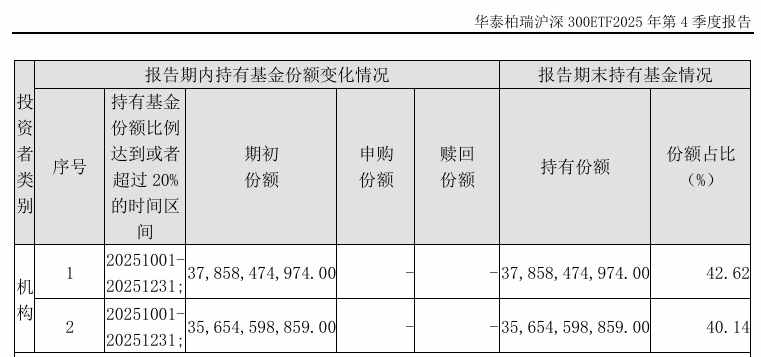
Group 1 - The core viewpoint of the articles highlights that despite a loss of 110.1 billion yuan in Q4 2025 for public funds, the overall annual profit exceeded 2.6 trillion yuan, indicating a strong performance in equity assets throughout the year [1][2] - In Q4 2025, mixed and stock funds collectively lost over 180 billion yuan, while QDII funds lost 71.047 billion yuan, and public FOFs had a slight loss of 213 million yuan [1] - Fixed income products emerged as the main profit contributors in Q4 2025, with bond products earning 57.725 billion yuan, money market funds earning 44.18 billion yuan, and commodity funds profiting 39.266 billion yuan [1] Group 2 - For the entire year of 2025, all types of public funds achieved profitability, with mixed and stock funds collectively earning nearly 2 trillion yuan, showcasing the characteristics of a strong equity year [2] - The top 10 profitable fund products in Q4 were predominantly gold ETFs and related funds, with six gold ETFs making the list, indicating a significant shift in capital market dynamics [2] - The Huatai-PB CSI 300 ETF was the standout performer, earning 78.516 billion yuan, making it the only product to exceed 70 billion yuan in profit [3]
中央汇金,新动向
Zhong Guo Zheng Quan Bao· 2026-01-22 09:05
Core Viewpoint - The latest holdings of Central Huijin Investment in major ETFs have been disclosed, indicating stable positions in various funds despite recent net outflows from the ETF market [1][4]. Group 1: Central Huijin Holdings - As of the end of 2025, Central Huijin Asset Management holds 378.58 billion shares and Central Huijin Investment holds 356.55 billion shares of the Huatai-PB CSI 300 ETF [1][2]. - The total holdings of Central Huijin in the Huatai-PB CSI 300 ETF represent 40.26% and 37.91% of the total shares, respectively [3]. Group 2: ETF Market Trends - The ETF market has experienced significant net outflows, with over 220 billion yuan leaving the CSI 300 theme ETFs and more than 570 billion yuan from the CSI 1000 theme ETFs from January 12 to January 21 [4]. - As of January 21, the total shares of leading ETFs such as Huatai-PB CSI 300 ETF and others have decreased compared to the end of 2025, indicating a decline in market interest [4][6]. Group 3: Comparison of ETF Holdings - The latest share counts for various ETFs as of January 21 are below the holdings reported by Central Huijin at the end of 2025, including Huatai-PB CSI 300 ETF at 719.78 billion shares compared to 735.13 billion shares [5][6]. - Other ETFs like E Fund CSI 300 ETF and Huaxia CSI 300 ETF also show a decline in shares compared to Central Huijin's previous holdings [5][6].