Recession risk

Search documents
Business growth slows to 11-month low as Iran war triggers price spike
Yahoo Finance· 2026-03-24 15:45
This story was originally published on CFO Dive. To receive daily news and insights, subscribe to our free daily CFO Dive newsletter. Dive Brief: Growth in U.S. business activity in March slowed to an 11-month low as the Iran war pushed up prices and restrained new orders, S&P Global said Tuesday. Service sector activity rose at the weakest pace in nearly a year, and businesses responded to higher input costs and a spike in energy prices by raising average selling prices at the fastest rate since August ...
Fed governor warns of recession risk as 'extreme fear' grips markets
Yahoo Finance· 2026-03-20 19:08
A widening Middle East conflict is starting to reshape market psychology far beyond oil. What began as a geopolitical shock is now feeding directly into inflation fears, bond volatility and a broader reassessment of growth risk. That shift has left investors juggling two threats at once. The risk of an energy-driven slowdown and the risk that central banks stay hawkish for longer. As those pressures build up, the usual playbook for risk assets is getting harder to trust. Related: Mysterious traders mo ...
Copper joins gold in broad commodities sell-off. There's a worrying reason behind it
CNBC· 2026-03-19 17:24
In this article@GC.1@SI.1@HG.1@PA.1.DXYWorkers roll up copper rods made from recycled copper at a metal melting facility in Yuexi County, central China's Anhui Province, Friday, July 11, 2025. Feature China | Future Publishing | Getty ImagesPrices for metals fell sharply across the board Thursday as investors worried about the impact rising oil prices due to the U.S.-Iran war will have on the global economy.Gold fell nearly 6%, while silver was off 8%. The sell-off extended beyond just those two, as industr ...


Fed's "Tightwire" Act: Oil, Private Credit & Uncertainty Rattles Interest Rate Balance
Youtube· 2026-03-17 22:00
Economic Environment and Market Fears - The current economic environment is characterized by three major market fears, including rising recession risk, complicating factors from oil prices, and private credit stress [2][3][13] - The probability of a recession is estimated at 20-30%, indicating a need for vigilance in the market [3][4] - Recent GDP readings showed a decline to 0.7%, which is half of previous expectations, contributing to market concerns [6] Oil Prices and Federal Reserve Implications - Elevated oil prices are complicating the Federal Reserve's decision-making process, as they impact consumer prices despite being excluded from core inflation metrics [7][9] - The market currently anticipates that high oil prices will be short-lived, but any change in this perception could force the Fed to respond [10][11] - The balancing act for the Fed involves managing inflation risks from high oil prices while monitoring the job market, which has shown signs of weakness [12] Private Credit Stress - Private credit stress is a potential risk that could lead to increased volatility in equity markets, as investors may need to liquidate high-quality assets for cash [15][16] - If private credit issues resurface in the headlines, it could trigger liquidity selling, creating opportunities for investors to buy quality stocks at lower prices [16] Investment Opportunities - Quarable, known for smartphone chips, is transitioning into aerospace defense and AI chips, presenting a potential buying opportunity as the market has not fully recognized this shift [17][19] - Talon Energy, which sells directly to wholesale buyers like Amazon and is expanding its energy centers, is positioned well in the AI power demand sector despite recent pressures [20][21] - Carpenter Technology, a supplier of high-end materials for aerospace, is expected to benefit from increased defense spending, making it a strong investment despite recent challenges [22][24]

Nearly 60% of Americans Are Stuck In The Same Financial Hole — Or Worse — Than They Started 2025
Yahoo Finance· 2026-03-13 15:01
Economic Sentiment - A recent LendingTree survey indicates a divided sentiment among Americans regarding their financial situation, with 44% feeling positive, 31% neutral, and 25% negative, resulting in 56% feeling stuck or worse [2][3] - Nearly half (46%) of respondents have a negative outlook on the overall U.S. economy, while only 33% view it positively [2] Inflation Concerns - Inflation is identified as the primary concern for many households, particularly those with high-interest debt, with 62% of respondents expressing pessimism about inflation and the cost of living [5] - About 38% of respondents expect the economy to worsen in the next year, highlighting widespread pessimism [4] Financial Stagnation - Nearly 60% of Americans feel financially stuck or worse than at the beginning of 2025, attributing this to rising inflation and living costs [9] - High-interest debt is a significant factor contributing to the perception of stagnation, as payments on such debt limit the ability to save or invest [7] Strategies for Improvement - Strategies such as 0% balance transfer cards and lower-rate personal loans are suggested as potential solutions for those struggling with high-interest debt [8] - The ability to compare multiple vetted lenders can facilitate better borrowing options, aiding in financial recovery [9]
Is the Vanguard 500 ETF a Buy Now?
Yahoo Finance· 2026-02-27 17:20
Market Overview - The U.S. equity market has shifted in 2026, with new leadership emerging from energy, materials, and consumer staples stocks, moving away from the previous tech stock dominance [1] - The S&P 500 index has outperformed most market sectors in recent years due to tech leadership and heavy weighting toward the "Magnificent Seven" stocks [2] Economic Indicators - The market is currently pricing in roughly two rate cuts in 2026, with the first likely at the June meeting, although current trends suggest challenges for the Federal Reserve in achieving this [5] - The latest PCE inflation data shows an annualized rate of 2.9% in December, the highest since March 2024, complicating the justification for significant rate cuts [6] - Economic growth has been sustained with annualized GDP growth rates of 3% to 4% over recent quarters, but issues like affordability, rising debt levels, and stubborn inflation pose potential recessionary signals [7] Earnings Performance - As of February 13, 74% of S&P 500 companies reported their fourth-quarter earnings, showing a year-over-year earnings growth rate of around 13%, which supports the investment case for the S&P 500 [9]
X @Binance
Binance· 2025-12-20 03:04
RT Binance Research (@BinanceResearch)Macro data shows a synchronized slowdown: inflation Consumer, PMI falling, and unemployment rising.Raising the question of whether markets will shift from “bad news is good news” to pricing in recession risk.Find out more ⬇️https://t.co/AsP05IInmM ...
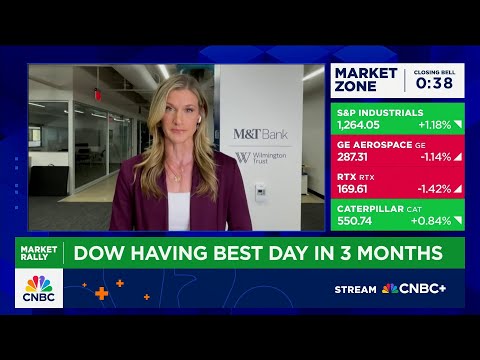
Market pullback has been a healthy development, says Wilmington Trust's Meghan Shue
Youtube· 2025-11-21 21:34
Core Viewpoint - The recent market pullback is seen as a healthy development, indicating a shift in sentiment towards higher quality companies, which have underperformed in the past six months [1][2][3]. Market Sentiment and Valuations - There has been a notable underperformance of higher quality names, suggesting a shift in market sentiment where valuations and balance sheets are gaining more attention [2]. - The speculative and aggressively valued stocks have driven the market to recent highs, leaving higher quality companies behind [3]. Economic Indicators - A stabilization in the labor market, particularly in small businesses and cyclical sectors, is necessary for higher quality companies to thrive [5]. - The ideal scenario for these companies would be a "Goldilocks" environment, where economic conditions are neither too hot nor too cold [4][6]. Recession Risks - There is a 45% probability of recession within the next 12 months, which is considered uncomfortably high compared to other Wall Street estimates [6]. - Current labor market conditions show some cracks, and clarity is expected in the coming weeks regarding the labor market's direction and potential productivity gains from AI investments [7].

Market pullback has been a healthy development, says Wilmington Trust's Meghan Shue
CNBC Television· 2025-11-21 21:34
and Megan, uh, even with today's uh, bounce in the, uh, in the indexes, you still have the S&P down 2% on the week, almost 5% off of its highs. Has this pullback um, kind of changed the riskreward in your view or or given a signal as to where to go next within the market. >> Yeah, I think this has been a bit of a healthy development for the market.We've been watching with a bit of trepidation that the market just keeps continuing to climb higher and it's been a pretty significant momentum trade. I think wha ...
Bazinet: The bull case on Netflix jumped from 25 to 40 times forward earnings
Youtube· 2025-10-21 11:41
Core Viewpoint - The current valuation of Netflix has seen a significant increase in forward earnings multiple, rising from 25 times to 40 times over the past 18 months, despite the stock's recent performance being driven more by fundamentals than by multiple expansion [1][4]. Group 1: Market Sentiment and Valuation - The initial bullish sentiment for Netflix was based on a lower earnings multiple, but concerns over AI risks, tariffs, recession, and government intervention led to a shift in investor focus towards Netflix, which was perceived as less risky [2][3]. - The stock has appreciated by 45% this year, but the expansion of its earnings multiple has plateaued, indicating a shift towards fundamental growth [4]. Group 2: Consumer Behavior and Market Position - Despite concerns about consumer spending and a bifurcated market, Netflix is viewed as an exceptional value, particularly when considering its cost relative to consumed hours [5]. - The company has not seen significant reductions in subscriptions compared to other streaming services, suggesting strong consumer loyalty [5]. Group 3: Growth Potential - Recent milestones, such as record viewership for specific events and content, indicate that Netflix may still have substantial growth opportunities, especially as streaming continues to capture a larger share of video consumption [6][7]. - Approximately 40% of all video consumption is now on streaming platforms, providing a favorable environment for Netflix's growth, although its market share within the streaming sector has remained relatively stable over the past four years [7][8].