
Systemic Risk

Search documents
'Greed Is Laid Bare': Hedge Fund Manager Reveals The Dark Side Of The Private Credit Crisis
Benzinga· 2026-03-20 17:22
Boaz Weinstein runs Saba Capital Management, a $5 billion hedge fund best known for picking fights with closed-end fund managers. Now he’s picking a bigger one. He’s tendering to buy shares in Blue Owl Capital Inc’s (NYSE:OWL) private credit BDC at 65 cents on the dollar.Blue Owl’s retail investors have been trying to cash out of the fund, but redemption requests are piling up faster than the fund can pay. Weinstein is stepping in with a lowball bid, betting that some investors would rather take 65 cents no ...




AI shock scenario could hit banks and insurers via private credit, warns UBS
Yahoo Finance· 2026-02-25 11:27
Core Viewpoint - UBS warns that a rapid shock from artificial intelligence could lead to a significant increase in defaults in the US credit market, particularly affecting private credit [1][2]. Group 1: Default Projections - In a severe AI disruption scenario, UBS projects defaults could rise to 3-6% in US high-yield bonds, 8-10% in leveraged loans, and 14-15% in private credit [3]. Group 2: Market Evolution - Private credit has become a structurally significant part of the US corporate debt landscape, now representing 6% of GDP, while leveraged loans account for 5% of GDP, up from 1% and 5% in 2008 respectively [4]. Group 3: Systemic Risk and Stress Indicators - The shift from banks to private lenders has raised concerns about systemic risk, with current private credit defaults reported between 3% and 5%, and stress indicators nearing post-pandemic highs [5]. - Leverage in some sectors has increased, with debt levels at 7.5-8 times earnings, and interest coverage in middle-market deals around 1.7-1.8 times, exposing borrowers to risks if growth slows or interest rates remain high [5]. Group 4: Concentration of Risk - Risk is concentrated in specific sectors, with private credit heavily weighted towards services, technology, and healthcare, raising concerns about potential spillover effects into public markets [6]. Group 5: Exposure of Financial Institutions - US and European banks hold approximately $1.3 trillion in loans and around $1.1 trillion in undrawn commitments to non-bank financial institutions, with major global banks accounting for 60% of this total [7].
2007 Parallel? Blue Owl Capital Freezes Retail Private Credit Fund Withdrawals - Blue Owl Capital (NYSE:OWL)
Benzinga· 2026-02-19 12:53
Economist Mohamed El-Erian took to X (formerly Twitter) on Thursday morning with a question after Blue Owl Capital Inc (NYSE:OWL) permanently halted redemption at its retail private credit fund.“Is this a ‘canary-in-the-coalmine’ moment, similar to August 2007?” El-Erian wrote, citing a Financial Times report that Blue Owl “will permanently restrict investors from withdrawing their cash from its inaugural private retail debt fund.” The idiom references the historical mining practice of using caged canaries ...
Bitcoin’s Divergence From Nasdaq Signals Dollar Liquidity Risk, Says Arthur Hayes
Yahoo Finance· 2026-02-18 08:22
BitMEX co-founder Arthur Hayes says Bitcoin is flashing a severe warning regarding dollar liquidity that stock markets have yet to acknowledge. While the Nasdaq remains flat, Bitcoin has tumbled from its highs, signaling what Hayes describes as an impending AI-driven credit crisis. This divergence suggests traditional equities are mispricing systemic risk. Key Takeaways Market Signal: Bitcoin’s decoupling from a stable Nasdaq indicates a sharp withdrawal of dollar liquidity. Macro Thesis: Hayes predi ...
X @Michael Saylor
Michael Saylor· 2026-01-28 17:51
RT The Hurdle Rate Podcast (@HurdleRatePod)Welcome back to The Hurdle Rate.Episode 45: Preferred Equity DemandThe crew is back to discuss preferred equity and potential systemic risk to Bitcoin, the Strive + Semler M&A transaction being the first in Bitcoin treasuries, the IBIT Bitcoin covered call ETF, gold and silver price action, what Japan is saying to the world right now, and Bitcoin in an action-packed 2026.Here's the latest with@TimKotzman, @ColeMacro, @PunterJeff and @Werkman0:30 - Welcome Back to T ...
X @Ansem
Ansem 🧸💸· 2026-01-24 21:43
You're wrong.Systemic risk to both BTC and crypto is buried deep in legacy code bases, best to get off the titanic.Commodities and stocks (ex-US) will continue to outperform all else.Sukhveer Sanghera (@sangheraio):@blknoiz06 You're wrong.Systemic risk to both BTC and crypto is buried deep in legacy code bases, best to get off the titanic.Commodities and stocks (ex-US) will continue to outperform all else. ...
Privatizing Fannie Mae and Freddie Mac the wrong way risks a second Great Recession
Fortune· 2025-12-30 14:05
Core Viewpoint - The Trump Administration's focus on privatizing Fannie Mae and Freddie Mac may undermine housing market stability and primarily benefit wealthy investors rather than the public [4][5][12]. Group 1: Current Challenges in the Housing Market - Homebuyers are facing challenges due to insufficient home construction, rising construction costs, and increasing insurance costs linked to climate risks [1]. - Fannie Mae and Freddie Mac play a crucial role in the housing market by purchasing mortgages, bundling them into securities, and selling them to investors, which helps maintain credit flow and lower rates for homebuyers [2]. Group 2: Historical Context and Risks - Excessive risk-taking by Fannie Mae and Freddie Mac contributed to the 2008 financial crisis, leading to their federal conservatorship to ensure market stability [3]. - The Trump Administration's push for privatization raises concerns about eroding safeguards that have maintained housing market stability and increasing systemic risks [4][5]. Group 3: Implications of Privatization - Privatization without strong safeguards could lead to higher borrowing costs for consumers, with estimates suggesting an increase of $500 to $2,000 annually for typical borrowers [9]. - A lack of government backing during financial crises could exacerbate housing credit crunches, deepening economic downturns [10]. - Privatization efforts may recreate conditions that led to the Great Recession, as for-profit entities could engage in excessive risk-taking without adequate oversight [11][12]. Group 4: Proposed Safeguards - Essential components for a successful privatization include a government backstop during downturns and strong operational guardrails during stable periods, referred to as the "twin pillars" [6][14]. - These pillars ensure liquidity and stability, allowing Fannie Mae and Freddie Mac to maintain affordable housing goals while managing risks effectively [14][15].

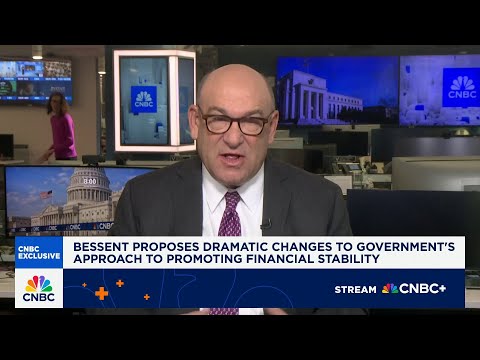
Bessent proposes dramatic changes to government's approach to promoting financial stability
CNBC Television· 2025-12-11 13:51
We got some uh breaking news I want to get to right now from the Treasury. Some big changes coming to the Financial Stability Oversight Council. Our own Steve [music] Leeman, economics, senior economics reporter joins us with that exclusive story.What you got. >> Hey Andrew, CNBC has obtained exclusively the contents of a letter written by Treasury Secretary Scott Besson, proposing a pretty radical rethink of how the government will promote financial stability and prevent systemic risk. Rather than addition ...
JPMorgan Again Tops FSB's G-SIB List: What Does This Mean?
ZACKS· 2025-12-01 14:30
Core Insights - JPMorgan has been ranked as the world's most systemically important bank, maintaining its position in the highest "bucket 4" category according to the Financial Stability Board's annual list of Global Systemically Important Banks [1][4] - The designation requires JPMorgan to hold an additional 2.5% Common Equity Tier 1 (CET1) capital buffer above baseline requirements, reflecting its critical role in the global financial system [2][8] - The ranking emphasizes JPMorgan's global footprint and interconnectedness with financial markets, which are essential for preventing systemic contagion [3][4] Capital Requirements - Banks in the top tier must maintain higher capital buffers to absorb losses during financial stress, with JPMorgan specifically needing a 2.5% CET1 capital buffer [2][8] - Bank of America has been moved from bucket 2 to bucket 3, requiring a 2% capital buffer effective from January 1, 2027, while Citigroup remains in bucket 3 with a 2% capital buffer [5][6] Performance and Valuation - JPMorgan shares have increased by 30.6% year-to-date [7][8] - The bank's current price-to-tangible book (P/TB) ratio is 3.14X, which is above the industry average [10] - Earnings estimates for 2025 and 2026 have been revised upward, with a projected 2.5% growth for 2025 and 4.7% for 2026 [11]


Rowan Says People ‘Lost Their Minds’ Over Private Credit Fears
Yahoo Finance· 2025-11-25 21:57
Core Viewpoint - Apollo Global Management's CEO Marc Rowan argues that concerns regarding systemic risks from adding private assets to retirement and insurance portfolios are exaggerated [1][3]. Group 1: Private Credit and Transparency - Most private credit held by insurers and pension funds is rated investment grade, countering the perception that this asset class lacks transparency compared to traditional loans [2]. - Apollo's exchange-traded private credit fund with State Street Corp. offers daily price updates, enhancing transparency [2]. - The firm has traded $6 billion in its investment-grade private credit business, showcasing its significant involvement in this sector [2]. Group 2: Industry Dynamics and Investment Strategies - Alternative asset managers, including Apollo, have increasingly acquired insurers to secure a stable source of long-term capital for investments, with Apollo being a pioneer in this model through its insurance arm, Athene [4]. - The close relationship between private equity and insurers has come under scrutiny, especially as insurers traditionally invested in more liquid assets like high-grade bonds and stocks [5]. Group 3: Economic Concerns and Capital Shortfalls - Economists at the Bank for International Settlements estimate that publicly traded North American life insurers could face a capital shortfall of approximately $150 billion in a severe economic downturn, a figure that has more than tripled over the past two decades [6]. - UBS Group AG Chairman Colm Kelleher expressed concerns about looming systemic risks in the insurance business, which Rowan refuted during Apollo's third-quarter earnings call [7].
