Trade Diversification

Search documents
Air Canada Expands its Mexico Presence with New Montréal-Guadalajara Route and 18% More Capacity this Summer to Sought After Destinations, Supporting Canada’s Trade Diversification
Globenewswire· 2026-02-17 14:10
Core Insights - Air Canada is expanding its summer schedule to Mexico with an 18% increase in seat capacity compared to last summer, reflecting the strengthening ties between Canada and Mexico [1][11] - New year-round flights from Montréal to Guadalajara will be introduced, along with increased frequencies to popular destinations such as Cancún, Monterrey, Mexico City, and Puerto Vallarta [1][3] Company Expansion - The airline's new service between Montréal and Guadalajara will operate year-round, enhancing connectivity and supporting growing passenger and cargo demand [3][4] - Increased flight frequencies include 11 weekly flights from Montréal to Cancún (up from 7), 4 weekly flights from Toronto to Monterrey (up from 3), and 11 weekly flights from Vancouver to Mexico City (up from 7) [6][9] Economic Impact - The expansion is part of a broader strategy to facilitate tourism, trade, and connectivity, aligning with Canada's efforts to strengthen economic ties with Mexico [4][5] - Enhanced direct connections are expected to benefit Canadian businesses and entrepreneurs by making it easier to pursue opportunities in Mexico [6][7] Historical Context - Air Canada has been operating flights to Mexico since 1954, and currently offers 30 non-stop flights from eight Canadian cities to 11 destinations in Mexico during peak winter season [10][12] - The airline's operations include connections to Europe and Asia through its hubs in Montréal, Toronto, and Vancouver, further integrating Mexico into its global network [10][12]


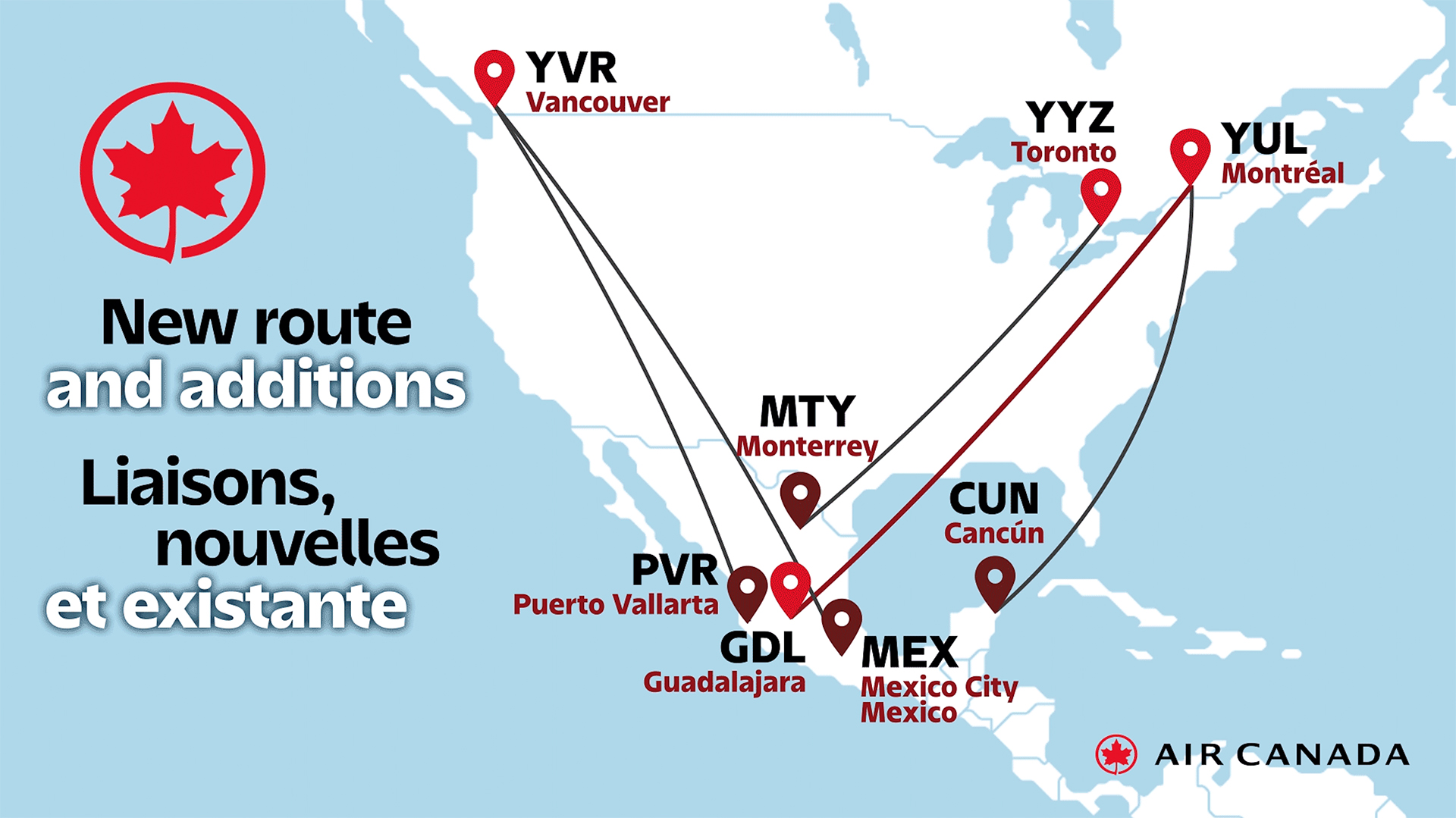
Air Canada Expands its Mexico Presence with New Montréal-Guadalajara Route and 18% More Capacity this Summer to Sought After Destinations, Supporting Canada's Trade Diversification
Globenewswire· 2026-02-17 14:10
Core Insights - Air Canada is expanding its summer schedule to Mexico with an 18% increase in seat capacity compared to last summer, reflecting the strengthening ties between Canada and Mexico [1][11] - New year-round flights from Montréal to Guadalajara will be introduced, along with increased frequencies to popular destinations such as Cancún, Monterrey, Mexico City, and Puerto Vallarta [1][6] Company Expansion - The airline's new service between Montréal and Guadalajara will operate year-round, enhancing connectivity and supporting growing passenger and cargo demand [3][11] - Increased flight frequencies include 11 weekly flights from Montréal to Cancún (up from 7), 4 weekly flights from Toronto to Monterrey (up from 3), 11 weekly flights from Vancouver to Mexico City (up from 7), and 2 weekly flights from Vancouver to Puerto Vallarta (up from 1) [6][9] Strategic Importance - Air Canada's expansion is part of a broader strategy to enhance its global network and strengthen tourism and commercial ties between Canada and Mexico [3][4] - The initiative aligns with Canada's efforts to diversify trade and create new partnerships, facilitating easier travel for business leaders, tourists, and investors [5][6] Historical Context - Air Canada has been operating flights to Mexico since 1954, and currently offers 30 non-stop flights from eight Canadian cities to 11 destinations in Mexico during peak winter season [10] - The airline connects Mexico globally to Europe and Asia through its hubs in Montréal, Toronto, and Vancouver, reinforcing its role in international travel [10]

特朗普扬言征100%关税,加拿大牵手中国建厂反击
Sou Hu Cai Jing· 2026-02-12 18:23
Group 1 - A Canada-China joint venture electric vehicle factory is planned to be established in Canada, focusing on global exports of electric vehicles [1] - The relationship between Canada and China shows signs of improvement, with China easing import restrictions on Canadian agricultural products and Canada reciprocating in the electric vehicle sector [2] - Starting in 2026, an agreement will allow up to 49,000 Chinese-made electric vehicles to enter the Canadian market at a reduced Most Favored Nation tariff rate of 6.1%, a significant decrease from the previous 100% tariff [3] Group 2 - The automotive supply chains of the US and Canada are closely intertwined, with major manufacturers like Ford, GM, and Stellantis projected to sell over 700,000 vehicles in Canada by 2025 [5] - Canada aims to reduce its dependence on the US automotive market and strengthen its domestic manufacturing base through partnerships with Chinese automakers, which is seen as a practical path forward [7] - If the collaboration materializes, Canada could become a key hub for China's global electric vehicle strategy, potentially leading to tensions with the US, which has threatened to impose retaliatory tariffs [9]

Canadian International Trade Minister on Free Trade Agreements
Bloomberg Television· 2026-02-10 15:19
As Canada pivots trade away from the US and towards Asia, just walk us through what that strategy actually looks like in practice. Absolutely. Look, I'm happy to be here in your studios in Singapore, of course, for the Canada and Asia Conference.And it really speaks to our focus and our goal of doubling non-U.S. exports to the tune of $300 billion. And what does that mean. It means more opportunities for Canada here in the Indo-Pacific, in Asia.But of course, it means more opportunities in Europe for Canadi ...

Seeking shelter from Trump's fury, U.S. trade partners reach deals with each other
Yahoo Finance· 2026-02-03 10:58
Core Insights - U.S. trade partners are increasingly seeking to diversify their economies away from the protectionist policies of the United States, leading to new trade agreements and a shift in global economic dynamics [2][5] - The actions of central banks and global investors, including the selling of U.S. dollars and the purchase of gold, may reduce U.S. influence and contribute to rising interest rates and prices for American consumers [2] - The unpredictability of President Trump's trade policies has led to a realization among U.S. allies that previous trade agreements may not provide the expected security, prompting a rapid acceleration in efforts to reduce dependence on the U.S. [3][5] Trade Dynamics - U.S. allies, including the European Union, Japan, and South Korea, have been pressured into accepting unfavorable trade deals under the threat of tariffs, but these agreements have proven to be unreliable [3][4] - Recent threats of new tariffs from Trump, even after agreements were reached, highlight the volatility of U.S. trade policy and its impact on international relations [4] Economic Implications - The decline in U.S. Treasury note holdings by foreign central banks is viewed as a potential vulnerability for the U.S., with concerns that rivals may seek to challenge the dominance of the U.S. dollar [5][6] - Despite claims from White House officials that the U.S. global standing remains intact, the actions of trading partners suggest a significant shift in the balance of economic power [6]
X @Bloomberg
Bloomberg· 2026-01-25 19:28
Canada won’t be derailed in its efforts to diversify trade away from the US despite the latest threats from the Trump administration, Canadian Foreign Minister Anita Anand said. https://t.co/IKRmHUFeUk ...
India fast-tracks key reforms to shield itself from US tariffs
The Economic Times· 2025-12-20 03:09
Economic Reforms - The Indian Parliament approved significant bills to open the nuclear industry to private firms and allow full foreign ownership of insurance companies, aiming to modernize the financial framework and encourage market participation [1][2] - The finance minister proposed unifying India's securities market laws under a single code, which is expected to attract more investments [1][2] Investment Potential - These reforms could unlock hundreds of billions of dollars in investments, supporting Prime Minister Modi's goal of transforming India into a developed nation within the next two decades [2] - The Adani Group is already planning to capitalize on these changes by developing a commercial nuclear energy project in northern India [2] Economic Growth Projections - Economists predict a growth rate of 6.9% for 2026, with a steady pace of 6.5% expected for the fiscal year through March, although this is below the 8% growth needed for India to achieve developed-nation status by 2047 [6][7] - The recent policy actions are seen as a shift towards diversification and structural reforms, aimed at attracting long-term capital [6] Trade Relations - India's exports to the US have weakened due to higher tariffs imposed by the Trump administration, with ongoing negotiations for a trade deal lacking clarity [8] - Tamil Nadu, a key export-reliant state, has reported significant losses due to high tariffs, highlighting the impact on local businesses [10] Legislative Activity - December's parliamentary session was the most productive in five years, with 61.7 hours spent on legislation and eight bills passed, indicating a proactive legislative environment [11][14] - The burst of policy action is expected to energize Modi's Bharatiya Janata Party ahead of upcoming state elections [12][14]


Business Brief: The crisis behind the budget
The Globe And Mail· 2025-10-27 10:19
Trade Relations - The relationship between the U.S. and Canada is strained, with President Trump stating he will not meet Prime Minister Carney for an extended period due to a disagreement over a Canadian government ad criticizing U.S. tariffs [2] - Prime Minister Carney is promoting Canada as a reliable trading partner, emphasizing its resources like natural gas and critical minerals, especially in light of Trump's announcement of a 10% increase in tariffs on Canadian imports [3] Economic Context - Both the U.S. Federal Reserve and the Bank of Canada are anticipated to cut interest rates, with investors looking for guidance on future monetary policy amid a government shutdown limiting data availability [4] - Canada's labor productivity has been declining, with GDP per capita reverting to 2019 levels, raising concerns about wage growth and living standards [6][7] Investment Challenges - A significant factor contributing to Canada's low productivity is insufficient business investment, which hampers workers' efficiency due to a lack of necessary tools and technology [8] - A report from Toronto Dominion Bank emphasizes the need for urgent action to address the decline in business investment, suggesting a broadening of the tax base while lowering statutory rates [9][10] Fiscal Policy Recommendations - The Bank of Nova Scotia advocates for clear macroeconomic goals alongside fiscal accountability to enhance productivity and living standards [10] - The Prime Minister has indicated forthcoming changes to the corporate tax system, aiming to ensure competitive tax rates to stimulate investment [12] Trade Diversification Efforts - There is a push for Canada to diversify its trade relationships, particularly with countries like China and India, despite public sentiment favoring trade with the EU over these nations [15]