XOD模式

Search documents
精准破解融资堵点难题 武汉出台金融“十条”支持城市更新
Chang Jiang Ri Bao· 2026-01-14 00:50
Core Viewpoint - The Wuhan Municipal Financial Office and the Housing and Urban Renewal Bureau have jointly introduced measures to financially support the "Five Reforms and Four Goods" urban renewal initiative, aiming to create a new investment and financing pattern through diverse financial means [1][2]. Group 1: Financial Support Measures - The measures focus on key areas such as existing buildings, old residential communities, old streets, old factories, and urban village renovations, targeting to connect with at least 100 urban renewal projects and provide financing support of no less than 1 trillion yuan [1]. - A comprehensive financial support system is established, covering key support areas, service models, funding guarantees, policy coordination, and risk prevention throughout the entire process [1]. Group 2: Service Model Innovation - Projects included in the urban renewal implementation system at the district level can obtain credit financing based on market principles, covering the entire process from asset acquisition to construction and operation management [1]. - Various financial products such as fixed asset loans, syndicate loans, REITs, and asset securitization are introduced to provide tailored financial services for different stages of area development and project construction [1]. Group 3: Funding Channel Expansion - The measures encourage the adoption of new PPP models and the "Investor + EPC + O" approach to raise funds, supporting insurance funds to participate in projects through infrastructure debt investment plans [2]. - A city renewal fund will be established to attract social capital, and a mechanism will be clarified to ensure smooth connections between central budget investments, long-term special bonds, and bank loans [2]. Group 4: Financial Service Team and Optimization - Wuhan will form a financial service team for urban renewal, coordinating financial institutions with relevant departments and project implementers to participate in project planning and financing scheme design in advance [2]. - The measures support the establishment or restructuring of project implementation entities at the district level and improve the assessment and incentive mechanisms for financial institutions to stimulate the intrinsic motivation of financial services [2].
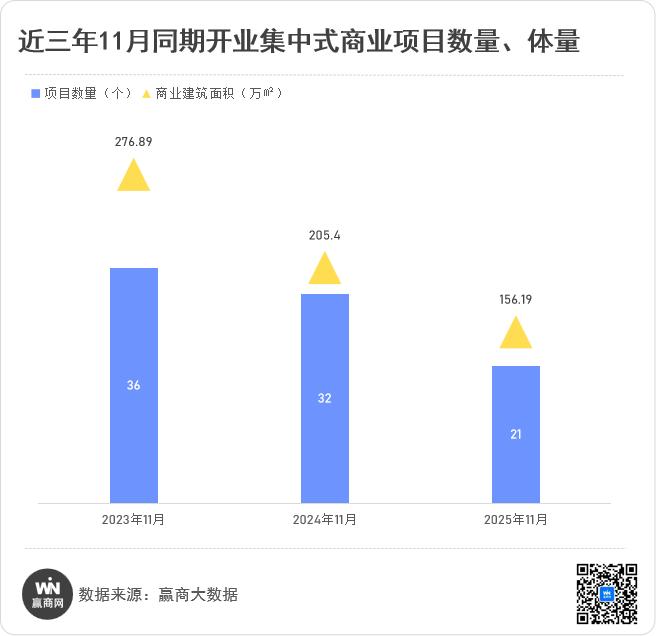
11月全国新开21个商场,“含金量”极高
3 6 Ke· 2025-12-19 05:54
Core Insights - November saw a return to normalcy in new openings, with a focus on high-quality projects across diverse commercial formats, including regional giants and innovative complexes [1][2] - The upcoming December is expected to witness a surge in openings, with numerous projects already announced [2] Group 1: November Opening Statistics - In November 2025, 21 new commercial projects opened nationwide, totaling approximately 1.56 million square meters, a decrease of 44.74% in number and 44.48% in volume compared to October [2] - Among the new openings, three were renovation projects, contributing about 170,000 square meters [2] Group 2: Regional Distribution of New Openings - Nearly 70% of the new openings in November were concentrated in East and South China, accounting for 66.67% of the total openings [4] - East China had a higher volume with three projects exceeding 100,000 square meters, while South China had only one such project [4] Group 3: Notable New Projects - Shenzhen had the highest number of new openings with four projects, including the largest MixC in Shenzhen, while Hangzhou had the largest volume with two significant projects [6] - The Shenzhen Huide MixC spans 180,000 square meters and aims to create a social lifestyle hub [18] - The Yongwang Dream City in Changsha, the largest in Hunan, covers 236,000 square meters and is designed as an urban lifestyle energy center [21] Group 4: Innovative Commercial Concepts - New projects are incorporating innovative concepts such as "XOD" and "POD+TOD" to enhance the commercial experience [10] - The Hangzhou North City Investment Garden City integrates public transport and ecological parks, while the Longfor Hangzhou Shangcheng Tianjie emphasizes park-style commercial spaces [12][15] Group 5: Emerging Trends - The trend of "micro-vacation outlets" is gaining traction, with new outlets in lower-tier cities [10] - Non-standard commercial projects like Nanjing Hongshan Sparkle are targeting young consumers with a focus on experiential spaces [11]

2026年基建融资大趋势之市场化融资模式的退散
Sou Hu Cai Jing· 2025-12-11 12:07
Core Insights - The infrastructure financing landscape has undergone significant changes in 2023, with new policies emerging that challenge previous financing models and practices [2][11][20] - The concept of market-oriented financing has been exposed as a facade, revealing that government-backed returns have been the norm rather than true market-driven profits [3][7][19] Group 1: Market Dynamics - Market-oriented returns are insufficient to cover the substantial investments required for infrastructure projects, as they only yield average market profits [3] - Any infrastructure sector showing profitability will likely become independent and no longer rely on government funding, transitioning into a competitive market [4] - There is a strict separation between market-oriented revenues and fiscal revenues, preventing market projects from capturing government monopoly income [5] Group 2: Financing Tools and Mechanisms - Traditional fixed-income infrastructure financing tools are gradually disappearing, while market-oriented financing tools are retreating [6] - New mechanisms introduced at the end of 2023 prohibit the use of government funds to cover construction costs, focusing instead on user-pay projects [11][13] - The new framework clearly delineates the boundaries of government subsidies, ensuring that only projects with sufficient revenue to cover costs can proceed [12][18] Group 3: EOD and XOD Models - The EOD (Ecological-Oriented Development) model emphasizes user payment without relying on government funding, contrasting with traditional financing methods [21][24] - XOD (e.g., Transit-Oriented Development) is recognized as a planning approach rather than a financing model, failing to address the funding needs for primary land development [25][29] - The EOD model and new mechanisms for special concessions diverge significantly from traditional area development, focusing on user fees rather than fiscal revenues [33][36]