Pesticides

Search documents
东吴证券:出口退税政策调整+国内反内卷+海外补库 农药行业景气度有望修复
智通财经网· 2026-01-20 01:53
Core Viewpoint - The cancellation of certain pesticide raw material export tax rebates starting April 2026 is expected to lead to short-term price increases and long-term elimination of outdated production capacity in China's pesticide industry [1][3]. Group 1: Policy Changes - The Ministry of Finance and the State Taxation Administration announced that from April 1, 2026, certain pesticide products, including herbicides, insecticides, fungicides, and plant growth regulators, will no longer qualify for VAT export tax rebates [2]. - Previously, China implemented export tax rebate policies for most pesticide raw materials, with rebate rates generally between 9% and 13% [3]. Group 2: Market Implications - In the short term, the adjustment of export tax rebates may trigger a rush to export as overseas clients anticipate increased costs post-policy implementation, potentially supporting price increases [3]. - In the long term, the profit margins for low-end products will be further compressed, pushing companies to shift from price competition to quality competition, leading to the exit of high-pollution and high-energy-consuming outdated production capacity [3]. Group 3: Industry Outlook - The pesticide industry in China is experiencing a recovery phase, with many pesticide varieties operating at low capacity utilization rates of 30%-60% [5]. - The global pesticide supply chain is in a restocking phase, and domestic spring farming is expected to support demand for pesticides [5]. - The peak production season for domestic spring farming occurs from February to May, leading to early demand for raw materials [5]. Group 4: Key Companies - Relevant companies in the industry include: - Yangnong Chemical, a leading company with a complete range of agricultural chemical products [5] - Runfeng Co., which has a comprehensive overseas marketing network and numerous overseas registration certificates [5] - Lier Chemical, a leader in the production of specific herbicides [5] - Jiangshan Chemical, a leader in glyphosate and other insecticides [5] - Guoguang Co., a leader in plant growth regulators [5]

农药原药出口退税取消,行业结构升级加速推进
Sou Hu Cai Jing· 2026-01-16 00:40
Group 1 - The Ministry of Finance and the State Taxation Administration announced the cancellation of export tax rebates for certain products, including various pesticide raw materials, effective April 1, 2026 [1] - The overall pesticide raw material market is under pressure, with the Zhongnong Lihua raw material price index at 70.94 points, a year-on-year decline of 2.67% [1] - The demand for glufosinate-ammonium is relatively strong, with production in China expected to grow from 18,300 tons in 2020 to 120,400 tons by 2025, an increase of 658.38% [1] Group 2 - The adjustment of the export tax rebate policy is expected to encourage the industry to extend into deep processing of formulations, as the export value of pesticide formulations surpassed that of raw materials for the first time in 2024, reaching 61.36 billion yuan, accounting for 54.12% [1] - In the short term, there may be a "rush to export" as overseas clients place orders ahead of the cost increase, supported by domestic spring farming demand, potentially leading to a temporary price increase for related products [1] - In the medium to long term, the industry is expected to undergo structural reshaping, with resources likely concentrating on leading companies with advanced technology and complete formulation supply chains [2]
草铵膦等重要重点农药原药观察
2025-12-24 12:57
Summary of Key Points from Conference Call Industry Overview - The conference call focuses on the herbicide industry, specifically the market dynamics of glyphosate alternatives such as glufosinate ammonium and precision herbicides [1][3][4]. Core Insights and Arguments - **Market Growth**: The glufosinate ammonium market has seen significant growth due to the optimization of production processes and the transition to precision herbicides. By the second half of 2025, industry operating rates are expected to exceed 90%, with inventory levels dropping to low points and demand increasing by over 50% year-on-year [1][3]. - **Replacement Drivers**: The main drivers for glufosinate ammonium replacing glyphosate and paraquat include glyphosate's cancer lawsuits and resistance issues, paraquat's high toxicity leading to its market exit, and the gradual emergence of cost advantages for glufosinate ammonium, supported by pesticide reduction policies [1][4]. - **One Product, One Certificate Policy**: This policy aims to standardize the market, benefiting large companies with strong distribution capabilities while putting smaller firms at a disadvantage. It is expected to increase market share for larger companies and enhance industry regulation [1][6]. - **Cost Comparison**: The raw material price of dicamba is significantly lower than that of glufosinate ammonium and precision herbicides, but the per-acre application cost is similar. As the price of precision formulations decreases, their per-acre cost is approaching or even falling below that of glyphosate, enhancing their competitiveness [1][9]. - **Transgenic Crop Demand**: There is a growing demand for herbicides resistant to transgenic crops, with several domestic companies obtaining registration certificates for transgenic crops. This trend is also reflected in overseas markets where companies are actively registering related products for import [1][10]. Challenges and Future Directions - **Cost Pressures**: The glufosinate ammonium industry faces challenges such as cost inversion and stricter environmental regulations. The high-serine route may become a key method for reducing costs, while small-scale, high-cost production routes may be eliminated [1][13][15]. - **Environmental Regulations**: New environmental regulations are expected to significantly increase production costs for glufosinate ammonium manufacturers, leading to higher overall costs. Companies will face stricter production thresholds and cost pressures, making it difficult for new entrants to compete [1][15]. - **Market Dynamics**: The market is currently experiencing a balance between supply and demand, with high operating rates and good inventory digestion. However, internal competition and new capacity investments may impact pricing strategies [1][22][25]. Additional Important Insights - **Industry Players**: Major domestic producers include Inner Mongolia Linsheng, Hebei Chengxin, and Shandong Yisheng, with total capacities nearing 100,000 tons. Future capacity expansions are uncertain due to the complexity of new projects [1][11][12]. - **Price Stability**: The industry prefers stable production over price manipulation, as price hikes can lead to long-term damage to the market. A strategy of "thin profit, high sales" is favored for sustainable growth [1][23]. - **Seasonal Trends**: The orange market's supply-demand dynamics are currently tight, affecting pesticide markets, but this is expected to be a temporary situation as production stabilizes [1][26][27]. This summary encapsulates the key points discussed in the conference call, providing a comprehensive overview of the herbicide industry's current state and future outlook.
国光股份(002749) - 002749国光股份投资者关系管理信息20251204
2025-12-04 08:58
Group 1: Company Performance and Strategies - In 2025, the company is promoting comprehensive solutions for crops such as corn, wheat, rice, cotton, peanuts, citrus, grapes, and cherries, showing growth compared to the same period in 2024 [3] - The gross margin for plant growth regulators is expected to remain stable, particularly after the new raw material projects are completed [3] - The increase in sales revenue in the second half of the year is attributed to the promotion of winter management solutions for crops and post-harvest management products [4] Group 2: Comprehensive Solutions and Industry Impact - The comprehensive crop solution is a new measure aimed at serving growers, focusing on the rational and standardized use of plant growth regulators, along with good water and fertilizer management throughout the crop lifecycle [4] - The "One Certificate, One Product" policy, effective from January 1, 2026, aims to standardize pesticide labels and ensure consistency in branding across products with the same registration number, which is expected to enhance market concentration in the pesticide industry [4] - The implementation of this policy is anticipated to benefit pesticide quality, maintain fair competition, and promote the sustainable development of the pesticide industry [4]

农资湘军亮相中部农博会,绿色创新赋能现代农业
Chang Sha Wan Bao· 2025-11-16 09:47
Core Viewpoint - The 26th Central (Hunan) Agricultural Expo has introduced a new agricultural input section, showcasing Hunan's innovations in the green pesticide sector through the participation of eight key pesticide production companies [1][2] Group 1: Event Overview - The expo took place from November 14 to 17, featuring a dedicated agricultural input section for the first time [1] - The Hunan Pesticide Association organized the participation of eight major pesticide companies, including Hunan Haili and Lier Chemical, to highlight the province's advancements in green pesticides [1] Group 2: Participating Companies - The participating companies represent critical segments of the pesticide industry chain, including raw material giants like Hunan Haili, which has established the world's largest carbamate pesticide production base [1] - Other notable companies include Lier Chemical, recognized for its achievements in formulation, along with Haohua Chemical, Nongda Haite Agricultural Chemicals, Shenlong Technology, Dafang Agricultural Chemicals, Wanjiafeng Technology, and Zefeng Agricultural Chemicals, forming a comprehensive industry display matrix [1] Group 3: Innovations and Impact - The companies showcased their latest achievements in green pesticide research and development, precision application technology, integrated pest management solutions, and environmentally friendly formulation products [1] - Representatives from participating companies expressed that the expo provided significant exposure for their green products, enhancing brand influence and facilitating precise connections with upstream and downstream resources [1] Group 4: Future Directions - The Hunan Pesticide Association aims to continue serving as a bridge for the industry, promoting a focus on green technology research and driving the transformation of Hunan's pesticide industry towards efficiency, safety, and environmental sustainability [2]


X @Investopedia
Investopedia· 2025-09-15 18:30
Corteva shares reversed course and traded lower Monday morning following a report that the manufacturer of crop seeds and pesticides is considering splitting itself in two. https://t.co/JLYf3MmHt8 ...
X @Bloomberg
Bloomberg· 2025-09-12 20:28
Business Strategy - Corteva is considering separating its seed and pesticide businesses into two separate companies [1] Market Dynamics - The Wall Street Journal reported the potential separation, citing sources [1]
光大证券-江山股份-600389-2025年半年报点评:25Q2盈利环比改善,新产能加速推进-250830
Xin Lang Cai Jing· 2025-08-30 12:01
Core Insights - The company reported a revenue of 3.36 billion yuan for the first half of 2025, marking a year-on-year increase of 6.07% [1] - The net profit attributable to shareholders reached 338 million yuan, showing a significant year-on-year growth of 98.18% [1] Revenue and Profit Analysis - In Q2 2025, the company achieved a revenue of 1.61 billion yuan, continuing the upward trend [1] - The increase in revenue is attributed to a notable recovery in glyphosate prices, alongside growth in sales and revenue from pesticide and chlor-alkali products [1] - Sales revenue for herbicides and insecticides in H1 2025 amounted to 1.63 billion yuan and 422 million yuan, respectively [1] Project Development - The company is actively advancing key project constructions, particularly focusing on the research of the new herbicide JS-T205 [1] - The JS-T205 project in Hubei and the Jiangshan 998 base project for isopropyl methylamine have entered the trial production phase [1] - The first phase of the heating center project has been completed [1] Earnings Forecast and Valuation - Due to the recovery in glyphosate and other pesticide prices, the company has revised its profit forecasts for 2025-2026 and introduced a forecast for 2027 [1] - The expected net profits attributable to shareholders for 2025-2027 are projected to be 548 million yuan (up 59.9%), 741 million yuan (up 84.4%), and additional forecasts for 2027 [1]

汇丰:中国化工_2Q25 展望_农用化工上行;磷酸盐领涨
汇丰· 2025-07-15 01:58
Investment Rating - The report maintains a "Buy" rating for Chanhen (002895 CH), Yuntianhua (600096 CH), and NHU (002001 CH), while Skshu (603737 CH) and Yuhong (002271 CH) are rated "Hold" [3][4][8]. Core Insights - The phosphate sector is experiencing strong performance, with companies like NHU expecting a profit increase of 50-70% in 1H25, driven by resilient agricultural demand and rising prices [3]. - Chanhen and Yuntianhua are highlighted as top picks due to their earnings momentum and robust dividend profiles, with expected earnings growth of over 40% year-on-year for Chanhen in 2Q and around 10% for Yuntianhua [3][8]. - The report notes potential catalysts for growth, including rising fertilizer export prices and elevated phosphate rock prices during the peak planting season [3]. Summary by Sections Phosphate Sector - Phosphate companies are expected to lead the sector, with Chanhen and Yuntianhua showing strong earnings growth and dividend yields exceeding 6% in 2025 [3][8]. - NHU's profit guidance indicates overall sector strength, with a projected increase of 50-70% [3]. Building Materials - Skshu has issued positive profit guidance for 2Q, projecting earnings growth of 69-118% year-on-year, but the report maintains a "Hold" rating due to the growth being largely priced in [4]. - Yuhong is expected to face ongoing weakness in earnings due to challenges in new housing and engineering construction [4]. Commodity Chemicals - Satellite Chemical is facing headwinds with expected earnings declines due to turbulence in ethane/propane imports and operational risks [5]. - Wanhua and LB Group are also under pressure from anti-dumping duties affecting their core products, leading to a negative outlook for their 2Q earnings [5].


2025年中国百菌清行业产业链、产业现状、重点企业及未来趋势研判:全球百菌清需求量持续上升,终端消费市场发生转移[图]
Chan Ye Xin Xi Wang· 2025-05-14 01:17
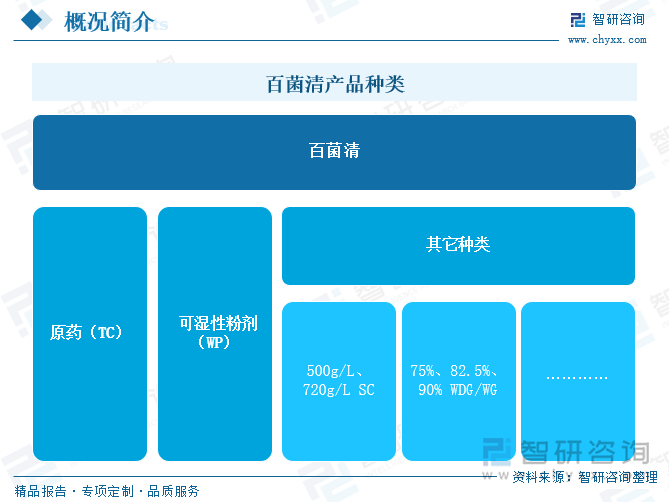
Core Insights - The article discusses the increasing demand for the fungicide Bacillus thuringiensis (also known as 2,4,5,6-tetrachloro-1,3-benzodioxole), driven by factors such as the outbreak of soybean rust in Brazil, the growing need for global disease resistance management, and the expansion of crop planting areas in emerging markets like China, India, and Southeast Asia [1][8][10]. Industry Overview - Bacillus thuringiensis is a broad-spectrum protective fungicide with advantages such as high efficiency, low toxicity, broad-spectrum activity, low residue, and long efficacy period [1][8]. - The global demand for Bacillus thuringiensis has increased from 20,000 tons in 2012 to over 60,000 tons in 2024, with projections to reach 72,000 tons by 2025 [1][8]. - The production supply of Bacillus thuringiensis is tightening due to strict environmental policies and limited new production capacity, leading to a continuous increase in market prices [8][10]. Application Demand - Bacillus thuringiensis is widely used in agriculture and forestry for the prevention of fungal diseases, particularly in vegetables and fruits, and is also utilized in non-agricultural areas such as golf courses and ornamental plants [6][8]. - The application demand breakdown shows that 30.45% is in vegetable cultivation, 27.36% in peanuts and grains, 29.36% in fruit cultivation, and 6.22% in other non-agricultural areas [6]. Market Dynamics - The market for Bacillus thuringiensis is highly concentrated, with major production capacities located in China, where leading companies include Zhejiang Limin Holdings, Taihe Co., and Jiangyin Sulin Chemical [14][21]. - The competitive landscape is characterized by a "three-legged" structure dominated by Limin, Sulin, and Jiangsu New River, with the top two companies holding over 80% of the market share [14][21]. Future Trends - The industry is expected to see continued consolidation, with leading companies enhancing their market position through economies of scale and technological barriers [21][22]. - Emerging markets, particularly in Southeast Asia and Brazil, are driving demand growth, prompting domestic companies to accelerate global expansion and establish partnerships with multinational agrochemical firms [22][23]. - The industry is shifting towards green transformation and high-end formulation research, with a focus on developing low-toxicity and low-residue products to meet stricter environmental standards [23].