
Coal

Search documents
X @The Economist
The Economist· 2025-11-09 09:20
China still burns a hell of a lot of coal. But since 2013 it has been doing so more cleanly. Our special report explains how sulphur extraction has improved air-quality—but increased temperatures https://t.co/imT0htOY3P ...
Warrior Met Coal, Inc. 2025 Q3 - Results - Earnings Call Presentation (NYSE:HCC) 2025-11-07
Seeking Alpha· 2025-11-07 23:17
Group 1 - The article does not provide any specific content related to a company or industry, as it appears to be a technical issue regarding browser settings and ad-blockers [1]



ETF日报:各方面利好消息不断出现,创新药板块或存在盈利和估值抬升的可能,可关注创新药ETF
Xin Lang Ji Jin· 2025-11-07 11:49
Market Overview - A-shares opened slightly lower and fluctuated before stabilizing, with the Shanghai Composite Index closing at 3997.56 points, down 0.25% [1] - The Shenzhen Component Index fell by 0.36%, and the ChiNext Index decreased by 0.51%, with over 3100 stocks declining [1] - The trading volume in both markets was approximately 2 trillion, slightly lower than the previous day [1] Sector Performance - Software and innovative drug sectors showed weaker performance, while chemical and photovoltaic sectors gained due to rising raw material prices and anti-involution policies [1] - The innovative drug ETF from Guotai (589720) has seen continuous inflows, totaling over 200 million in the last five trading days [7] Investment Sentiment - Concerns about the "AI bubble" and its potential impact on A-shares have emerged, with investors questioning whether market corrections present opportunities or traps [1] - Despite fluctuations in the external market, the domestic market's valuation logic remains strong, with a clear investment outlook emerging [2] Future Outlook - The bull market is expected to continue, with new leading sectors likely to emerge during the rotation process [5] - The innovative drug sector is anticipated to see both profit and valuation increases, driven by positive industry news and AI's role in drug development [9][11] - The coal sector is experiencing a rebound, with recent price increases and inventory reductions providing support for near-term performance [15][17] Policy and Economic Factors - Ongoing policy developments are expected to improve macroeconomic expectations, supporting coal prices from both supply and demand sides [17] - The introduction of AI in drug development is likely to enhance efficiency and reduce costs, further boosting the innovative drug sector [12][13]
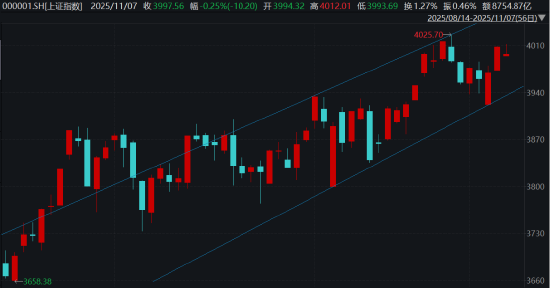
“耐心资本”青睐红利资产,国企红利ETF(159515)盘中上涨0.5%
Sou Hu Cai Jing· 2025-11-07 02:12
Core Viewpoint - The news highlights the increasing importance of dividend assets in the context of China's economic policies, particularly emphasizing the role of "patient capital" from insurance funds and the regulatory push for higher dividend payouts from listed companies [1][2]. Group 1: Market Performance - As of November 7, 2025, the CSI State-Owned Enterprises Dividend Index (000824) rose by 0.39%, with notable increases in constituent stocks such as Huayang Co. (600348) up by 2.58% and CITIC Bank (601998) up by 2.25% [1]. - The National Enterprise Dividend ETF (159515) also saw an increase of 0.50% [1]. Group 2: Policy and Regulatory Environment - The "14th Five-Year Plan" emphasizes the introduction of "patient capital," primarily from insurance funds, which favor dividend assets due to their stable cash flow characteristics [1]. - Policies like the "Nine National Policies" require listed companies to increase their dividend payout ratios, with state-owned enterprises' dividend scale exceeding 370 billion yuan [1][2]. - Regulatory focus on dividend payouts is expected to provide a solid institutional guarantee for the long-term investment value of dividend assets [1]. Group 3: Investment Strategy - Analysts suggest that the policy guidance injects significant vitality into dividend assets, with major brokerages recommending a dual strategy of technology and dividend stocks for 2025, positioning dividend stocks as defensive assets in a low-interest-rate environment [1].





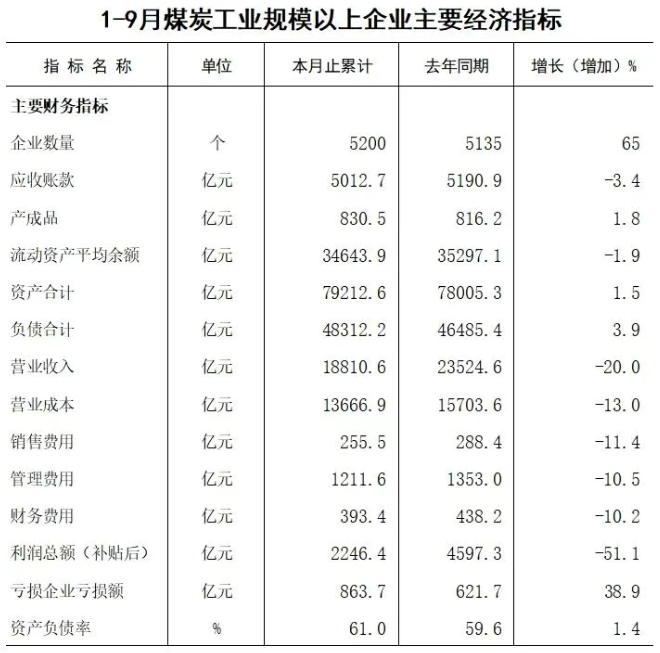
2025年1-9月煤炭工业规模以上企业主要经济指标
Guo Jia Tong Ji Ju· 2025-11-07 01:49
Core Insights - The coal industry has shown mixed performance in key economic indicators for the first nine months, with a total of 5,200 enterprises reported, an increase from 5,135 in the same period last year [1] Financial Indicators - Accounts receivable decreased by 3.4% to CNY 50.127 billion from CNY 51.909 billion [1] - Finished goods inventory increased by 1.8% to CNY 8.305 billion from CNY 8.162 billion [1] - Average balance of current assets decreased by 1.9% to CNY 352.971 billion from CNY 346.439 billion [1] - Total assets rose by 1.5% to CNY 792.126 billion from CNY 780.053 billion [1] - Total liabilities increased by 3.9% to CNY 464.854 billion from CNY 188.106 billion [1] Revenue and Profitability - Operating revenue decreased by 13.0% to CNY 157.036 billion from CNY 224.646 billion [1] - Operating costs also fell to CNY 136.669 billion, reflecting a decline in profitability [1] - Total profit (after subsidies) dropped significantly by 51.1% to CNY 45.973 billion from CNY 93.000 billion [1] - Losses from loss-making enterprises decreased by 38.9% to CNY 6.217 billion from CNY 8.637 billion [1] Financial Ratios - The asset-liability ratio increased to 61.0% from 59.6% [1]
Natural Resource Partners' Q3 Earnings Fall Y/Y on Weak Coal, Soda Ash
ZACKS· 2025-11-06 19:01
Core Viewpoint - Natural Resource Partners L.P. (NRP) reported a decline in net income and revenues for Q3 2025, reflecting challenges in the coal and soda ash markets, while maintaining a focus on deleveraging and free cash flow generation [2][12][14]. Financial Performance - NRP's net income for Q3 2025 was $30.9 million, down 20% from $38.6 million a year earlier [2] - Total revenues fell 17% to $49.9 million from $60.3 million in the prior-year quarter [2] - Basic earnings per common unit decreased to $2.31 from $2.55 [2] - Operating cash flow was $41.1 million compared to $54.1 million in Q3 2024 [2] - Free cash flow decreased 24% year over year to $41.8 million from $54.8 million [2] Segment Performance - **Mineral Rights Segment**: Net income rose slightly to $40.9 million from $40.6 million, but operating and free cash flows decreased due to lower metallurgical coal sales prices and volumes [3] - **Coal Royalty Revenues**: Dropped approximately 9% to $34.2 million, with average royalty revenue per ton declining to $4.51 from $5.24, attributed to weak global steel demand and low natural gas prices [4] - **Soda Ash Segment**: Net income fell by $10.5 million due to lower international sales prices, with no distributions received from the joint venture Sisecam Wyoming LLC in Q3 [5][6] Management Commentary - Management highlighted the ongoing depressed market conditions for coal, soda ash, and carbon-neutral ventures, yet emphasized the generation of substantial free cash flow [8] - The global soda ash market is described as oversupplied, with prices at or below production costs for many operators [6] - The company is focused on maintaining a conservative capital management approach and has made significant progress in deleveraging [11] Guidance & Outlook - NRP anticipates continued weakness in coal and soda ash markets through 2026 but expects to remain free cash flow positive [14] - The long-term goal is to achieve a "fortress balance sheet" with no permanent debt and at least $30 million in cash reserves [15] Other Developments - NRP maintained its quarterly cash distribution of 75 cents per common unit, payable on November 25, 2025 [16] - The company is diversifying by leasing acreage for lithium production in the Smackover formation, indicating a shift beyond its traditional coal and soda ash businesses [17]


Alpha Metallurgical Resources(AMR) - 2025 Q3 - Earnings Call Transcript
2025-11-06 16:00
Financial Data and Key Metrics Changes - Adjusted EBITDA for Q3 2025 was $41.7 million, down from $46.1 million in Q2 2025 [6] - Cost of coal sales decreased to $97.27 per ton in Q3, down from $100.06 per ton in Q2 [7] - Cash provided by operating activities was $50.6 million in Q3, down from $53.2 million in Q2 [9] - Total liquidity increased to $568.5 million at the end of Q3, up from $556.9 million at the end of Q2 [9] Business Line Data and Key Metrics Changes - The company shipped 3.9 million tons in Q3, the same amount as in Q2 [6] - Metallurgical segment realizations decreased to an average of $114.94 per ton in Q3, down from $119.43 in Q2 [6] - Realizations in the incidental thermal portion of the metallurgical segment increased to $81.64 per ton in Q3, compared to $78.01 per ton in Q2 [7] Market Data and Key Metrics Changes - The Australian Premium Low-Vol Index increased by 9.6% during Q3, rising from $173.50 per metric ton to $190.20 per metric ton [14] - The US East Coast Low-Vol Index increased from $174 per metric ton at the beginning of the quarter to $177 per metric ton at quarter close [14] - The API-2 Index in the seaborne thermal market decreased from $107.95 per metric ton to $95.40 per metric ton during Q3, but increased to $100.70 per metric ton as of November 4 [15] Company Strategy and Development Direction - The company is focused on maintaining cost discipline while navigating a challenging market cycle, with plans for 2026 already in progress [4] - Discussions with North American customers regarding domestic sales commitments for 2026 are ongoing, with guidance not yet issued [5] - The company is exploring opportunities in rare earth elements but does not see it as a strategic priority at this moment [27] Management's Comments on Operating Environment and Future Outlook - Management noted that the underlying economic conditions affecting steel demand remain vulnerable to uncertainty and lackluster growth expectations [4] - The company is preparing for potentially another challenging year for the coal industry in 2026 [4] - Management emphasized the importance of safety and operational efficiency, with recent achievements in safety performance [11] Other Important Information - Capital expenditures for Q3 were $25.1 million, down from $34.6 million in Q2 [8] - The company has $408.5 million in unrestricted cash and $49.4 million in short-term investments as of September 30, 2025 [9] - The Kingston Wildcat mine is in development production, with expectations to ramp up to a full annual run rate of approximately 1 million tons in 2026 [12] Q&A Session Summary Question: Sustainability of Cost Cuts - Management acknowledged the volatility in costs and production but highlighted the operations team's success in maintaining cost reductions while ensuring safety [20][21] Question: Domestic Contracts and Volume Flexibility - Management indicated that domestic contracts are typically fixed price, and while there may be fluctuations, significant changes in volume are not expected [22][24] Question: Rare Earth Opportunities - Management stated that while they are exploring rare earth opportunities, it is not a primary focus, and they are content with their current metallurgical coal operations [26][27] Question: CSX Derailment Impact - Management confirmed that the CSX line is expected to reopen soon, and they have sufficient inventory to meet customer contracts [31][32] Question: Market Conditions and Competition - Management expressed confidence in navigating market conditions and emphasized their position as a preferred supplier despite new competition [39] Question: CapEx Expectations for 2026 - Management indicated that they are not ready to provide detailed CapEx expectations for 2026 but mentioned ongoing projects like the Kingston Wildcat Mine [45] Question: M&A Opportunities - Management is cautious about M&A in the current market but remains open to opportunities that align with their strategic goals [51][52] Question: Safety Procedures Amid MSHA Shutdown - Management reported that MSHA enforcement remains active despite the shutdown, and the company is committed to maintaining high safety standards [53]

Core Natural Resources (CNR) Q3 Earnings Beat Estimates
ZACKS· 2025-11-06 14:06
Core Earnings Performance - Core Natural Resources (CNR) reported quarterly earnings of $0.61 per share, exceeding the Zacks Consensus Estimate of a loss of $1.4 per share, but down from $3.22 per share a year ago, indicating an earnings surprise of +143.57% [1] - The company had previously expected earnings of $1.31 per share but reported a loss of $0.7, resulting in a surprise of -153.44% [1] Revenue Analysis - CNR posted revenues of $1 billion for the quarter ended September 2025, which missed the Zacks Consensus Estimate by 3.89%, compared to revenues of $574.85 million in the same quarter last year [2] - Over the last four quarters, the company has surpassed consensus revenue estimates two times [2] Stock Performance and Outlook - CNR shares have declined approximately 27.2% since the beginning of the year, contrasting with the S&P 500's gain of 15.6% [3] - The company's earnings outlook will be crucial for future stock performance, with current consensus EPS estimates at $0.59 on $1.01 billion in revenues for the upcoming quarter and -$2.89 on $4.17 billion in revenues for the current fiscal year [7] Industry Context - The coal industry, to which CNR belongs, is currently ranked in the bottom 5% of over 250 Zacks industries, indicating a challenging environment [8] - Empirical research suggests a strong correlation between near-term stock movements and trends in earnings estimate revisions, which could impact CNR's stock performance [5][6]
X @The Economist
The Economist· 2025-11-06 13:40
Last year China burned 4.9bn tonnes of coal. In the same year, it generated almost a third of the world’s electricity. Our special report explains how the two are connected https://t.co/6Ks3Ra1KoA ...
Warrior Met Coal raises 2025 production guidance by 10% and accelerates Blue Creek longwall start-up (NYSE:HCC)
Seeking Alpha· 2025-11-06 07:02
Group 1 - The article does not provide any specific information or insights regarding a company or industry [1]