Funds

Search documents
PDI CEF: Best Time To Sell In 5 Years
Seeking Alpha· 2025-08-05 20:39
Core Insights - The article discusses the PIMCO Dynamic Income Fund (NYSE: PDI) and its performance in light of recent U.S. credit rating downgrades by Moody's [1] Group 1: Fund Analysis - The PIMCO Dynamic Income Fund was last analyzed on May 22, focusing on its comparison with another fund, PDO, amid concerns regarding U.S. credit ratings [1] - The analysis suggests that investors may consider holding PDO due to the implications of the credit downgrade on fund performance [1] Group 2: Contributor Background - Sensor Unlimited, the contributor, holds a PhD in financial economics and has a decade of experience covering the mortgage market, commercial market, and banking industry [2] - The contributor specializes in asset allocation and ETFs, particularly in relation to the overall market, bonds, banking, and housing sectors [2]


今日13只基金公告成立
Mei Ri Jing Ji Xin Wen· 2025-08-05 08:10
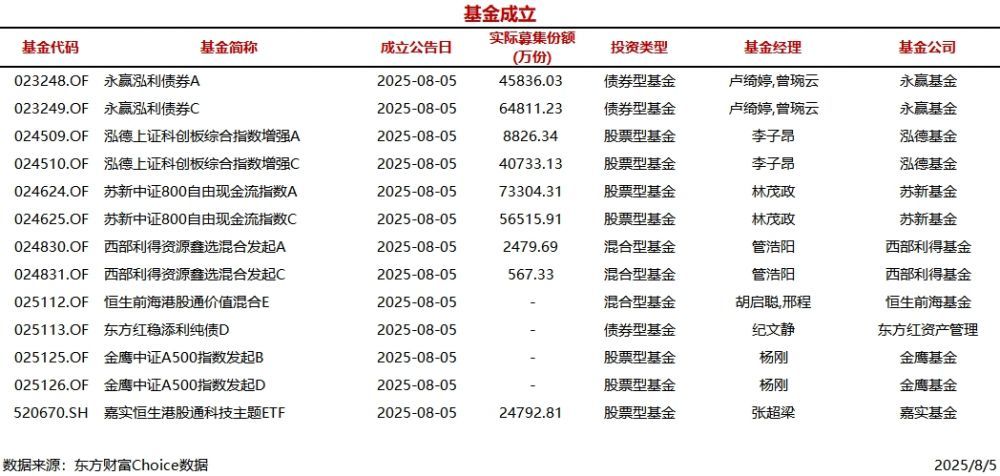
Group 1 - A total of 13 funds were announced to be established today, including 7 equity funds, 3 bond funds, and 3 mixed funds [1] - The bond fund "永赢别利债券A" has a total share of 45836.03 million units, while "永赢沿利债券C" has 64811.23 million units [2] - The equity fund "沿德上证科创板综合指数增强A" has 8826.34 million units, and "泓德上证科创板综合指数增强C" has 40733.13 million units [2] Group 2 - The mixed fund "西部利得资源鑫选混合发起A" has 2479.69 million units, and "西部利得资源参选混合发起C" has 567.33 million units [2] - The ETF "嘉实恒生港股通科技主题ETF" has a total share of 24792.81 million units [2] - The funds were all announced on August 5, 2025, indicating a significant activity in the fund establishment sector [1][2]
今日新聘基金经理16人,离任3人
Sou Hu Cai Jing· 2025-08-05 08:03
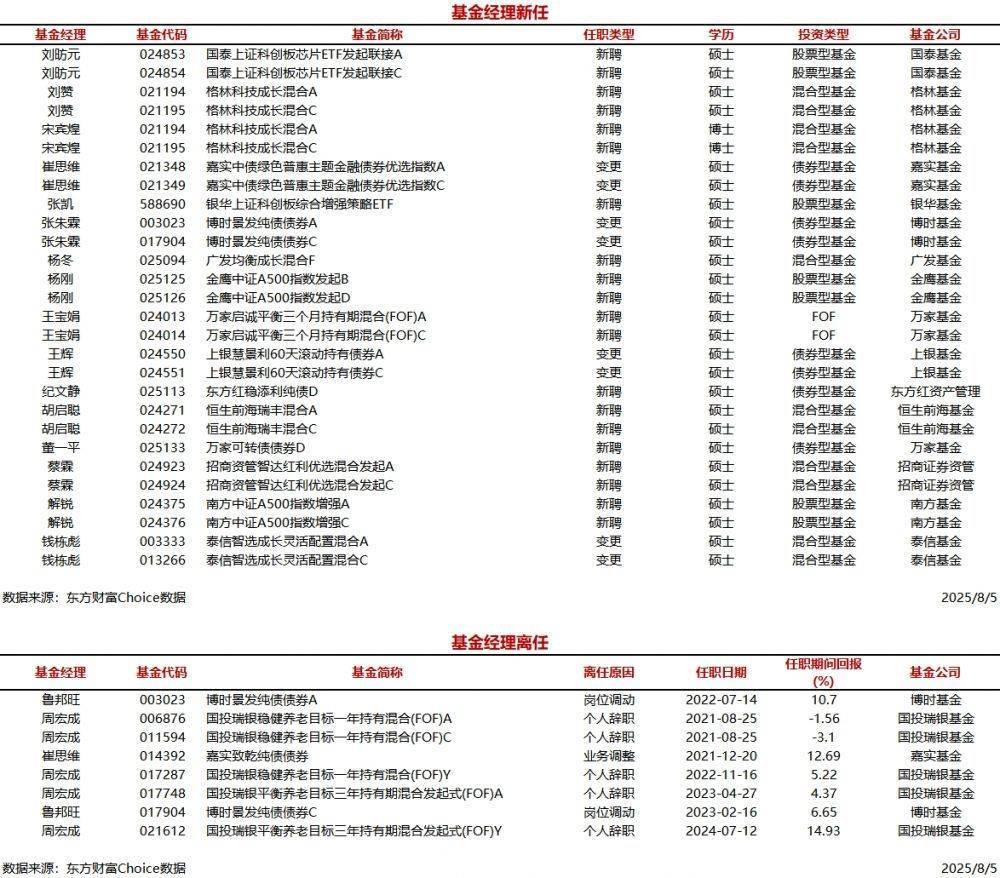
每经AI快讯,据东方财富Choice数据统计,今日新聘基金经理16人,涉及26只基金(A/C类分开计算),主要来自格林基金、万家基金等公 司。另外,今日有3位基金经理离任。 每日经济新闻 | 基金经理 | 基金代码 | 基金简称 | 离任原因 | 任职日期 | 甘肃到同可报 | 其金公司 | | --- | --- | --- | --- | --- | --- | --- | | | | | | | (%) | | | 鲁邦旺 | 003023 | 博时景发纯债债券A | 岗位调动 | 2022-07-14 | 10.7 | 博时基金 | | 周宏成 | 006876 | 国投瑞银稳健养老目标一年持有混合(FOF)A | 个人辞职 | 2021-08-25 | -1.56 | 国投瑞银耳会 | | 周宏成 | 011594 | 国投瑞银稳健养老目标一年持有混合(FOF)C | 个人辞职 | 2021-08-25 | -3.1 | 国投瑞银基金 | | 舞蹈得 | 014392 | 嘉实致乾纯债债券 | 业务调整 | 2021-12-20 | 12.69 | 第二章寺 | | 周宏成 | 017287 | 国 ...
HNW: Good Junk Bond Fund, But Wait For Pullback Before Buying Shares
Seeking Alpha· 2025-08-05 07:46
Core Viewpoint - The Pioneer Diversified High Income Fund (NYSE: HNW) is a closed-end fund designed to provide investors with a high level of income from their existing assets [1] Group 1: Fund Overview - The fund aims to generate a 7%+ income yield by investing in a portfolio of energy stocks while minimizing the risk of principal loss [1] - The fund offers a method for investors to earn significant income through their current asset holdings [1] Group 2: Subscription Service - The service provides subscribers with early access to investment ideas that are not released to the general public, along with in-depth research [1] - A two-week free trial is currently being offered for the subscription service [1]

新型浮动费率基金收益“两重天”:有月赚8%,有投资者急了
Sou Hu Cai Jing· 2025-08-05 05:41
Core Insights - The second batch of 12 new floating rate funds has been launched, offering more diverse options in terms of fee structures and investment themes compared to the first batch of 26 funds [2][3] - The new floating rate funds align the interests of fund companies and investors by adopting a "more profit, more fees; less profit, less fees" principle, addressing previous controversies regarding management fees despite fund losses [2][3] Fund Launch and Structure - The second batch received approval from the China Securities Regulatory Commission on July 24, with some fund managers making their debut while others are returning from the first batch [3] - Three funds from this batch, including E Fund Value Return, China Europe Core Selection, and Jianxin Medical Innovation, have set a fundraising cap of 30 billion yuan for the latter [3][4] Fee Structure and Performance - The management fee structure remains performance-based, with three tiers: 1.2% for baseline performance, 1.5% for exceeding the benchmark by 6%, and 0.6% for underperforming by 3% [4][5] - Some funds have stricter thresholds for fee adjustments, such as Huatai-PB and Oriental Red Asset Management, which set the underperformance threshold at 2% [8] Fund Performance and Investor Sentiment - Among the first batch of floating rate funds, some have shown significant returns, with one fund achieving an 8% profit in its first month, while others have stagnated around a net value of 1 yuan [2][13] - As of August 1, 2025, many funds have underperformed their benchmarks, leading to investor frustration, especially as the A-share market has been rising [15][16] Fundraising and Market Response - The first batch of 26 floating rate funds raised a total of 25.86 billion yuan, with significant disparities in fundraising success among different funds [10][12] - The average subscription period for the first batch was 21.5 days, indicating a favorable market response compared to the average for equity mixed funds [10]

年内首只“一日售罄”FOF诞生 摩根盈元稳健三个月持有期混合FOF提前结募
Xin Lang Ji Jin· 2025-08-05 03:02
Core Insights - Morgan Fund Management (China) announced the early closure of its Morgan Yingyuan Stable Three-Month Holding Period Mixed FOF due to overwhelming demand, with a total fundraising of nearly 2.8 billion yuan, making it the first FOF product to sell out in one day in 2025 [1][2] Group 1: Fund Characteristics - The Morgan Yingyuan FOF targets investors' needs for stable low volatility and diversified income sources, employing a "fixed income plus" strategy [2] - The fund limits equity investments to no more than 30% and includes flexible allocations to public REITs, gold, and QDII funds to diversify risk while pursuing multiple income streams [2] - Morgan Asset Management has partnered with China Merchants Bank to limit the initial fundraising scale, focusing on providing a better holding experience for investors [2] Group 2: Market Trends - The success of the Morgan Yingyuan FOF reflects a broader recovery in the FOF market, with the total number of FOFs reaching 515 and an overall scale of 165.372 billion yuan, marking a growth of 35.6 billion yuan since the beginning of the year [3][4] - The average return for equity mixed FOFs in the first half of 2025 was 4.92%, indicating strong performance that supports the recovery of the FOF market [4] - The personal pension system introduced in 2022 has accelerated the expansion of the target date and target risk FOFs, with significant increases in their numbers from 2020 to 2025 [4]
公募新发积极性延续 权益类基金占比逾七成
Sou Hu Cai Jing· 2025-08-05 00:53
Group 1 - The public fund issuance market is experiencing a continuous increase in activity, with 36 new funds launched this week, representing a week-on-week growth of 5.88% [1] - This marks the second consecutive week where the number of newly issued funds is not less than 30, with over 70% being equity funds [1] - The manager of the equity investment department at Xingye Fund expresses a strategic long-term bullish outlook on the market, despite potential short-term volatility due to external factors and performance evaluations [1] Group 2 - The A-share market is supported by macro policies and structural highlights from the transition of old and new growth drivers, with continuous inflow of incremental capital [1] - The long-term market outlook remains positive, indicating confidence in sustained growth despite short-term fluctuations [1]
HPS: Valuation Has Become More Attractive (Rating Upgrade)
Seeking Alpha· 2025-08-04 19:38
Core Viewpoint - Current market uncertainty and volatility in traditional equities make funds like John Hancock Preferred Income Fund III (NYSE: HPS) an attractive option for hedging investor portfolios [1] Investment Strategy - HPS offers investors exposure to a diverse range of assets, which can enhance portfolio stability [1] - A hybrid investment strategy combining classic dividend growth stocks, Business Development Companies, REITs, and Closed End Funds can effectively boost investment income while achieving total returns comparable to traditional index funds like the S&P [1]

招行王小青调任13万亿招商金控,三家资管子公司亦将换帅
21世纪经济报道· 2025-08-04 15:42
Group 1 - Wang Xiaoqing, the Vice President of China Merchants Bank, has resigned due to work reasons, effective from August 4, 2025, and has been appointed as the Party Secretary and prospective General Manager of China Merchants Jin Kong [1][2] - China Merchants Jin Kong, established in September 2022, is the third financial holding company approved in China, with total assets reaching 13 trillion yuan and managed assets exceeding 23 trillion yuan as of the end of 2024 [1] - Under Wang Xiaoqing's leadership, China Merchants Jin Kong reported an operating income of 507.5 billion yuan and a net profit of 160.28 billion yuan for the year 2024 [1] Group 2 - Wang Xiaoqing joined China Merchants Bank in 2020 and has held multiple leadership roles, including Chairman of several asset management subsidiaries [2] - The resignation of Wang Xiaoqing will lead to adjustments in the leadership of the subsidiaries he managed, including China Merchants Fund and China Merchants Life Insurance [2] - The independent director of China Merchants Bank, Tian Hongqi, has also resigned after completing a six-year term [3]

新华基金注销浙江分公司,中小公募收缩战线渐成趋势
Nan Fang Du Shi Bao· 2025-08-04 12:01
Core Viewpoint - Xinhua Fund Management Co., Ltd. has officially announced the cancellation of its Zhejiang branch, marking a trend of strategic contraction among small and medium-sized public funds in China [2][7]. Company Summary - Xinhua Fund was established in 2004 and is headquartered in Chongqing, being the first public fund management company in Southwest China. The company has a registered capital of 628 million yuan and manages 46 public funds with an asset management scale of 53.206 billion yuan as of the second quarter of 2025, ranking 84th in the industry [5]. - In March 2023, Xinhua Fund underwent a significant capital increase of 188%, raising its registered capital from approximately 218 million yuan to 628 million yuan, with contributions from shareholders totaling nearly 800 million yuan [5]. - The company plans to use the newly raised funds to strengthen operational capital, explore new business areas, and delve into ESG investments and cross-border asset allocation [5]. Industry Summary - The cancellation of local branches by public fund companies has become increasingly common, with several firms such as Guotou Ruijin Fund, Jinying Fund, and others also shutting down branches in various regions, indicating a broader trend of resource reallocation from less efficient areas to core economic zones [7][8]. - The trend of branch cancellations is primarily observed among small and medium-sized public funds, with a notable increase in the number of cancellations in 2023 compared to previous years [7][8]. - Industry experts suggest that the cancellation of branches does not equate to exiting the market but rather reflects a strategic optimization of resources to enhance competitiveness in core markets [8].