Brokerage

Search documents
FINRA Fines Osaic Broker/Dealer $1M Over Mutual Fund Supervision
Yahoo Finance· 2025-12-03 17:12
You can find original article here WealthManagement. Subscribe to our free daily WealthManagement newsletters. Securities America, an Omaha, Neb.-based broker/dealer that was consolidated into Osaic last year, will pay $3 million in restitution and fines to settle Financial Industry Regulatory Authority allegations that it failed to supervise mutual fund recommendations. In a letter of acceptance, waiver and consent detailing the settlement, Securities America did not admit nor deny the findings, b ...
As Robinhood Dives Into the Prediction Markets, Should You Buy, Sell, or Hold HOOD Stock?
Yahoo Finance· 2025-12-01 17:25
Robinhood (HOOD) just stole the spotlight again. This week, the Menlo Park-based brokerage revealed a plan to launch its own CFTC-licensed exchange for event contracts via a joint venture with Susquehanna International Group and Miami International (MIAX). Under the deal, Robinhood will acquire 90% of MIAX’s MIAXdx derivatives exchange (with MIAX keeping 10%), giving it direct control over the clearing and listing of futures, options, and prediction market contracts. The news sent HOOD shares jumping 10% ...

Schwab Plans to Charge for Shelf Space Next Year. It Could Hit Small Issuers Hardest
Yahoo Finance· 2025-12-01 11:10
Core Insights - The financial services industry is witnessing a shift as Charles Schwab plans to reintroduce platform fees next year, following similar moves by Fidelity and other major broker-dealers [2][4] - This change is expected to pressure smaller and newer asset managers to innovate and differentiate their products to stand out in a competitive market [3][5] Group 1: Company Actions - Charles Schwab previously eliminated platform fees five years ago but is now reconsidering them due to the evolving ETF landscape and the potential revenue opportunities [2][3] - The anticipated fees may include a charge of 15% of what ETF issuers earn or a $100 transaction fee for investors, similar to Fidelity's model [4] Group 2: Industry Trends - The trend of declining fund fees may be disrupted as asset managers will need to allocate funds for distribution costs, potentially slowing the overall decrease in fees across the industry [5] - There are currently fewer than 30 ETFs available through Fidelity that do not incur a service fee, indicating a growing trend towards platform charges that may disproportionately impact smaller firms [6]

Is Robinhood Markets (HOOD) the Best Stock from Cathie Wood’s Portfolio to Buy Now?
Yahoo Finance· 2025-12-01 10:28
Core Insights - Robinhood Markets Inc. is identified as one of the top 10 stocks to buy from Cathie Wood's ARK Investment Management portfolio, despite a significant reduction in its position by nearly 36% in Q3 [1] - The company plans to launch a new futures and derivatives exchange and clearinghouse, aiming to enhance its presence in prediction markets [2] - The exchange will operate through a joint venture with Susquehanna International Group, with operations expected to begin in 2026 [3] Financial Performance - ARK's stake in Robinhood was valued at approximately $718 million, representing around 4.3% of its 13F portfolio [1] - The prediction markets revenue growth has accelerated, with over 9 billion contracts traded by more than 1 million users in the first year of launch [2] Market Positioning - The joint venture will acquire MIAXdx, a CFTC-licensed Designated Contract Market and Derivatives Clearing Organization, to enhance regulatory readiness [3] - Analyst Gautam Chhugani reaffirmed a Buy rating on Robinhood with a price target of $160, indicating a strong consensus Buy with a 1-year median price target of $155, representing a potential 34% upside [4] Company Overview - Robinhood is a U.S.-based retail brokerage and trading platform that allows individual investors to trade various financial instruments through a zero-commission model [5]
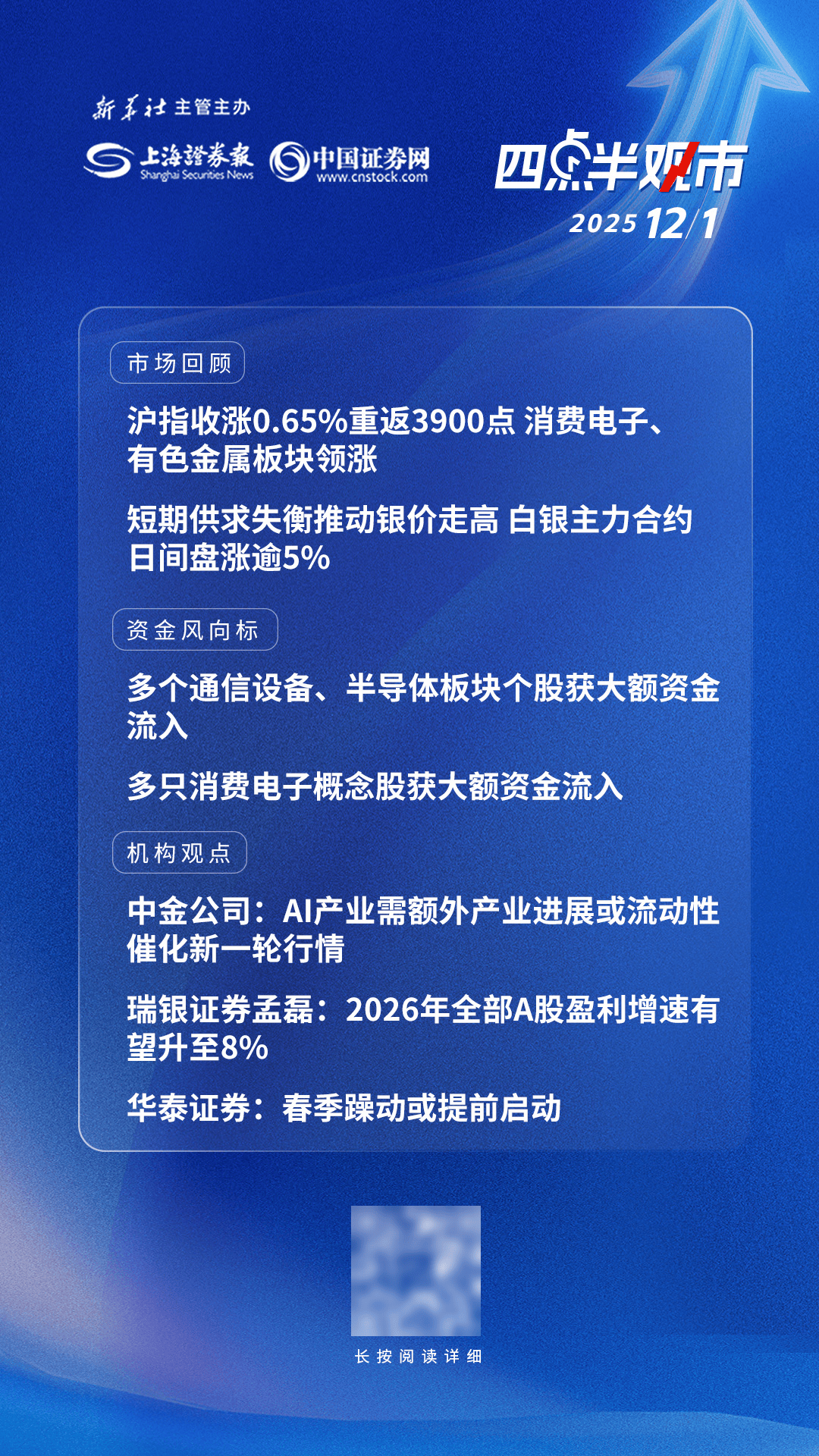
四点半观市 | 机构:AI产业需额外产业进展或流动性催化新一轮行情
Sou Hu Cai Jing· 2025-12-01 08:39
Market Overview - The Shanghai Composite Index rose by 0.65%, closing at 3914.01 points, marking a return to the 3900-point level. The Shenzhen Component and ChiNext Index increased by 1.25% and 1.31%, respectively. The total trading volume in both markets reached 1.87 trillion yuan, an increase of 288.1 billion yuan compared to the previous Friday [6][4]. Sector Performance - The consumer electronics and non-ferrous metals sectors led the market gains. Silver prices surged over 5% due to short-term supply-demand imbalances, with the main silver futures contract showing strong performance [4][6]. - In the commodity futures market, most major contracts saw price increases, with silver, platinum, and polysilicon rising over 3%, while copper and coke increased by over 2% [6]. Fund Flow - Significant capital inflows were observed in several stocks, particularly in the communication equipment and semiconductor sectors, with net inflows exceeding 70 billion yuan for these sectors on December 1. Notable stocks included ZTE Corporation, Beijing Junzheng, and Guanghetong, with ZTE receiving over 5 billion yuan in net inflows [7][8]. - The top ten stocks by net capital inflow included ZTE Corporation, Zhaoyi Innovation, and Zijin Mining, all exceeding 800 million yuan in inflows [7]. Institutional Insights - CICC indicated that the AI industry requires additional industrial progress or liquidity to catalyze a new market cycle, despite high valuations and expectations in the sector [8]. - UBS's analyst Meng Lei projected that the overall A-share profit growth rate could rise from 6% this year to 8% by 2026, driven by nominal GDP growth, corporate revenue increases, and supportive policies [8]. - Huatai Securities suggested that the market may experience an early spring rally due to improving fundamentals and macro liquidity, alongside policy and industry theme catalysts [8]. - Industrial insights from various securities firms highlighted the potential for recovery in Chinese assets, driven by easing global risk aversion and favorable domestic conditions [9].




Dow Jones Signals Further Gains After Holiday; ASML Leads 5 Stocks Flashing Buy Signals
Investors· 2025-11-28 12:50
Market Overview - U.S. stock markets are closed for Thanksgiving, with Dow Jones, S&P 500, and Nasdaq futures showing little change [1] - The stock market rally has seen a solid broad advance, with major indexes moving above their 50-day moving averages [1] Sector Performance - Leading stocks, particularly in the semiconductor, gold, and other metal sectors, have performed well [1] Notable Stocks - ASML, Pan American Silver, and Comstock Resources are highlighted as strong performers in the recent market action [2]
券商资管“公募热”退潮:年内三家撤回,仅剩国金等批文;多家基金公司撤销监事会 | 券商基金早参
Mei Ri Jing Ji Xin Wen· 2025-11-28 01:05
Group 1 - The enthusiasm for public fund licenses among securities asset management companies has significantly cooled, with three institutions withdrawing their applications this year, leaving only Guojin Asset Management in the queue for approval [1] - This trend reflects a rational return to the industry regarding public fund licenses, potentially leading to a greater focus on active management capabilities and promoting differentiated competition among firms [1] - The reduction in new entrants may alleviate homogenization pressure in the public fund industry, prompting existing institutions to strengthen their core competitiveness [1] Group 2 - The total scale of cross-border mergers and acquisitions (M&A) has doubled year-on-year, with Chinese enterprises disclosing 182 outbound M&A events totaling 177.25 billion, of which 142 events occurred in 2025 alone, amounting to 156.85 billion [2] - Major securities firms are actively seizing opportunities in cross-border M&A, with firms like CICC and CITIC Securities enhancing their service offerings and team structures to capture market share [2] - Despite the growth, many Chinese securities firms still lack the capability to handle complex cross-border transactions, which remains a shortcoming in the industry [2] Group 3 - The number of newly established index-enhanced funds has surged over 400% year-on-year, with 160 new products launched this year, driven by policy support, improved index systems, and increased investor demand [3] - This explosive growth indicates a strong market preference for passive investment strategies, leading to intensified competition among public fund institutions [3] - The trend may reshape the asset management industry landscape, concentrating funds further into leading index products and enhancing overall market pricing efficiency [3] Group 4 - Several fund companies have begun to abolish their supervisory boards, following Yingda Fund's lead, with firms like Yimin Fund and Fangzheng Fubang Fund also making this move to streamline operations and reduce costs [4] - The decision to eliminate supervisory boards reflects an internal optimization strategy within the legal framework, aimed at enhancing efficiency and lowering operational costs [4] - This trend may support stock prices of small and medium-sized public companies and accelerate industry consolidation, indicating a shift towards more refined operational practices in the financial sector [4]
X @Investopedia
Investopedia· 2025-11-27 01:00
The retail brokerage is muscling into prediction markets in a bid to be a one-stop shop for trading everything. https://t.co/GxnyunTl1v ...
Robinhood is pushing deeper into the booming prediction markets, and its stock is surging
Yahoo Finance· 2025-11-27 00:35
Core Insights - Robinhood stock experienced a 9% increase on Wednesday, contributing to a year-to-date gain of 235% [1][2] Company Developments - Robinhood announced a partnership with Susquehanna International Group to acquire LedgerX, a regulated crypto exchange previously part of FTX [2][6] - The acquisition includes a 90% stake in LedgerX, enhancing Robinhood's position in the prediction markets [2][6] Market Trends - There is strong customer demand for prediction markets, which Robinhood aims to capitalize on [3][5] - Prediction markets have become Robinhood's fastest-growing product line by revenue, with over 9 billion contracts traded by more than 1 million customers within a year of launch [5][6] Strategic Implications - The acquisition of a Designated Contract Market (DCM) and Derivatives Clearing Organization (DCO) will enable Robinhood to offer futures and options on futures, as well as clear trades in various derivatives [5][6] - This strategic move positions Robinhood to further expand its offerings in the rapidly growing prediction market sector [6]
Robinhood Markets, Inc. (NASDAQ:HOOD) Targets Expansion and Growth
Financial Modeling Prep· 2025-11-26 21:13
Core Insights - Robinhood Markets, Inc. is expanding its presence in the prediction market by acquiring a 90% stake in MIAX Derivatives Exchange, aiming to launch its own futures and derivatives exchange by 2026 [2][6] - The acquisition is expected to enhance Robinhood's economics, flexibility, and product innovation, with prediction-market revenues already exceeding $100 million annually [4][6] - Susquehanna has set a bullish price target of $155 for Robinhood's stock, indicating a potential upside of 34.12% from its current trading price [1][6] Company Overview - Robinhood is known for pioneering commission-free trading and has gained popularity among retail investors due to its user-friendly platform [1] - The company competes with other brokerage firms such as E*TRADE and Charles Schwab [1] - As of the latest trading data, Robinhood's stock is priced at $125.21, reflecting an 8.34% increase, with a market capitalization of approximately $110.82 billion [5] Strategic Moves - The acquisition of MIAX Derivatives Exchange is part of a strategic partnership with Susquehanna International Group, aimed at bolstering Robinhood's market presence and product offerings [2][3] - Miami International Holdings will retain a 10% stake in MIAX, allowing Robinhood to leverage MIAX's established market position while maintaining operational control [3] - This move aligns with Robinhood's goal to diversify its revenue streams and enhance its competitive edge in the financial services industry [4][6]