脑机接口

Search documents
利好频频,脑机接口概念股集体大涨!
Sou Hu Cai Jing· 2025-11-12 06:39
Core Viewpoint - The brain-computer interface (BCI) sector is experiencing significant activity and is on the verge of a potential explosion in growth, driven by recent regulatory advancements and clinical developments [6][10]. Group 1: Market Activity - On November 12, companies in the brain-computer interface sector, such as Aipeng Medical and Innovation Medical, saw notable stock price increases, indicating strong market interest [2]. - In the Hong Kong market, companies like MicroPort NeuroTech and Nanjing Panda Electronics also recorded gains, reflecting a broader trend in the BCI industry [3]. Group 2: Regulatory Developments - The invasive brain-computer interface product developed by Shanghai Ladder Medical Technology has entered the "green channel" for approval by the National Medical Products Administration, marking a significant regulatory milestone [4]. - This is the first invasive BCI product to receive such treatment in China, indicating a growing confidence in the safety and efficacy of these technologies by regulatory bodies [5]. Group 3: Clinical Advancements - The first global trial of an invasive BCI for restoring motor function in patients has been successfully completed in China, showcasing the potential of these technologies in clinical applications [7]. - Clinical trials for BCI systems are set to take place in 10 centers across China, with plans to enroll 30 to 50 patients by the end of the year, further pushing the technology towards commercialization [8]. Group 4: Market Projections - The global BCI market is projected to reach approximately $2.62 billion in 2024, with expectations to grow to $2.94 billion in 2025 and potentially $12.4 billion by 2034, reflecting a compound annual growth rate of 17.35% over the next decade [8]. - In China, the BCI market is expected to grow from 3.2 billion yuan in 2024 to 6.14 billion yuan by 2028, indicating strong domestic growth potential [8]. Group 5: Policy Support - The Chinese government has recognized BCI technology as a strategic priority, with policies aimed at fostering innovation and establishing it as a new economic growth point [9]. - Recent joint initiatives by multiple government departments have outlined clear industry goals and begun to implement pricing and insurance coverage for BCI medical services, facilitating the industry's development [9].


“大象起舞”!突破3万亿元!
天天基金网· 2025-11-12 05:30
Core Viewpoint - The article discusses the recent performance of Agricultural Bank of China, highlighting its stock price increase and market capitalization, as well as the broader market trends in the banking and pharmaceutical sectors [3][5][10]. Group 1: Agricultural Bank Performance - Agricultural Bank of China has experienced a 14-day consecutive rise in stock price, with its price-to-book (PB) ratio recovering to above 1 for the first time, breaking the long-standing trend of state-owned banks trading below book value [3][8]. - The stock price increased by 3.13% on the latest trading day, reaching a total market capitalization of 3 trillion yuan, making it the largest in A-shares [3][5]. - The bank's PB ratio stands at 1.09, while other major banks like Industrial and Commercial Bank of China and China Construction Bank have PB ratios of 0.773 and 0.737, respectively [8]. Group 2: Key Highlights of Agricultural Bank - The bank benefits from the potential release of county-level economic growth and has a deeper layout in these regions, providing greater credit growth space compared to peers [8][9]. - Agricultural Bank has the highest proportion of personal demand deposits among its peers, resulting in lower deposit costs and stronger interest margin resilience [8]. - The bank maintains the lowest non-performing loan ratio compared to its peers while adhering to strict non-performing loan recognition standards [9]. - High provisions strengthen the bank's risk absorption capacity and profit reinvestment ability, leading the industry [10]. Group 3: Market Trends - The banking sector is entering a seasonal uptrend, with historical data indicating a 70% probability of absolute returns from November to December and an 80% probability in January of the following year [10]. - The pharmaceutical sector has shown strong performance, with significant gains in stocks related to medical commerce and brain-computer interface technologies [11][12]. - The brain-computer interface market is projected to grow significantly, with estimates suggesting a market size of approximately $26.2 billion in 2024, reaching $124 billion by 2034 [16][17].


A股“一哥”,3万亿元
Zhong Guo Zheng Quan Bao· 2025-11-12 04:34
Group 1: Agricultural Bank Performance - Agricultural Bank experienced a 14-day consecutive rise in stock price from September 25 to October 22, with its price-to-book ratio (PB) recovering to above 1, breaking the long-standing trend of state-owned banks trading below book value [1] - On the morning of the report, Agricultural Bank's stock rose by 3.13%, reaching a market capitalization of 3 trillion yuan, making it the largest in A-shares and setting a new historical high [1] - The bank's PB is currently at 1.09, while other major banks like Industrial and Commercial Bank of China, China Construction Bank, and Bank of China have PBs of 0.773, 0.737, and 0.7 respectively [6] Group 2: Key Highlights of Agricultural Bank - The bank benefits from the potential release of county-level economic growth and has a larger credit growth space compared to peers due to its deep layout in these regions [6] - Agricultural Bank has the highest proportion of personal demand deposits among comparable peers, resulting in lower deposit costs and stronger interest margin resilience [6] - The bank maintains the lowest non-performing loan ratio among its peers while adhering to strict non-performing loan recognition standards [6][7] - High provisions strengthen the bank's risk compensation and profit reinvestment capabilities, leading the industry [7] Group 3: Market Trends - The banking sector saw an overall rise, with Agricultural Bank, Bank of China, and Chongqing Rural Commercial Bank among the top gainers [4] - The broader market, however, faced declines with the Shanghai Composite Index down by 0.24%, Shenzhen Component Index down by 1.07%, and ChiNext Index down by 1.58% [3] Group 4: Pharmaceutical Sector Performance - The pharmaceutical sector showed strong performance, with significant gains in pharmaceutical commerce, brain-computer interface, and ophthalmology sectors [8] - Notable stocks in the pharmaceutical commerce sector included Yaoyigou and Jianfa Zhixin, with the latter hitting the daily limit [11] Group 5: Brain-Computer Interface Industry - The brain-computer interface industry is expected to see significant growth, with a projected global market size of approximately $2.62 billion in 2024, reaching $2.94 billion in 2025, and potentially growing to $12.4 billion by 2034 [13] - Recent policy support and industry standards are anticipated to drive innovation and development in the brain-computer interface sector, creating new market opportunities [12][13]

首入审批“绿通”!脑机接口产业化提速,板块应声起舞
Ge Long Hui A P P· 2025-11-12 04:19
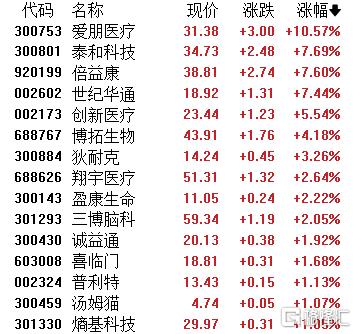
Core Viewpoint - The A-share market related to brain-computer interface (BCI) stocks has shown strong performance, driven by multiple favorable policies and significant technological advancements in the industry [1][4]. Group 1: Market Performance - A-share related concept stocks collectively surged, with notable gains including Aipeng Medical rising over 10% [1]. - Specific stock performances include: - Aipeng Medical: +10.57% to 31.38 - Taihe Technology: +7.69% to 34.73 - Beiyikang: +7.60% to 38.81 - Century Huatong: +7.44% to 18.92 - Innovation Medical: +5.54% to 23.44 [2]. Group 2: Policy Support - The BCI sector's strong rise is primarily driven by supportive policies from both central and local governments [1][4]. - The "14th Five-Year Plan" explicitly identifies BCI as a key future industry direction, aiming to promote it as a new economic growth point [4]. - Various local initiatives include the establishment of specialized incubation funds and innovation platforms to support BCI technology development [4]. Group 3: Technological Advancements - Shanghai Jieti Medical Technology's "implantable wireless brain-computer interface system" has entered the special review process by the National Medical Products Administration, marking a significant step towards commercialization [3]. - Recent technological breakthroughs include a flexible neural interface developed by the Chinese Academy of Sciences, which can monitor deep brain diseases [6]. - Internationally, MergeLabs is exploring non-invasive BCI pathways, indicating a broadening of technological possibilities [6]. Group 4: Market Potential - The global BCI market is projected to grow from approximately $2.62 billion in 2024 to $12.4 billion by 2034, indicating significant market potential [6]. - The Chinese BCI market is expected to grow from 3.2 billion yuan in 2024 to 6.14 billion yuan by 2028, attracting policy and capital investments [6]. Group 5: Investment Landscape - Over 1,000 disclosed financing transactions in the BCI field have occurred globally, with nearly 400 companies receiving investments totaling close to $10 billion [7]. - The BCI industry is anticipated to experience substantial development opportunities driven by technological innovations, policy support, and capital investments [7]. - Specific investment strategies include focusing on leading invasive companies, data reading capabilities, and the combination of medical and consumer applications in non-invasive methods [7].
A股“一哥”,3万亿元!
Zhong Guo Zheng Quan Bao· 2025-11-12 04:16
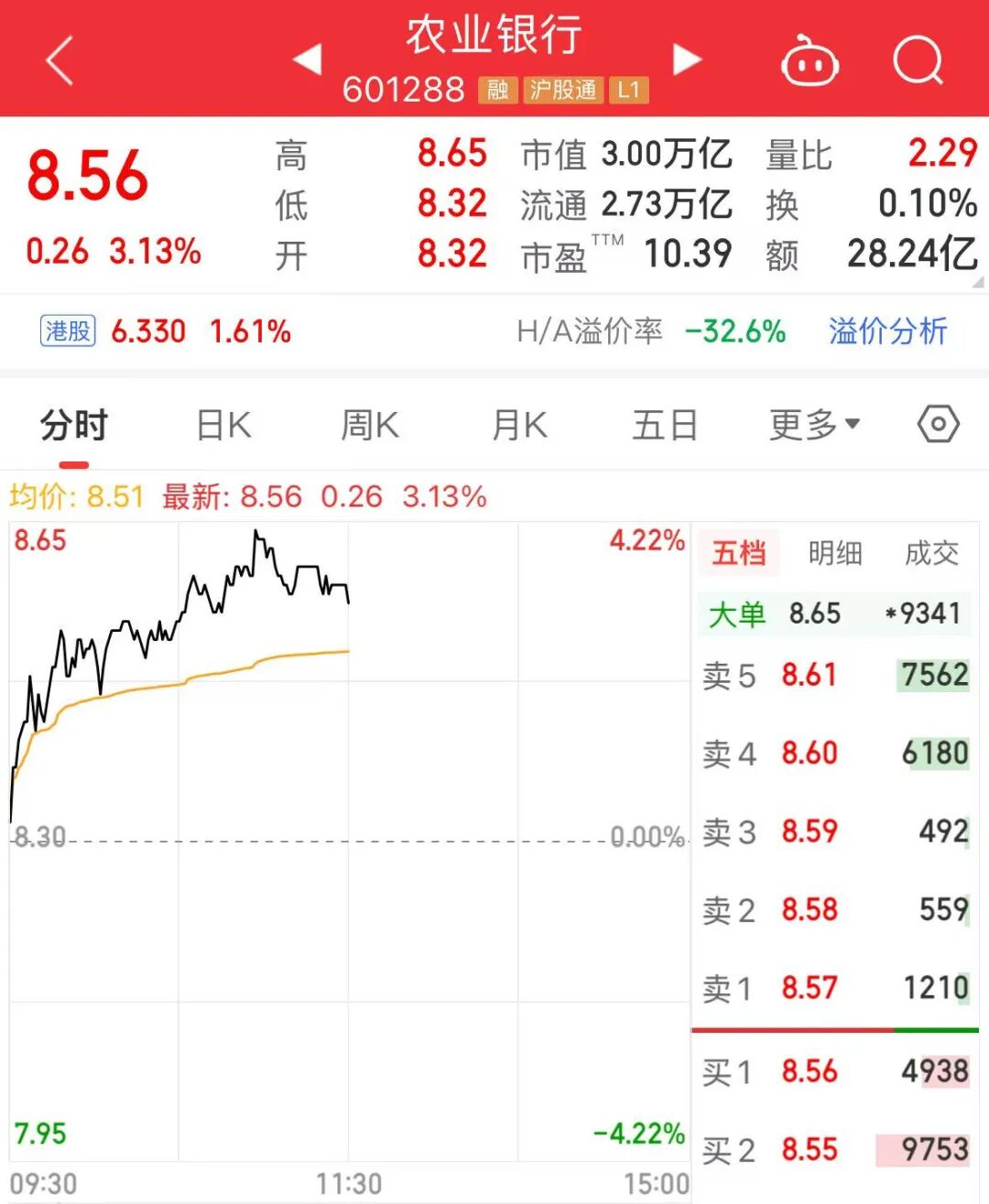
Group 1: Agricultural Bank Performance - Agricultural Bank experienced a 14-day consecutive rise in stock price from September 25 to October 22, breaking the long-standing price-to-book (PB) ratio below 1, now exceeding 1 [1][6] - The stock price increased by 3.13% today, reaching a market capitalization of 3 trillion yuan, making it the largest in A-shares [1][2] - The PB ratio of Agricultural Bank is currently at 1.09, while other major banks like Industrial and Commercial Bank of China (ICBC) and China Construction Bank have PB ratios of 0.773 and 0.737 respectively [6] Group 2: Key Highlights of Agricultural Bank - Agricultural Bank benefits from the potential release of county-level economic growth and has a larger credit growth space compared to peers due to its deep layout in these regions [6][7] - The bank has the highest proportion of personal demand deposits among comparable peers, leading to lower deposit costs and stronger interest margin resilience [6] - Agricultural Bank maintains the lowest non-performing loan ratio among its peers while having a strict recognition of non-performing loans [6][7] - The bank's high provisions strengthen its risk compensation and profit reinvestment capabilities, leading the industry [7] Group 3: Market Trends - The banking sector saw an overall rise today, with Agricultural Bank, Bank of China, and Chongqing Rural Commercial Bank among the top gainers [4][5] - The Shanghai Composite Index fell by 0.24%, while the Shenzhen Component Index and the ChiNext Index dropped by 1.07% and 1.58% respectively [3]
人脑工程概念走高 爱朋医疗、倍益康涨超10%
Zheng Quan Shi Bao Wang· 2025-11-12 03:03
Core Insights - The brain-computer interface (BCI) sector is experiencing significant growth, driven by technological innovations, policy support, and capital investment [1][2] - The first invasive brain-computer interface product, developed by Shanghai Ladder Medical Technology Co., has entered the special review process of the National Medical Products Administration, marking a milestone for the industry [1] Industry Overview - The BCI industry has established a complete industrial chain, covering upstream (materials, chips, electrodes), midstream (signal acquisition and processing), and downstream (medical health, consumer life, industrial production) segments [2] - The global BCI market is projected to grow from approximately $2.62 billion in 2024 to $2.94 billion in 2025, with expectations to reach $12.4 billion by 2034 [2] Market Performance - Companies such as Aipeng Medical, Beiyikang, and Century Huatong have seen stock price increases of over 10%, 10%, and 8% respectively, indicating strong market interest in the BCI sector [1]
港股脑机接口概念股走强,脑动极光涨超9%
Ge Long Hui A P P· 2025-11-12 02:27
Core Viewpoint - The brain-computer interface (BCI) concept stocks in the Hong Kong market have shown strong performance, driven by the advancement of a domestically developed implantable wireless BCI system entering a special review process by the National Medical Products Administration (NMPA) in China, marking a significant step in the commercialization of this technology [1][2]. Group 1: Market Performance - Brain动极光-B has increased by over 9%, with a latest price of 6.960 and a total market capitalization of 8.813 billion [2] - 微创脑科学 has risen by over 4%, with a latest price of 11.880 and a total market capitalization of 6.843 billion [2] - 南京熊猫电子股份 has gained nearly 3%, with a latest price of 5.140 and a total market capitalization of 4.697 billion [2] Group 2: Industry Development - The implantable wireless brain-computer interface system developed by Shanghai Ladder Medical Technology Co., Ltd. is the first invasive BCI product to enter the "green channel" for innovative medical devices in China, indicating a key transition from clinical validation to market access in this cutting-edge technology field [1]

脑机接口概念股集体上扬 国内脑机接口产品首次进入审批“绿色通道”
Zhi Tong Cai Jing· 2025-11-12 02:27
Core Viewpoint - The brain-computer interface (BCI) sector is experiencing a significant surge, driven by advancements in technology and supportive regulatory developments in China [1] Group 1: Stock Performance - Brain-computer concept stocks have collectively risen, with notable increases: - Brainstorm Aurora (06681) up 8.49% to 6.9 HKD - Nanjing Panda Electronics (00553) up 3.2% to 5.16 HKD - Micron Brain Science (02172) up 4.39% to 11.9 HKD [1] Group 2: Regulatory Developments - On November 11, Shanghai Ladder Medical Technology Co., Ltd. announced that its "implantable wireless brain-computer interface system" has entered the special review process for innovative medical devices by the National Medical Products Administration (NMPA) [1] - This product is the first invasive brain-computer interface to enter the "green channel" for market access in China, marking a critical step in the industrialization process of this cutting-edge technology [1] Group 3: Industry Standards and Outlook - The NMPA has officially released the YY/T 1987—2025 standard for medical devices using brain-computer interface technology [1] - Dongwu Securities expresses optimism regarding the BCI industry, citing accelerated clinical and commercialization progress due to favorable domestic policies [1] - Huafu Securities notes that advancements in brain science, artificial intelligence, medicine, cognitive neuroscience, and psychology are enriching the scope of BCI, highlighting multiple advantages for the development of the BCI industry in China [1]
港股异动 | 脑机接口概念股集体上扬 国内脑机接口产品首次进入审批“绿色通道”
智通财经网· 2025-11-12 02:23
Core Viewpoint - The brain-machine interface (BMI) sector is experiencing a significant rise, driven by advancements in technology and supportive regulatory developments in China [1] Group 1: Market Performance - Brain-machine concept stocks have collectively surged, with notable increases: Brainhole Aurora (06681) up 8.49% to HKD 6.9, Nanjing Panda Electronics (00553) up 3.2% to HKD 5.16, and Microneuroscience (02172) up 4.39% to HKD 11.9 [1] Group 2: Regulatory Developments - On November 11, Shanghai Ladder Medical Technology Co., Ltd.'s "implantable wireless brain-machine interface system" entered the special review process for innovative medical devices by the National Medical Products Administration (NMPA), marking it as the first invasive brain-machine interface product to enter this "green channel" in China [1] - The NMPA has also released the YY/T 1987—2025 standard for medical devices utilizing brain-machine interface technology, indicating a formalization of industry standards [1] Group 3: Industry Outlook - Dongwu Securities expresses optimism regarding the domestic policy support and accelerated clinical and commercial progress in the brain-machine interface industry [1] - Huafu Securities notes that advancements in brain science, artificial intelligence, medicine, cognitive neuroscience, and psychology are enriching the scope of brain-machine interfaces, highlighting multiple advantages for the development of this industry in China [1]
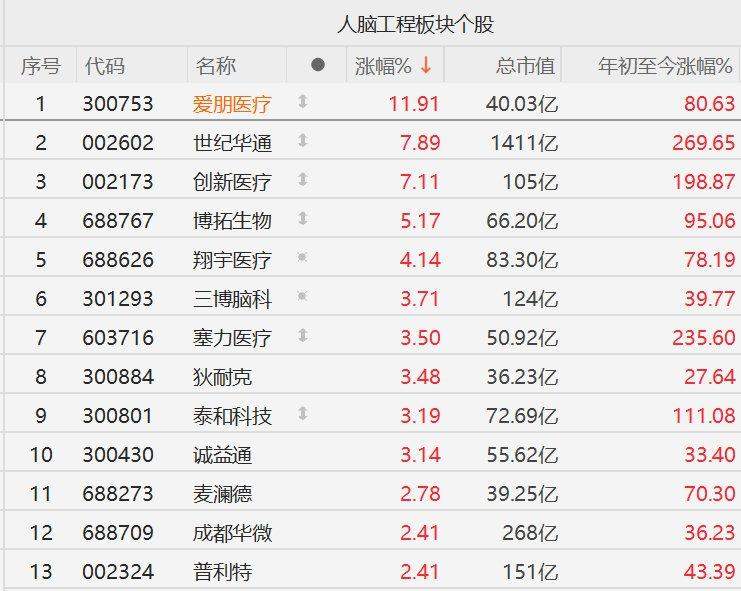
A股脑机接口概念股走强,爱朋医疗涨近12%,世纪华通、创新医疗涨超7%,三博脑科涨3%!国内脑机接口产品首次进入审批“绿色通道”
Ge Long Hui· 2025-11-12 02:21
Group 1 - The core point of the news is that Shanghai Ladder Medical Technology Co., Ltd. has developed an "implantable wireless brain-machine interface system" which has entered the special review process for innovative medical devices by the National Medical Products Administration (NMPA) in China, marking a significant step in the commercialization of this cutting-edge technology in the country [1] - This product is the first invasive brain-machine interface to enter the "green channel" for medical devices in China, indicating a transition from clinical validation to market access [1] Group 2 - Following this news, A-share market stocks related to brain-machine interfaces have shown strong performance, with Aipeng Medical rising nearly 12%, Century Huatong and Innovation Medical increasing over 7%, and Botuo Bio up over 5% [2] - Other companies in the sector, such as Xiangyu Medical, Sanbo Neuroscience, Saili Medical, Dinake, Taihe Technology, and Chengyitong, have also seen their stock prices rise by over 3% [2]