纺织服装

Search documents
稳健医疗(300888)2025年中报简析:营收净利润同比双双增长,公司应收账款体量较大
Sou Hu Cai Jing· 2025-08-22 22:28
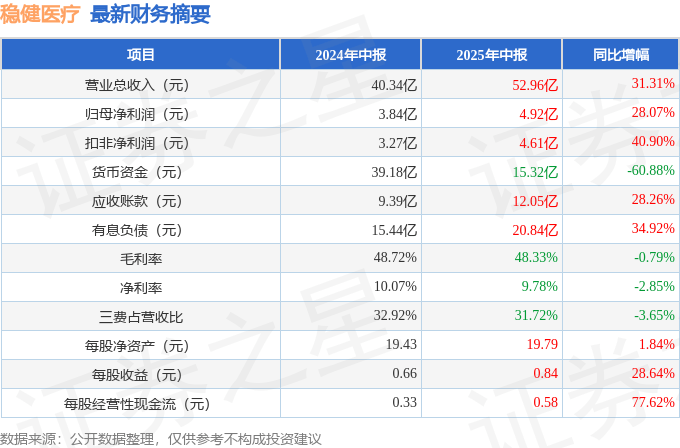
Financial Performance - The company reported a total revenue of 5.296 billion yuan for the first half of 2025, representing a year-on-year increase of 31.31% [1] - The net profit attributable to shareholders reached 492 million yuan, up 28.07% year-on-year [1] - In Q2 2025, total revenue was 2.691 billion yuan, with a year-on-year growth of 26.66%, and net profit was 243 million yuan, increasing by 20.68% [1] Key Financial Ratios - Gross margin stood at 48.33%, a decrease of 0.79% compared to the previous year [1] - Net margin was 9.78%, down 2.85% year-on-year [1] - The ratio of selling, general, and administrative expenses to revenue was 31.72%, a decrease of 3.65% year-on-year [1] Accounts Receivable and Cash Flow - Accounts receivable amounted to 1.205 billion yuan, accounting for 173.23% of the net profit, indicating a significant receivables issue [2] - Operating cash flow per share increased by 77.62% to 0.58 yuan [1] Investment and Debt - The company’s interest-bearing debt rose to 2.084 billion yuan, an increase of 34.92% [1] - Cash and cash equivalents decreased by 60.88% to 1.532 billion yuan [1] Market Position and Growth Strategy - The company is focusing on high-potential product categories such as high-end dressings and surgical kits, aiming to establish a leading position in niche markets [7] - The domestic hospital business is expected to grow significantly, with strategies to enhance market share through competitive pricing and product promotion [8] Fund Management and Investor Interest - The company is held by a prominent fund manager, who has recently increased their stake, indicating strong investor confidence [2] - The largest fund holding the company is the "交银内需增长一年持有混合" fund, which has shown a significant increase in value over the past year [3]

恒辉安防股价上涨2.46% 公司聚焦机器人材料应用开发
Jin Rong Jie· 2025-08-22 17:05
Group 1 - The latest stock price of Henghui Security is 29.94 yuan, an increase of 0.72 yuan from the previous trading day, with a highest intraday price of 30.38 yuan and a lowest of 28.91 yuan, and a total transaction amount of 238 million yuan [1] - Henghui Security's main business includes the research, production, and sales of safety protective gloves, primarily used in industrial and medical protection sectors [1] - The company is involved in sectors such as textiles and apparel, as well as robotics concepts [1] Group 2 - The company is currently developing applications for ultra-high molecular weight polyethylene fibers in areas such as robotic dexterous hand tendons and lightweight shell materials [1] - As of August 20, the total number of shareholders for Henghui Security is 15,248 [1] - Data indicates that on the day of reporting, the net outflow of main funds was 243,400 yuan, with a cumulative net outflow of 70.34 million yuan over the past five trading days [1]

伟星股份: 东亚前海证券有限责任公司关于浙江伟星实业发展股份有限公司部分募集资金投资项目延期的核查意见
Zheng Quan Zhi Xing· 2025-08-22 16:49
Core Viewpoint - The company, Zhejiang Weixing Industrial Development Co., Ltd., has decided to extend the construction period of its fundraising project, specifically the "Annual Production of 220 Million Meters High-end Zipper Expansion Project," by two years due to changes in the market environment and municipal planning adjustments [1][4]. Fundraising Overview - The total amount raised through the issuance of shares is 1,195.40 million yuan, with a net amount of 1,181.80 million yuan after deducting issuance costs [1]. - The funds are allocated to four projects, including the high-end zipper expansion project, a clothing accessory production project in Vietnam, and working capital supplementation [2][3]. Project Implementation Status - The high-end zipper expansion project has reached a progress of 19.38% as of June 2025, with the expected completion date adjusted to December 2028 [3]. - The project aims to produce various types of high-end zippers and will utilize existing facilities along with new construction and advanced production equipment [3]. Reasons for Delay - The delay is attributed to external factors such as the U.S. tariff war affecting global supply chains and a cautious decision-making approach from downstream brand clients due to a sluggish domestic economy [3][4]. - The company plans to enhance communication with relevant departments and monitor market dynamics during the delay period to ensure timely project completion [4]. Impact of Delay - The delay does not alter the project’s implementation entity, location, investment purpose, or total fundraising commitment, and it is expected to facilitate a more reasonable project advancement and reduce funding usage risks [4][5]. - The decision aligns with regulatory requirements and is seen as a prudent choice in light of the current economic conditions [5].

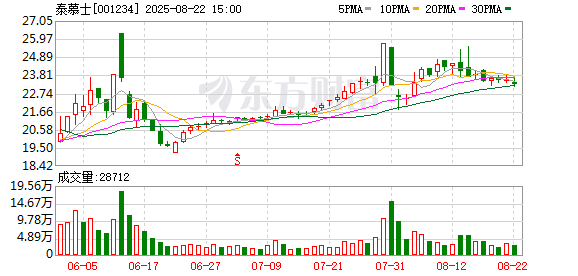
泰慕士:2025年半年度归属于上市公司股东的净利润为29713966.75元
Zheng Quan Ri Bao Zhi Sheng· 2025-08-22 16:09
Core Viewpoint - The company reported a significant decline in both revenue and net profit for the first half of 2025 compared to the previous year [1] Financial Performance - The company's operating revenue for the first half of 2025 was 380,337,296.18 yuan, representing a year-on-year decrease of 16.34% [1] - The net profit attributable to shareholders of the listed company was 29,713,966.75 yuan, showing a year-on-year decline of 43.69% [1]
泰慕士:第二届监事会第二十三次会议决议公告
Zheng Quan Ri Bao· 2025-08-22 16:07
(文章来源:证券日报) 证券日报网讯 8月22日晚间,泰慕士发布公告称,公司第二届监事会第二十三次会议审议通过了《关于 公司2025年半年度报告及其摘要的议案》等。 ...
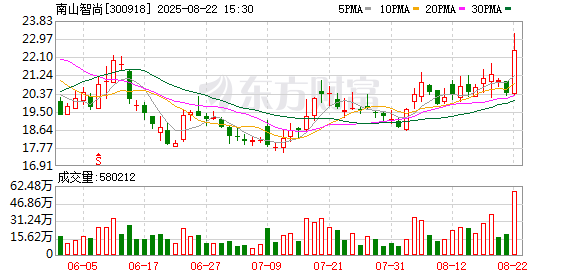
南山智尚:截至2025年8月20日公司股东人数为28415户
Zheng Quan Ri Bao· 2025-08-22 11:41
Group 1 - The company Nanshan Zhishang stated on August 22 that as of August 20, 2025, the number of shareholders is 28,415 [2]
际华集团:2025年上半年净利润亏损7903.18万元
Xin Lang Cai Jing· 2025-08-22 09:30
际华集团公告,2025年上半年营业收入32.08亿元,同比下降38.36%。归属于上市公司股东的净利 润-7903.18万元,上年同期为-1882.84万元。基本每股收益-0.018元/股。 ...

际华集团:控股股东拟增持1亿元
Xin Lang Cai Jing· 2025-08-22 09:30
际华集团公告,控股股东新兴际华集团及一致行动人合计持股50.19%,拟自公告披露之日起12个月 内,通过集中竞价或大宗交易方式增持公司无限售流通股A股,增持金额1亿元~2亿元,资金来源为自 有或其他合法资金,增持期间及法定期限内不减持所持股份。 ...
泉城论道,共启新程——2025 齐鲁时尚大会赋能产业价值跃升
Qi Lu Wan Bao Wang· 2025-08-22 09:23
Core Insights - The 2025 Qilu Fashion Conference in Jinan aims to elevate the city's image and promote industrial transformation and cultural output, emphasizing the theme "'Jinan' Meets the Future, 'City' Creates Fashion" [1][2][3] Group 1: Event Overview - The conference is organized by the Shandong Textile and Apparel Industry Association and the Tianqiao District People's Government of Jinan, featuring prominent industry leaders and experts [1] - It serves as a significant platform for the integration of culture and fashion, showcasing Jinan's potential in becoming an international fashion city [1][2] Group 2: Industry Development - Jinan is leveraging its rich cultural heritage to drive fashion industry innovation, with government support for the textile and apparel sector [2][3] - The textile and apparel industry in Shandong is recognized as a traditional stronghold, with the first half of 2025 showing growth in value added that exceeds the national average [2][3] Group 3: Cultural Integration - The conference highlights the importance of integrating traditional culture with modern fashion, encouraging the development of unique brands and innovative industry practices [2][4] - Experts emphasize the need for cities to create distinctive cultural IPs to enhance their competitiveness and avoid mediocrity [4][5] Group 4: Collaborative Innovation - Discussions at the conference focus on collaborative innovation within the fashion industry, addressing challenges such as information barriers and talent mismatches [6] - Various successful models from other regions are presented, showcasing how collaboration can lead to industry transformation and the creation of a digital supply chain [6]

每日报告精选-20250822
GUOTAI HAITONG SECURITIES· 2025-08-22 09:00
Group 1: Logistics and Warehousing Industry - In July 2025, the national express delivery volume reached 16.4 billion pieces, a year-on-year increase of 15.1%, with a total of 112.05 billion pieces from January to July, up 18.7% year-on-year [5][6] - The express delivery industry is experiencing a trend of concentration, with the CR8 increasing to 86.9, reflecting a 1.7 point year-on-year increase, indicating a significant rise in the market share of leading companies [6][7] - The revenue of the express delivery industry in July 2025 increased by 8.9% year-on-year, while the average revenue per piece decreased by 5.3%, showing a narrowing of the price decline and a shift towards healthier competition [7][8] Group 2: New Energy Power Generation Industry - The report discusses the supply-demand contradictions and cyclical nature of the new energy industry, particularly focusing on the photovoltaic sector [10] - It emphasizes the importance of reviewing the photovoltaic industry's supply-side capacity cycles and new technologies [10] Group 3: Building Materials Industry - The report outlines a research framework focusing on sub-industries such as cement, glass fiber, and consumer building materials [11] Group 4: Robotics Industry - The report highlights breakthroughs in humanoid robots, particularly in their ability to walk without visual aids, indicating significant advancements in technology [12][13] - It suggests that the humanoid robot industry is rapidly evolving, driven by technological deepening and practical applications, with a focus on key manufacturers and core component suppliers [13][15] Group 5: Dairy Products Industry - The report indicates that raw milk prices are expected to continue declining, with a potential supply-demand balance in the second half of 2025, benefiting from reduced costs and improved demand [17][18] - It notes that beef prices are entering an upward cycle, driven by supply reduction and decreased import pressures, which could enhance profitability for livestock companies [18][20] Group 6: Company Reports - Futu Holdings reported a strong net inflow of funds, with H1 2025 revenue and net profit reaching 10.006 billion and 4.72 billion HKD, respectively, marking increases of 74.89% and 109.76% year-on-year [22][23] - Baba Foods achieved H1 2025 revenue of 8.35 billion, a year-on-year increase of 9.31%, with net profit rising by 18.08% [26][28] - Milky Way achieved a 13.17% year-on-year increase in net profit for H1 2025, driven by a focus on intelligent supply chain services [35][36]