
Banking

Search documents
Fast Finance Pay Corp Expands EU Operations via OK.de Services GmbH Launching OK.pay
Accessnewswire· 2025-11-12 14:30
Core Insights - Fast Finance Pay Corp.'s German subsidiary, OK.de Services GmbH, has signed an agreement to provide banking and debit card processing services through the OK.secure app for users with IBANs in the EU and the UK [1] Company Developments - The OK.secure platform will operate under the brand OK.pay, which aims to offer innovative solutions for modern banking and crypto asset management [1]


Franklin Templeton Expands Benji Technology Platform to Canton Network
Yahoo Finance· 2025-11-12 14:00
Core Insights - Franklin Templeton's Benji Technology Platform is now operational on the Canton Network, enhancing its presence in regulated digital markets and providing institutional investors with broader access to tokenized investment products [1][2]. Group 1: Franklin Templeton's Strategy - The integration of Franklin Templeton's blockchain infrastructure with Canton's Global Collateral Network offers market makers and institutions a new source of liquidity and collateral while ensuring compliance and privacy [2][5]. - The Benji platform supports Franklin Templeton's tokenization strategy, having powered the first U.S.-registered mutual fund to utilize blockchain for transactions and recordkeeping since 2021 [4][6]. - Franklin Templeton aims to meet institutional clients' needs by providing interoperability and privacy without sacrificing transparency or security through this partnership [5]. Group 2: Market Context and Predictions - Tokenization refers to the conversion of real-world assets into blockchain-based tokens, with Standard Chartered predicting that tokenized real-world assets will reach $2 trillion by 2028 [3]. - The Canton Network, developed by Digital Asset and supported by major firms like Goldman Sachs and BNP Paribas, seeks to create a permissioned blockchain infrastructure that connects traditional and digital markets [6].
Wall: There’s been macro news that’s really supportive of European stocks
CNBC Television· 2025-11-12 13:22
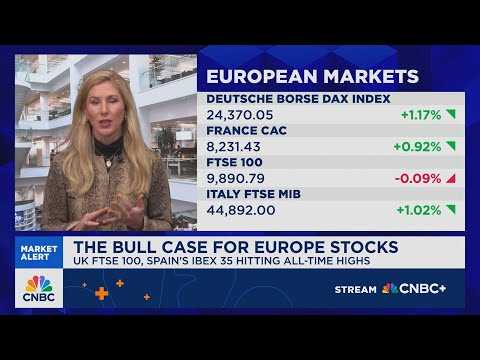
What's driving these gains. >> Well, there's a little bit of micro and a little bit of macro at the risk of sounding like a song. I mean, the macro is some of it's global and I do think the fact that actually we are nearing a resolution for the US shutdown has had a positive impact on markets across the globe.Plus, you've had things like the resolution on kind of Swiss tariffs this week, you know, in the last week, which has also added some tailwinds to the European markets. You've also got expectation of l ...
Global Markets Navigate Geopolitical Tensions, IEA’s Oil Outlook Shift, and Strong Italian Data
Stock Market News· 2025-11-12 09:38
Economic Resilience and Investment Outlook - Italy's industrial production increased by 2.8% month-over-month in September, surpassing the estimated 1.5% and rebounding from a revised decline of 2.7% in the previous month [3] - Year-over-year, industrial production rose by 1.5% on a working day adjusted basis, defying expectations of a 0.5% contraction, while unadjusted year-over-year data showed a robust increase of 4.6% compared to a prior decrease of 5.7% [3] Equities Market Outlook - UBS has reaffirmed its "overweight" position on Chinese stocks for the upcoming year, indicating continued confidence in the market despite recent volatility and global economic pressures [4] Geopolitical Standoffs - Diplomatic dialogue between the UK and Russia has stalled, with the Kremlin stating that the UK showed no willingness to engage with Russia's position [5] - Russia has expressed readiness to resume talks with Ukraine, indicating that the "ball is in the Ukrainian court" for negotiations [6] - Ukraine has suspended its Justice Minister over a graft probe in the energy sector, highlighting ongoing anti-corruption efforts [7] Energy Market Shifts - The International Energy Agency (IEA) has revised its long-term outlook, projecting that global oil consumption could grow until 2050, with demand potentially reaching 113 million barrels per day, a 13% increase from 2024 consumption [8] Corporate Earnings Watch - Alibaba Group Holding Limited (BABA) is set to announce its unaudited financial results for the quarter ended September 30, 2025, on November 25, 2025, with investors keenly awaiting insights into the company's growth and the broader Chinese tech sector [10]



Web Summit聚焦AI竞赛,“西方科技主导时代正谢幕”
2 1 Shi Ji Jing Ji Bao Dao· 2025-11-12 08:03
Core Insights - The Web Summit has evolved from a small startup event in 2015 to a major global technology conference, highlighting the rapid changes in the tech landscape over the past decade [2] - The event attracted 70,000 attendees from 75 countries, including government representatives, entrepreneurs, and tech investors, marking a significant increase in participation [2] - The founder of Web Summit emphasized the rise of Chinese AI models and Brazil's PIX payment system as key examples of global shifts in technology and finance, challenging the dominance of Western tech companies [3][4] Technology and Innovation - The emergence of advanced humanoid robots and leading AI models from China was showcased, indicating a shift in technological leadership [3] - The PIX payment system from Brazil is described as revolutionary and free, posing a challenge to existing Western payment systems [4] - The decline of German startups at the Web Summit contrasts with the rise of Polish startups, indicating a shift in the entrepreneurial landscape within Europe [4][5] Economic and Cultural Shifts - Lisbon is positioning itself as a hub for innovation and culture, with significant growth in tech companies and job creation [7][8] - The city has seen the establishment of 16 unicorns and 82 tech companies, contributing to over 16,000 jobs [8] - The mayor of Lisbon highlighted the importance of social justice and cultural integration in fostering innovation [9][10] Future Outlook - Portugal aims to become a global innovation hub, leveraging technology to enhance governance and create opportunities [11][12] - The government is investing in digital infrastructure and skills training to prepare citizens for a tech-driven future [12][13] - The establishment of an AI super factory in Portugal is seen as a response to the dominance of Silicon Valley, aiming to enhance Europe's digital sovereignty [13]
美联储理事巴尔:AI将重塑经济前景,但最终走向何方仍是谜
Zhi Tong Cai Jing· 2025-11-12 07:10
Core Viewpoint - The Federal Reserve Governor Michael Barr highlighted the transformative potential of artificial intelligence (AI) on the economy, presenting two primary scenarios: one where generative AI enhances existing tasks and roles, and another where it fundamentally alters work and leisure, reshaping business models and improving efficiency [1][1][1] Group 1: AI Impact on Employment - AI has led employers to reduce hiring plans, which may be slowing down job creation [1] - There is uncertainty regarding which scenario of AI evolution will materialize, complicating predictions about its impact on employment [1] Group 2: Monetary Policy and Economic Transformation - Following a significant slowdown in summer hiring, the Federal Reserve has lowered the benchmark interest rate in recent policy meetings [1] - There is a divergence among Fed officials regarding the necessity of a third rate cut in December, although futures markets indicate investor expectations for a rate decrease [1] - Barr noted that trillions of dollars in planned capital investment in data centers could drive significant economic changes, including productivity improvements [1] Group 3: Capital Investment and Productivity - Capital investment typically enhances labor productivity and creates conditions for higher output growth in the long term while mitigating inflationary pressures [1] - Significant changes driven by AI and capital investment may also influence the implementation of monetary policy [1]
Inbank acquires full-service car rental company Mobire Group
Globenewswire· 2025-11-12 06:30
Core Insights - Inbank's subsidiary AS Inbank Holdings has signed an agreement to acquire an additional 33% stake in Mobire Group OÜ, increasing its ownership to 100% [1] - The acquisition aligns with Inbank's long-term strategy in the profitable and fast-growing full-service car rental segment in the Baltics [2] - Mobire Group operates independently under its existing governance and brand, continuing to be led by CEO Andrus Valma [2][3] Company Overview - Mobire Group is the leading full-service car rental provider in the Baltics, managing a fleet of over 4,800 vehicles and reporting a consolidated turnover of €47.4 million in 2024 [4] - Inbank is a financial technology company with an EU banking license, partnering with over 5,900 merchants and managing 915,000+ active contracts across 7 European markets [5] Transaction Details - The price of the transaction has not been disclosed, and it is subject to approval from competition authorities in Estonia and Lithuania, with completion expected in Q1 2026 [3]
Infosys, TCS tumble up to 27% as IT meltdown drags Nifty vs global peers. Where's the heartbeat index headed?
The Economic Times· 2025-11-12 04:22
Sector Performance - The IT sector accounts for 9.91% of the Nifty's total weight, with Infosys at 4.53% and TCS at 2.65% [1] - Over the past year, Infosys shares have fallen 18%, while TCS has declined 27% [1] - HCL Technologies, Wipro, and Tech Mahindra have also seen declines of 16%, 16%, and 17%, respectively [1] - The power sector, with a weight of 2.27% in the Nifty, has also underperformed, with constituents like Power Grid Corporation, NTPC, and Coal India declining 19%, 17%, and 9% respectively [1] Financial Sector - Financials hold the largest weight in the Nifty at 36.33%, yielding up to 48% returns [8] - Bajaj Finance leads the financial sector, followed by SBI Life Insurance Company at 28% [8] - HDFC Bank, with a weight of 12.78%, returned 12%, while ICICI Bank and State Bank of India outperformed the index with returns of 12% and 7% respectively [8] Auto and FMCG Sectors - Tata Motors has seen a significant decline of 49%, making it the worst-performing Nifty stock, while Bajaj Auto has dropped 10% [4] - In the FMCG sector, ITC has fallen 15% and Hindustan Unilever is down nearly 3% [5] Healthcare Sector - Healthcare stocks have had mixed performance, with Sun Pharmaceuticals, Dr Reddy's Laboratories, and Cipla slipping up to 6% [6] - Conversely, Max Healthcare and Apollo Hospitals have shown positive returns, with Max up 7% and Apollo up 5% [6] Metals and Capital Goods - In the metals sector, Tata Steel, JSW Steel, Hindalco Industries, and Grasim Industries have rallied between 25% and 10%, while Adani Enterprises has declined 18% [9] - Bharat Electronics from the capital goods space has delivered a notable 43% return [10] Market Outlook - A constructive outlook for the Nifty is expected, with a potential range of 5-7% movement [11][16] - The IT sector may benefit from improving global tech spending and margin stability, while the energy sector is supported by resilient demand and easing input costs [12][16] - Renewed foreign institutional investor interest is anticipated in fundamentally strong and reasonably valued companies [13][16]

Tweedy, Browne Mutual Funds Q3 2025 Commentary
Seeking Alpha· 2025-11-12 01:25
Core Insights - Global equity markets experienced significant growth in Q3, with the S&P 500 rising 8.12% for the quarter and 14.83% year-to-date, while the MSCI EAFE Index increased by 4.77% for the quarter and 25.14% year-to-date [2][3] Market Performance - The S&P 500 achieved back-to-back annual returns of 26% and 25% in 2023 and 2024, respectively, with valuation metrics like the "Buffett Indicator" and CAPE-Shiller P/E at or near record highs [2] - Non-US equities, particularly European stocks, outperformed the S&P 500 year-to-date, benefiting from a weaker US dollar and a resurgence in value recognition [3][11] Fund Performance - Tweedy, Browne Funds reported year-to-date returns ranging from 15.98% for the Value Fund to 23.17% for the International Value Fund II, with the Worldwide High Dividend Yield Value Fund outperforming its benchmark [3][5] - The International Value Fund II had a return of 23.17%, trailing its benchmark, the unhedged MSCI EAFE Index, by 197 basis points [3] Portfolio Activity - The company made strategic adjustments to its portfolio, trimming or selling holdings that reached estimated value and adding to companies perceived as attractively priced, such as Berkeley Group Holdings and Breedon Group [8] - New positions were initiated in Santec Holdings and additional investments were made in companies like Dentium and Azelis Group, reflecting a focus on growth potential and reasonable valuations [8] Outlook - The company is optimistic about the resurgence of non-US equity returns and believes its funds are well-positioned for future market conditions, whether they favor non-US equities or face broader market challenges [11]

Global Markets Navigate AI Bubble Fears, Fed Hopes, and China Policy Shifts
Stock Market News· 2025-11-12 00:08
Group 1 - Concerns over an AI bubble have resurfaced following SoftBank's $5.8 billion sale of its stake in Nvidia, impacting investor sentiment in the AI sector [3] - Asian markets showed strength as optimism grew for a resolution to the U.S. government shutdown, which may influence the Federal Reserve's policy decisions [2][5] - Goldman Sachs has revised its outlook for China's monetary policy, delaying expectations for a "dual cut" in interest rates and reserve requirements to early 2026, indicating a less dovish stance from the People's Bank of China [4] Group 2 - Oil prices remained stable near $61 a barrel as traders awaited new forecasts from OPEC and the International Energy Agency regarding potential market surpluses from rising supply [6] - The Reserve Bank of Australia's Brad Jones noted that markets are struggling to accurately price geopolitical risks, with early signs of fragmentation in central bank gold holdings [7] - Sony launched a Japan-only, region-locked PlayStation 5 Digital Edition at ¥55,000, aiming to reclaim market share from rival Nintendo [8]

