
Higher Education

Search documents
4 retirement insights advisors can't ignore for university faculty
Yahoo Finance· 2025-09-17 20:15
Core Insights - Budgetary pressures at American colleges and universities are increasing due to lawsuits, funding changes, and other financial strains, potentially affecting faculty retirement benefits [1] - Research from Fidelity reveals that university professors exhibit distinct financial behaviors and preparedness compared to the general population, providing valuable insights for financial advisors [2] Group 1: Retirement Trends - University professors are increasingly delaying retirement, with nearly half of baby boomers continuing to work beyond age 65, and almost half of recent retirees doing so after age 70 [4] - On average, faculty retirees leave their positions at age 73 after a tenure of approximately 35 years [4] Group 2: Factors Influencing Retirement Decisions - The desire for intellectual freedom and the ability to choose work projects contribute to professors' decisions to remain in their roles longer [5] - The academic calendar's structure, which includes flexible summer and holiday breaks, allows faculty to balance work with personal interests, further influencing their retirement timing [5][6] Group 3: Job Satisfaction - The nature of academic work is described as intellectually rich, which keeps many faculty members engaged and less inclined to retire quickly [6]
X @Bloomberg
Bloomberg· 2025-09-16 18:46
Elon University is looking to expand its footprint in Charlotte, North Carolina through a merger with a college with a long history there https://t.co/Lg82RYRtow ...
HR manager’s bias concerns weren’t the basis for her firing, 6th Circuit finds
Yahoo Finance· 2025-09-15 15:59
Group 1 - The 6th Circuit Court upheld the district court's decision that the plaintiff's firing was not retaliatory, citing a four-month gap between her protected activity and termination as "too long" to establish causation [4] - The plaintiff's claim of unlawful retaliation was weakened by the lack of supporting evidence, as the finding from Ohio's Civil Rights Commission focused on racial discrimination affecting other employees rather than her specific case [5] - Other HR professionals have had varying success in retaliation claims, with a recent case resulting in a settlement after a federal judge denied a food producer's motion for summary judgment against a former HR manager [6] Group 2 - The plaintiff in the case against the University of Toledo argued that her firing was in retaliation for opposing an allegedly unlawful promotion decision, which she believed violated equal employment opportunity laws [7] - The university defended the termination by citing the plaintiff's failure to attend meetings and complete projects, leading to the district court granting summary judgment in favor of the university [7]
BNY and Carnegie Mellon University Join Forces to Advance Research and Development in AI
Prnewswire· 2025-09-11 12:30
Core Insights - BNY and Carnegie Mellon University have entered a five-year, $10 million agreement to advance research and development in artificial intelligence (AI) [1][2] - The collaboration, named the BNY AI Lab, aims to develop technologies ensuring governance, trust, and accountability in mission-critical AI applications, particularly in financial services [2][4] - A dedicated space will be established on CMU's Pittsburgh campus to facilitate joint research, education projects, and talent recruitment [3][4] Company Overview - BNY is a global financial services company managing $55.8 trillion in assets under custody and/or administration and $2.1 trillion in assets under management as of June 30, 2025 [6] - BNY has a long-standing relationship with CMU, being the largest employer of graduates from CMU's Master of Science in Artificial Intelligence and Innovation program [5] Industry Impact - The partnership aims to strengthen Pittsburgh's position as a global hub for AI advancement and foster economic development in Western Pennsylvania [5] - The collaboration seeks to combine CMU's AI research leadership with BNY's scale to ensure AI delivers measurable benefits for clients and the broader financial ecosystem [4][5]



X @Bloomberg
Bloomberg· 2025-09-04 17:06
A dwindling number of prospective students will drive as many as 370 private colleges in the US to shutter or merge in the next decade, according to a major higher-education consulting firm https://t.co/IY4zYLz5rs ...
8所新型高校分数赶超985,背后什么信号
21世纪经济报道· 2025-09-03 09:58
Core Viewpoint - The emergence of eight new research universities, referred to as "Eight Little Dragons," is reshaping the educational landscape in China, with their admission scores surpassing those of traditional 985 universities, indicating a shift in academic prestige and student preferences [1][20]. Summary by Sections New University Admissions - The "Eight Little Dragons" include Southern University of Science and Technology, Shanghai University of Science and Technology, West Lake University, Fuyou University, Shenzhen University of Technology, Greater Bay Area University, Ningbo Oriental University of Technology, and others. This year, some of these universities achieved admission scores that exceeded those of 985 universities, with some approaching the C9 league [1][3][4]. Admission Scores and Quality - Southern University of Science and Technology enrolled over 1,400 students, with a notable admission score of 652 in Guangdong, ranking first among local universities and surpassing several 985 institutions [3]. Shenzhen University of Technology achieved a score of 629 in Guangdong, ranking second among local universities [3]. Fuyou University recorded a maximum score of 683 in Henan, indicating strong competition for admission [4][6]. Student Demographics and Recruitment - The new universities primarily recruit students from their respective provinces, with Southern University of Science and Technology and Shanghai University of Science and Technology having broader recruitment across multiple provinces [9][10]. Notably, local high schools with strong academic performance contribute significantly to the student body of these new institutions [12]. Impact on Local Economies - The establishment of these new universities is expected to bring economic benefits to their host cities, enhancing local talent pools and meeting the demand for skilled graduates in various industries [15][16]. Cities like Shenzhen and Dongguan, which previously lacked top-tier universities, are now seeing an influx of educational institutions that can support local economic development [15][17]. Future Prospects - The long-term success of these new universities will depend on their ability to maintain high educational standards and attract quality students. The current enrollment figures are relatively small, with a total of 3,147 undergraduate students across the "Eight Little Dragons," indicating potential for growth [6][7]. The universities' commitment to a "small but excellent" approach may influence their future recruitment strategies [7].

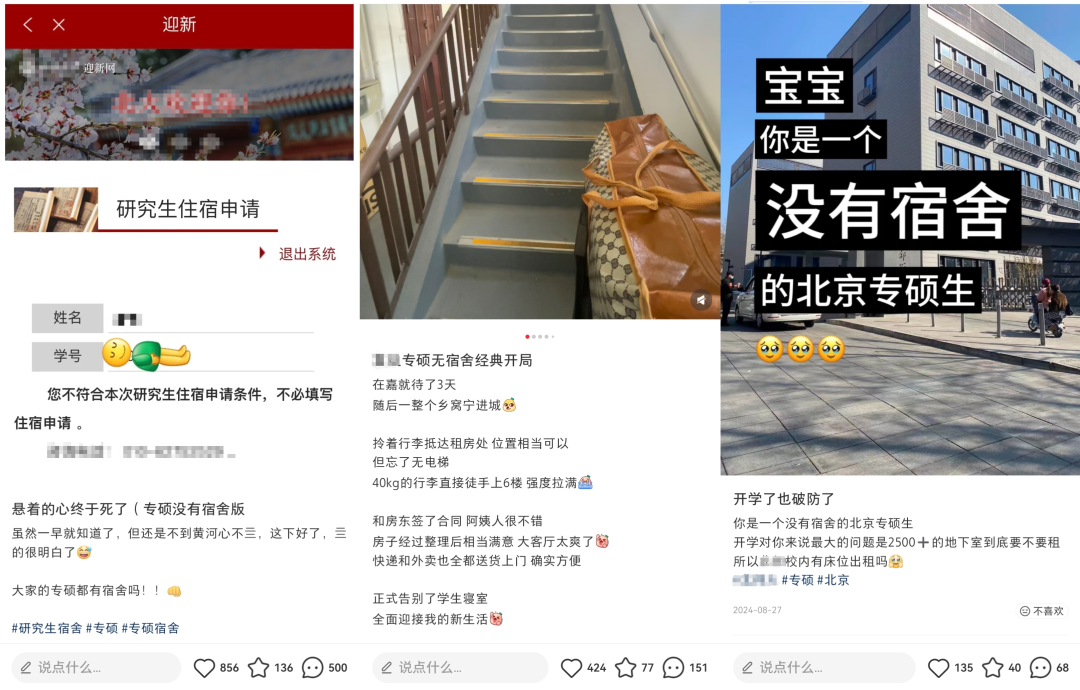
多所大学明确:专硕,不提供宿舍
Hu Xiu· 2025-09-02 13:46
Core Viewpoint - The increasing number of graduate students in China has led to a shortage of on-campus accommodation, particularly affecting professional master's students who are often left without housing options [2][3][4][8]. Group 1: Current Situation of Graduate Student Accommodation - Many universities, including Fudan University and Peking University, have stopped providing on-campus accommodation for full-time professional master's students, forcing them to seek off-campus housing [4][10]. - The cost of off-campus housing is significantly higher, with reports indicating monthly rents in cities like Shanghai reaching 3000 yuan, while on-campus accommodation can be as low as 1000-2000 yuan per year [5][6]. - The average living space per student has not met the standards set by the State Council, and this has been declining in recent years [6][7]. Group 2: Reasons for Accommodation Shortage - The rapid expansion of graduate enrollment, which has doubled over the past decade to exceed 1.35 million in 2024, has outpaced the construction of new dormitories [7][8]. - The distinction between academic master's and professional master's programs has led to a prioritization of resources, with professional master's students facing more accommodation challenges due to their shorter study duration and different resource needs [8][10]. Group 3: Responses and Solutions - Universities are encouraged to actively address accommodation shortages rather than shifting the burden to students, as highlighted in a joint directive from several government departments [12][18]. - Initiatives are underway in various universities to build new dormitories, purchase idle properties for student housing, and renovate old dormitories to improve living conditions [16][20][21]. - For instance, Inner Mongolia University plans to invest 188 million yuan to build new student dormitories, while Guizhou University has initiated projects to provide additional accommodation for graduate students [16][17].
打造校地协同“订单式”人才培养新模式
Xin Hua Ri Bao· 2025-09-01 22:20
Core Viewpoint - The article emphasizes the importance of talent in rural revitalization and highlights the need for reform in agricultural education to align with modern agricultural and rural development demands [1][2]. Group 1: National Strategy and Local Development - The cultivation of a workforce that understands agriculture and rural issues is a key mission of the rural revitalization strategy outlined in the 19th National Congress report [2]. - In 2022, a joint document from the Ministry of Education and the Ministry of Agriculture and Rural Affairs encouraged collaboration between universities and local governments to develop targeted agricultural talent [2]. Group 2: Addressing Regional Talent Challenges - The Suzhou region in Jiangsu Province faces significant challenges in agriculture, characterized by an aging workforce, low educational attainment, and high turnover rates [3]. - Local governments have initiated cooperative programs since 2010 to address talent shortages in agriculture, with cities like Zhangjiagang and Changshu leading the way [3]. Group 3: Innovative Talent Cultivation Mechanisms - A collaborative education mechanism involving government, industry, academia, and research has been established, featuring policies like tuition waivers and flexible academic systems [4]. - Local agricultural experts participate in teaching, while university professors serve as advisors, facilitating a two-way flow of talent [4]. Group 4: Curriculum and Training Innovations - The "Three Full Education" concept integrates agricultural understanding into the entire educational process, with practical activities designed to enhance professional identity and community engagement [5]. - A modular curriculum system has been developed, aligning professional training with local industry needs [5]. Group 5: Quality Assurance Mechanisms - A dual mentorship system involving university professors and local experts has been implemented to ensure quality in education, with a balanced focus on theory and practice [6]. - The assessment includes both academic papers and practical reports, ensuring a comprehensive evaluation of student capabilities [6]. Group 6: Outcomes and Demonstration Value - The new educational model has led to significant improvements in student quality, with graduates adapting to job roles in an average of 1.8 months, a 60% efficiency increase compared to traditional methods [7]. - Nearly 90% of graduates are employed in the agricultural sector, with many taking on leadership roles in local agricultural organizations [7]. Group 7: Theoretical Insights and Adaptability - The model integrates policy support, resource sharing, and collaborative governance into a sustainable framework for talent cultivation [8]. - Successful implementation relies on strong local government demand, university capabilities, and regional economic support, making it more adaptable in economically developed areas [8].
连续3年为新生家长提供住宿,细节诠释大学温度
Xin Jing Bao· 2025-09-01 09:50
Group 1 - The core viewpoint of the articles highlights the initiative taken by Lanzhou University to provide temporary accommodation for new students' parents, showcasing a caring approach during the busy enrollment season [1][2][3] - Lanzhou University has set up temporary accommodation areas in sports venues for parents, which has been a practice for three consecutive years, reflecting the university's commitment to supporting families [1][2] - The rising hotel prices and limited availability around universities during the enrollment period create challenges for parents, making the provision of free accommodation a thoughtful solution [1][2] Group 2 - The initiative not only addresses the immediate needs of parents but also emphasizes the importance of humanistic care in higher education, extending beyond academic instruction [2][3] - The university's efforts include providing local delicacies and tickets to scenic spots, enhancing the overall experience for new students and their families [2] - This trend of offering free accommodation by universities may inspire other institutions to adopt similar practices, reinforcing the idea that education encompasses care and responsibility in all aspects of campus life [3]
X @The Economist
The Economist· 2025-08-29 14:20
Industry Trend - College athletes in America are about to be paid directly by their universities, marking a significant shift [1] - The new system has the potential to reshape the college sports industry as a whole [1]